

SEARCH Upcoming events
Search by Category
- Buddhist Ceremonies
- Buddhist Retreats
- Buddhist Studies
- Buddhist teachings
- Children's Programme
- Children's Yoga
- Children's mindfulness
- Children's relaxation and breathing
- Children's wellbeing
- Community Events
- Eco Dharma
- External Courses
- Meditation
- Public Talk
- Pujas and Practice
- Retreat
- Tech support
- Wellbeing
- Yoga
UPCOMING EVENTS LIST
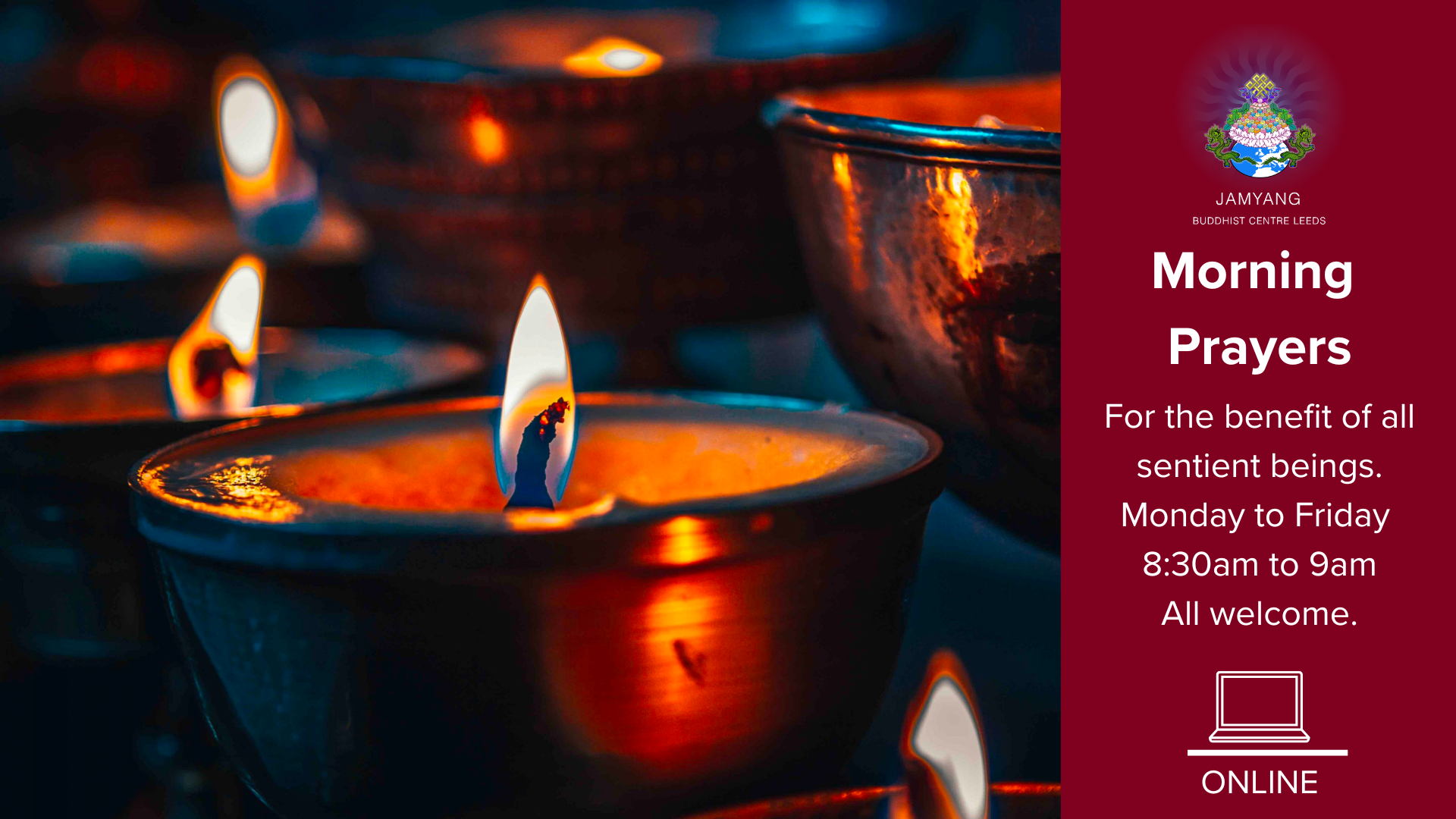
Morning Prayers
Overview
Start the day by joining us for Morning Prayers recommended by Lama Zopa Rinpoche and HH Dalai Lama, for the benefit of all sentient beings and the swift return of Lama Zopa Rinpoche. Everyone is welcome.
DATE: Monday – Friday all year around
TIME: 8:30am - 9:00am
LOCATION: Zoom
LEVEL: Buddhist Practices – All Welcome
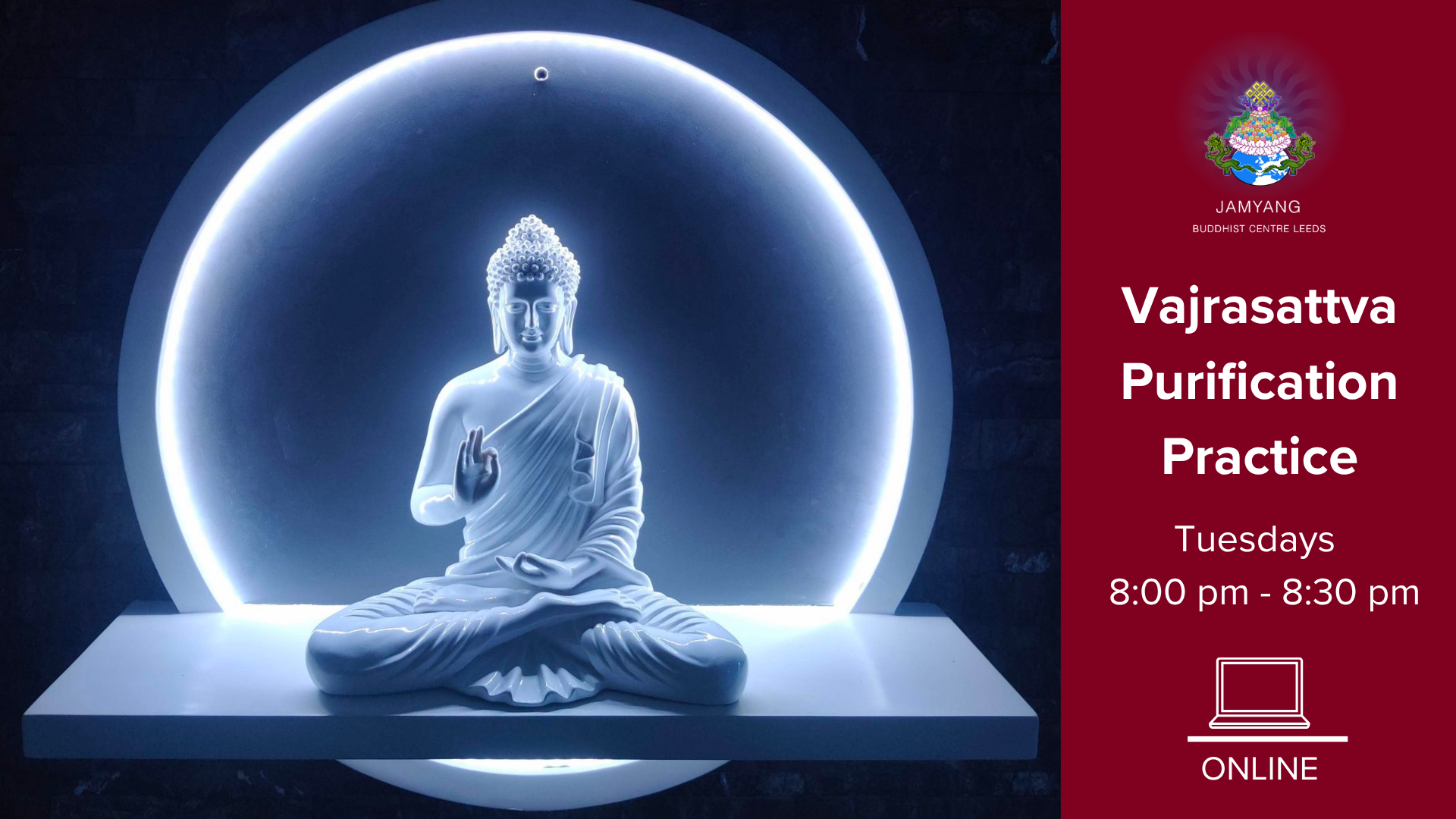
Vajrasattva Practice
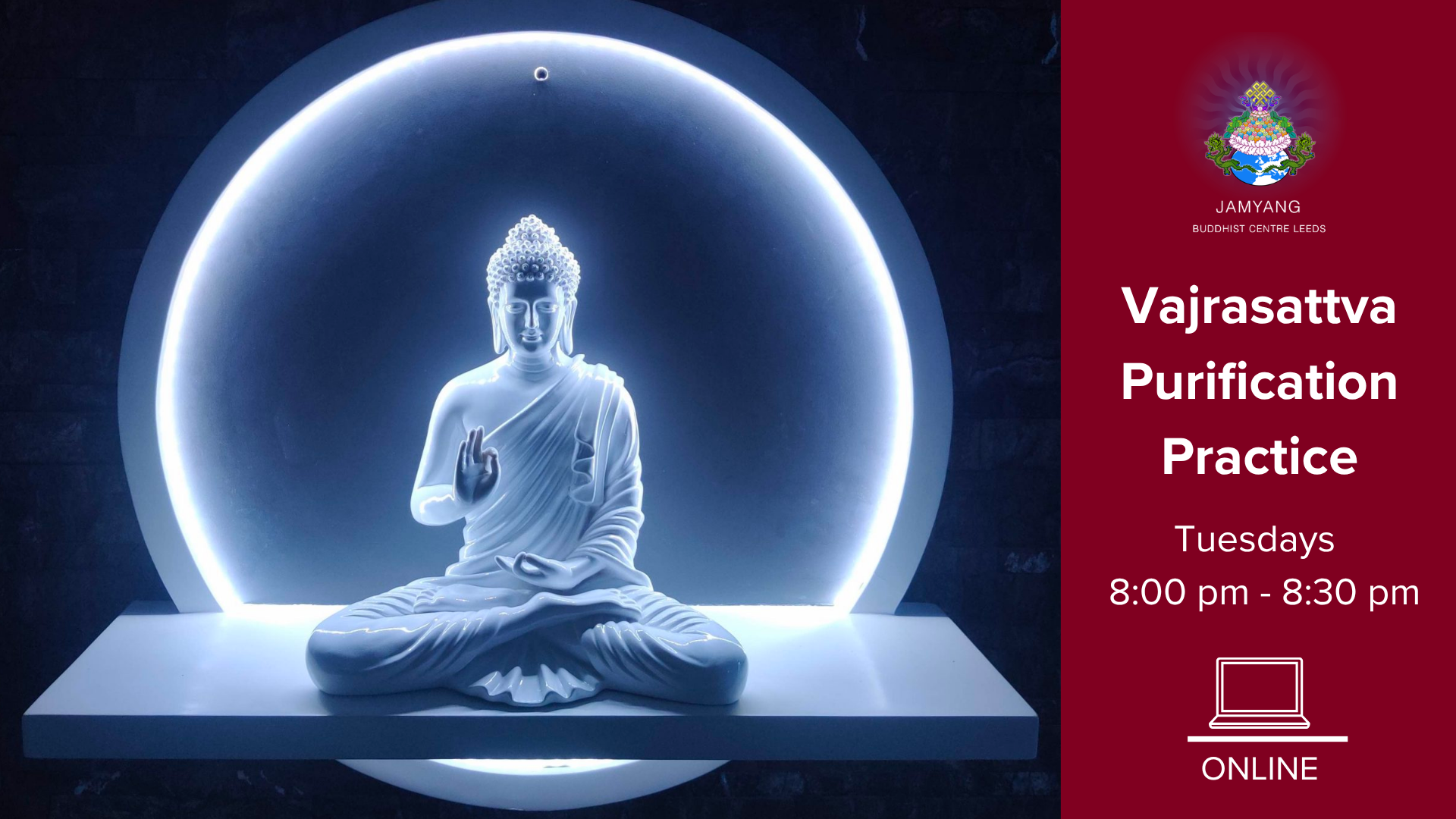
Overview of The Vajrasattva Practice
DATE: Tuesdays
TIME: 8:00pm-8:30pm
LOCATION: Zoom
LEVEL: Buddhist Practices – All Welcome
SUGGESTED DONATION: £4
Purification here means looking at our past unskillful actions which have created seeds of negative karma in our minds, and using visualisation and mantra recitation to remove those seeds in a healthy and productive way. Vajrasattva is the embodiment of all the Buddha’s cleaning and purifying energy. We all make mistakes, and how we deal with them is key to making spiritual progress. We’ll be using a short text composed by Lama Zopa Rinpoche

the eight verses of thoughts transformation

Overview of the eight verses of thoughts transformation
Everflowing Nectar of Bodhichitta – Annihilating the Demon of the Self-Cherishing Mind
DATE: Wednesdays
TIME: 7am-7:30am
LOCATION: Zoom
LEVEL: Buddhist Practices- All Welcome
SUGGESTED DONATION: £4
Everflowing Nectar of Bodhichitta – Annihilating the Demon of the Self-Cherishing Mind
Led by Di or Sande
This practice is based on the short text” Eight Verses of Thought Transformation”, which contains the entire technique for transforming the mind into relative bodhichitta (i.e., the wish to achieve enlightenment for the benefit of all sentient beings) and absolute bodhichitta (i.e., the wisdom realizing emptiness).

Chanting the Verses of Noble manjushri
Overview of Session
DATE: Thursdays
TIME: 7:45am to 8:25 am
LOCATION: Zoom only
LEVEL: Buddhist Practices – suitable for Lama Zopa Rinpoche’s students
Join us to fulfill His Holiness the Dalai Lama’s wishes and chant the Names of Noble Manjushri for the swift return of Lama Zopa Rinpoche.
Please come along even if you havent done the practice before, its quite wonderful and very energising. Please download the text below, you can also listen and practice with the audio clip of Lama Zopa Rinpoche reciting the Chanting the Names of Noble Manjushri.

Kshitigarbha Practice

Overview of Kshitigarbha practice
DATE: Tuesdays & Thursdays
TIME: 12pm-12:30pm
LOCATION: Zoom only
LEVEL: Buddhist Practices – All Welcome
SUGGESTED DONATION: £4
Lama Zopa Rinpoche (our organisation’s Spiritual Director) suggested Jamyang Leeds perform these practices to help with the financial obstacles we are currently having. From September 2022, we’ll be reciting this practice as much as we can. See the special newsletter explaining all about the practice here.

Kalachakra Practice group
Overview of practice
This is a restricted group for those who have received the Kalachakra empowerment from a qualified Lama. To join the group you need to have either received the full Kalachakra empowerment or another High Yoga Tantra empowerment such as Heruka, as long as you have received a Kalachakra Jenang (permission).
This international group of Kalachakra practitioners meets weekly and alternates with commentary and practice.
Mind Mandala once a month and six session guru yoga for other sessions:
If you’re already part of this group, please use the details sent in the weekly email to join the practice
If you’d like to join us, please email spc@jamyangleeds.co.uk confirming that you have the appropriate empowerments. You will then be sent a registration form to complete.

Shamatha – Meditation on the Breath
Overview of Session
DATE: Fridays
TIME: 7am-7:30am
LOCATION: Zoom
LEVEL: All Welcome
SUGGESTED DONATION: £4
Led by Ruth
Mindfulness of Breathing is universally acknowledged to be of benefit to all living in the modern world. Many feel overloaded with all that is expected of us living this complex and exhausting existence. Developing our awareness in this way is a general prescription for soothing and healing the overworked body and mind.
Practicing focusing the attention on an object such as the breath is also a core practice in Tibetan Buddhism. Gradually over time we are able to hold the object of our attention over longer periods, which enables us to practice other meditations such as Vipassana more successfully.

White Dzambhala practice
Overview of practice
DATE: Fridays
TIME: 11 am to 11:30 am
LOCATION: Please note this is online only
LEVEL: Buddhist Practices – see note below
SUGGESTED DONATION: £4
Dzambhala practice is said to bring wealth, prosperity, success, good fortune and luck, long life and wisdom.
Please come and join in with this monthly practice to help the centre, the FPMT and Buddha Dharma to flourish and be free from obstacles.
To do this practice in full, it is best to have a Kriya tantra empowerment of Chenrezig. However, one may still do this practice without such an empowerment by simply skipping the
self-generation on page 3. The Torma Offering on page 15 requires empowerment
Dzambhala is an emanation of Ratnasambhava, one of the five buddha families, whose enlightened activity is increasing and whose essence is generosity. Some people practice Dzambhala to
achieve spiritual prosperity, although this deity is also associated with wealth and prosperity in the material world. Dzambhala practice is said to bring wealth, prosperity, success, good fortune
and luck, long life and wisdom. He is depicted holding a mongoose spouting jewels.
There are five different wealth Dzambhala, each has their own practice and mantra to help eliminate poverty and create financial stability.
Through the power of compassionate intention, visualization, and mantra recitation, as well as a wealth-stimulating ritual, this practice ripens and enhances our karma for an abundance of
resources. When done with single-pointed concentration and faith, this ritual easily increases one’s financial prosperity.

White Umbrella Deity practice
Overview of practice
DATE: Fridays
TIME: 11:30 am to 12:00 pm
LOCATION: Please note this is online only
LEVEL: Buddhist Practices – see note below
SUGGESTED DONATION: £4
In September 2024, His Eminence Ling Rinpoche gave us this practice to overcome obstacles to the centre flourishing.
In addition to many benefits of engaging in these practices, Lama Zopa Rinpoche recommended that these two practices are beneficial to helping bring peace to situation between Israel and Palestine.
The Sanskrit name for the White Umbrella deity is Ushnisha Sitatapatra which can also be translated as “The Victorious White Parasol.” The White Umbrella Deity, [Skt. Sitatapatra, Tib. gdugs dkar] is a powerful female deity. She is relied upon for protection; healing illness; dispelling interferences, spirit possession, and harmful forces; quelling disasters; averting obstacles; and bringing auspiciousness.
Ushnisha Sitatapatra is a female form of Avalokiteshvara, the Bodhisattva of Compassion. Like this Bodhisattva in an elaborate form, she also has a thousand eyes that watch over living beings, and a thousand arms that protect and assist them. Thus she symbolizes the power of active compassion.
Practices of Arya Sitatapatra includes, “The Supreme Accomplishment of Sitatapatra,” and “Praises and Repelling Practices of Sitatapatra.”
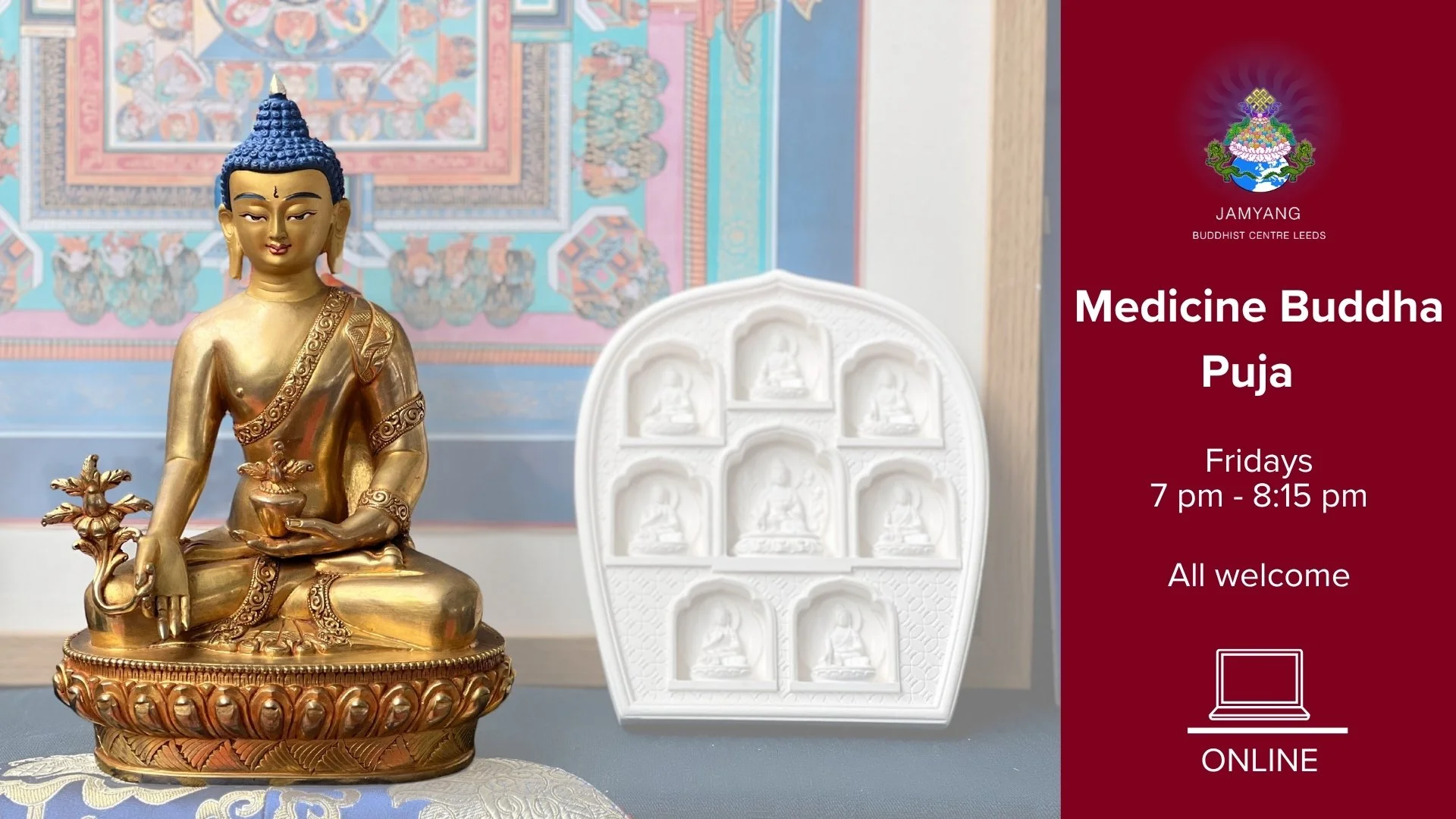
Medicine Buddha Puja
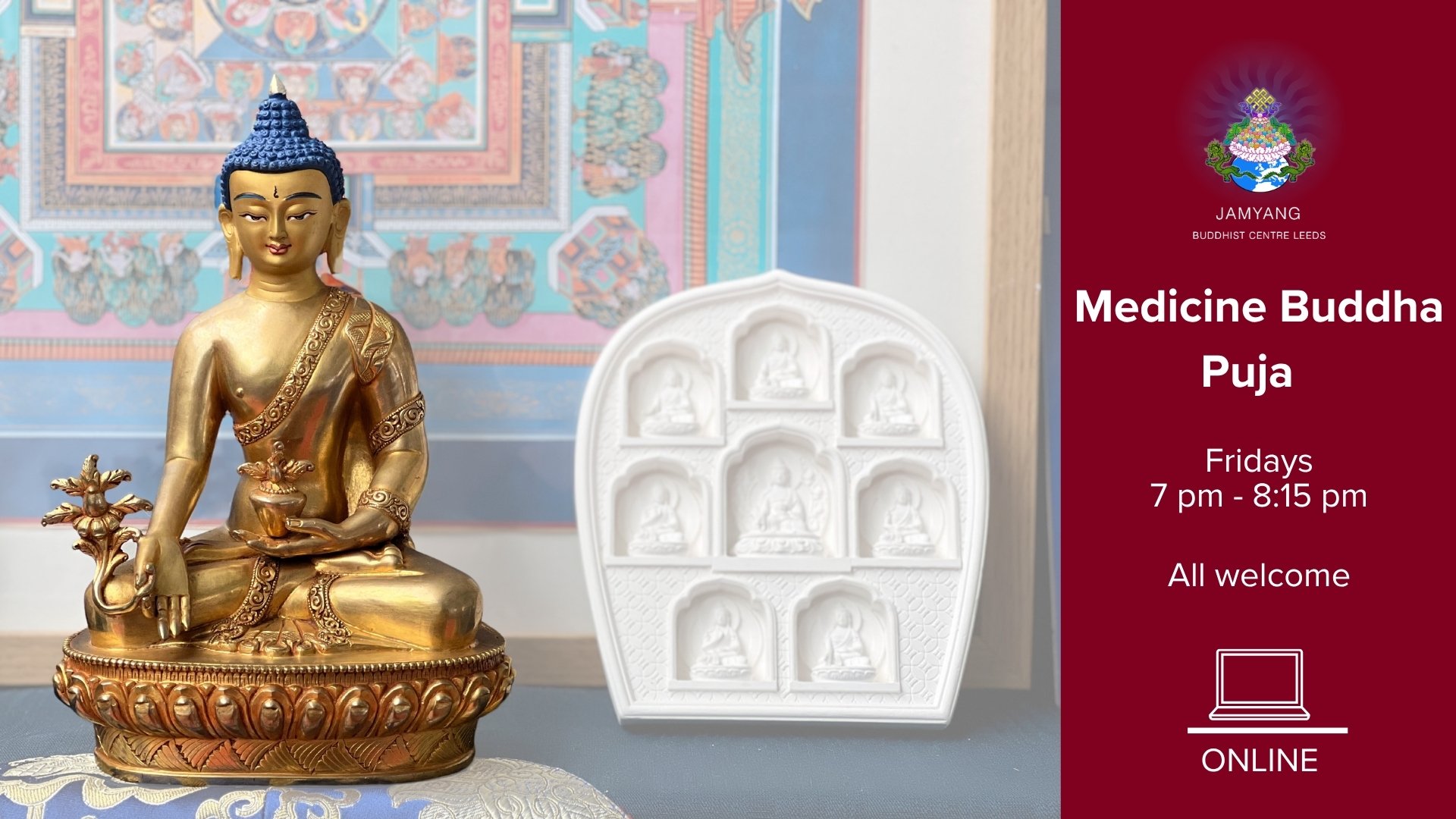
Overview of Medicine Buddha Puja
Medicine Buddha is one of the practices recommended by the FPMT for students to do for the swift return of Kyabje Lama Zopa Rinpoche.
DATE: FRIDAYS
TIME: 7 pm to 8:15 pm
LOCATION: Zoom
LEVEL: Buddhist Practices – All Welcome
SUGGESTED DONATION: £6
This is a longer meditation on Medicine Buddha – to remove obstacles, esp. those relating to health and achieving a favourable rebirth, and activate a swift path to enlightenment.
As Lama Zopa Rinpoche said: “One of the best healing meditations is that on the Medicine Buddha, who is the manifestation of the healing energy of all enlightened beings.”
The puja involves chanting prayers to the Seven Medicine Buddhas and reciting the Medicine Buddha mantras.
It is kindly led by Sande
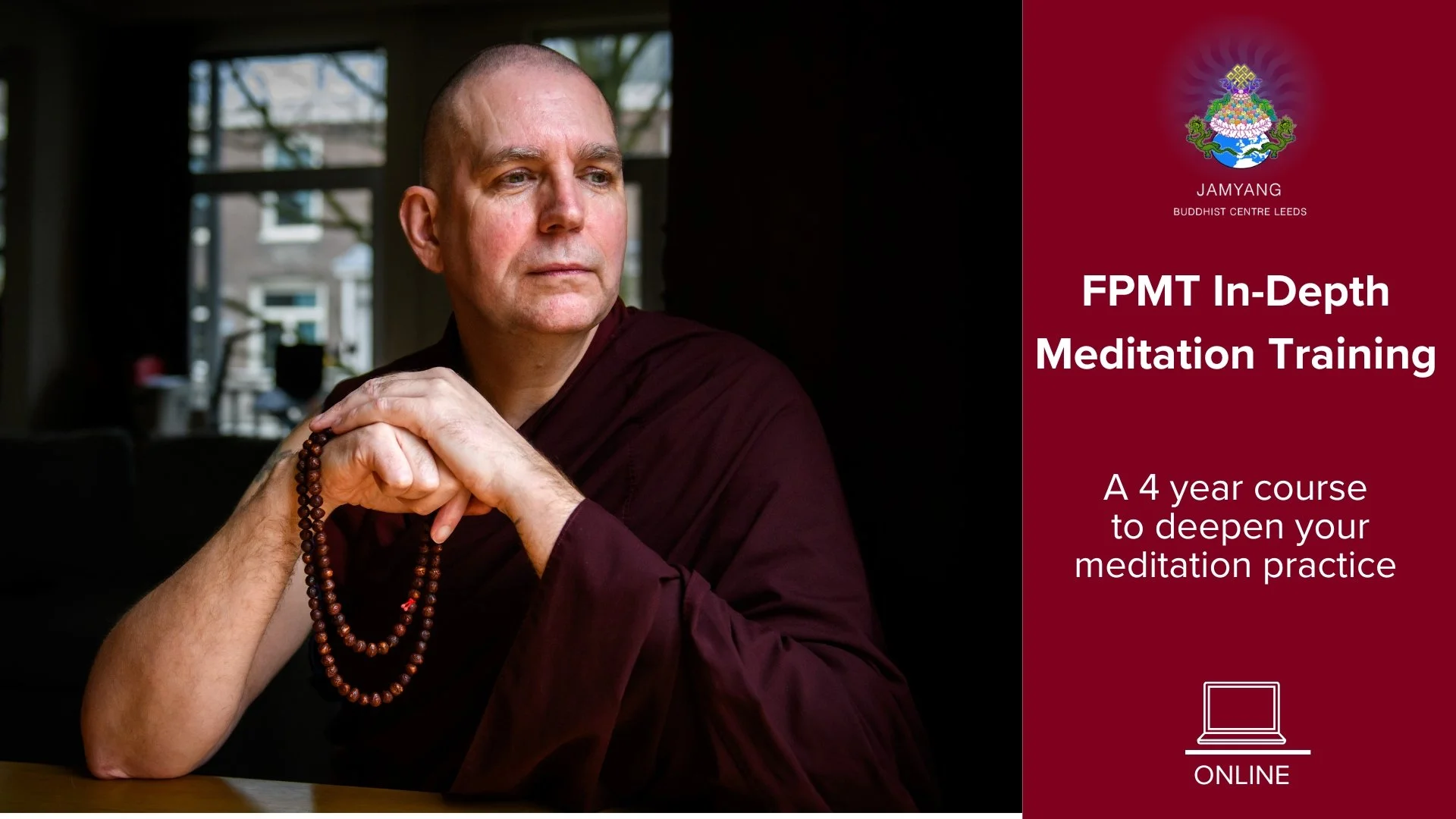
FPMT In-Depth Meditation Training
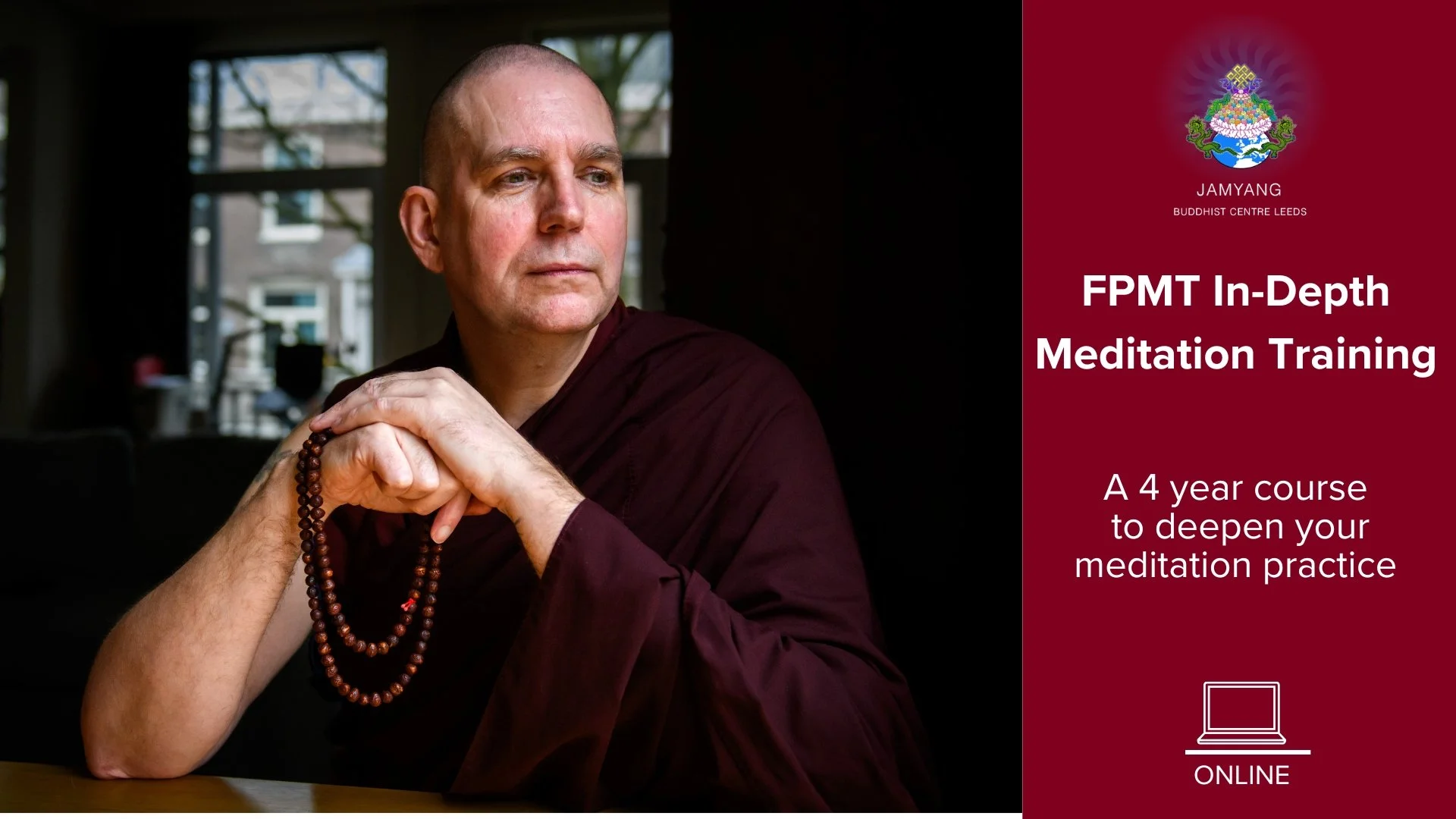
Overview of SESSION
DATE: 2026 / 2027: Year 4
Term 1: September 5th to November 28th 2026
If you are starting as a new student in year 4, don’t worry. You will get some preparatory advice on what previous recordings to have a listen to. Alternatively you may wish to join the new Ngondro Lamrim Meditation course for 2 years before starting In Depth Meditation Training. They are designed to be complementary.
TIME: Saturdays weekly 2:30pm – 5pm UK time
LOCATION: Zoom only
LEVEL: Buddhist Meditation – Intermediate to Advanced
IDMT Year Four, The Vajra Ground: Mahamudra and Kriya Tantra
In this culminating fourth year of our journey, our path turns inward to the mind itself—its empty, luminous nature—and outward to the transformative methods of tantra, where the naturally pure nature of our perception is recognized as the very ground of awakening.
As always, the year will start with generating the mind of awakening, using evocative instructions ranging from Langri Thangpa to Nāgārjuna and Lord Buddha in the famous Bodhisattvapiṭaka. This mind generation we'll cultivate through the four immeasurable thoughts and the support of calm abiding.
Illuminated by the life stories of the masters of the Gelug Mahāmudrā lineage and beyond, we'll explore its roots in the history of the early Indian Mahāsiddhas, such as Saraha and Tilopa, through the Kagyü master Gampopa's and Je Tsongkhapa's Mañjuśrī lineage up to Paṇchen Losang Chökyi Gyaltsen's Highway of the Conquerors and its perspective on this practice. In Sūtra Mahāmudrā we will practice resting attention in the empty nature of awareness, recognizing its clarity and openness as inseparable.
Kriyā Tantra offers a complementary method. Rather than suppress the ordinary, narrow self-narrative that we impose on ourselves and our world, it substitutes for it an extraordinary perspective of pure view. Occasionally, by way of introduction, we'll also taste practices from the higher tantras—glimpsing how afflictive emotions can be met as innate wisdom, and how the dissolution of the death process opens onto the innate mind of clear light. The structured practices of generation and recitation become a rehearsal for transformation, training perception to meet appearances as pure.
These methods rest on a relationship. We will therefore examine the practice of guru devotion candidly—both as the means by which the lineage's realization is transmitted and as a practice with real pitfalls, requiring discernment as much as trust. Through the Ganden Lha Gyāma, the Yoga of the inseparability of guru and Avalokiteśvara, and supporting sādhanas, devotion is approached not as deference but as the ethical road toward the state of Vajradhara: the full integration of wisdom and method.
This final year is an invitation to let realization ripen into a way of being. Grounded in bodhicitta and the four immeasurables, sustained by the preliminary practices, and held by the strength of community, we learn to meet the mind without grasping and to meet the world as pure appearance. Our aim is not to accumulate practices, but to bring the path to maturity—wisdom and compassion no longer cultivated separately, but lived as one.
This four-year online course provides students with long term, in-depth support in their meditative development.
The teacher and course developer is Venerable Losang Gendun. He has trained extensively in meditation in both Theravada and Mahayana Traditions
The In Depth Meditation Training course is also part of The Buddha Project led by Venerable Losang Gendun. You can find out more about Venerable Gendun, the course and who it is suitable for on our FPMT In-Depth Meditation Training webpage
If you have any questions you would like to ask before registering please email our In-Depth Meditation Coordinator Marie Odile on idmt@jamyangleeds.co.uk
The zoom link and all materials for the course are provided to registered students.
Donations:
Generosity is one of the cornerstones of the Buddhist path. With your donation we support The Buddha Project and we keep our centre going for the benefit of all sentient beings.
As the course is a collaboration with other FPMT centres it is not possible to offer this as part of our Jamyang Leeds membership programme.
The recommended donation per calendar month is £45.
If you are able to practice generosity and sponsor other students we recommend £58 per calendar month.
If you are on a reduced income it is £31 per calendar month.
There is also the option to donate annually.
If none of the above options are affordable please do still register, we never turn anyone away from the Dharma for financial reasons and we can agree a donation that is affordable for you right now. Please email Marie Odile our IDMT Coordinator idmt@jamyangleeds.co.uk if you would like to chat.
Vipassana Meditation
Overview of Vipassana Meditation
Join us for a peaceful start to your week with a 30 minute Vipassana meditation session, designed to cultivate mindfulness, self-awareness, and equanimity. Led by Geshe Rinchen
DATE: Mondays weekly (March to May and July to November)
TIME: 7:00 am to 7:30 am
Vipassana (Special Insight Meditation), also called analytical meditation, is primarily a practice of wisdom. It is a form of concentration that focuses single-pointedly on the ultimate nature of phenomena through analytical reasoning. Analysing phenomena is a key aspect of Vipassana practice, as it helps develop a definitive understanding of the nature of reality—such as the self, mind, emotions, and thoughts.
As Je Tsongkhapa explains, shamatha (calm abiding) is like a lamp that remains clear and steady in a place without wind, whereas vipassana (special insight) is like seeing the nature of phenomena clearly through such a steady and clear lamp. Therefore, the usual order of these two meditations is: first, achieving calm abiding or mental stability as a foundation, then engaging in special insight meditation through analysis. However, Vipassana meditation can also be practised by analysing and observing sensations, thoughts, and emotions without first achieving shamatha. This practice should still begin with focusing on the breath or another object of meditation. In our case, we will focus on the breath to start analysing the nature of the mind in relation to our sense of self, emotions, and thoughts.
The session begins by focusing on the breath—either the rise and fall of the abdomen or the sensation of air entering and leaving the nostrils. This practice calms the mind and helps establish a deep sense of presence.
Next, we move into a guided body scan, bringing awareness to different parts of the body and observing subtle sensations without judgement. This helps develop a greater connection to your physical experience.
As we proceed, you will practise observing and analysing sensations, thoughts, and emotions as they arise, learning to witness them without attachment or aversion. This fosters a deeper understanding of the impermanence and interconnectedness of the mind and self. Finally, you will rest your mind either in the natural state of awareness or in the analytical clarity gained through observation and reasoning.
Through regular practice, Vipassana meditation cultivates wisdom, encouraging a balanced and objective view of internal experiences. This session is ideal for those seeking greater insight and calmness in their daily lives.
Morning Prayers
Overview
Start the day by joining us for Morning Prayers recommended by Lama Zopa Rinpoche and HH Dalai Lama, for the benefit of all sentient beings and the swift return of Lama Zopa Rinpoche. Everyone is welcome.
DATE: Monday – Friday all year around
TIME: 8:30am - 9:00am
LOCATION: Zoom
LEVEL: Buddhist Practices – All Welcome
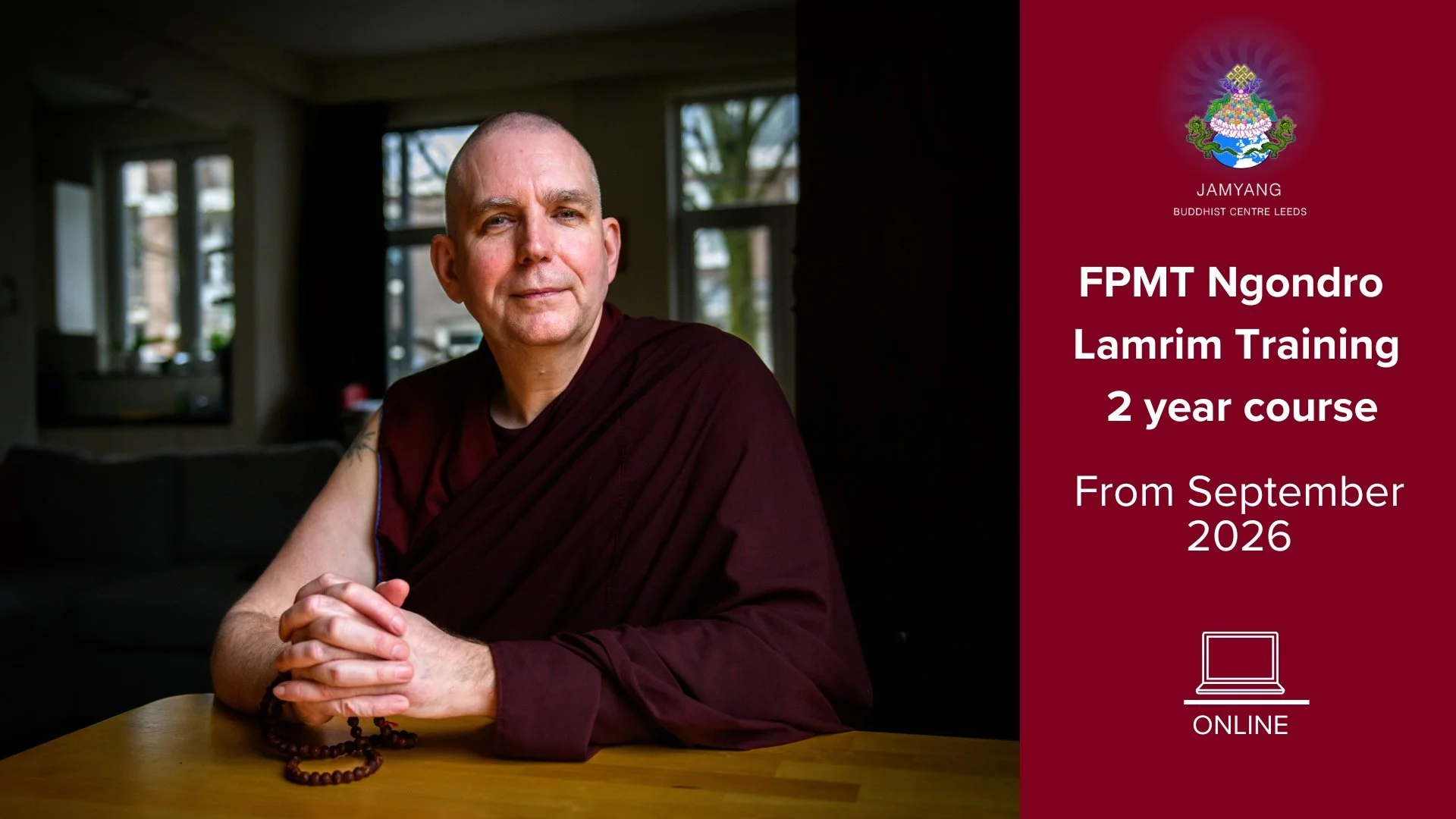
FPMT Ngondro Lamrim Training
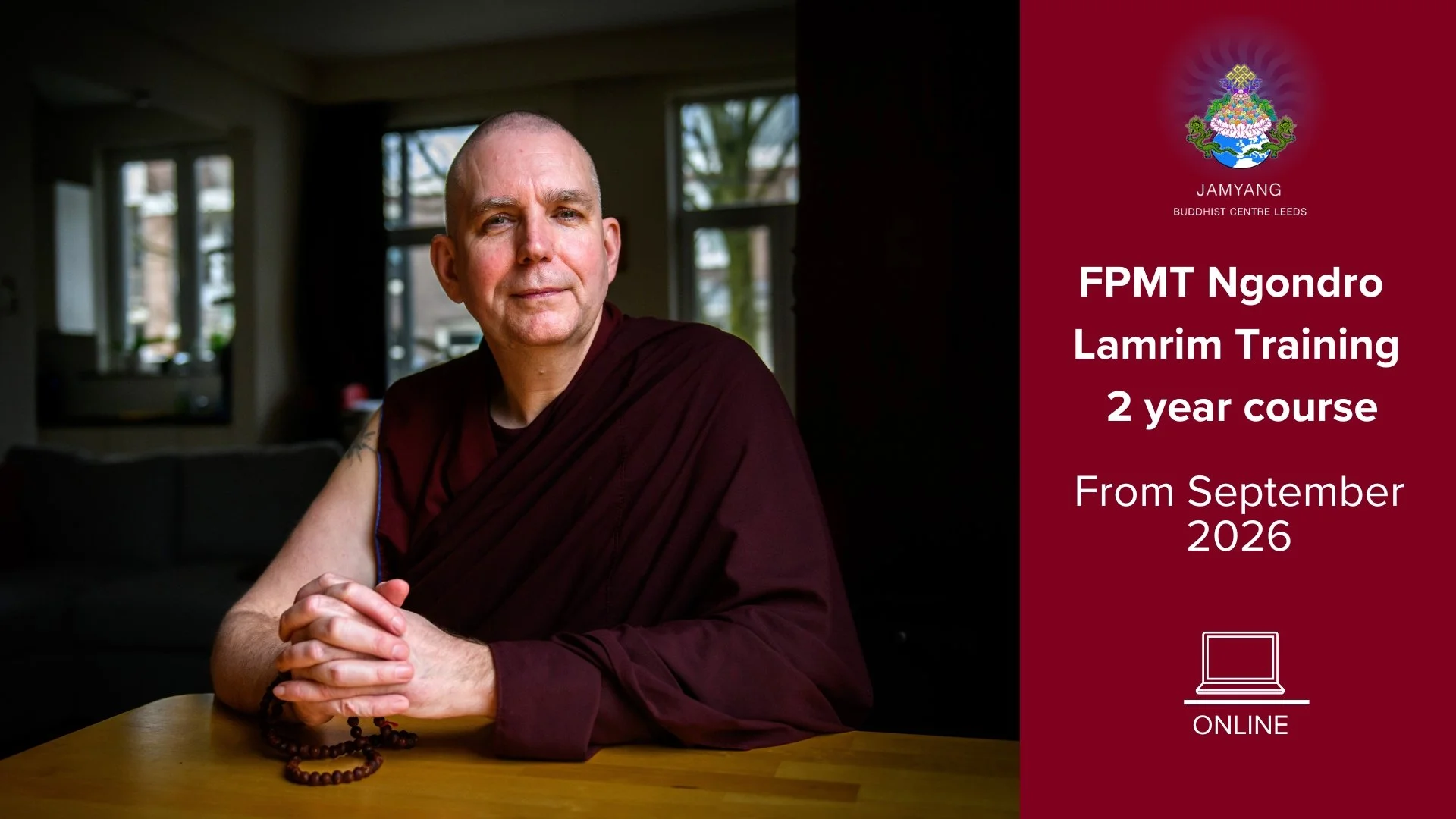
Overview of SESSION
DATE: 2026 / 2027: Year 1
Term 1: September 14th to November 28th 2026
Over a period of two years, the FPMT Ngöndro Lamrim Training (NLRT) offers 16 months of training in the common and uncommon preliminary practices. The training is designed to generate the motivation that supports the development of calm abiding, special insight, and tantra. By cultivating the inner qualities needed to ease unskillful patterns of mind that are the cause of hindrances on the path, it facilitates deep transformation.
An excellent preparation for the FPMT In-Depth Meditation Training (IDMT)
LOCATION: Recordings are released weekly
LEVEL: Buddhist Preliminary Practices
About the Course:
The Lamrim — "Stages of the Path" in Tibetan — is a systematic presentation of the entire Buddhist path to Awakening, written by the great Tibetan master Je Tsongkhapa in the 14th and early 15th century, based on writings of the Indian master Atisha. It arranges every essential teaching of the Buddha into a single, coherent, graduated sequence tailored to your mind, exactly as it is right now. Its true power lies not in study alone, but in practice. Each teaching is carefully arranged to meet the mind where it is and guide it—step by step—toward genuine change.
The uncommon preliminary practices (ngöndro) are powerful methods to purify the mind and prepare it for lasting transformation.
Over the first eleven months the common foundations, renunciation, bodhicitta, and the view of emptiness, are explored based on the Lamrim. For the remaining five months the focus is on the uncommon practices, Vajrasattva purification, mandala offerings, and guru yoga. Weekly sessions each introduce a new topic that examines different ways to meditate and why, in combination with a guided meditation.
The training helps establish a consistent daily meditative practice in supports of its overall aim: to engage in contemplative meditation in a way that genuinely transforms the mind's outlook on the world and gives one's life a new direction. Students gain a deep understanding of how to accumulate merit and purify unskillful karma while cultivating a healthy relationship with the Three Jewels and their teacher. The emphasis is on learning to meditate in a personally tailored way, in accordance with one’s psychological makeup and life conditions.
The Ngondro Lamrim Training teaching sessions are pre-recorded.
Each week, a 90-minute teaching together with two guided meditations are uploaded. On other days, advanced students contribute additional guided meditations. The teacher, Venerable Gendun, offers regular online Q&A sessions. For those who have already studied the Lamrim or the FPMT Basic Program, the training also offers specialized opportunities to learn how to guide others in meditation.
Year 1: Definite Emergence and Mind of Awakening
Prepare the mind for śamatha, vipaśyanā, and tantra
Explore renunciation and bodhicitta, the first two Principles of the Path
Develop genuine urgency through Lamrim contemplation
Cultivate the aspiration to Awakening for all beings
FPMT Ngondro Lamrim Taining is also part of The Buddha Project led by Venerable Losang Gendun. You can find out more about Venerable Gendun, the course and who it is suitable for on our FPMTNgondro Lamrim Training webpage
If you have any questions you would like to ask before registering please email our In-Depth Meditation Coordinator Marie Odile on idmt@jamyangleeds.co.uk
All materials for the course are provided to registered students.
Donations:
Generosity is one of the cornerstones of the Buddhist path. Donations help support both the centre and The Buddha Project as well as providing a donation for the teachings to Venerable Gendun. There are different levels depending on your income. There are three terms a year, each approximately 3 months long
As the course is a collaboration with other FPMT centres it is not possible to offer this as part of our Jamyang Leeds membership programme.
For those with a regular income the recommended donation is £95 per term
The sponsorhsip level is £115 per term
Ordained Sangha are free
If this isn’t affordable please do register, we never turn anyone away from the Dharma for financial reasons and we can agree a donation that is affordable for you at the current time. Please email Marie-Odile our IDMT Coordinator idmt@jamyangleeds.co.uk if you would like to chat.

Yamantaka Practice Group

Overview of SESSION
This is a restricted practice, for those who have received the empowerment to practice Solitary Hero Vajrabhairava/Yamantaka.
If you have an interest in joining the group please email yamantakagroup@gmail.com to register.
The Yamantaka practice is held on the Mondays weekly. Please note that some weeks it starts at 2:30pm and some at 6pm it doesn’t always alternate weekly.

Tonglen Loving Kindness meditation Practice

Overview of Tonglen Meditation
The Buddhist practice of Giving & Taking (Tonglen in Tibetan) is at its heart a selfless meditation of loving kindness and compassion.
DATE: Tuesdays
TIME: 7am-7:30am
LOCATION: Zoom
LEVEL: Buddhist Meditation – All Welcome
SUGGESTED DONATION: £4
A beautiful practice led by Chrissie and Di.
The Buddhist practice of Giving & Taking (Tonglen in Tibetan) is at its heart a selfless meditation of loving kindness and compassion. You imagine giving all your happiness to others, sometimes using visualisation with the breath, and then taking all the suffering and its causes from others. It’s a powerful practice for the brave-hearted!
Kshitigarbha Practice
Overview of Kshitigarbha practice
DATE: Tuesdays & Thursdays
TIME: 12pm-12:30pm
LOCATION: Zoom only
LEVEL: Buddhist Practices – All Welcome
SUGGESTED DONATION: £4
Lama Zopa Rinpoche (our organisation’s Spiritual Director) suggested Jamyang Leeds perform these practices to help with the financial obstacles we are currently having. From September 2022, we’ll be reciting this practice as much as we can. See the special newsletter explaining all about the practice here.
Vajrasattva Practice
Overview of The Vajrasattva Practice
DATE: Tuesdays
TIME: 8:00pm-8:30pm
LOCATION: Zoom
LEVEL: Buddhist Practices – All Welcome
SUGGESTED DONATION: £4
Purification here means looking at our past unskillful actions which have created seeds of negative karma in our minds, and using visualisation and mantra recitation to remove those seeds in a healthy and productive way. Vajrasattva is the embodiment of all the Buddha’s cleaning and purifying energy. We all make mistakes, and how we deal with them is key to making spiritual progress. We’ll be using a short text composed by Lama Zopa Rinpoche
the eight verses of thoughts transformation
Overview of the eight verses of thoughts transformation
Everflowing Nectar of Bodhichitta – Annihilating the Demon of the Self-Cherishing Mind
DATE: Wednesdays
TIME: 7am-7:30am
LOCATION: Zoom
LEVEL: Buddhist Practices- All Welcome
SUGGESTED DONATION: £4
Everflowing Nectar of Bodhichitta – Annihilating the Demon of the Self-Cherishing Mind
Led by Di or Sande
This practice is based on the short text” Eight Verses of Thought Transformation”, which contains the entire technique for transforming the mind into relative bodhichitta (i.e., the wish to achieve enlightenment for the benefit of all sentient beings) and absolute bodhichitta (i.e., the wisdom realizing emptiness).
Chanting the Verses of Noble manjushri
Overview of Session
DATE: Thursdays
TIME: 7:45am to 8:25 am
LOCATION: Zoom only
LEVEL: Buddhist Practices – suitable for Lama Zopa Rinpoche’s students
Join us to fulfill His Holiness the Dalai Lama’s wishes and chant the Names of Noble Manjushri for the swift return of Lama Zopa Rinpoche.
Please come along even if you havent done the practice before, its quite wonderful and very energising. Please download the text below, you can also listen and practice with the audio clip of Lama Zopa Rinpoche reciting the Chanting the Names of Noble Manjushri.
Kshitigarbha Practice
Overview of Kshitigarbha practice
DATE: Tuesdays & Thursdays
TIME: 12pm-12:30pm
LOCATION: Zoom only
LEVEL: Buddhist Practices – All Welcome
SUGGESTED DONATION: £4
Lama Zopa Rinpoche (our organisation’s Spiritual Director) suggested Jamyang Leeds perform these practices to help with the financial obstacles we are currently having. From September 2022, we’ll be reciting this practice as much as we can. See the special newsletter explaining all about the practice here.
Kalachakra Practice group
Overview of practice
This is a restricted group for those who have received the Kalachakra empowerment from a qualified Lama. To join the group you need to have either received the full Kalachakra empowerment or another High Yoga Tantra empowerment such as Heruka, as long as you have received a Kalachakra Jenang (permission).
This international group of Kalachakra practitioners meets weekly and alternates with commentary and practice.
Mind Mandala once a month and six session guru yoga for other sessions:
If you’re already part of this group, please use the details sent in the weekly email to join the practice
If you’d like to join us, please email spc@jamyangleeds.co.uk confirming that you have the appropriate empowerments. You will then be sent a registration form to complete.
Shamatha – Meditation on the Breath
Overview of Session
DATE: Fridays
TIME: 7am-7:30am
LOCATION: Zoom
LEVEL: All Welcome
SUGGESTED DONATION: £4
Led by Ruth
Mindfulness of Breathing is universally acknowledged to be of benefit to all living in the modern world. Many feel overloaded with all that is expected of us living this complex and exhausting existence. Developing our awareness in this way is a general prescription for soothing and healing the overworked body and mind.
Practicing focusing the attention on an object such as the breath is also a core practice in Tibetan Buddhism. Gradually over time we are able to hold the object of our attention over longer periods, which enables us to practice other meditations such as Vipassana more successfully.
White Umbrella Deity practice
Overview of practice
DATE: Fridays
TIME: 11:30 am to 12:00 pm
LOCATION: Please note this is online only
LEVEL: Buddhist Practices – see note below
SUGGESTED DONATION: £4
In September 2024, His Eminence Ling Rinpoche gave us this practice to overcome obstacles to the centre flourishing.
In addition to many benefits of engaging in these practices, Lama Zopa Rinpoche recommended that these two practices are beneficial to helping bring peace to situation between Israel and Palestine.
The Sanskrit name for the White Umbrella deity is Ushnisha Sitatapatra which can also be translated as “The Victorious White Parasol.” The White Umbrella Deity, [Skt. Sitatapatra, Tib. gdugs dkar] is a powerful female deity. She is relied upon for protection; healing illness; dispelling interferences, spirit possession, and harmful forces; quelling disasters; averting obstacles; and bringing auspiciousness.
Ushnisha Sitatapatra is a female form of Avalokiteshvara, the Bodhisattva of Compassion. Like this Bodhisattva in an elaborate form, she also has a thousand eyes that watch over living beings, and a thousand arms that protect and assist them. Thus she symbolizes the power of active compassion.
Practices of Arya Sitatapatra includes, “The Supreme Accomplishment of Sitatapatra,” and “Praises and Repelling Practices of Sitatapatra.”
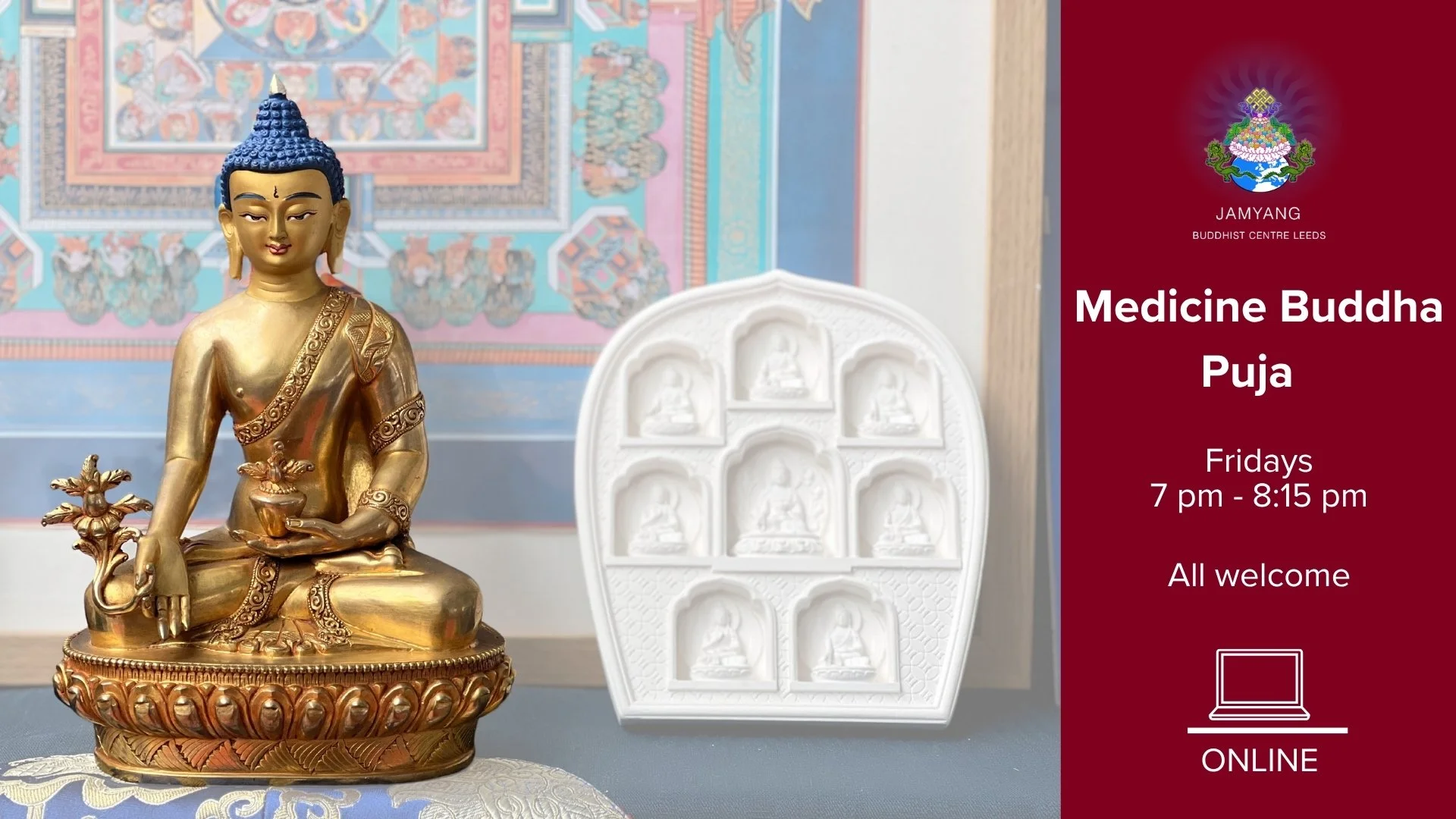
Medicine Buddha Puja
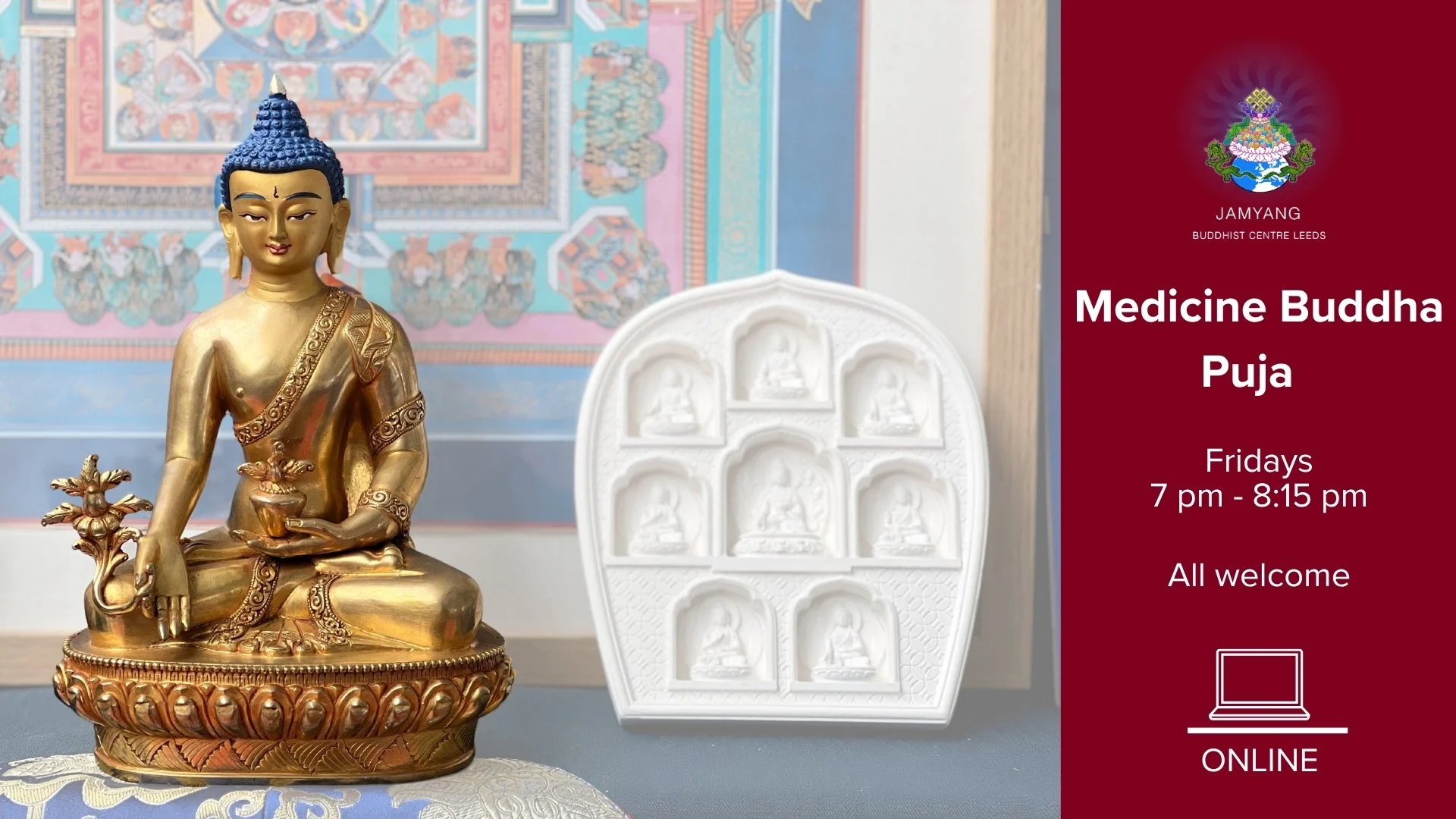
Overview of Medicine Buddha Puja
Medicine Buddha is one of the practices recommended by the FPMT for students to do for the swift return of Kyabje Lama Zopa Rinpoche.
DATE: FRIDAYS
TIME: 7 pm to 8:15 pm
LOCATION: Zoom
LEVEL: Buddhist Practices – All Welcome
SUGGESTED DONATION: £6
This is a longer meditation on Medicine Buddha – to remove obstacles, esp. those relating to health and achieving a favourable rebirth, and activate a swift path to enlightenment.
As Lama Zopa Rinpoche said: “One of the best healing meditations is that on the Medicine Buddha, who is the manifestation of the healing energy of all enlightened beings.”
The puja involves chanting prayers to the Seven Medicine Buddhas and reciting the Medicine Buddha mantras.
It is kindly led by Sande
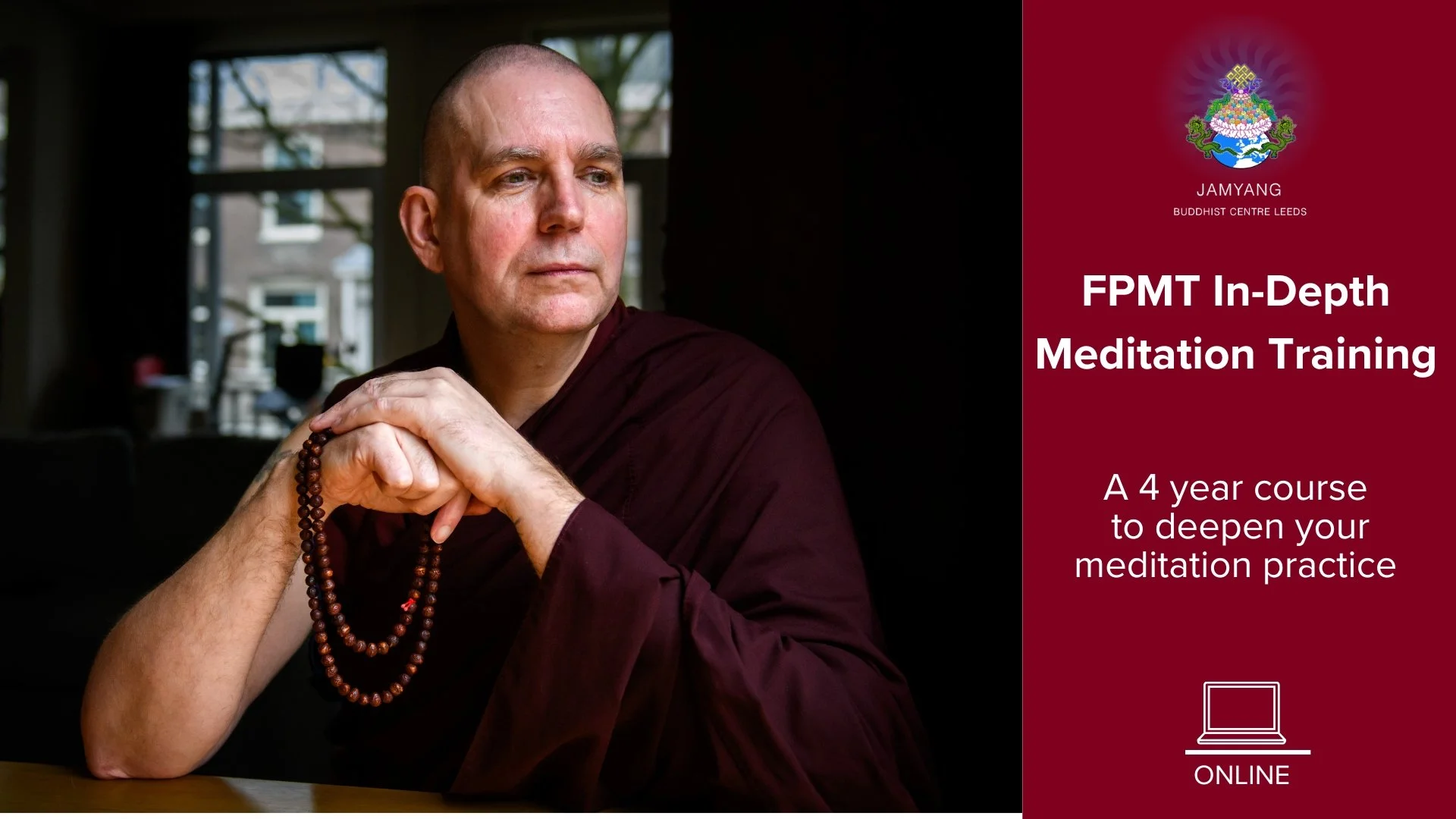
FPMT In-Depth Meditation Training
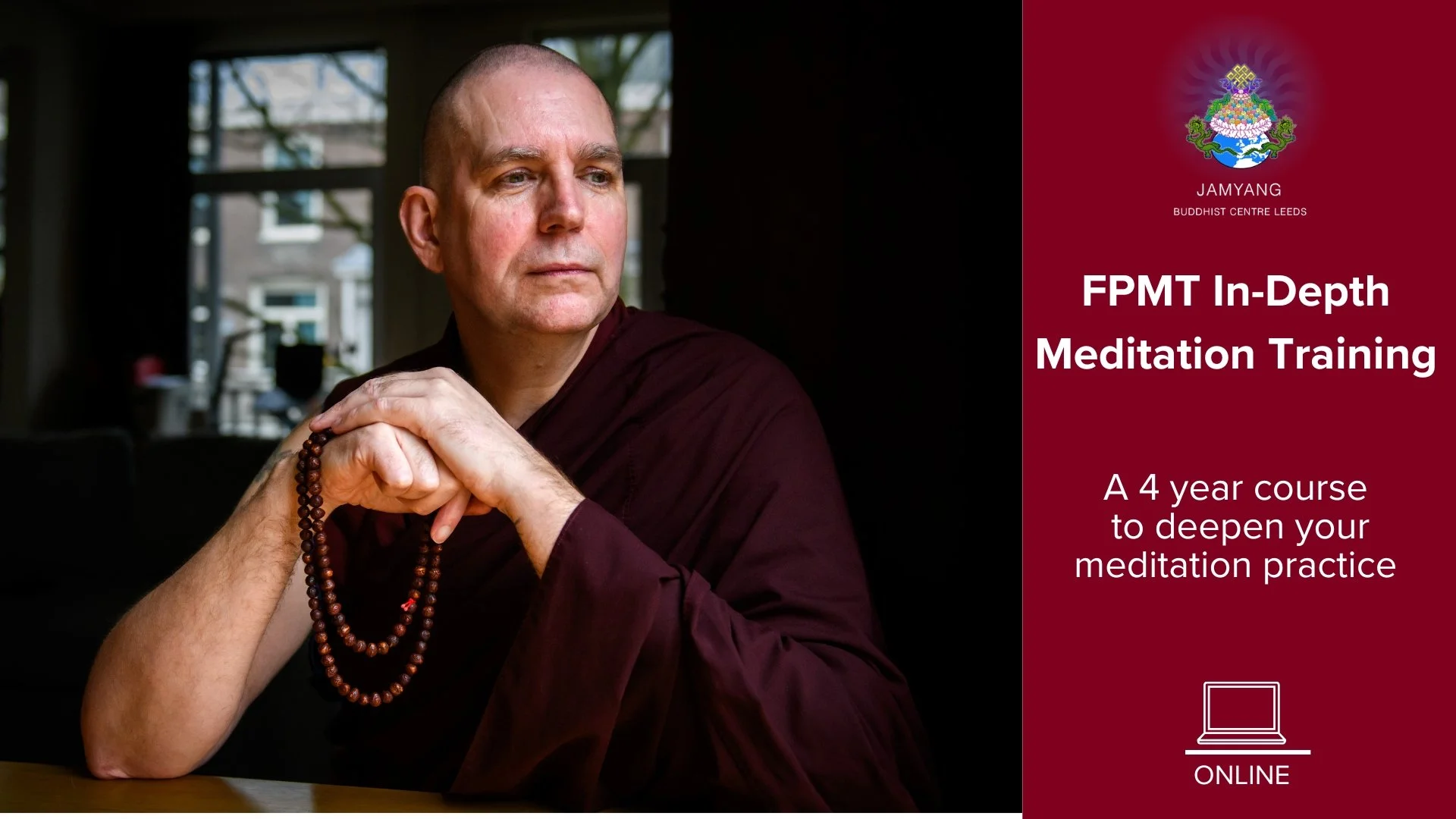
Overview of SESSION
DATE: 2026 / 2027: Year 4
Term 1: September 5th to November 28th 2026
If you are starting as a new student in year 4, don’t worry. You will get some preparatory advice on what previous recordings to have a listen to. Alternatively you may wish to join the new Ngondro Lamrim Meditation course for 2 years before starting In Depth Meditation Training. They are designed to be complementary.
TIME: Saturdays weekly 2:30pm – 5pm UK time
LOCATION: Zoom only
LEVEL: Buddhist Meditation – Intermediate to Advanced
IDMT Year Four, The Vajra Ground: Mahamudra and Kriya Tantra
In this culminating fourth year of our journey, our path turns inward to the mind itself—its empty, luminous nature—and outward to the transformative methods of tantra, where the naturally pure nature of our perception is recognized as the very ground of awakening.
As always, the year will start with generating the mind of awakening, using evocative instructions ranging from Langri Thangpa to Nāgārjuna and Lord Buddha in the famous Bodhisattvapiṭaka. This mind generation we'll cultivate through the four immeasurable thoughts and the support of calm abiding.
Illuminated by the life stories of the masters of the Gelug Mahāmudrā lineage and beyond, we'll explore its roots in the history of the early Indian Mahāsiddhas, such as Saraha and Tilopa, through the Kagyü master Gampopa's and Je Tsongkhapa's Mañjuśrī lineage up to Paṇchen Losang Chökyi Gyaltsen's Highway of the Conquerors and its perspective on this practice. In Sūtra Mahāmudrā we will practice resting attention in the empty nature of awareness, recognizing its clarity and openness as inseparable.
Kriyā Tantra offers a complementary method. Rather than suppress the ordinary, narrow self-narrative that we impose on ourselves and our world, it substitutes for it an extraordinary perspective of pure view. Occasionally, by way of introduction, we'll also taste practices from the higher tantras—glimpsing how afflictive emotions can be met as innate wisdom, and how the dissolution of the death process opens onto the innate mind of clear light. The structured practices of generation and recitation become a rehearsal for transformation, training perception to meet appearances as pure.
These methods rest on a relationship. We will therefore examine the practice of guru devotion candidly—both as the means by which the lineage's realization is transmitted and as a practice with real pitfalls, requiring discernment as much as trust. Through the Ganden Lha Gyāma, the Yoga of the inseparability of guru and Avalokiteśvara, and supporting sādhanas, devotion is approached not as deference but as the ethical road toward the state of Vajradhara: the full integration of wisdom and method.
This final year is an invitation to let realization ripen into a way of being. Grounded in bodhicitta and the four immeasurables, sustained by the preliminary practices, and held by the strength of community, we learn to meet the mind without grasping and to meet the world as pure appearance. Our aim is not to accumulate practices, but to bring the path to maturity—wisdom and compassion no longer cultivated separately, but lived as one.
This four-year online course provides students with long term, in-depth support in their meditative development.
The teacher and course developer is Venerable Losang Gendun. He has trained extensively in meditation in both Theravada and Mahayana Traditions
The In Depth Meditation Training course is also part of The Buddha Project led by Venerable Losang Gendun. You can find out more about Venerable Gendun, the course and who it is suitable for on our FPMT In-Depth Meditation Training webpage
If you have any questions you would like to ask before registering please email our In-Depth Meditation Coordinator Marie Odile on idmt@jamyangleeds.co.uk
The zoom link and all materials for the course are provided to registered students.
Donations:
Generosity is one of the cornerstones of the Buddhist path. With your donation we support The Buddha Project and we keep our centre going for the benefit of all sentient beings.
As the course is a collaboration with other FPMT centres it is not possible to offer this as part of our Jamyang Leeds membership programme.
The recommended donation per calendar month is £45.
If you are able to practice generosity and sponsor other students we recommend £58 per calendar month.
If you are on a reduced income it is £31 per calendar month.
There is also the option to donate annually.
If none of the above options are affordable please do still register, we never turn anyone away from the Dharma for financial reasons and we can agree a donation that is affordable for you right now. Please email Marie Odile our IDMT Coordinator idmt@jamyangleeds.co.uk if you would like to chat.
Vipassana Meditation
Overview of Vipassana Meditation
Join us for a peaceful start to your week with a 30 minute Vipassana meditation session, designed to cultivate mindfulness, self-awareness, and equanimity. Led by Geshe Rinchen
DATE: Mondays weekly (March to May and July to November)
TIME: 7:00 am to 7:30 am
Vipassana (Special Insight Meditation), also called analytical meditation, is primarily a practice of wisdom. It is a form of concentration that focuses single-pointedly on the ultimate nature of phenomena through analytical reasoning. Analysing phenomena is a key aspect of Vipassana practice, as it helps develop a definitive understanding of the nature of reality—such as the self, mind, emotions, and thoughts.
As Je Tsongkhapa explains, shamatha (calm abiding) is like a lamp that remains clear and steady in a place without wind, whereas vipassana (special insight) is like seeing the nature of phenomena clearly through such a steady and clear lamp. Therefore, the usual order of these two meditations is: first, achieving calm abiding or mental stability as a foundation, then engaging in special insight meditation through analysis. However, Vipassana meditation can also be practised by analysing and observing sensations, thoughts, and emotions without first achieving shamatha. This practice should still begin with focusing on the breath or another object of meditation. In our case, we will focus on the breath to start analysing the nature of the mind in relation to our sense of self, emotions, and thoughts.
The session begins by focusing on the breath—either the rise and fall of the abdomen or the sensation of air entering and leaving the nostrils. This practice calms the mind and helps establish a deep sense of presence.
Next, we move into a guided body scan, bringing awareness to different parts of the body and observing subtle sensations without judgement. This helps develop a greater connection to your physical experience.
As we proceed, you will practise observing and analysing sensations, thoughts, and emotions as they arise, learning to witness them without attachment or aversion. This fosters a deeper understanding of the impermanence and interconnectedness of the mind and self. Finally, you will rest your mind either in the natural state of awareness or in the analytical clarity gained through observation and reasoning.
Through regular practice, Vipassana meditation cultivates wisdom, encouraging a balanced and objective view of internal experiences. This session is ideal for those seeking greater insight and calmness in their daily lives.
Morning Prayers
Overview
Start the day by joining us for Morning Prayers recommended by Lama Zopa Rinpoche and HH Dalai Lama, for the benefit of all sentient beings and the swift return of Lama Zopa Rinpoche. Everyone is welcome.
DATE: Monday – Friday all year around
TIME: 8:30am - 9:00am
LOCATION: Zoom
LEVEL: Buddhist Practices – All Welcome
FPMT Ngondro Lamrim Training
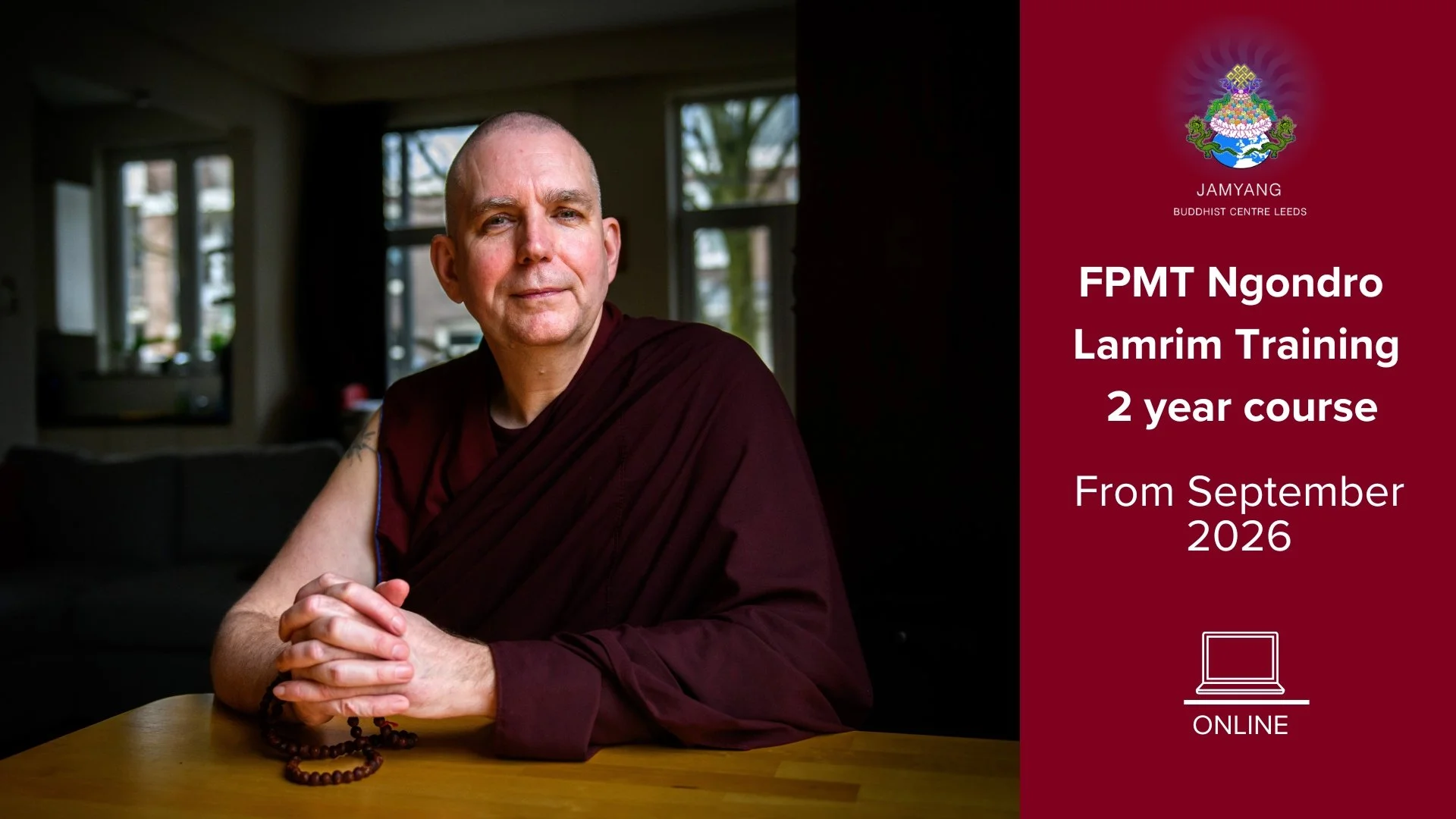
Overview of SESSION
DATE: 2026 / 2027: Year 1
Term 1: September 14th to November 28th 2026
Over a period of two years, the FPMT Ngöndro Lamrim Training (NLRT) offers 16 months of training in the common and uncommon preliminary practices. The training is designed to generate the motivation that supports the development of calm abiding, special insight, and tantra. By cultivating the inner qualities needed to ease unskillful patterns of mind that are the cause of hindrances on the path, it facilitates deep transformation.
An excellent preparation for the FPMT In-Depth Meditation Training (IDMT)
LOCATION: Recordings are released weekly
LEVEL: Buddhist Preliminary Practices
About the Course:
The Lamrim — "Stages of the Path" in Tibetan — is a systematic presentation of the entire Buddhist path to Awakening, written by the great Tibetan master Je Tsongkhapa in the 14th and early 15th century, based on writings of the Indian master Atisha. It arranges every essential teaching of the Buddha into a single, coherent, graduated sequence tailored to your mind, exactly as it is right now. Its true power lies not in study alone, but in practice. Each teaching is carefully arranged to meet the mind where it is and guide it—step by step—toward genuine change.
The uncommon preliminary practices (ngöndro) are powerful methods to purify the mind and prepare it for lasting transformation.
Over the first eleven months the common foundations, renunciation, bodhicitta, and the view of emptiness, are explored based on the Lamrim. For the remaining five months the focus is on the uncommon practices, Vajrasattva purification, mandala offerings, and guru yoga. Weekly sessions each introduce a new topic that examines different ways to meditate and why, in combination with a guided meditation.
The training helps establish a consistent daily meditative practice in supports of its overall aim: to engage in contemplative meditation in a way that genuinely transforms the mind's outlook on the world and gives one's life a new direction. Students gain a deep understanding of how to accumulate merit and purify unskillful karma while cultivating a healthy relationship with the Three Jewels and their teacher. The emphasis is on learning to meditate in a personally tailored way, in accordance with one’s psychological makeup and life conditions.
The Ngondro Lamrim Training teaching sessions are pre-recorded.
Each week, a 90-minute teaching together with two guided meditations are uploaded. On other days, advanced students contribute additional guided meditations. The teacher, Venerable Gendun, offers regular online Q&A sessions. For those who have already studied the Lamrim or the FPMT Basic Program, the training also offers specialized opportunities to learn how to guide others in meditation.
Year 1: Definite Emergence and Mind of Awakening
Prepare the mind for śamatha, vipaśyanā, and tantra
Explore renunciation and bodhicitta, the first two Principles of the Path
Develop genuine urgency through Lamrim contemplation
Cultivate the aspiration to Awakening for all beings
FPMT Ngondro Lamrim Taining is also part of The Buddha Project led by Venerable Losang Gendun. You can find out more about Venerable Gendun, the course and who it is suitable for on our FPMTNgondro Lamrim Training webpage
If you have any questions you would like to ask before registering please email our In-Depth Meditation Coordinator Marie Odile on idmt@jamyangleeds.co.uk
All materials for the course are provided to registered students.
Donations:
Generosity is one of the cornerstones of the Buddhist path. Donations help support both the centre and The Buddha Project as well as providing a donation for the teachings to Venerable Gendun. There are different levels depending on your income. There are three terms a year, each approximately 3 months long
As the course is a collaboration with other FPMT centres it is not possible to offer this as part of our Jamyang Leeds membership programme.
For those with a regular income the recommended donation is £95 per term
The sponsorhsip level is £115 per term
Ordained Sangha are free
If this isn’t affordable please do register, we never turn anyone away from the Dharma for financial reasons and we can agree a donation that is affordable for you at the current time. Please email Marie-Odile our IDMT Coordinator idmt@jamyangleeds.co.uk if you would like to chat.
Yamantaka Practice Group
Overview of SESSION
This is a restricted practice, for those who have received the empowerment to practice Solitary Hero Vajrabhairava/Yamantaka.
If you have an interest in joining the group please email yamantakagroup@gmail.com to register.
The Yamantaka practice is held on Mondays weekly. Please note that some weeks it starts at 2:30pm and some at 6pm it doesn’t always alternate weekly.

Tara Puja for World Peace

Overview of Session
DATE: 2026: Last Monday monthly (break in August)
TIME: 5:45pm-6:30pm
LOCATION: Zoom
LEVEL: Buddhist Practices – All welcome
SUGGESTED DONATION: £6
Tara Puja dedicated to world peace is held on a monthly basis.
Led by Ondy Willson and translated by Venerable Tenzin into Russian for Russian and Ukrainian students
Please join us, occasionally or regularly, at 17.45 UK time to show our support for the courageous spiritual communities both in Ukraine & Russia and also in Israel and Gaza. May we all nurture compassion & peace in the face of destruction & violence.
By coming together like this we send a powerful message that comes from the depths of our being. We value peace, harmony and the enlightened qualities we aspire to embody, as generated in the 21 Taras Sadhana.
By the power of our merit may there be a non-violent and bloodless revolution of consciousness so that enlightened democracies based on social wellbeing flourish everywhere.
Please forward this invitation to anyone who you think may be interested in this free and beneficial session.
The puja will last approximately 45 minutes to include some guidance on harnessing the positive power of the prayers in generating the particular qualities of compassion and fearlessness.
Ondy Willson, a touring FPMT teacher since 2007, has students in Russia & Ukraine, so felt particularly moved to offer these pujas both to connect with & support those who are suffering on the front line. So these pujas have provided, not just an opportunity to deal with fear and pray for peace, but to meet directly together as a global community and interact with our Ukrainian and Russian dharma friends. At the end of one week’s puja, participants in Ukraine & Russia shared their stories & experiences, which was very moving for us all to hear.
Tonglen Loving Kindness meditation Practice
Overview of Tonglen Meditation
The Buddhist practice of Giving & Taking (Tonglen in Tibetan) is at its heart a selfless meditation of loving kindness and compassion.
DATE: Tuesdays
TIME: 7am-7:30am
LOCATION: Zoom
LEVEL: Buddhist Meditation – All Welcome
SUGGESTED DONATION: £4
A beautiful practice led by Chrissie and Di.
The Buddhist practice of Giving & Taking (Tonglen in Tibetan) is at its heart a selfless meditation of loving kindness and compassion. You imagine giving all your happiness to others, sometimes using visualisation with the breath, and then taking all the suffering and its causes from others. It’s a powerful practice for the brave-hearted!
Kshitigarbha Practice
Overview of Kshitigarbha practice
DATE: Tuesdays & Thursdays
TIME: 12pm-12:30pm
LOCATION: Zoom only
LEVEL: Buddhist Practices – All Welcome
SUGGESTED DONATION: £4
Lama Zopa Rinpoche (our organisation’s Spiritual Director) suggested Jamyang Leeds perform these practices to help with the financial obstacles we are currently having. From September 2022, we’ll be reciting this practice as much as we can. See the special newsletter explaining all about the practice here.
Vajrasattva Practice
Overview of The Vajrasattva Practice
DATE: Tuesdays
TIME: 8:00pm-8:30pm
LOCATION: Zoom
LEVEL: Buddhist Practices – All Welcome
SUGGESTED DONATION: £4
Purification here means looking at our past unskillful actions which have created seeds of negative karma in our minds, and using visualisation and mantra recitation to remove those seeds in a healthy and productive way. Vajrasattva is the embodiment of all the Buddha’s cleaning and purifying energy. We all make mistakes, and how we deal with them is key to making spiritual progress. We’ll be using a short text composed by Lama Zopa Rinpoche
the eight verses of thoughts transformation
Overview of the eight verses of thoughts transformation
Everflowing Nectar of Bodhichitta – Annihilating the Demon of the Self-Cherishing Mind
DATE: Wednesdays
TIME: 7am-7:30am
LOCATION: Zoom
LEVEL: Buddhist Practices- All Welcome
SUGGESTED DONATION: £4
Everflowing Nectar of Bodhichitta – Annihilating the Demon of the Self-Cherishing Mind
Led by Di or Sande
This practice is based on the short text” Eight Verses of Thought Transformation”, which contains the entire technique for transforming the mind into relative bodhichitta (i.e., the wish to achieve enlightenment for the benefit of all sentient beings) and absolute bodhichitta (i.e., the wisdom realizing emptiness).
Chanting the Verses of Noble manjushri
Overview of Session
DATE: Thursdays
TIME: 7:45am to 8:25 am
LOCATION: Zoom only
LEVEL: Buddhist Practices – suitable for Lama Zopa Rinpoche’s students
Join us to fulfill His Holiness the Dalai Lama’s wishes and chant the Names of Noble Manjushri for the swift return of Lama Zopa Rinpoche.
Please come along even if you havent done the practice before, its quite wonderful and very energising. Please download the text below, you can also listen and practice with the audio clip of Lama Zopa Rinpoche reciting the Chanting the Names of Noble Manjushri.
Kshitigarbha Practice
Overview of Kshitigarbha practice
DATE: Tuesdays & Thursdays
TIME: 12pm-12:30pm
LOCATION: Zoom only
LEVEL: Buddhist Practices – All Welcome
SUGGESTED DONATION: £4
Lama Zopa Rinpoche (our organisation’s Spiritual Director) suggested Jamyang Leeds perform these practices to help with the financial obstacles we are currently having. From September 2022, we’ll be reciting this practice as much as we can. See the special newsletter explaining all about the practice here.
Kalachakra Practice group
Overview of practice
This is a restricted group for those who have received the Kalachakra empowerment from a qualified Lama. To join the group you need to have either received the full Kalachakra empowerment or another High Yoga Tantra empowerment such as Heruka, as long as you have received a Kalachakra Jenang (permission).
This international group of Kalachakra practitioners meets weekly and alternates with commentary and practice.
Mind Mandala once a month and six session guru yoga for other sessions:
If you’re already part of this group, please use the details sent in the weekly email to join the practice
If you’d like to join us, please email spc@jamyangleeds.co.uk confirming that you have the appropriate empowerments. You will then be sent a registration form to complete.
Shamatha – Meditation on the Breath
Overview of Session
DATE: Fridays
TIME: 7am-7:30am
LOCATION: Zoom
LEVEL: All Welcome
SUGGESTED DONATION: £4
Led by Ruth
Mindfulness of Breathing is universally acknowledged to be of benefit to all living in the modern world. Many feel overloaded with all that is expected of us living this complex and exhausting existence. Developing our awareness in this way is a general prescription for soothing and healing the overworked body and mind.
Practicing focusing the attention on an object such as the breath is also a core practice in Tibetan Buddhism. Gradually over time we are able to hold the object of our attention over longer periods, which enables us to practice other meditations such as Vipassana more successfully.
White Umbrella Deity practice
Overview of practice
DATE: Fridays
TIME: 11:30 am to 12:00 pm
LOCATION: Please note this is online only
LEVEL: Buddhist Practices – see note below
SUGGESTED DONATION: £4
In September 2024, His Eminence Ling Rinpoche gave us this practice to overcome obstacles to the centre flourishing.
In addition to many benefits of engaging in these practices, Lama Zopa Rinpoche recommended that these two practices are beneficial to helping bring peace to situation between Israel and Palestine.
The Sanskrit name for the White Umbrella deity is Ushnisha Sitatapatra which can also be translated as “The Victorious White Parasol.” The White Umbrella Deity, [Skt. Sitatapatra, Tib. gdugs dkar] is a powerful female deity. She is relied upon for protection; healing illness; dispelling interferences, spirit possession, and harmful forces; quelling disasters; averting obstacles; and bringing auspiciousness.
Ushnisha Sitatapatra is a female form of Avalokiteshvara, the Bodhisattva of Compassion. Like this Bodhisattva in an elaborate form, she also has a thousand eyes that watch over living beings, and a thousand arms that protect and assist them. Thus she symbolizes the power of active compassion.
Practices of Arya Sitatapatra includes, “The Supreme Accomplishment of Sitatapatra,” and “Praises and Repelling Practices of Sitatapatra.”
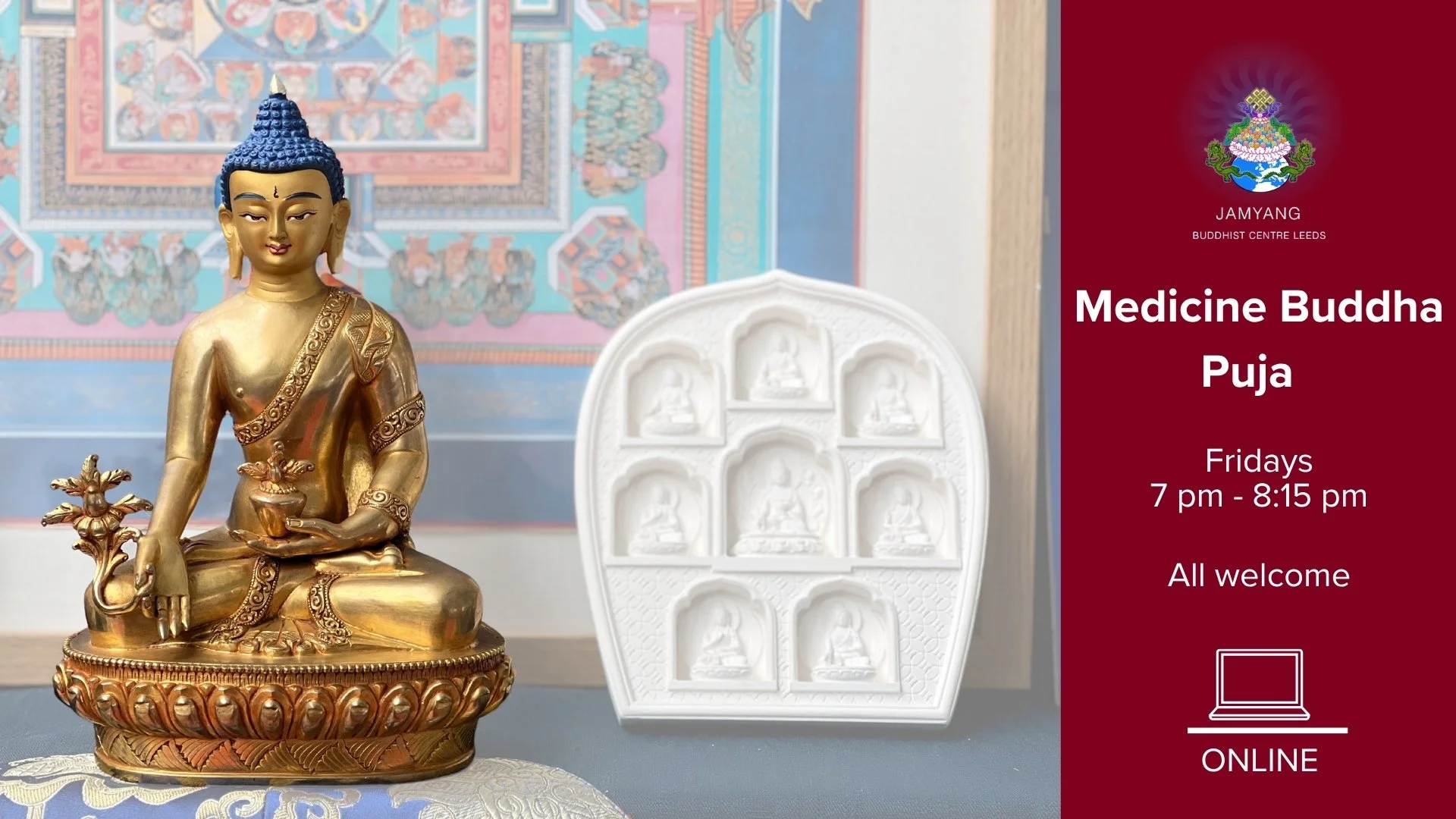
Medicine Buddha Puja
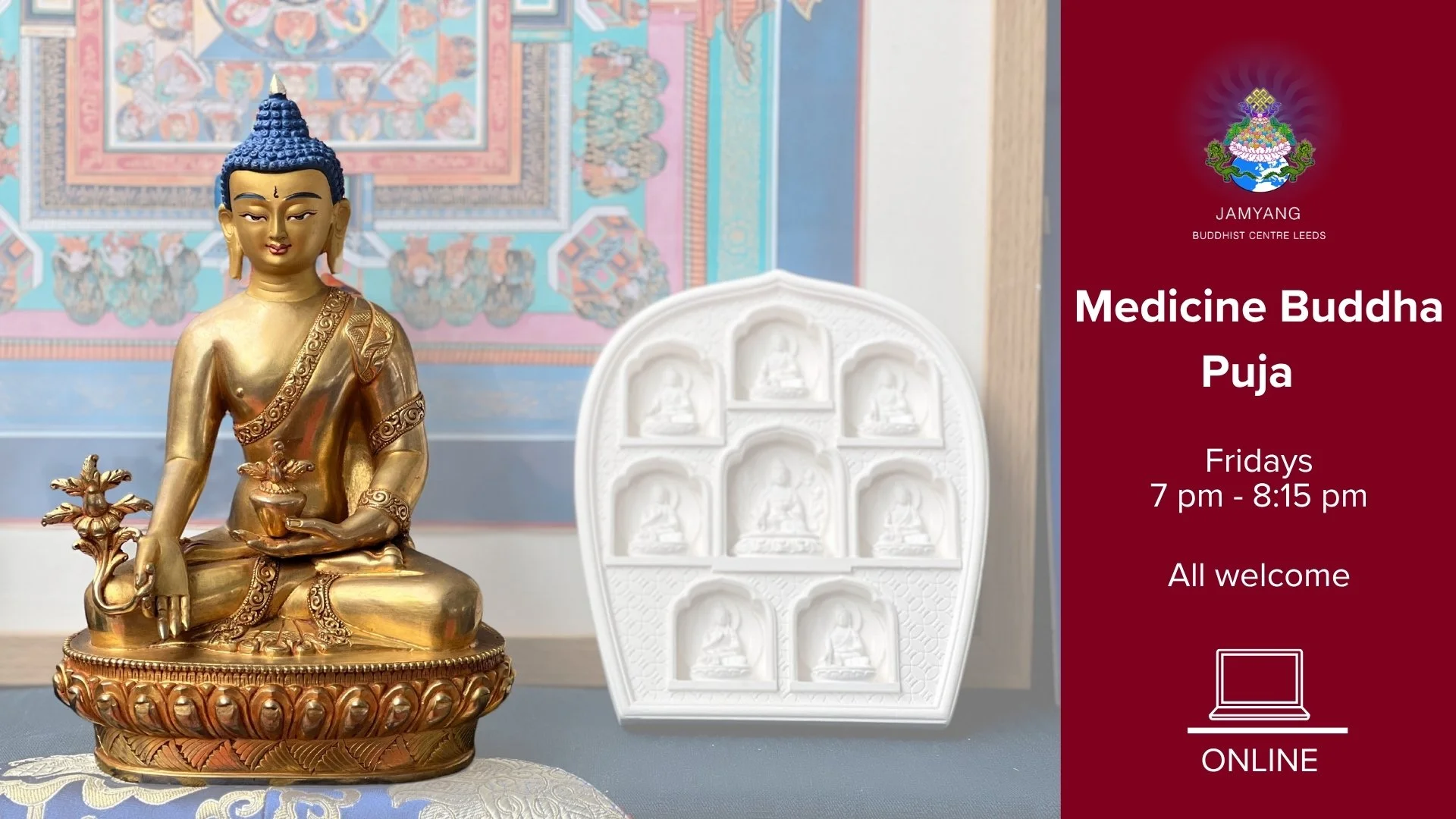
Overview of Medicine Buddha Puja
Medicine Buddha is one of the practices recommended by the FPMT for students to do for the swift return of Kyabje Lama Zopa Rinpoche.
DATE: FRIDAYS
TIME: 7 pm to 8:15 pm
LOCATION: Zoom
LEVEL: Buddhist Practices – All Welcome
SUGGESTED DONATION: £6
This is a longer meditation on Medicine Buddha – to remove obstacles, esp. those relating to health and achieving a favourable rebirth, and activate a swift path to enlightenment.
As Lama Zopa Rinpoche said: “One of the best healing meditations is that on the Medicine Buddha, who is the manifestation of the healing energy of all enlightened beings.”
The puja involves chanting prayers to the Seven Medicine Buddhas and reciting the Medicine Buddha mantras.
It is kindly led by Sande
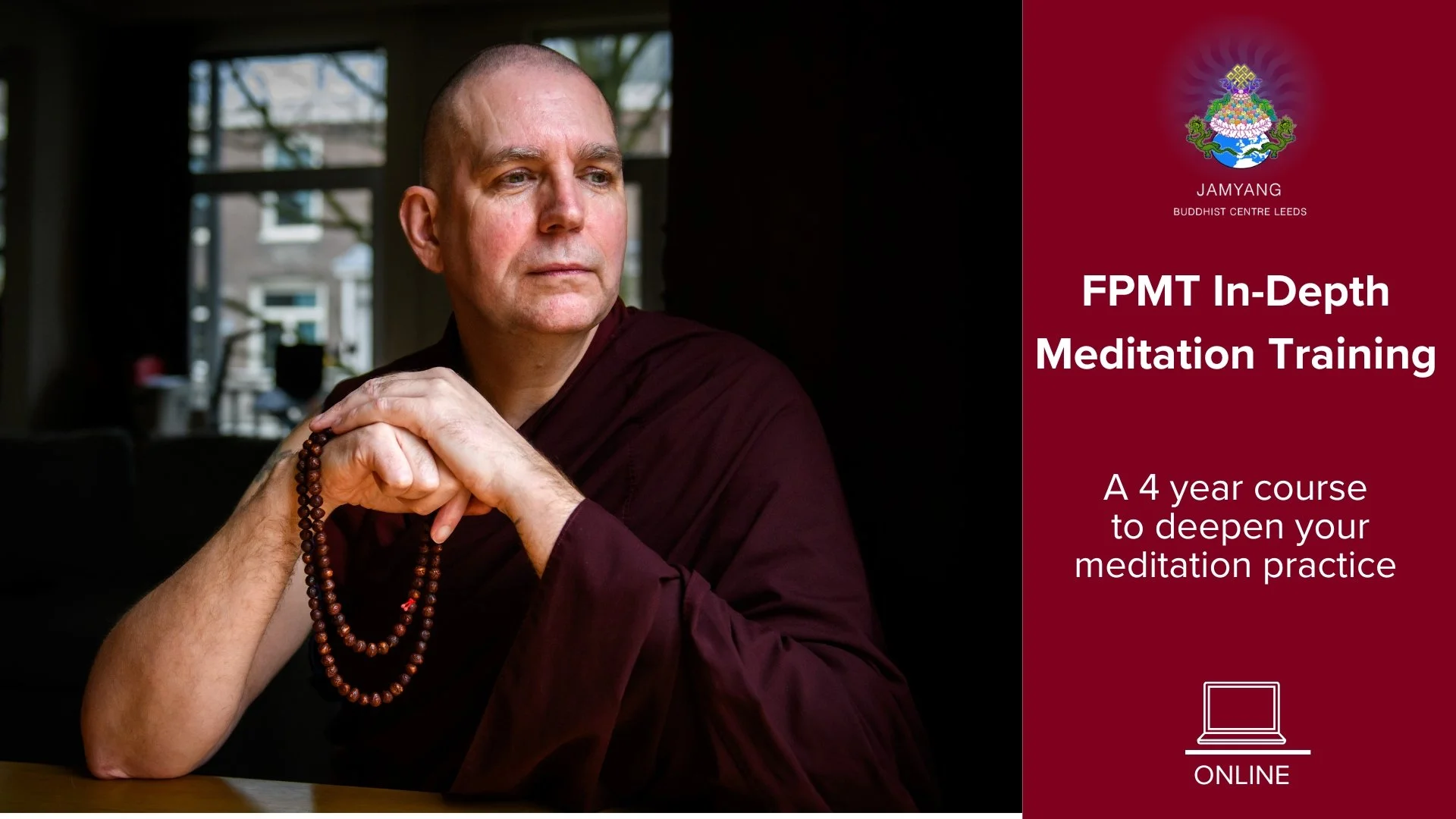
FPMT In-Depth Meditation Training
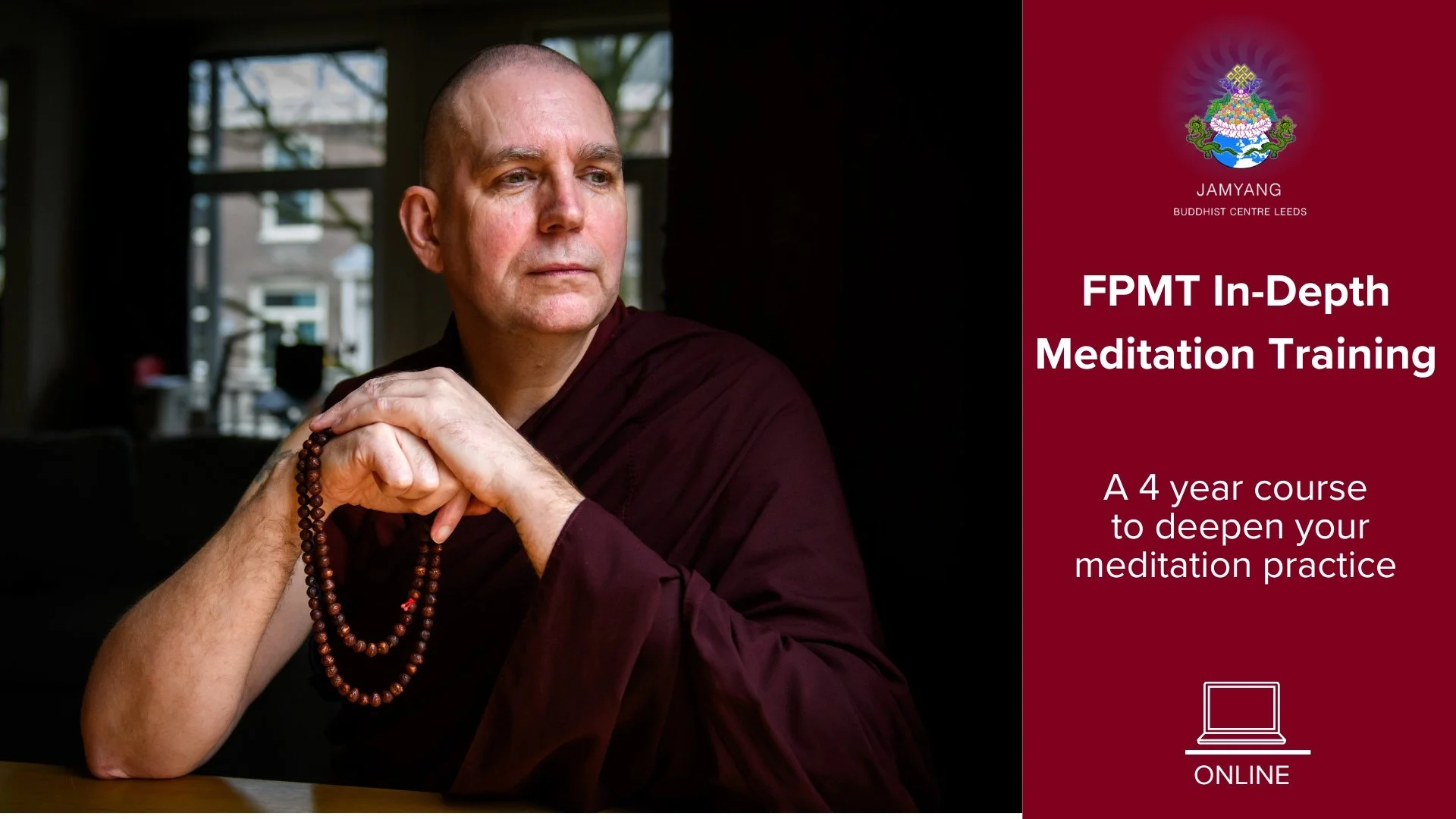
Overview of SESSION
DATE: 2026 / 2027: Year 4
Term 1: September 5th to November 28th 2026
If you are starting as a new student in year 4, don’t worry. You will get some preparatory advice on what previous recordings to have a listen to. Alternatively you may wish to join the new Ngondro Lamrim Meditation course for 2 years before starting In Depth Meditation Training. They are designed to be complementary.
TIME: Saturdays weekly 2:30pm – 5pm UK time
LOCATION: Zoom only
LEVEL: Buddhist Meditation – Intermediate to Advanced
IDMT Year Four: The Vajra Ground: Mahamudra and Kriya Tantra
In this culminating fourth year of our journey, our path turns inward to the mind itself—its empty, luminous nature—and outward to the transformative methods of tantra, where the naturally pure nature of our perception is recognized as the very ground of awakening.
As always, the year will start with generating the mind of awakening, using evocative instructions ranging from Langri Thangpa to Nāgārjuna and Lord Buddha in the famous Bodhisattvapiṭaka. This mind generation we'll cultivate through the four immeasurable thoughts and the support of calm abiding.
Illuminated by the life stories of the masters of the Gelug Mahāmudrā lineage and beyond, we'll explore its roots in the history of the early Indian Mahāsiddhas, such as Saraha and Tilopa, through the Kagyü master Gampopa's and Je Tsongkhapa's Mañjuśrī lineage up to Paṇchen Losang Chökyi Gyaltsen's Highway of the Conquerors and its perspective on this practice. In Sūtra Mahāmudrā we will practice resting attention in the empty nature of awareness, recognizing its clarity and openness as inseparable.
Kriyā Tantra offers a complementary method. Rather than suppress the ordinary, narrow self-narrative that we impose on ourselves and our world, it substitutes for it an extraordinary perspective of pure view. Occasionally, by way of introduction, we'll also taste practices from the higher tantras—glimpsing how afflictive emotions can be met as innate wisdom, and how the dissolution of the death process opens onto the innate mind of clear light. The structured practices of generation and recitation become a rehearsal for transformation, training perception to meet appearances as pure.
These methods rest on a relationship. We will therefore examine the practice of guru devotion candidly—both as the means by which the lineage's realization is transmitted and as a practice with real pitfalls, requiring discernment as much as trust. Through the Ganden Lha Gyāma, the Yoga of the inseparability of guru and Avalokiteśvara, and supporting sādhanas, devotion is approached not as deference but as the ethical road toward the state of Vajradhara: the full integration of wisdom and method.
This final year is an invitation to let realization ripen into a way of being. Grounded in bodhicitta and the four immeasurables, sustained by the preliminary practices, and held by the strength of community, we learn to meet the mind without grasping and to meet the world as pure appearance. Our aim is not to accumulate practices, but to bring the path to maturity—wisdom and compassion no longer cultivated separately, but lived as one.
This four-year online course provides students with long term, in-depth support in their meditative development.
The teacher and course developer is Venerable Losang Gendun. He has trained extensively in meditation in both Theravada and Mahayana Traditions
The In Depth Meditation Training course is also part of The Buddha Project led by Venerable Losang Gendun. You can find out more about Venerable Gendun, the course and who it is suitable for on our FPMT In-Depth Meditation Training webpage
If you have any questions you would like to ask before registering please email our In-Depth Meditation Coordinator Marie Odile on idmt@jamyangleeds.co.uk
The zoom link and all materials for the course are provided to registered students.
Donations:
Generosity is one of the cornerstones of the Buddhist path. With your donation we support The Buddha Project and we keep our centre going for the benefit of all sentient beings.
As the course is a collaboration with other FPMT centres it is not possible to offer this as part of our Jamyang Leeds membership programme.
The recommended donation per calendar month is £45.
If you are able to practice generosity and sponsor other students we recommend £58 per calendar month.
If you are on a reduced income it is £31 per calendar month.
There is also the option to donate annually.
If none of the above options are affordable please do still register, we never turn anyone away from the Dharma for financial reasons and we can agree a donation that is affordable for you right now. Please email Marie Odile our IDMT Coordinator idmt@jamyangleeds.co.uk if you would like to chat.
Vipassana Meditation
Overview of Vipassana Meditation
Join us for a peaceful start to your week with a 30 minute Vipassana meditation session, designed to cultivate mindfulness, self-awareness, and equanimity. Led by Geshe Rinchen
DATE: Mondays weekly (March to May and July to November)
TIME: 7:00 am to 7:30 am
Vipassana (Special Insight Meditation), also called analytical meditation, is primarily a practice of wisdom. It is a form of concentration that focuses single-pointedly on the ultimate nature of phenomena through analytical reasoning. Analysing phenomena is a key aspect of Vipassana practice, as it helps develop a definitive understanding of the nature of reality—such as the self, mind, emotions, and thoughts.
As Je Tsongkhapa explains, shamatha (calm abiding) is like a lamp that remains clear and steady in a place without wind, whereas vipassana (special insight) is like seeing the nature of phenomena clearly through such a steady and clear lamp. Therefore, the usual order of these two meditations is: first, achieving calm abiding or mental stability as a foundation, then engaging in special insight meditation through analysis. However, Vipassana meditation can also be practised by analysing and observing sensations, thoughts, and emotions without first achieving shamatha. This practice should still begin with focusing on the breath or another object of meditation. In our case, we will focus on the breath to start analysing the nature of the mind in relation to our sense of self, emotions, and thoughts.
The session begins by focusing on the breath—either the rise and fall of the abdomen or the sensation of air entering and leaving the nostrils. This practice calms the mind and helps establish a deep sense of presence.
Next, we move into a guided body scan, bringing awareness to different parts of the body and observing subtle sensations without judgement. This helps develop a greater connection to your physical experience.
As we proceed, you will practise observing and analysing sensations, thoughts, and emotions as they arise, learning to witness them without attachment or aversion. This fosters a deeper understanding of the impermanence and interconnectedness of the mind and self. Finally, you will rest your mind either in the natural state of awareness or in the analytical clarity gained through observation and reasoning.
Through regular practice, Vipassana meditation cultivates wisdom, encouraging a balanced and objective view of internal experiences. This session is ideal for those seeking greater insight and calmness in their daily lives.
Morning Prayers
Overview
Start the day by joining us for Morning Prayers recommended by Lama Zopa Rinpoche and HH Dalai Lama, for the benefit of all sentient beings and the swift return of Lama Zopa Rinpoche. Everyone is welcome.
DATE: Monday – Friday all year around
TIME: 8:30am - 9:00am
LOCATION: Zoom
LEVEL: Buddhist Practices – All Welcome
FPMT Ngondro Lamrim Training
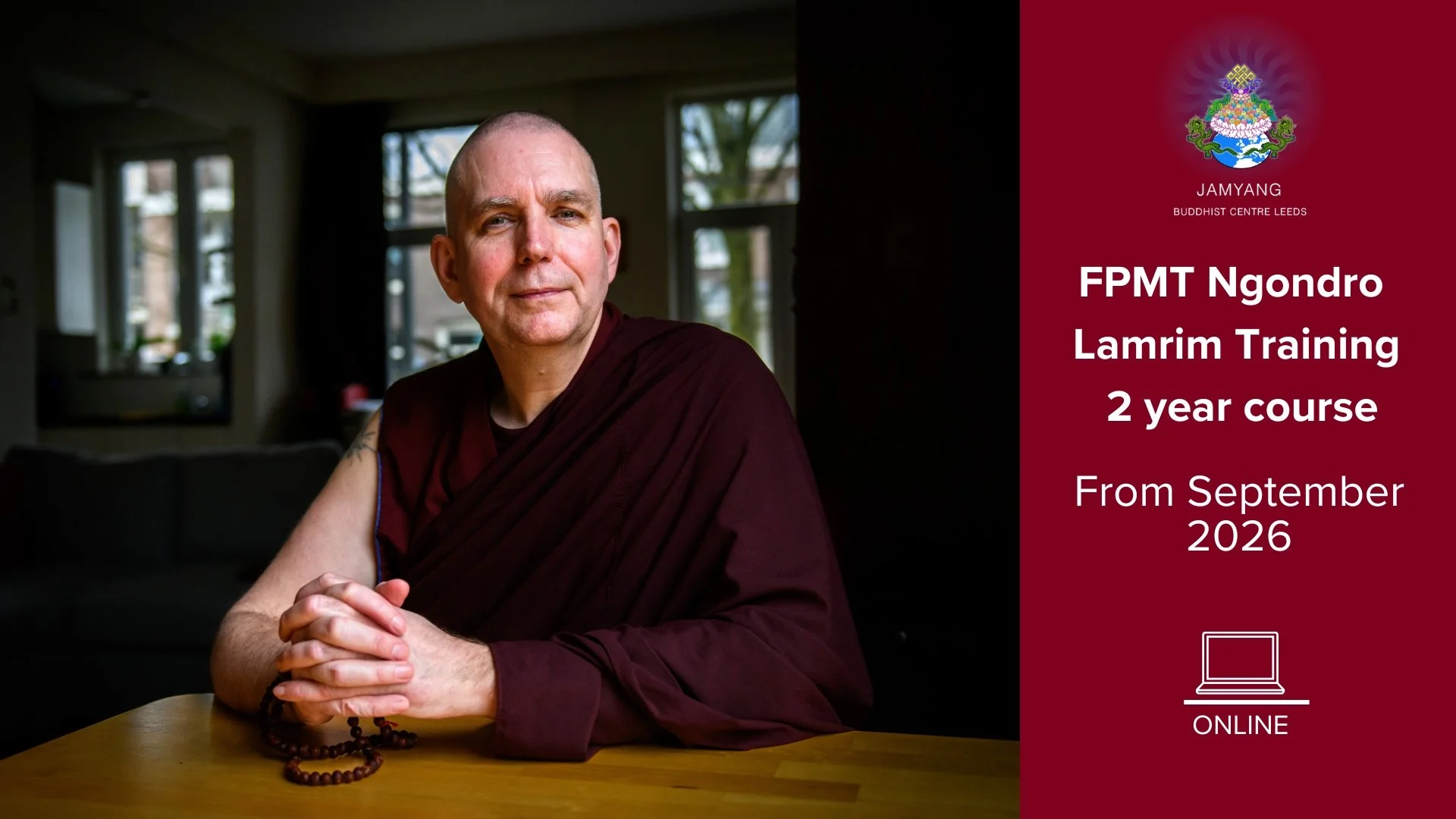
Overview of SESSION
DATE: 2026 / 2027: Year 1
Term 1: September 14th to November 28th 2026
Over a period of two years, the FPMT Ngöndro Lamrim Training (NLRT) offers 16 months of training in the common and uncommon preliminary practices. The training is designed to generate the motivation that supports the development of calm abiding, special insight, and tantra. By cultivating the inner qualities needed to ease unskillful patterns of mind that are the cause of hindrances on the path, it facilitates deep transformation.
An excellent preparation for the FPMT In-Depth Meditation Training (IDMT)
LOCATION: Recordings are released weekly
LEVEL: Buddhist Preliminary Practices
About the Course:
The Lamrim — "Stages of the Path" in Tibetan — is a systematic presentation of the entire Buddhist path to Awakening, written by the great Tibetan master Je Tsongkhapa in the 14th and early 15th century, based on writings of the Indian master Atisha. It arranges every essential teaching of the Buddha into a single, coherent, graduated sequence tailored to your mind, exactly as it is right now. Its true power lies not in study alone, but in practice. Each teaching is carefully arranged to meet the mind where it is and guide it—step by step—toward genuine change.
The uncommon preliminary practices (ngöndro) are powerful methods to purify the mind and prepare it for lasting transformation.
Over the first eleven months the common foundations, renunciation, bodhicitta, and the view of emptiness, are explored based on the Lamrim. For the remaining five months the focus is on the uncommon practices, Vajrasattva purification, mandala offerings, and guru yoga. Weekly sessions each introduce a new topic that examines different ways to meditate and why, in combination with a guided meditation.
The training helps establish a consistent daily meditative practice in supports of its overall aim: to engage in contemplative meditation in a way that genuinely transforms the mind's outlook on the world and gives one's life a new direction. Students gain a deep understanding of how to accumulate merit and purify unskillful karma while cultivating a healthy relationship with the Three Jewels and their teacher. The emphasis is on learning to meditate in a personally tailored way, in accordance with one’s psychological makeup and life conditions.
The Ngondro Lamrim Training teaching sessions are pre-recorded.
Each week, a 90-minute teaching together with two guided meditations are uploaded. On other days, advanced students contribute additional guided meditations. The teacher, Venerable Gendun, offers regular online Q&A sessions. For those who have already studied the Lamrim or the FPMT Basic Program, the training also offers specialized opportunities to learn how to guide others in meditation.
Year 1: Definite Emergence and Mind of Awakening
Prepare the mind for śamatha, vipaśyanā, and tantra
Explore renunciation and bodhicitta, the first two Principles of the Path
Develop genuine urgency through Lamrim contemplation
Cultivate the aspiration to Awakening for all beings
FPMT Ngondro Lamrim Taining is also part of The Buddha Project led by Venerable Losang Gendun. You can find out more about Venerable Gendun, the course and who it is suitable for on our FPMT Ngondro Lamrim Training webpage
If you have any questions you would like to ask before registering please email our In-Depth Meditation Coordinator Marie Odile on idmt@jamyangleeds.co.uk
All materials for the course are provided to registered students.
Donations:
Generosity is one of the cornerstones of the Buddhist path. Donations help support both the centre and The Buddha Project as well as providing a donation for the teachings to Venerable Gendun. There are different levels depending on your income. There are three terms a year, each approximately 3 months long
As the course is a collaboration with other FPMT centres it is not possible to offer this as part of our Jamyang Leeds membership programme.
For those with a regular income the recommended donation is £95 per term
The sponsorhsip level is £115 per term
Ordained Sangha are free
If this isn’t affordable please do register, we never turn anyone away from the Dharma for financial reasons and we can agree a donation that is affordable for you at the current time. Please email Marie-Odile our IDMT Coordinator idmt@jamyangleeds.co.uk if you would like to chat.
Yamantaka Practice Group
Overview of SESSION
This is a restricted practice, for those who have received the empowerment to practice Solitary Hero Vajrabhairava/Yamantaka.
If you have an interest in joining the group please email yamantakagroup@gmail.com to register.
The Yamantaka practice is held on the Mondays weekly. Please note that some weeks it starts at 2:30pm and some at 6pm it doesn’t always alternate weekly.
Tonglen Loving Kindness meditation Practice
Overview of Tonglen Meditation
The Buddhist practice of Giving & Taking (Tonglen in Tibetan) is at its heart a selfless meditation of loving kindness and compassion.
DATE: Tuesdays
TIME: 7am-7:30am
LOCATION: Zoom
LEVEL: Buddhist Meditation – All Welcome
SUGGESTED DONATION: £4
A beautiful practice led by Chrissie and Di.
The Buddhist practice of Giving & Taking (Tonglen in Tibetan) is at its heart a selfless meditation of loving kindness and compassion. You imagine giving all your happiness to others, sometimes using visualisation with the breath, and then taking all the suffering and its causes from others. It’s a powerful practice for the brave-hearted!
Kshitigarbha Practice
Overview of Kshitigarbha practice
DATE: Tuesdays & Thursdays
TIME: 12pm-12:30pm
LOCATION: Zoom only
LEVEL: Buddhist Practices – All Welcome
SUGGESTED DONATION: £4
Lama Zopa Rinpoche (our organisation’s Spiritual Director) suggested Jamyang Leeds perform these practices to help with the financial obstacles we are currently having. From September 2022, we’ll be reciting this practice as much as we can. See the special newsletter explaining all about the practice here.
Vajrasattva Practice
Overview of The Vajrasattva Practice
DATE: Tuesdays
TIME: 8:00pm-8:30pm
LOCATION: Zoom
LEVEL: Buddhist Practices – All Welcome
SUGGESTED DONATION: £4
Purification here means looking at our past unskillful actions which have created seeds of negative karma in our minds, and using visualisation and mantra recitation to remove those seeds in a healthy and productive way. Vajrasattva is the embodiment of all the Buddha’s cleaning and purifying energy. We all make mistakes, and how we deal with them is key to making spiritual progress. We’ll be using a short text composed by Lama Zopa Rinpoche
the eight verses of thoughts transformation
Overview of the eight verses of thoughts transformation
Everflowing Nectar of Bodhichitta – Annihilating the Demon of the Self-Cherishing Mind
DATE: Wednesdays
TIME: 7am-7:30am
LOCATION: Zoom
LEVEL: Buddhist Practices- All Welcome
SUGGESTED DONATION: £4
Everflowing Nectar of Bodhichitta – Annihilating the Demon of the Self-Cherishing Mind
Led by Di or Sande
This practice is based on the short text” Eight Verses of Thought Transformation”, which contains the entire technique for transforming the mind into relative bodhichitta (i.e., the wish to achieve enlightenment for the benefit of all sentient beings) and absolute bodhichitta (i.e., the wisdom realizing emptiness).
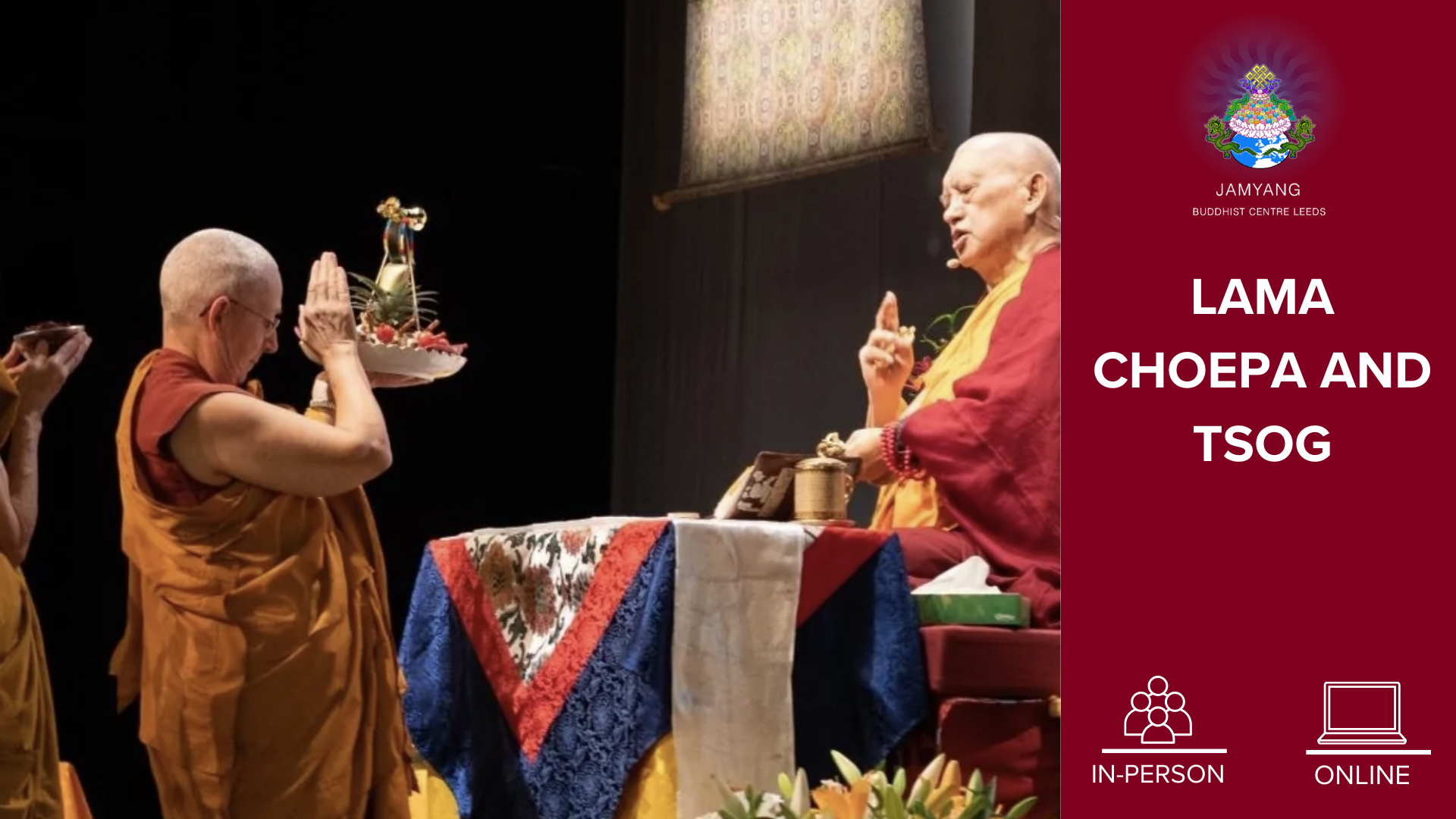
Lama Choepa (Guru Puja) and Tsog
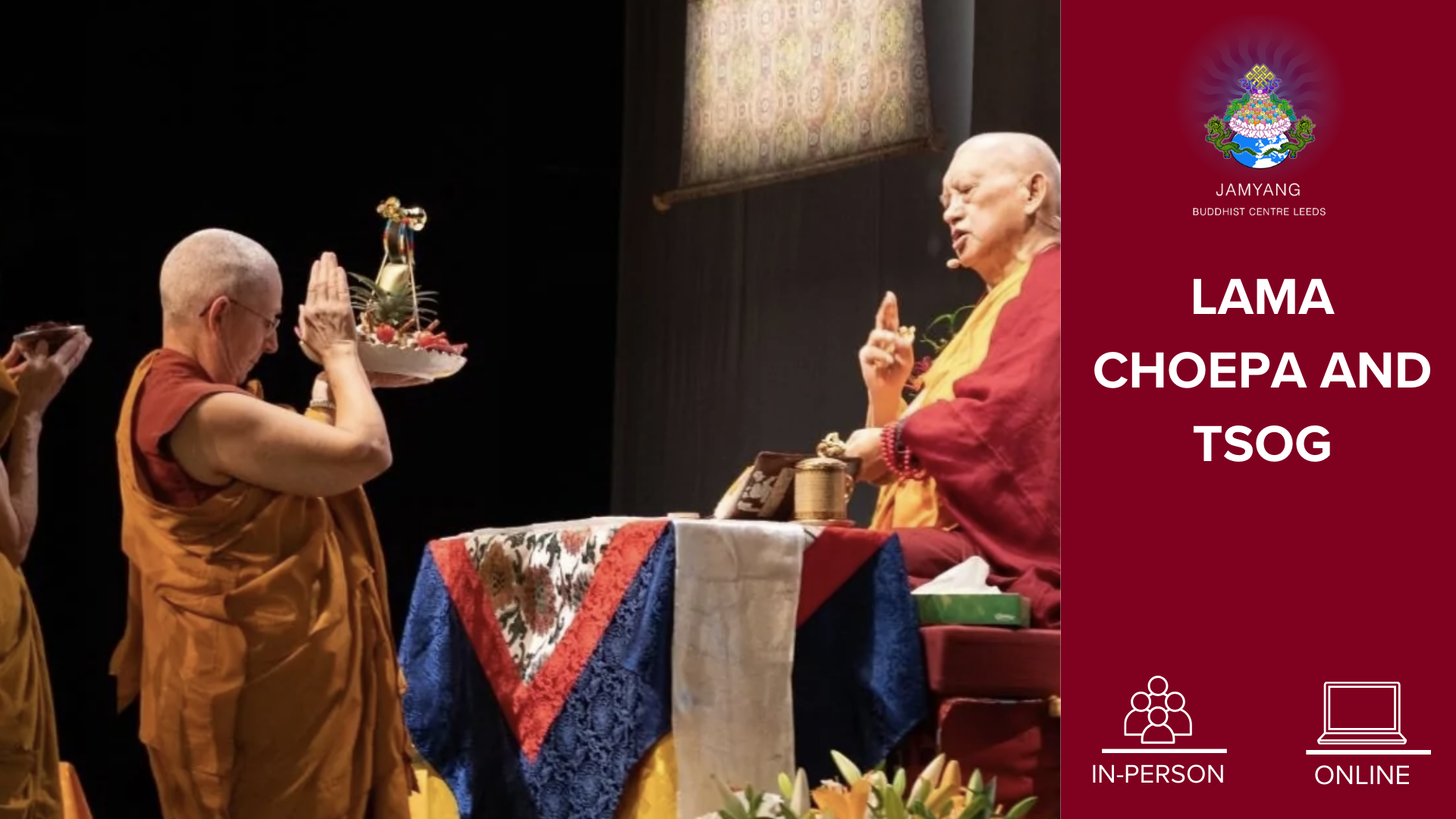
Overview of Session
DATES: 2026: 13th January; 11th February; 13th March; 26th April; 12th May; 10th June; 24th July; 8th August; 21st September; 5th October; 4th November; 3rd December
TIME: 60 - 90 minute sessions, start time varies
LOCATION: In Person and Online
LEVEL: Buddhist Ceremonies – All Welcome
Dedicated to the Swift return of Lama Zopa Rinpoche as a bright, unmistaken child.
During the practice of Lama Choepa, we invoke all the lamas of the graduated path lineage, beginning with Shakyamuni Buddha himself, extending to our present direct teachers who have shown us the path. We pay homage to them, make offerings, and request each of them to please bless our minds with the same realizations that they themselves have generated. By offering sincere, heartfelt requests, we make our minds ripe to receive the full blessings of this precious lineage and quickly actualize the realizations we need to attain enlightenment. If we wish to experience realisations quickly, the practice of Lama Choepa is indispensable.
“If you are able to do the practice of Guru Puja in your daily life, it contains all the important points of sutra and tantra. It is a complete practice, and it shows the heart of the instruction of Lama Tsongkhapa’s tradition. Even if one can’t do much else in daily life, Guru Puja is the essential practice.”
Open to all Buddhists, no empowerments needed.
Please arrive early and bring flowers, incense, vegetarian food and drink as offerings for the altar.
More information can also be found on this FPMT page.
Chanting the Verses of Noble manjushri
Overview of Session
DATE: Thursdays
TIME: 7:45am to 8:25 am
LOCATION: Zoom only
LEVEL: Buddhist Practices – suitable for Lama Zopa Rinpoche’s students
Join us to fulfill His Holiness the Dalai Lama’s wishes and chant the Names of Noble Manjushri for the swift return of Lama Zopa Rinpoche.
Please come along even if you havent done the practice before, its quite wonderful and very energising. Please download the text below, you can also listen and practice with the audio clip of Lama Zopa Rinpoche reciting the Chanting the Names of Noble Manjushri.
Kshitigarbha Practice
Overview of Kshitigarbha practice
DATE: Tuesdays & Thursdays
TIME: 12pm-12:30pm
LOCATION: Zoom only
LEVEL: Buddhist Practices – All Welcome
SUGGESTED DONATION: £4
Lama Zopa Rinpoche (our organisation’s Spiritual Director) suggested Jamyang Leeds perform these practices to help with the financial obstacles we are currently having. From September 2022, we’ll be reciting this practice as much as we can. See the special newsletter explaining all about the practice here.
Kalachakra Practice group
Overview of practice
This is a restricted group for those who have received the Kalachakra empowerment from a qualified Lama. To join the group you need to have either received the full Kalachakra empowerment or another High Yoga Tantra empowerment such as Heruka, as long as you have received a Kalachakra Jenang (permission).
This international group of Kalachakra practitioners meets weekly and alternates with commentary and practice.
Mind Mandala once a month and six session guru yoga for other sessions:
If you’re already part of this group, please use the details sent in the weekly email to join the practice
If you’d like to join us, please email spc@jamyangleeds.co.uk confirming that you have the appropriate empowerments. You will then be sent a registration form to complete.
Shamatha – Meditation on the Breath
Overview of Session
DATE: Fridays
TIME: 7am-7:30am
LOCATION: Zoom
LEVEL: All Welcome
SUGGESTED DONATION: £4
Led by Ruth
Mindfulness of Breathing is universally acknowledged to be of benefit to all living in the modern world. Many feel overloaded with all that is expected of us living this complex and exhausting existence. Developing our awareness in this way is a general prescription for soothing and healing the overworked body and mind.
Practicing focusing the attention on an object such as the breath is also a core practice in Tibetan Buddhism. Gradually over time we are able to hold the object of our attention over longer periods, which enables us to practice other meditations such as Vipassana more successfully.
White Umbrella Deity practice
Overview of practice
DATE: Fridays
TIME: 11:30 am to 12:00 pm
LOCATION: Please note this is online only
LEVEL: Buddhist Practices – see note below
SUGGESTED DONATION: £4
In September 2024, His Eminence Ling Rinpoche gave us this practice to overcome obstacles to the centre flourishing.
In addition to many benefits of engaging in these practices, Lama Zopa Rinpoche recommended that these two practices are beneficial to helping bring peace to situation between Israel and Palestine.
The Sanskrit name for the White Umbrella deity is Ushnisha Sitatapatra which can also be translated as “The Victorious White Parasol.” The White Umbrella Deity, [Skt. Sitatapatra, Tib. gdugs dkar] is a powerful female deity. She is relied upon for protection; healing illness; dispelling interferences, spirit possession, and harmful forces; quelling disasters; averting obstacles; and bringing auspiciousness.
Ushnisha Sitatapatra is a female form of Avalokiteshvara, the Bodhisattva of Compassion. Like this Bodhisattva in an elaborate form, she also has a thousand eyes that watch over living beings, and a thousand arms that protect and assist them. Thus she symbolizes the power of active compassion.
Practices of Arya Sitatapatra includes, “The Supreme Accomplishment of Sitatapatra,” and “Praises and Repelling Practices of Sitatapatra.”
Medicine Buddha Puja
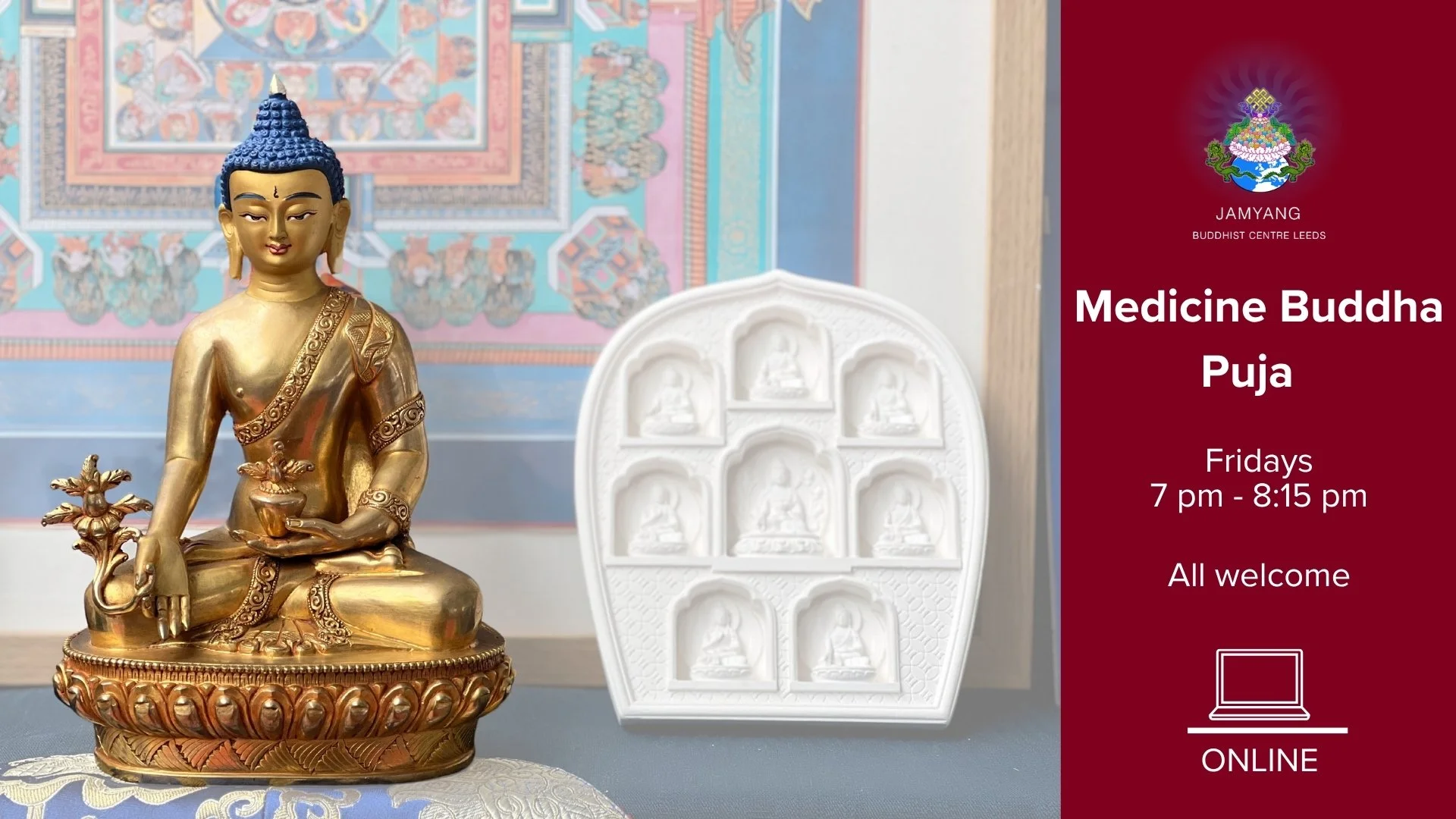
Overview of Medicine Buddha Puja
Medicine Buddha is one of the practices recommended by the FPMT for students to do for the swift return of Kyabje Lama Zopa Rinpoche.
DATE: FRIDAYS
TIME: 7 pm to 8:15 pm
LOCATION: Zoom
LEVEL: Buddhist Practices – All Welcome
SUGGESTED DONATION: £6
This is a longer meditation on Medicine Buddha – to remove obstacles, esp. those relating to health and achieving a favourable rebirth, and activate a swift path to enlightenment.
As Lama Zopa Rinpoche said: “One of the best healing meditations is that on the Medicine Buddha, who is the manifestation of the healing energy of all enlightened beings.”
The puja involves chanting prayers to the Seven Medicine Buddhas and reciting the Medicine Buddha mantras.
It is kindly led by Sande
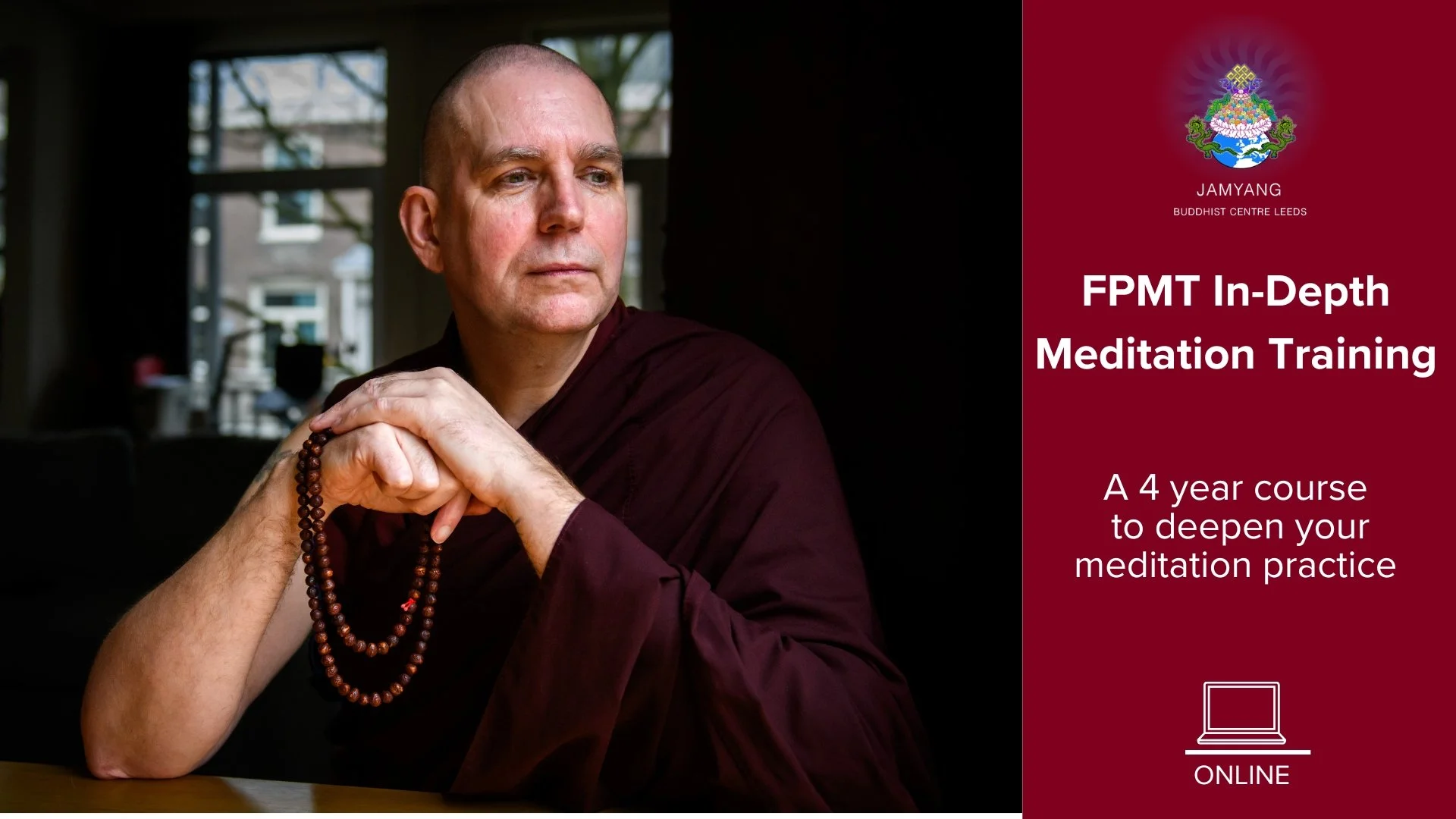
FPMT In-Depth Meditation Training
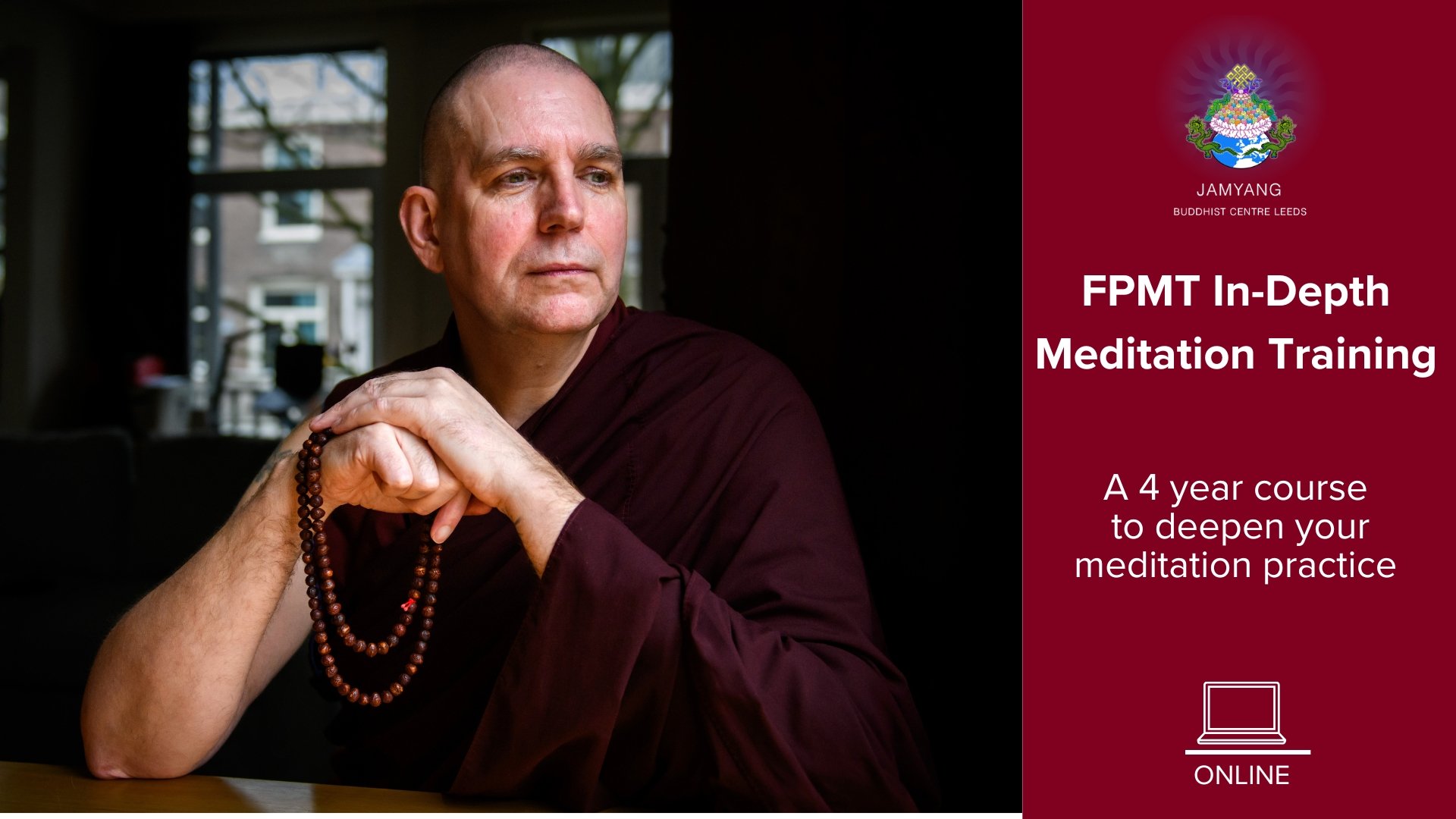
Overview of SESSION
DATE: 2026 / 2027: Year 4
Term 1: September 5th to November 28th 2026
If you are starting as a new student in year 4, don’t worry. You will get some preparatory advice on what previous recordings to have a listen to. Alternatively you may wish to join the new Ngondro Lamrim Meditation course for 2 years before starting In Depth Meditation Training. They are designed to be complementary.
TIME: Saturdays weekly 2:30pm – 5pm UK time
LOCATION: Zoom only
LEVEL: Buddhist Meditation – Intermediate to Advanced
IDMT Year Four, The Vajra Ground: Mahamudra and Kriya Tantra
In this culminating fourth year of our journey, our path turns inward to the mind itself—its empty, luminous nature—and outward to the transformative methods of tantra, where the naturally pure nature of our perception is recognized as the very ground of awakening.
As always, the year will start with generating the mind of awakening, using evocative instructions ranging from Langri Thangpa to Nāgārjuna and Lord Buddha in the famous Bodhisattvapiṭaka. This mind generation we'll cultivate through the four immeasurable thoughts and the support of calm abiding.
Illuminated by the life stories of the masters of the Gelug Mahāmudrā lineage and beyond, we'll explore its roots in the history of the early Indian Mahāsiddhas, such as Saraha and Tilopa, through the Kagyü master Gampopa's and Je Tsongkhapa's Mañjuśrī lineage up to Paṇchen Losang Chökyi Gyaltsen's Highway of the Conquerors and its perspective on this practice. In Sūtra Mahāmudrā we will practice resting attention in the empty nature of awareness, recognizing its clarity and openness as inseparable.
Kriyā Tantra offers a complementary method. Rather than suppress the ordinary, narrow self-narrative that we impose on ourselves and our world, it substitutes for it an extraordinary perspective of pure view. Occasionally, by way of introduction, we'll also taste practices from the higher tantras—glimpsing how afflictive emotions can be met as innate wisdom, and how the dissolution of the death process opens onto the innate mind of clear light. The structured practices of generation and recitation become a rehearsal for transformation, training perception to meet appearances as pure.
These methods rest on a relationship. We will therefore examine the practice of guru devotion candidly—both as the means by which the lineage's realization is transmitted and as a practice with real pitfalls, requiring discernment as much as trust. Through the Ganden Lha Gyāma, the Yoga of the inseparability of guru and Avalokiteśvara, and supporting sādhanas, devotion is approached not as deference but as the ethical road toward the state of Vajradhara: the full integration of wisdom and method.
This final year is an invitation to let realization ripen into a way of being. Grounded in bodhicitta and the four immeasurables, sustained by the preliminary practices, and held by the strength of community, we learn to meet the mind without grasping and to meet the world as pure appearance. Our aim is not to accumulate practices, but to bring the path to maturity—wisdom and compassion no longer cultivated separately, but lived as one.
This four-year online course provides students with long term, in-depth support in their meditative development.
The teacher and course developer is Venerable Losang Gendun. He has trained extensively in meditation in both Theravada and Mahayana Traditions
The In Depth Meditation Training course is also part of The Buddha Project led by Venerable Losang Gendun. You can find out more about Venerable Gendun, the course and who it is suitable for on our FPMT In-Depth Meditation Training webpage
If you have any questions you would like to ask before registering please email our In-Depth Meditation Coordinator Marie Odile on idmt@jamyangleeds.co.uk
The zoom link and all materials for the course are provided to registered students.
Donations:
Generosity is one of the cornerstones of the Buddhist path. With your donation we support The Buddha Project and we keep our centre going for the benefit of all sentient beings.
As the course is a collaboration with other FPMT centres it is not possible to offer this as part of our Jamyang Leeds membership programme.
The recommended donation per calendar month is £45.
If you are able to practice generosity and sponsor other students we recommend £58 per calendar month.
If you are on a reduced income it is £31 per calendar month.
There is also the option to donate annually.
If none of the above options are affordable please do still register, we never turn anyone away from the Dharma for financial reasons and we can agree a donation that is affordable for you right now. Please email Marie Odile our IDMT Coordinator idmt@jamyangleeds.co.uk if you would like to chat.
Vipassana Meditation
Overview of Vipassana Meditation
Join us for a peaceful start to your week with a 30 minute Vipassana meditation session, designed to cultivate mindfulness, self-awareness, and equanimity. Led by Geshe Rinchen
DATE: Mondays weekly (March to May and July to November)
TIME: 7:00 am to 7:30 am
Vipassana (Special Insight Meditation), also called analytical meditation, is primarily a practice of wisdom. It is a form of concentration that focuses single-pointedly on the ultimate nature of phenomena through analytical reasoning. Analysing phenomena is a key aspect of Vipassana practice, as it helps develop a definitive understanding of the nature of reality—such as the self, mind, emotions, and thoughts.
As Je Tsongkhapa explains, shamatha (calm abiding) is like a lamp that remains clear and steady in a place without wind, whereas vipassana (special insight) is like seeing the nature of phenomena clearly through such a steady and clear lamp. Therefore, the usual order of these two meditations is: first, achieving calm abiding or mental stability as a foundation, then engaging in special insight meditation through analysis. However, Vipassana meditation can also be practised by analysing and observing sensations, thoughts, and emotions without first achieving shamatha. This practice should still begin with focusing on the breath or another object of meditation. In our case, we will focus on the breath to start analysing the nature of the mind in relation to our sense of self, emotions, and thoughts.
The session begins by focusing on the breath—either the rise and fall of the abdomen or the sensation of air entering and leaving the nostrils. This practice calms the mind and helps establish a deep sense of presence.
Next, we move into a guided body scan, bringing awareness to different parts of the body and observing subtle sensations without judgement. This helps develop a greater connection to your physical experience.
As we proceed, you will practise observing and analysing sensations, thoughts, and emotions as they arise, learning to witness them without attachment or aversion. This fosters a deeper understanding of the impermanence and interconnectedness of the mind and self. Finally, you will rest your mind either in the natural state of awareness or in the analytical clarity gained through observation and reasoning.
Through regular practice, Vipassana meditation cultivates wisdom, encouraging a balanced and objective view of internal experiences. This session is ideal for those seeking greater insight and calmness in their daily lives.
Morning Prayers
Overview
Start the day by joining us for Morning Prayers recommended by Lama Zopa Rinpoche and HH Dalai Lama, for the benefit of all sentient beings and the swift return of Lama Zopa Rinpoche. Everyone is welcome.
DATE: Monday – Friday all year around
TIME: 8:30am - 9:00am
LOCATION: Zoom
LEVEL: Buddhist Practices – All Welcome
FPMT Ngondro Lamrim Training
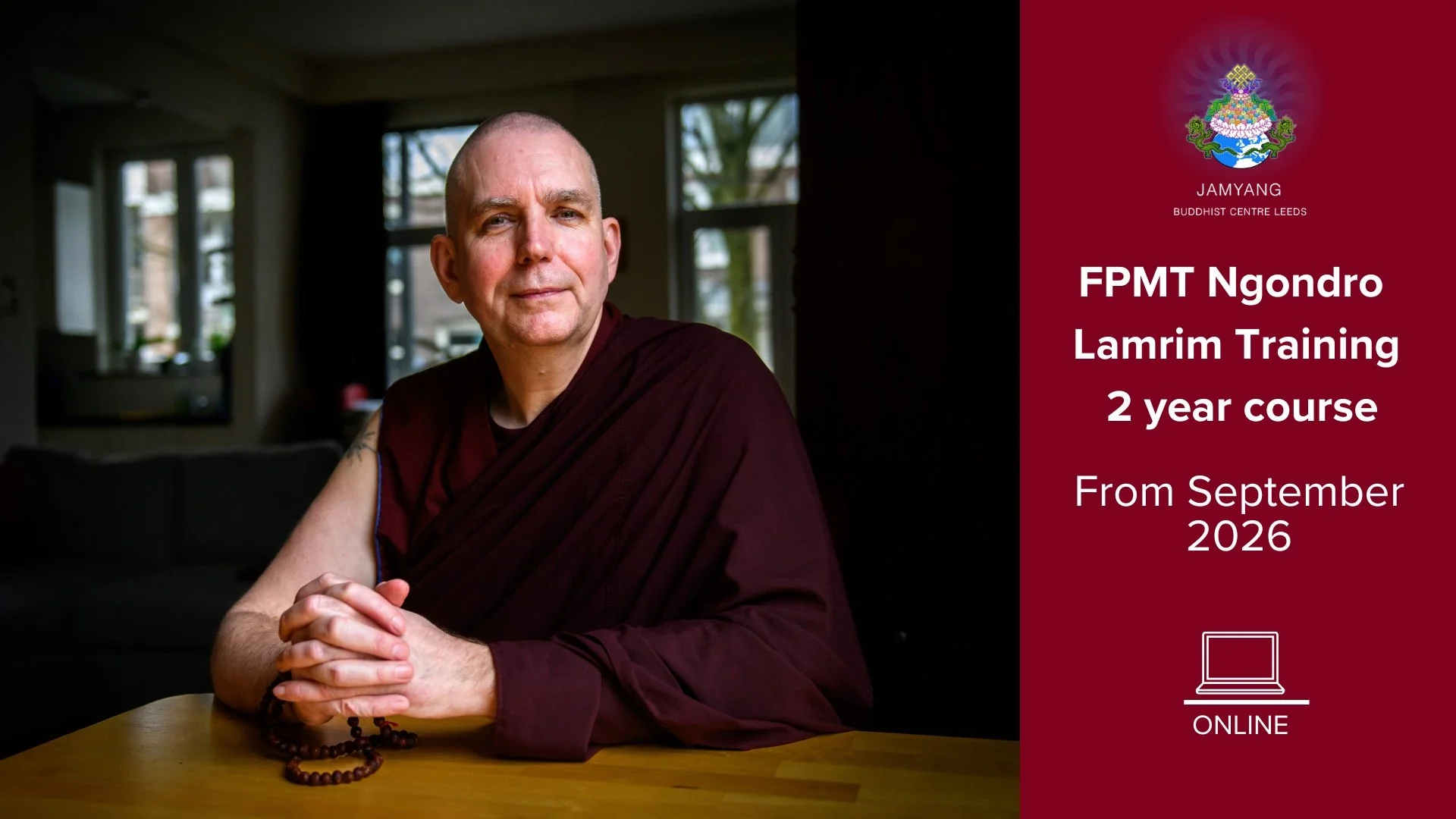
Overview of SESSION
DATE: 2026 / 2027: Year 1
Term 1: September 14th to November 28th 2026
Over a period of two years, the FPMT Ngöndro Lamrim Training (NLRT) offers 16 months of training in the common and uncommon preliminary practices. The training is designed to generate the motivation that supports the development of calm abiding, special insight, and tantra. By cultivating the inner qualities needed to ease unskillful patterns of mind that are the cause of hindrances on the path, it facilitates deep transformation.
An excellent preparation for the FPMT In-Depth Meditation Training (IDMT)
LOCATION: Recordings are released weekly
LEVEL: Buddhist Preliminary Practices
About the Course:
The Lamrim — "Stages of the Path" in Tibetan — is a systematic presentation of the entire Buddhist path to Awakening, written by the great Tibetan master Je Tsongkhapa in the 14th and early 15th century, based on writings of the Indian master Atisha. It arranges every essential teaching of the Buddha into a single, coherent, graduated sequence tailored to your mind, exactly as it is right now. Its true power lies not in study alone, but in practice. Each teaching is carefully arranged to meet the mind where it is and guide it—step by step—toward genuine change.
The uncommon preliminary practices (ngöndro) are powerful methods to purify the mind and prepare it for lasting transformation.
Over the first eleven months the common foundations, renunciation, bodhicitta, and the view of emptiness, are explored based on the Lamrim. For the remaining five months the focus is on the uncommon practices, Vajrasattva purification, mandala offerings, and guru yoga. Weekly sessions each introduce a new topic that examines different ways to meditate and why, in combination with a guided meditation.
The training helps establish a consistent daily meditative practice in supports of its overall aim: to engage in contemplative meditation in a way that genuinely transforms the mind's outlook on the world and gives one's life a new direction. Students gain a deep understanding of how to accumulate merit and purify unskillful karma while cultivating a healthy relationship with the Three Jewels and their teacher. The emphasis is on learning to meditate in a personally tailored way, in accordance with one’s psychological makeup and life conditions.
The Ngondro Lamrim Training teaching sessions are pre-recorded.
Each week, a 90-minute teaching together with two guided meditations are uploaded. On other days, advanced students contribute additional guided meditations. The teacher, Venerable Gendun, offers regular online Q&A sessions. For those who have already studied the Lamrim or the FPMT Basic Program, the training also offers specialized opportunities to learn how to guide others in meditation.
Year 1: Definite Emergence and Mind of Awakening
Prepare the mind for śamatha, vipaśyanā, and tantra
Explore renunciation and bodhicitta, the first two Principles of the Path
Develop genuine urgency through Lamrim contemplation
Cultivate the aspiration to Awakening for all beings
FPMT Ngondro Lamrim Taining is also part of The Buddha Project led by Venerable Losang Gendun. You can find out more about Venerable Gendun, the course and who it is suitable for on our FPMT Ngondro Lamrim Training webpage
If you have any questions you would like to ask before registering please email our In-Depth Meditation Coordinator Marie Odile on idmt@jamyangleeds.co.uk
All materials for the course are provided to registered students.
Donations:
Generosity is one of the cornerstones of the Buddhist path. Donations help support both the centre and The Buddha Project as well as providing a donation for the teachings to Venerable Gendun. There are different levels depending on your income. There are three terms a year, each approximately 3 months long
As the course is a collaboration with other FPMT centres it is not possible to offer this as part of our Jamyang Leeds membership programme.
For those with a regular income the recommended donation is £95 per term
The sponsorhsip level is £115 per term
Ordained Sangha are free
If this isn’t affordable please do register, we never turn anyone away from the Dharma for financial reasons and we can agree a donation that is affordable for you at the current time. Please email Marie-Odile our IDMT Coordinator idmt@jamyangleeds.co.uk if you would like to chat.
Yamantaka Practice Group
Overview of SESSION
This is a restricted practice, for those who have received the empowerment to practice Solitary Hero Vajrabhairava/Yamantaka.
If you have an interest in joining the group please email yamantakagroup@gmail.com to register.
The Yamantaka practice is held on the Mondays weekly. Please note that some weeks it starts at 2:30pm and some at 6pm it doesn’t always alternate weekly.
Yamantaka Study Group
Overview of SESSION
This study group is for those who have received the empowerment to practice Solitary Hero Vajrabhairava/Yamantaka.
If you have an interest in joining the study group please email yamantakagroup@gmail.com to register.
The Yamantaka study group is held on the first or second Monday monthly at 6pm.
Tonglen Loving Kindness meditation Practice
Overview of Tonglen Meditation
The Buddhist practice of Giving & Taking (Tonglen in Tibetan) is at its heart a selfless meditation of loving kindness and compassion.
DATE: Tuesdays
TIME: 7am-7:30am
LOCATION: Zoom
LEVEL: Buddhist Meditation – All Welcome
SUGGESTED DONATION: £4
A beautiful practice led by Chrissie and Di.
The Buddhist practice of Giving & Taking (Tonglen in Tibetan) is at its heart a selfless meditation of loving kindness and compassion. You imagine giving all your happiness to others, sometimes using visualisation with the breath, and then taking all the suffering and its causes from others. It’s a powerful practice for the brave-hearted!
Kshitigarbha Practice
Overview of Kshitigarbha practice
DATE: Tuesdays & Thursdays
TIME: 12pm-12:30pm
LOCATION: Zoom only
LEVEL: Buddhist Practices – All Welcome
SUGGESTED DONATION: £4
Lama Zopa Rinpoche (our organisation’s Spiritual Director) suggested Jamyang Leeds perform these practices to help with the financial obstacles we are currently having. From September 2022, we’ll be reciting this practice as much as we can. See the special newsletter explaining all about the practice here.
Vajrasattva Practice
Overview of The Vajrasattva Practice
DATE: Tuesdays
TIME: 8:00pm-8:30pm
LOCATION: Zoom
LEVEL: Buddhist Practices – All Welcome
SUGGESTED DONATION: £4
Purification here means looking at our past unskillful actions which have created seeds of negative karma in our minds, and using visualisation and mantra recitation to remove those seeds in a healthy and productive way. Vajrasattva is the embodiment of all the Buddha’s cleaning and purifying energy. We all make mistakes, and how we deal with them is key to making spiritual progress. We’ll be using a short text composed by Lama Zopa Rinpoche
the eight verses of thoughts transformation
Overview of the eight verses of thoughts transformation
Everflowing Nectar of Bodhichitta – Annihilating the Demon of the Self-Cherishing Mind
DATE: Wednesdays
TIME: 7am-7:30am
LOCATION: Zoom
LEVEL: Buddhist Practices- All Welcome
SUGGESTED DONATION: £4
Everflowing Nectar of Bodhichitta – Annihilating the Demon of the Self-Cherishing Mind
Led by Di or Sande
This practice is based on the short text” Eight Verses of Thought Transformation”, which contains the entire technique for transforming the mind into relative bodhichitta (i.e., the wish to achieve enlightenment for the benefit of all sentient beings) and absolute bodhichitta (i.e., the wisdom realizing emptiness).
Chanting the Verses of Noble manjushri
Overview of Session
DATE: Thursdays
TIME: 7:45am to 8:25 am
LOCATION: Zoom only
LEVEL: Buddhist Practices – suitable for Lama Zopa Rinpoche’s students
Join us to fulfill His Holiness the Dalai Lama’s wishes and chant the Names of Noble Manjushri for the swift return of Lama Zopa Rinpoche.
Please come along even if you havent done the practice before, its quite wonderful and very energising. Please download the text below, you can also listen and practice with the audio clip of Lama Zopa Rinpoche reciting the Chanting the Names of Noble Manjushri.
Kshitigarbha Practice
Overview of Kshitigarbha practice
DATE: Tuesdays & Thursdays
TIME: 12pm-12:30pm
LOCATION: Zoom only
LEVEL: Buddhist Practices – All Welcome
SUGGESTED DONATION: £4
Lama Zopa Rinpoche (our organisation’s Spiritual Director) suggested Jamyang Leeds perform these practices to help with the financial obstacles we are currently having. From September 2022, we’ll be reciting this practice as much as we can. See the special newsletter explaining all about the practice here.
Kalachakra Practice group
Overview of practice
This is a restricted group for those who have received the Kalachakra empowerment from a qualified Lama. To join the group you need to have either received the full Kalachakra empowerment or another High Yoga Tantra empowerment such as Heruka, as long as you have received a Kalachakra Jenang (permission).
This international group of Kalachakra practitioners meets weekly and alternates with commentary and practice.
Mind Mandala once a month and six session guru yoga for other sessions:
If you’re already part of this group, please use the details sent in the weekly email to join the practice
If you’d like to join us, please email spc@jamyangleeds.co.uk confirming that you have the appropriate empowerments. You will then be sent a registration form to complete.
Shamatha – Meditation on the Breath
Overview of Session
DATE: Fridays
TIME: 7am-7:30am
LOCATION: Zoom
LEVEL: All Welcome
SUGGESTED DONATION: £4
Led by Ruth
Mindfulness of Breathing is universally acknowledged to be of benefit to all living in the modern world. Many feel overloaded with all that is expected of us living this complex and exhausting existence. Developing our awareness in this way is a general prescription for soothing and healing the overworked body and mind.
Practicing focusing the attention on an object such as the breath is also a core practice in Tibetan Buddhism. Gradually over time we are able to hold the object of our attention over longer periods, which enables us to practice other meditations such as Vipassana more successfully.
White Dzambhala practice
Overview of practice
DATE: Fridays
TIME: 11 am to 11:30 am
LOCATION: Please note this is online only
LEVEL: Buddhist Practices – see note below
SUGGESTED DONATION: £4
Dzambhala practice is said to bring wealth, prosperity, success, good fortune and luck, long life and wisdom.
Please come and join in with this monthly practice to help the centre, the FPMT and Buddha Dharma to flourish and be free from obstacles.
To do this practice in full, it is best to have a Kriya tantra empowerment of Chenrezig. However, one may still do this practice without such an empowerment by simply skipping the
self-generation on page 3. The Torma Offering on page 15 requires empowerment
Dzambhala is an emanation of Ratnasambhava, one of the five buddha families, whose enlightened activity is increasing and whose essence is generosity. Some people practice Dzambhala to
achieve spiritual prosperity, although this deity is also associated with wealth and prosperity in the material world. Dzambhala practice is said to bring wealth, prosperity, success, good fortune
and luck, long life and wisdom. He is depicted holding a mongoose spouting jewels.
There are five different wealth Dzambhala, each has their own practice and mantra to help eliminate poverty and create financial stability.
Through the power of compassionate intention, visualization, and mantra recitation, as well as a wealth-stimulating ritual, this practice ripens and enhances our karma for an abundance of
resources. When done with single-pointed concentration and faith, this ritual easily increases one’s financial prosperity.
White Umbrella Deity practice
Overview of practice
DATE: Fridays
TIME: 11:30 am to 12:00 pm
LOCATION: Please note this is online only
LEVEL: Buddhist Practices – see note below
SUGGESTED DONATION: £4
In September 2024, His Eminence Ling Rinpoche gave us this practice to overcome obstacles to the centre flourishing.
In addition to many benefits of engaging in these practices, Lama Zopa Rinpoche recommended that these two practices are beneficial to helping bring peace to situation between Israel and Palestine.
The Sanskrit name for the White Umbrella deity is Ushnisha Sitatapatra which can also be translated as “The Victorious White Parasol.” The White Umbrella Deity, [Skt. Sitatapatra, Tib. gdugs dkar] is a powerful female deity. She is relied upon for protection; healing illness; dispelling interferences, spirit possession, and harmful forces; quelling disasters; averting obstacles; and bringing auspiciousness.
Ushnisha Sitatapatra is a female form of Avalokiteshvara, the Bodhisattva of Compassion. Like this Bodhisattva in an elaborate form, she also has a thousand eyes that watch over living beings, and a thousand arms that protect and assist them. Thus she symbolizes the power of active compassion.
Practices of Arya Sitatapatra includes, “The Supreme Accomplishment of Sitatapatra,” and “Praises and Repelling Practices of Sitatapatra.”
Medicine Buddha Puja
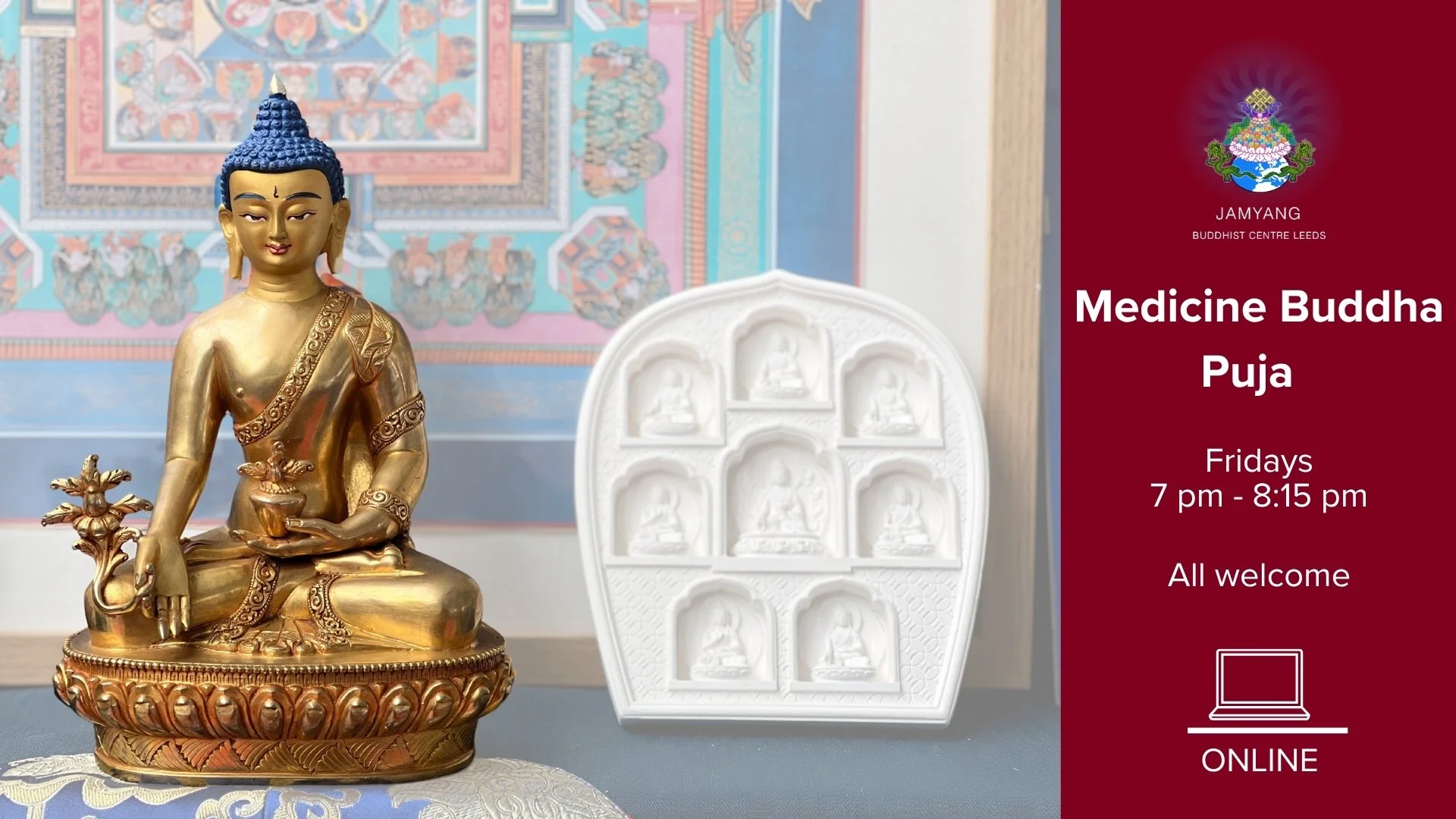
Overview of Medicine Buddha Puja
Medicine Buddha is one of the practices recommended by the FPMT for students to do for the swift return of Kyabje Lama Zopa Rinpoche.
DATE: FRIDAYS
TIME: 7 pm to 8:15 pm
LOCATION: Zoom
LEVEL: Buddhist Practices – All Welcome
SUGGESTED DONATION: £6
This is a longer meditation on Medicine Buddha – to remove obstacles, esp. those relating to health and achieving a favourable rebirth, and activate a swift path to enlightenment.
As Lama Zopa Rinpoche said: “One of the best healing meditations is that on the Medicine Buddha, who is the manifestation of the healing energy of all enlightened beings.”
The puja involves chanting prayers to the Seven Medicine Buddhas and reciting the Medicine Buddha mantras.
It is kindly led by Sande
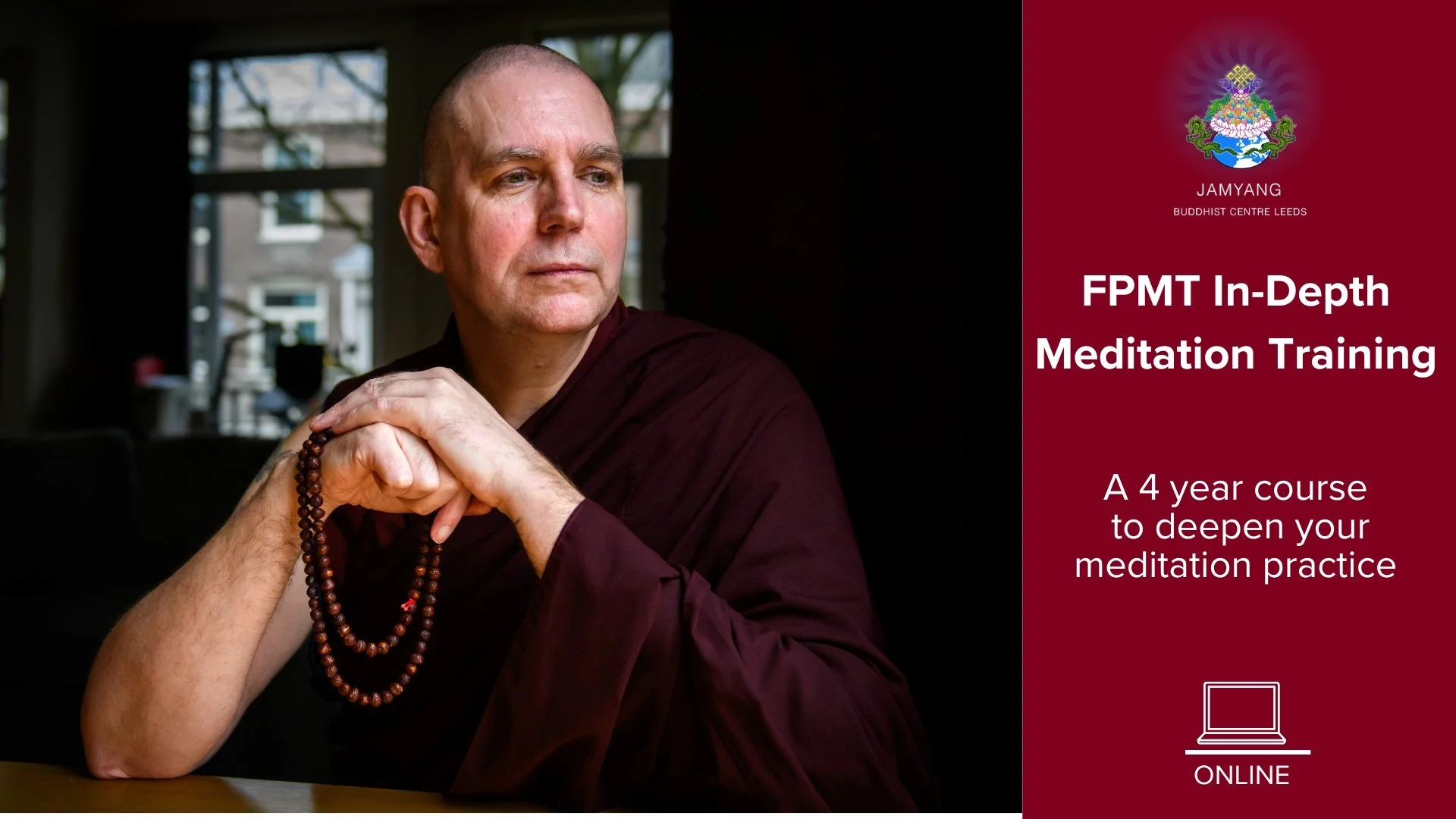
FPMT In-Depth Meditation Training
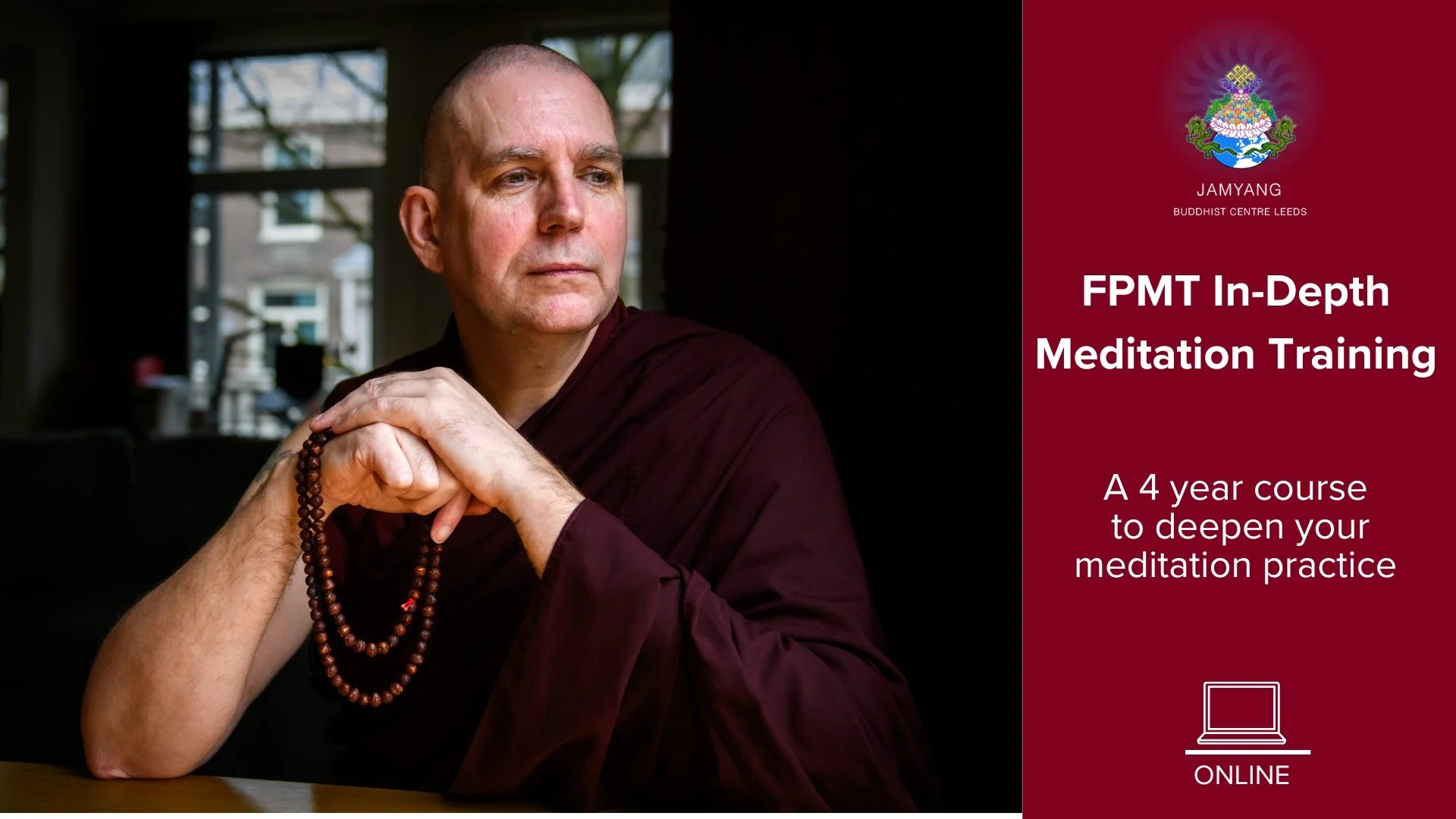
Overview of SESSION
DATE: 2026 / 2027: Year 4
Term 1: September 5th to November 28th 2026
If you are starting as a new student in year 4, don’t worry. You will get some preparatory advice on what previous recordings to have a listen to. Alternatively you may wish to join the new Ngondro Lamrim Meditation course for 2 years before starting In Depth Meditation Training. They are designed to be complementary.
TIME: Saturdays weekly 2:30pm – 5pm UK time
LOCATION: Zoom only
LEVEL: Buddhist Meditation – Intermediate to Advanced
IDMT Year Four, The Vajra Ground: Mahamudra and Kriya Tantra
In this culminating fourth year of our journey, our path turns inward to the mind itself—its empty, luminous nature—and outward to the transformative methods of tantra, where the naturally pure nature of our perception is recognized as the very ground of awakening.
As always, the year will start with generating the mind of awakening, using evocative instructions ranging from Langri Thangpa to Nāgārjuna and Lord Buddha in the famous Bodhisattvapiṭaka. This mind generation we'll cultivate through the four immeasurable thoughts and the support of calm abiding.
Illuminated by the life stories of the masters of the Gelug Mahāmudrā lineage and beyond, we'll explore its roots in the history of the early Indian Mahāsiddhas, such as Saraha and Tilopa, through the Kagyü master Gampopa's and Je Tsongkhapa's Mañjuśrī lineage up to Paṇchen Losang Chökyi Gyaltsen's Highway of the Conquerors and its perspective on this practice. In Sūtra Mahāmudrā we will practice resting attention in the empty nature of awareness, recognizing its clarity and openness as inseparable.
Kriyā Tantra offers a complementary method. Rather than suppress the ordinary, narrow self-narrative that we impose on ourselves and our world, it substitutes for it an extraordinary perspective of pure view. Occasionally, by way of introduction, we'll also taste practices from the higher tantras—glimpsing how afflictive emotions can be met as innate wisdom, and how the dissolution of the death process opens onto the innate mind of clear light. The structured practices of generation and recitation become a rehearsal for transformation, training perception to meet appearances as pure.
These methods rest on a relationship. We will therefore examine the practice of guru devotion candidly—both as the means by which the lineage's realization is transmitted and as a practice with real pitfalls, requiring discernment as much as trust. Through the Ganden Lha Gyāma, the Yoga of the inseparability of guru and Avalokiteśvara, and supporting sādhanas, devotion is approached not as deference but as the ethical road toward the state of Vajradhara: the full integration of wisdom and method.
This final year is an invitation to let realization ripen into a way of being. Grounded in bodhicitta and the four immeasurables, sustained by the preliminary practices, and held by the strength of community, we learn to meet the mind without grasping and to meet the world as pure appearance. Our aim is not to accumulate practices, but to bring the path to maturity—wisdom and compassion no longer cultivated separately, but lived as one.
This four-year online course provides students with long term, in-depth support in their meditative development.
The teacher and course developer is Venerable Losang Gendun. He has trained extensively in meditation in both Theravada and Mahayana Traditions
The In Depth Meditation Training course is also part of The Buddha Project led by Venerable Losang Gendun. You can find out more about Venerable Gendun, the course and who it is suitable for on our FPMT In-Depth Meditation Training webpage
If you have any questions you would like to ask before registering please email our In-Depth Meditation Coordinator Marie Odile on idmt@jamyangleeds.co.uk
The zoom link and all materials for the course are provided to registered students.
Donations:
Generosity is one of the cornerstones of the Buddhist path. With your donation we support The Buddha Project and we keep our centre going for the benefit of all sentient beings.
As the course is a collaboration with other FPMT centres it is not possible to offer this as part of our Jamyang Leeds membership programme.
The recommended donation per calendar month is £45.
If you are able to practice generosity and sponsor other students we recommend £58 per calendar month.
If you are on a reduced income it is £31 per calendar month.
There is also the option to donate annually.
If none of the above options are affordable please do still register, we never turn anyone away from the Dharma for financial reasons and we can agree a donation that is affordable for you right now. Please email Marie Odile our IDMT Coordinator idmt@jamyangleeds.co.uk if you would like to chat.
Vipassana Meditation
Overview of Vipassana Meditation
Join us for a peaceful start to your week with a 30 minute Vipassana meditation session, designed to cultivate mindfulness, self-awareness, and equanimity. Led by Geshe Rinchen
DATE: Mondays weekly (March to May and July to November)
TIME: 7:00 am to 7:30 am
Vipassana (Special Insight Meditation), also called analytical meditation, is primarily a practice of wisdom. It is a form of concentration that focuses single-pointedly on the ultimate nature of phenomena through analytical reasoning. Analysing phenomena is a key aspect of Vipassana practice, as it helps develop a definitive understanding of the nature of reality—such as the self, mind, emotions, and thoughts.
As Je Tsongkhapa explains, shamatha (calm abiding) is like a lamp that remains clear and steady in a place without wind, whereas vipassana (special insight) is like seeing the nature of phenomena clearly through such a steady and clear lamp. Therefore, the usual order of these two meditations is: first, achieving calm abiding or mental stability as a foundation, then engaging in special insight meditation through analysis. However, Vipassana meditation can also be practised by analysing and observing sensations, thoughts, and emotions without first achieving shamatha. This practice should still begin with focusing on the breath or another object of meditation. In our case, we will focus on the breath to start analysing the nature of the mind in relation to our sense of self, emotions, and thoughts.
The session begins by focusing on the breath—either the rise and fall of the abdomen or the sensation of air entering and leaving the nostrils. This practice calms the mind and helps establish a deep sense of presence.
Next, we move into a guided body scan, bringing awareness to different parts of the body and observing subtle sensations without judgement. This helps develop a greater connection to your physical experience.
As we proceed, you will practise observing and analysing sensations, thoughts, and emotions as they arise, learning to witness them without attachment or aversion. This fosters a deeper understanding of the impermanence and interconnectedness of the mind and self. Finally, you will rest your mind either in the natural state of awareness or in the analytical clarity gained through observation and reasoning.
Through regular practice, Vipassana meditation cultivates wisdom, encouraging a balanced and objective view of internal experiences. This session is ideal for those seeking greater insight and calmness in their daily lives.
Morning Prayers
Overview
Start the day by joining us for Morning Prayers recommended by Lama Zopa Rinpoche and HH Dalai Lama, for the benefit of all sentient beings and the swift return of Lama Zopa Rinpoche. Everyone is welcome.
DATE: Monday – Friday all year around
TIME: 8:30am - 9:00am
LOCATION: Zoom
LEVEL: Buddhist Practices – All Welcome
FPMT Ngondro Lamrim Training
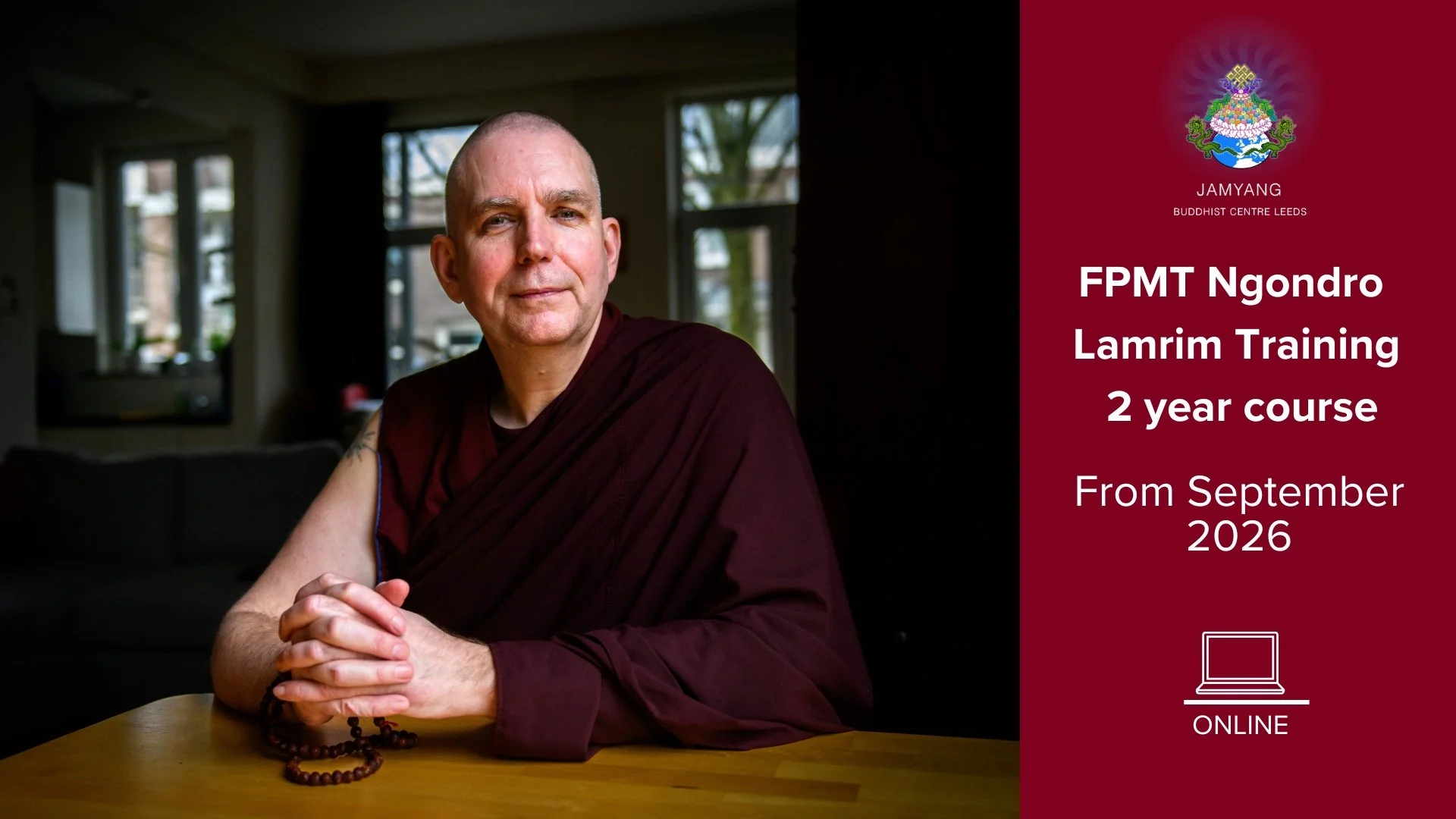
Overview of SESSION
DATE: 2026 / 2027: Year 1
Term 1: September 14th to November 28th 2026
Over a period of two years, the FPMT Ngöndro Lamrim Training (NLRT) offers 16 months of training in the common and uncommon preliminary practices. The training is designed to generate the motivation that supports the development of calm abiding, special insight, and tantra. By cultivating the inner qualities needed to ease unskillful patterns of mind that are the cause of hindrances on the path, it facilitates deep transformation.
An excellent preparation for the FPMT In-Depth Meditation Training (IDMT)
LOCATION: Recordings are released weekly
LEVEL: Buddhist Preliminary Practices
About the Course:
The Lamrim — "Stages of the Path" in Tibetan — is a systematic presentation of the entire Buddhist path to Awakening, written by the great Tibetan master Je Tsongkhapa in the 14th and early 15th century, based on writings of the Indian master Atisha. It arranges every essential teaching of the Buddha into a single, coherent, graduated sequence tailored to your mind, exactly as it is right now. Its true power lies not in study alone, but in practice. Each teaching is carefully arranged to meet the mind where it is and guide it—step by step—toward genuine change.
The uncommon preliminary practices (ngöndro) are powerful methods to purify the mind and prepare it for lasting transformation.
Over the first eleven months the common foundations, renunciation, bodhicitta, and the view of emptiness, are explored based on the Lamrim. For the remaining five months the focus is on the uncommon practices, Vajrasattva purification, mandala offerings, and guru yoga. Weekly sessions each introduce a new topic that examines different ways to meditate and why, in combination with a guided meditation.
The training helps establish a consistent daily meditative practice in supports of its overall aim: to engage in contemplative meditation in a way that genuinely transforms the mind's outlook on the world and gives one's life a new direction. Students gain a deep understanding of how to accumulate merit and purify unskillful karma while cultivating a healthy relationship with the Three Jewels and their teacher. The emphasis is on learning to meditate in a personally tailored way, in accordance with one’s psychological makeup and life conditions.
The Ngondro Lamrim Training teaching sessions are pre-recorded.
Each week, a 90-minute teaching together with two guided meditations are uploaded. On other days, advanced students contribute additional guided meditations. The teacher, Venerable Gendun, offers regular online Q&A sessions. For those who have already studied the Lamrim or the FPMT Basic Program, the training also offers specialized opportunities to learn how to guide others in meditation.
Year 1: Definite Emergence and Mind of Awakening
Prepare the mind for śamatha, vipaśyanā, and tantra
Explore renunciation and bodhicitta, the first two Principles of the Path
Develop genuine urgency through Lamrim contemplation
Cultivate the aspiration to Awakening for all beings
FPMT Ngondro Lamrim Taining is also part of The Buddha Project led by Venerable Losang Gendun. You can find out more about Venerable Gendun, the course and who it is suitable for on our FPMTNgondro Lamrim Training webpage
If you have any questions you would like to ask before registering please email our In-Depth Meditation Coordinator Marie Odile on idmt@jamyangleeds.co.uk
All materials for the course are provided to registered students.
Donations:
Generosity is one of the cornerstones of the Buddhist path. Donations help support both the centre and The Buddha Project as well as providing a donation for the teachings to Venerable Gendun. There are different levels depending on your income. There are three terms a year, each approximately 3 months long
As the course is a collaboration with other FPMT centres it is not possible to offer this as part of our Jamyang Leeds membership programme.
For those with a regular income the recommended donation is £95 per term
The sponsorhsip level is £115 per term
Ordained Sangha are free
If this isn’t affordable please do register, we never turn anyone away from the Dharma for financial reasons and we can agree a donation that is affordable for you at the current time. Please email Marie-Odile our IDMT Coordinator idmt@jamyangleeds.co.uk if you would like to chat.
Yamantaka Practice Group
Overview of SESSION
This is a restricted practice, for those who have received the empowerment to practice Solitary Hero Vajrabhairava/Yamantaka.
If you have an interest in joining the group please email yamantakagroup@gmail.com to register.
The Yamantaka practice is held on Mondays weekly. Please note that some weeks it starts at 2:30pm and some at 6pm it doesn’t always alternate weekly.
Tonglen Loving Kindness meditation Practice
Overview of Tonglen Meditation
The Buddhist practice of Giving & Taking (Tonglen in Tibetan) is at its heart a selfless meditation of loving kindness and compassion.
DATE: Tuesdays
TIME: 7am-7:30am
LOCATION: Zoom
LEVEL: Buddhist Meditation – All Welcome
SUGGESTED DONATION: £4
A beautiful practice led by Chrissie and Di.
The Buddhist practice of Giving & Taking (Tonglen in Tibetan) is at its heart a selfless meditation of loving kindness and compassion. You imagine giving all your happiness to others, sometimes using visualisation with the breath, and then taking all the suffering and its causes from others. It’s a powerful practice for the brave-hearted!
Kshitigarbha Practice
Overview of Kshitigarbha practice
DATE: Tuesdays & Thursdays
TIME: 12pm-12:30pm
LOCATION: Zoom only
LEVEL: Buddhist Practices – All Welcome
SUGGESTED DONATION: £4
Lama Zopa Rinpoche (our organisation’s Spiritual Director) suggested Jamyang Leeds perform these practices to help with the financial obstacles we are currently having. From September 2022, we’ll be reciting this practice as much as we can. See the special newsletter explaining all about the practice here.
Vajrasattva Practice
Overview of The Vajrasattva Practice
DATE: Tuesdays
TIME: 8:00pm-8:30pm
LOCATION: Zoom
LEVEL: Buddhist Practices – All Welcome
SUGGESTED DONATION: £4
Purification here means looking at our past unskillful actions which have created seeds of negative karma in our minds, and using visualisation and mantra recitation to remove those seeds in a healthy and productive way. Vajrasattva is the embodiment of all the Buddha’s cleaning and purifying energy. We all make mistakes, and how we deal with them is key to making spiritual progress. We’ll be using a short text composed by Lama Zopa Rinpoche
the eight verses of thoughts transformation
Overview of the eight verses of thoughts transformation
Everflowing Nectar of Bodhichitta – Annihilating the Demon of the Self-Cherishing Mind
DATE: Wednesdays
TIME: 7am-7:30am
LOCATION: Zoom
LEVEL: Buddhist Practices- All Welcome
SUGGESTED DONATION: £4
Everflowing Nectar of Bodhichitta – Annihilating the Demon of the Self-Cherishing Mind
Led by Di or Sande
This practice is based on the short text” Eight Verses of Thought Transformation”, which contains the entire technique for transforming the mind into relative bodhichitta (i.e., the wish to achieve enlightenment for the benefit of all sentient beings) and absolute bodhichitta (i.e., the wisdom realizing emptiness).
Chanting the Verses of Noble manjushri
Overview of Session
DATE: Thursdays
TIME: 7:45am to 8:25 am
LOCATION: Zoom only
LEVEL: Buddhist Practices – suitable for Lama Zopa Rinpoche’s students
Join us to fulfill His Holiness the Dalai Lama’s wishes and chant the Names of Noble Manjushri for the swift return of Lama Zopa Rinpoche.
Please come along even if you havent done the practice before, its quite wonderful and very energising. Please download the text below, you can also listen and practice with the audio clip of Lama Zopa Rinpoche reciting the Chanting the Names of Noble Manjushri.
Kshitigarbha Practice
Overview of Kshitigarbha practice
DATE: Tuesdays & Thursdays
TIME: 12pm-12:30pm
LOCATION: Zoom only
LEVEL: Buddhist Practices – All Welcome
SUGGESTED DONATION: £4
Lama Zopa Rinpoche (our organisation’s Spiritual Director) suggested Jamyang Leeds perform these practices to help with the financial obstacles we are currently having. From September 2022, we’ll be reciting this practice as much as we can. See the special newsletter explaining all about the practice here.
Kalachakra Practice group
Overview of practice
This is a restricted group for those who have received the Kalachakra empowerment from a qualified Lama. To join the group you need to have either received the full Kalachakra empowerment or another High Yoga Tantra empowerment such as Heruka, as long as you have received a Kalachakra Jenang (permission).
This international group of Kalachakra practitioners meets weekly and alternates with commentary and practice.
Mind Mandala once a month and six session guru yoga for other sessions:
If you’re already part of this group, please use the details sent in the weekly email to join the practice
If you’d like to join us, please email spc@jamyangleeds.co.uk confirming that you have the appropriate empowerments. You will then be sent a registration form to complete.
Shamatha – Meditation on the Breath
Overview of Session
DATE: Fridays
TIME: 7am-7:30am
LOCATION: Zoom
LEVEL: All Welcome
SUGGESTED DONATION: £4
Led by Ruth
Mindfulness of Breathing is universally acknowledged to be of benefit to all living in the modern world. Many feel overloaded with all that is expected of us living this complex and exhausting existence. Developing our awareness in this way is a general prescription for soothing and healing the overworked body and mind.
Practicing focusing the attention on an object such as the breath is also a core practice in Tibetan Buddhism. Gradually over time we are able to hold the object of our attention over longer periods, which enables us to practice other meditations such as Vipassana more successfully.
White Umbrella Deity practice
Overview of practice
DATE: Fridays
TIME: 11:30 am to 12:00 pm
LOCATION: Please note this is online only
LEVEL: Buddhist Practices – see note below
SUGGESTED DONATION: £4
In September 2024, His Eminence Ling Rinpoche gave us this practice to overcome obstacles to the centre flourishing.
In addition to many benefits of engaging in these practices, Lama Zopa Rinpoche recommended that these two practices are beneficial to helping bring peace to situation between Israel and Palestine.
The Sanskrit name for the White Umbrella deity is Ushnisha Sitatapatra which can also be translated as “The Victorious White Parasol.” The White Umbrella Deity, [Skt. Sitatapatra, Tib. gdugs dkar] is a powerful female deity. She is relied upon for protection; healing illness; dispelling interferences, spirit possession, and harmful forces; quelling disasters; averting obstacles; and bringing auspiciousness.
Ushnisha Sitatapatra is a female form of Avalokiteshvara, the Bodhisattva of Compassion. Like this Bodhisattva in an elaborate form, she also has a thousand eyes that watch over living beings, and a thousand arms that protect and assist them. Thus she symbolizes the power of active compassion.
Practices of Arya Sitatapatra includes, “The Supreme Accomplishment of Sitatapatra,” and “Praises and Repelling Practices of Sitatapatra.”
Medicine Buddha Puja

Overview of Medicine Buddha Puja
Medicine Buddha is one of the practices recommended by the FPMT for students to do for the swift return of Kyabje Lama Zopa Rinpoche.
DATE: FRIDAYS
TIME: 7 pm to 8:15 pm
LOCATION: Zoom
LEVEL: Buddhist Practices – All Welcome
SUGGESTED DONATION: £6
This is a longer meditation on Medicine Buddha – to remove obstacles, esp. those relating to health and achieving a favourable rebirth, and activate a swift path to enlightenment.
As Lama Zopa Rinpoche said: “One of the best healing meditations is that on the Medicine Buddha, who is the manifestation of the healing energy of all enlightened beings.”
The puja involves chanting prayers to the Seven Medicine Buddhas and reciting the Medicine Buddha mantras.
It is kindly led by Sande
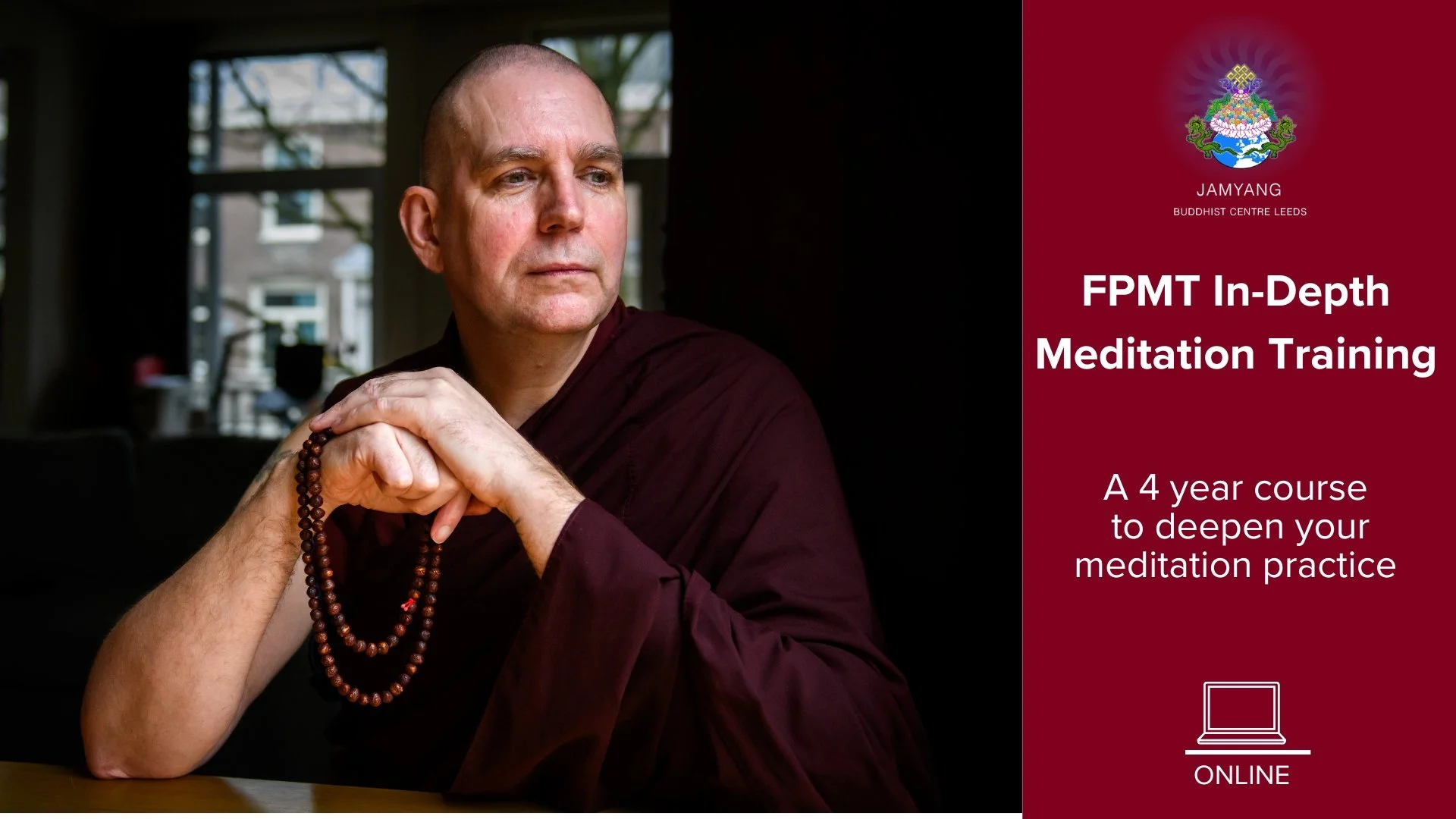
FPMT In-Depth Meditation Training
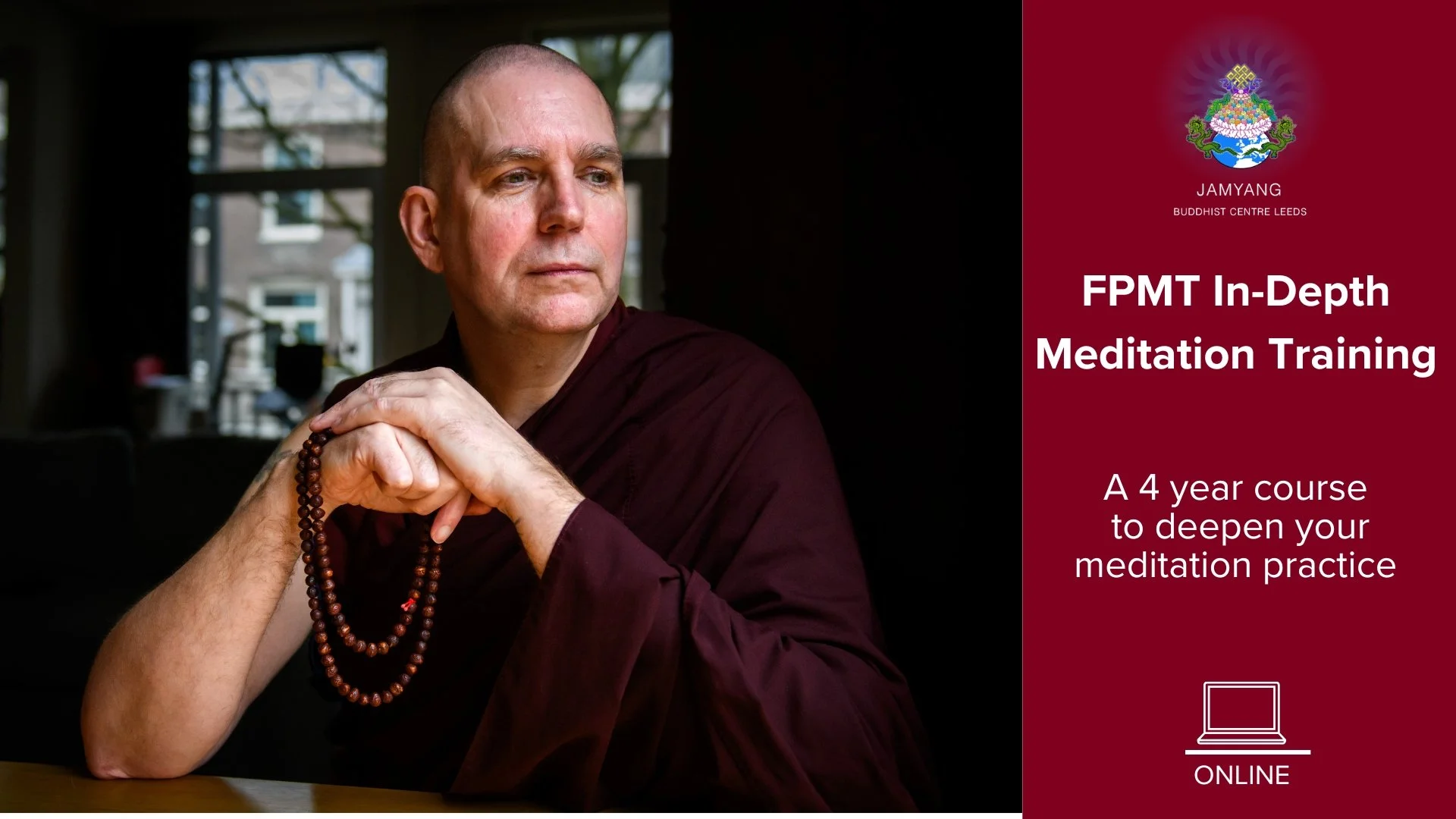
Overview of SESSION
DATE: 2026 / 2027: Year 4
Term 1: September 5th to November 28th 2026
If you are starting as a new student in year 4, don’t worry. You will get some preparatory advice on what previous recordings to have a listen to. Alternatively you may wish to join the new Ngondro Lamrim Meditation course for 2 years before starting In Depth Meditation Training. They are designed to be complementary.
TIME: Saturdays weekly 2:30pm – 5pm UK time
LOCATION: Zoom only
LEVEL: Buddhist Meditation – Intermediate to Advanced
IDMT Year Four, The Vajra Ground: Mahamudra and Kriya Tantra
In this culminating fourth year of our journey, our path turns inward to the mind itself—its empty, luminous nature—and outward to the transformative methods of tantra, where the naturally pure nature of our perception is recognized as the very ground of awakening.
As always, the year will start with generating the mind of awakening, using evocative instructions ranging from Langri Thangpa to Nāgārjuna and Lord Buddha in the famous Bodhisattvapiṭaka. This mind generation we'll cultivate through the four immeasurable thoughts and the support of calm abiding.
Illuminated by the life stories of the masters of the Gelug Mahāmudrā lineage and beyond, we'll explore its roots in the history of the early Indian Mahāsiddhas, such as Saraha and Tilopa, through the Kagyü master Gampopa's and Je Tsongkhapa's Mañjuśrī lineage up to Paṇchen Losang Chökyi Gyaltsen's Highway of the Conquerors and its perspective on this practice. In Sūtra Mahāmudrā we will practice resting attention in the empty nature of awareness, recognizing its clarity and openness as inseparable.
Kriyā Tantra offers a complementary method. Rather than suppress the ordinary, narrow self-narrative that we impose on ourselves and our world, it substitutes for it an extraordinary perspective of pure view. Occasionally, by way of introduction, we'll also taste practices from the higher tantras—glimpsing how afflictive emotions can be met as innate wisdom, and how the dissolution of the death process opens onto the innate mind of clear light. The structured practices of generation and recitation become a rehearsal for transformation, training perception to meet appearances as pure.
These methods rest on a relationship. We will therefore examine the practice of guru devotion candidly—both as the means by which the lineage's realization is transmitted and as a practice with real pitfalls, requiring discernment as much as trust. Through the Ganden Lha Gyāma, the Yoga of the inseparability of guru and Avalokiteśvara, and supporting sādhanas, devotion is approached not as deference but as the ethical road toward the state of Vajradhara: the full integration of wisdom and method.
This final year is an invitation to let realization ripen into a way of being. Grounded in bodhicitta and the four immeasurables, sustained by the preliminary practices, and held by the strength of community, we learn to meet the mind without grasping and to meet the world as pure appearance. Our aim is not to accumulate practices, but to bring the path to maturity—wisdom and compassion no longer cultivated separately, but lived as one.
This four-year online course provides students with long term, in-depth support in their meditative development.
The teacher and course developer is Venerable Losang Gendun. He has trained extensively in meditation in both Theravada and Mahayana Traditions
The In Depth Meditation Training course is also part of The Buddha Project led by Venerable Losang Gendun. You can find out more about Venerable Gendun, the course and who it is suitable for on our FPMT In-Depth Meditation Training webpage
If you have any questions you would like to ask before registering please email our In-Depth Meditation Coordinator Marie Odile on idmt@jamyangleeds.co.uk
The zoom link and all materials for the course are provided to registered students.
Donations:
Generosity is one of the cornerstones of the Buddhist path. With your donation we support The Buddha Project and we keep our centre going for the benefit of all sentient beings.
As the course is a collaboration with other FPMT centres it is not possible to offer this as part of our Jamyang Leeds membership programme.
The recommended donation per calendar month is £45.
If you are able to practice generosity and sponsor other students we recommend £58 per calendar month.
If you are on a reduced income it is £31 per calendar month.
There is also the option to donate annually.
If none of the above options are affordable please do still register, we never turn anyone away from the Dharma for financial reasons and we can agree a donation that is affordable for you right now. Please email Marie Odile our IDMT Coordinator idmt@jamyangleeds.co.uk if you would like to chat.
Vipassana Meditation
Overview of Vipassana Meditation
Join us for a peaceful start to your week with a 30 minute Vipassana meditation session, designed to cultivate mindfulness, self-awareness, and equanimity. Led by Geshe Rinchen
DATE: Mondays weekly (March to May and July to November)
TIME: 7:00 am to 7:30 am
Vipassana (Special Insight Meditation), also called analytical meditation, is primarily a practice of wisdom. It is a form of concentration that focuses single-pointedly on the ultimate nature of phenomena through analytical reasoning. Analysing phenomena is a key aspect of Vipassana practice, as it helps develop a definitive understanding of the nature of reality—such as the self, mind, emotions, and thoughts.
As Je Tsongkhapa explains, shamatha (calm abiding) is like a lamp that remains clear and steady in a place without wind, whereas vipassana (special insight) is like seeing the nature of phenomena clearly through such a steady and clear lamp. Therefore, the usual order of these two meditations is: first, achieving calm abiding or mental stability as a foundation, then engaging in special insight meditation through analysis. However, Vipassana meditation can also be practised by analysing and observing sensations, thoughts, and emotions without first achieving shamatha. This practice should still begin with focusing on the breath or another object of meditation. In our case, we will focus on the breath to start analysing the nature of the mind in relation to our sense of self, emotions, and thoughts.
The session begins by focusing on the breath—either the rise and fall of the abdomen or the sensation of air entering and leaving the nostrils. This practice calms the mind and helps establish a deep sense of presence.
Next, we move into a guided body scan, bringing awareness to different parts of the body and observing subtle sensations without judgement. This helps develop a greater connection to your physical experience.
As we proceed, you will practise observing and analysing sensations, thoughts, and emotions as they arise, learning to witness them without attachment or aversion. This fosters a deeper understanding of the impermanence and interconnectedness of the mind and self. Finally, you will rest your mind either in the natural state of awareness or in the analytical clarity gained through observation and reasoning.
Through regular practice, Vipassana meditation cultivates wisdom, encouraging a balanced and objective view of internal experiences. This session is ideal for those seeking greater insight and calmness in their daily lives.
Morning Prayers
Overview
Start the day by joining us for Morning Prayers recommended by Lama Zopa Rinpoche and HH Dalai Lama, for the benefit of all sentient beings and the swift return of Lama Zopa Rinpoche. Everyone is welcome.
DATE: Monday – Friday all year around
TIME: 8:30am - 9:00am
LOCATION: Zoom
LEVEL: Buddhist Practices – All Welcome
FPMT Ngondro Lamrim Training
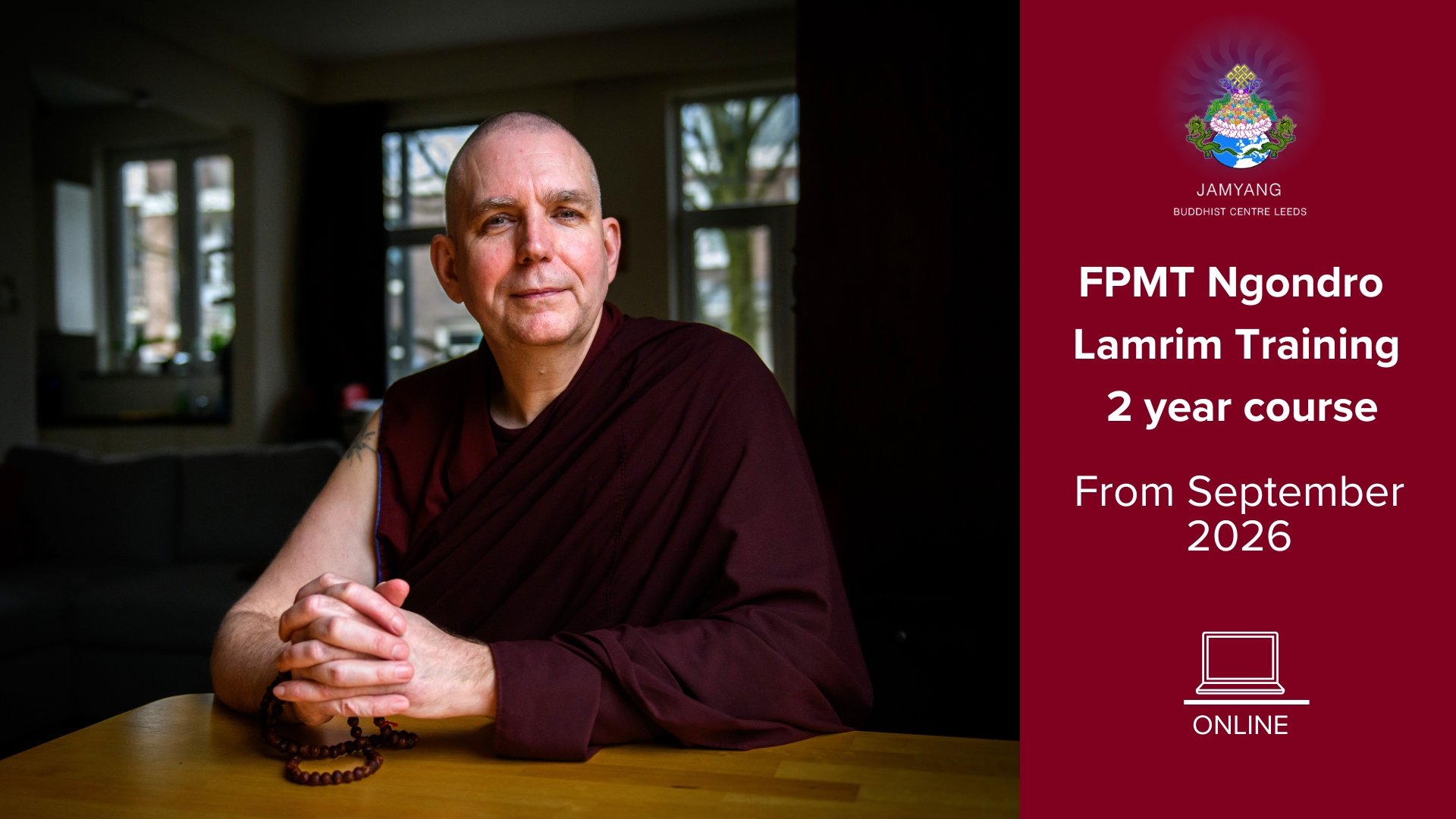
Overview of SESSION
DATE: 2026 / 2027: Year 1
Term 1: September 14th to November 28th 2026
Over a period of two years, the FPMT Ngöndro Lamrim Training (NLRT) offers 16 months of training in the common and uncommon preliminary practices. The training is designed to generate the motivation that supports the development of calm abiding, special insight, and tantra. By cultivating the inner qualities needed to ease unskillful patterns of mind that are the cause of hindrances on the path, it facilitates deep transformation.
An excellent preparation for the FPMT In-Depth Meditation Training (IDMT)
LOCATION: Recordings are released weekly
LEVEL: Buddhist Preliminary Practices
About the Course:
The Lamrim — "Stages of the Path" in Tibetan — is a systematic presentation of the entire Buddhist path to Awakening, written by the great Tibetan master Je Tsongkhapa in the 14th and early 15th century, based on writings of the Indian master Atisha. It arranges every essential teaching of the Buddha into a single, coherent, graduated sequence tailored to your mind, exactly as it is right now. Its true power lies not in study alone, but in practice. Each teaching is carefully arranged to meet the mind where it is and guide it—step by step—toward genuine change.
The uncommon preliminary practices (ngöndro) are powerful methods to purify the mind and prepare it for lasting transformation.
Over the first eleven months the common foundations, renunciation, bodhicitta, and the view of emptiness, are explored based on the Lamrim. For the remaining five months the focus is on the uncommon practices, Vajrasattva purification, mandala offerings, and guru yoga. Weekly sessions each introduce a new topic that examines different ways to meditate and why, in combination with a guided meditation.
The training helps establish a consistent daily meditative practice in supports of its overall aim: to engage in contemplative meditation in a way that genuinely transforms the mind's outlook on the world and gives one's life a new direction. Students gain a deep understanding of how to accumulate merit and purify unskillful karma while cultivating a healthy relationship with the Three Jewels and their teacher. The emphasis is on learning to meditate in a personally tailored way, in accordance with one’s psychological makeup and life conditions.
The Ngondro Lamrim Training teaching sessions are pre-recorded.
Each week, a 90-minute teaching together with two guided meditations are uploaded. On other days, advanced students contribute additional guided meditations. The teacher, Venerable Gendun, offers regular online Q&A sessions. For those who have already studied the Lamrim or the FPMT Basic Program, the training also offers specialized opportunities to learn how to guide others in meditation.
Year 1: Definite Emergence and Mind of Awakening
Prepare the mind for śamatha, vipaśyanā, and tantra
Explore renunciation and bodhicitta, the first two Principles of the Path
Develop genuine urgency through Lamrim contemplation
Cultivate the aspiration to Awakening for all beings
FPMT Ngondro Lamrim Taining is also part of The Buddha Project led by Venerable Losang Gendun. You can find out more about Venerable Gendun, the course and who it is suitable for on our FPMT Ngondro Lamrim Training webpage
If you have any questions you would like to ask before registering please email our In-Depth Meditation Coordinator Marie Odile on idmt@jamyangleeds.co.uk
All materials for the course are provided to registered students.
Donations:
Generosity is one of the cornerstones of the Buddhist path. Donations help support both the centre and The Buddha Project as well as providing a donation for the teachings to Venerable Gendun. There are different levels depending on your income. There are three terms a year, each approximately 3 months long
As the course is a collaboration with other FPMT centres it is not possible to offer this as part of our Jamyang Leeds membership programme.
For those with a regular income the recommended donation is £95 per term
The sponsorhsip level is £115 per term
Ordained Sangha are free
If this isn’t affordable please do register, we never turn anyone away from the Dharma for financial reasons and we can agree a donation that is affordable for you at the current time. Please email Marie-Odile our IDMT Coordinator idmt@jamyangleeds.co.uk if you would like to chat.
Yamantaka Practice Group
Overview of SESSION
This is a restricted practice, for those who have received the empowerment to practice Solitary Hero Vajrabhairava/Yamantaka.
If you have an interest in joining the group please email yamantakagroup@gmail.com to register.
The Yamantaka practice is held on the Mondays weekly. Please note that some weeks it starts at 2:30pm and some at 6pm it doesn’t always alternate weekly.
Tonglen Loving Kindness meditation Practice
Overview of Tonglen Meditation
The Buddhist practice of Giving & Taking (Tonglen in Tibetan) is at its heart a selfless meditation of loving kindness and compassion.
DATE: Tuesdays
TIME: 7am-7:30am
LOCATION: Zoom
LEVEL: Buddhist Meditation – All Welcome
SUGGESTED DONATION: £4
A beautiful practice led by Chrissie and Di.
The Buddhist practice of Giving & Taking (Tonglen in Tibetan) is at its heart a selfless meditation of loving kindness and compassion. You imagine giving all your happiness to others, sometimes using visualisation with the breath, and then taking all the suffering and its causes from others. It’s a powerful practice for the brave-hearted!
Kshitigarbha Practice
Overview of Kshitigarbha practice
DATE: Tuesdays & Thursdays
TIME: 12pm-12:30pm
LOCATION: Zoom only
LEVEL: Buddhist Practices – All Welcome
SUGGESTED DONATION: £4
Lama Zopa Rinpoche (our organisation’s Spiritual Director) suggested Jamyang Leeds perform these practices to help with the financial obstacles we are currently having. From September 2022, we’ll be reciting this practice as much as we can. See the special newsletter explaining all about the practice here.
Vajrasattva Practice
Overview of The Vajrasattva Practice
DATE: Tuesdays
TIME: 8:00pm-8:30pm
LOCATION: Zoom
LEVEL: Buddhist Practices – All Welcome
SUGGESTED DONATION: £4
Purification here means looking at our past unskillful actions which have created seeds of negative karma in our minds, and using visualisation and mantra recitation to remove those seeds in a healthy and productive way. Vajrasattva is the embodiment of all the Buddha’s cleaning and purifying energy. We all make mistakes, and how we deal with them is key to making spiritual progress. We’ll be using a short text composed by Lama Zopa Rinpoche
the eight verses of thoughts transformation
Overview of the eight verses of thoughts transformation
Everflowing Nectar of Bodhichitta – Annihilating the Demon of the Self-Cherishing Mind
DATE: Wednesdays
TIME: 7am-7:30am
LOCATION: Zoom
LEVEL: Buddhist Practices- All Welcome
SUGGESTED DONATION: £4
Everflowing Nectar of Bodhichitta – Annihilating the Demon of the Self-Cherishing Mind
Led by Di or Sande
This practice is based on the short text” Eight Verses of Thought Transformation”, which contains the entire technique for transforming the mind into relative bodhichitta (i.e., the wish to achieve enlightenment for the benefit of all sentient beings) and absolute bodhichitta (i.e., the wisdom realizing emptiness).
Chanting the Verses of Noble manjushri
Overview of Session
DATE: Thursdays
TIME: 7:45am to 8:25 am
LOCATION: Zoom only
LEVEL: Buddhist Practices – suitable for Lama Zopa Rinpoche’s students
Join us to fulfill His Holiness the Dalai Lama’s wishes and chant the Names of Noble Manjushri for the swift return of Lama Zopa Rinpoche.
Please come along even if you havent done the practice before, its quite wonderful and very energising. Please download the text below, you can also listen and practice with the audio clip of Lama Zopa Rinpoche reciting the Chanting the Names of Noble Manjushri.
Kshitigarbha Practice
Overview of Kshitigarbha practice
DATE: Tuesdays & Thursdays
TIME: 12pm-12:30pm
LOCATION: Zoom only
LEVEL: Buddhist Practices – All Welcome
SUGGESTED DONATION: £4
Lama Zopa Rinpoche (our organisation’s Spiritual Director) suggested Jamyang Leeds perform these practices to help with the financial obstacles we are currently having. From September 2022, we’ll be reciting this practice as much as we can. See the special newsletter explaining all about the practice here.
Kalachakra Practice group
Overview of practice
This is a restricted group for those who have received the Kalachakra empowerment from a qualified Lama. To join the group you need to have either received the full Kalachakra empowerment or another High Yoga Tantra empowerment such as Heruka, as long as you have received a Kalachakra Jenang (permission).
This international group of Kalachakra practitioners meets weekly and alternates with commentary and practice.
Mind Mandala once a month and six session guru yoga for other sessions:
If you’re already part of this group, please use the details sent in the weekly email to join the practice
If you’d like to join us, please email spc@jamyangleeds.co.uk confirming that you have the appropriate empowerments. You will then be sent a registration form to complete.
Shamatha – Meditation on the Breath
Overview of Session
DATE: Fridays
TIME: 7am-7:30am
LOCATION: Zoom
LEVEL: All Welcome
SUGGESTED DONATION: £4
Led by Ruth
Mindfulness of Breathing is universally acknowledged to be of benefit to all living in the modern world. Many feel overloaded with all that is expected of us living this complex and exhausting existence. Developing our awareness in this way is a general prescription for soothing and healing the overworked body and mind.
Practicing focusing the attention on an object such as the breath is also a core practice in Tibetan Buddhism. Gradually over time we are able to hold the object of our attention over longer periods, which enables us to practice other meditations such as Vipassana more successfully.
White Umbrella Deity practice
Overview of practice
DATE: Fridays
TIME: 11:30 am to 12:00 pm
LOCATION: Please note this is online only
LEVEL: Buddhist Practices – see note below
SUGGESTED DONATION: £4
In September 2024, His Eminence Ling Rinpoche gave us this practice to overcome obstacles to the centre flourishing.
In addition to many benefits of engaging in these practices, Lama Zopa Rinpoche recommended that these two practices are beneficial to helping bring peace to situation between Israel and Palestine.
The Sanskrit name for the White Umbrella deity is Ushnisha Sitatapatra which can also be translated as “The Victorious White Parasol.” The White Umbrella Deity, [Skt. Sitatapatra, Tib. gdugs dkar] is a powerful female deity. She is relied upon for protection; healing illness; dispelling interferences, spirit possession, and harmful forces; quelling disasters; averting obstacles; and bringing auspiciousness.
Ushnisha Sitatapatra is a female form of Avalokiteshvara, the Bodhisattva of Compassion. Like this Bodhisattva in an elaborate form, she also has a thousand eyes that watch over living beings, and a thousand arms that protect and assist them. Thus she symbolizes the power of active compassion.
Practices of Arya Sitatapatra includes, “The Supreme Accomplishment of Sitatapatra,” and “Praises and Repelling Practices of Sitatapatra.”
Medicine Buddha Puja
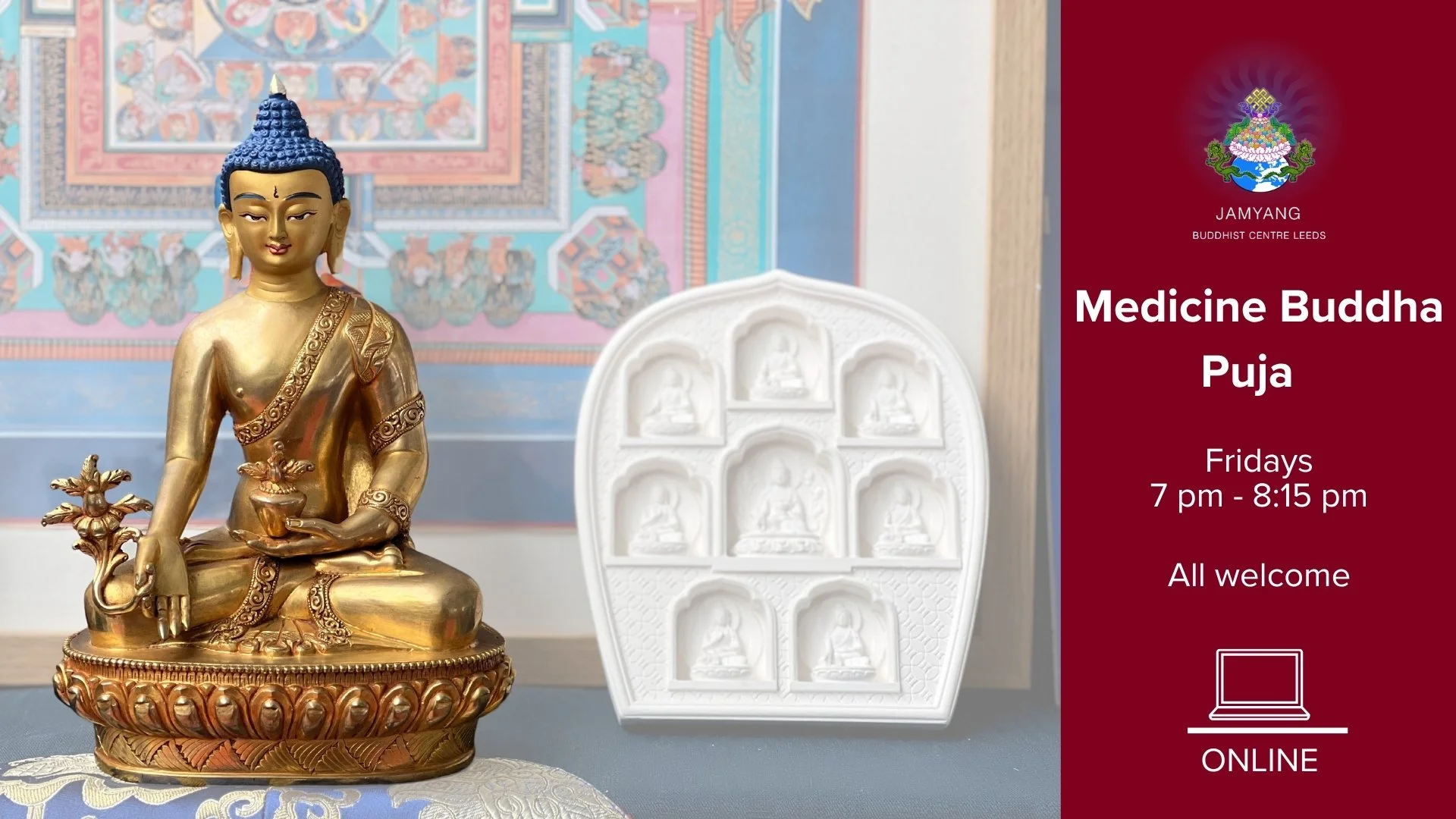
Overview of Medicine Buddha Puja
Medicine Buddha is one of the practices recommended by the FPMT for students to do for the swift return of Kyabje Lama Zopa Rinpoche.
DATE: FRIDAYS
TIME: 7 pm to 8:15 pm
LOCATION: Zoom
LEVEL: Buddhist Practices – All Welcome
SUGGESTED DONATION: £6
This is a longer meditation on Medicine Buddha – to remove obstacles, esp. those relating to health and achieving a favourable rebirth, and activate a swift path to enlightenment.
As Lama Zopa Rinpoche said: “One of the best healing meditations is that on the Medicine Buddha, who is the manifestation of the healing energy of all enlightened beings.”
The puja involves chanting prayers to the Seven Medicine Buddhas and reciting the Medicine Buddha mantras.
It is kindly led by Sande
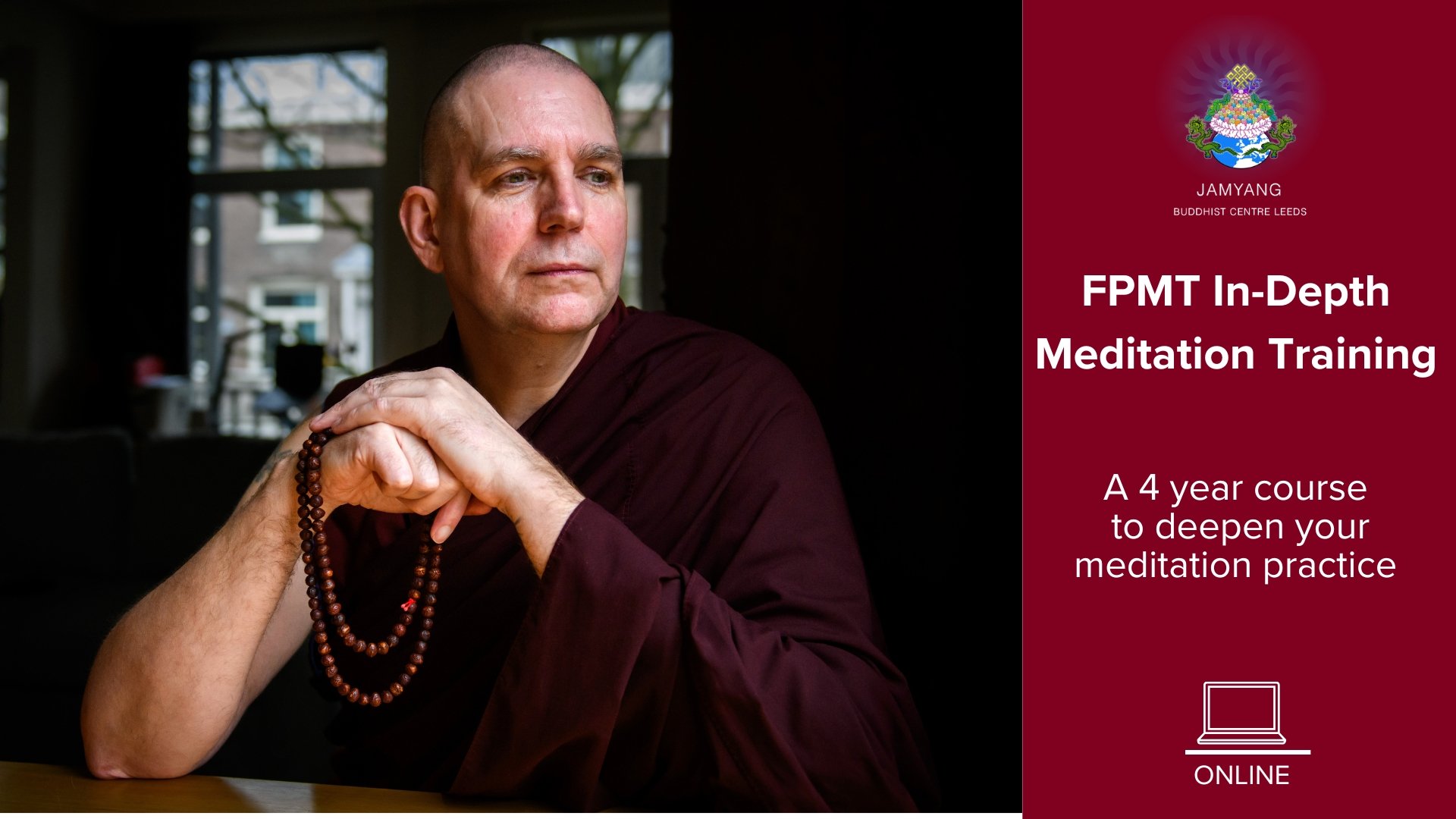
FPMT In-Depth Meditation Training
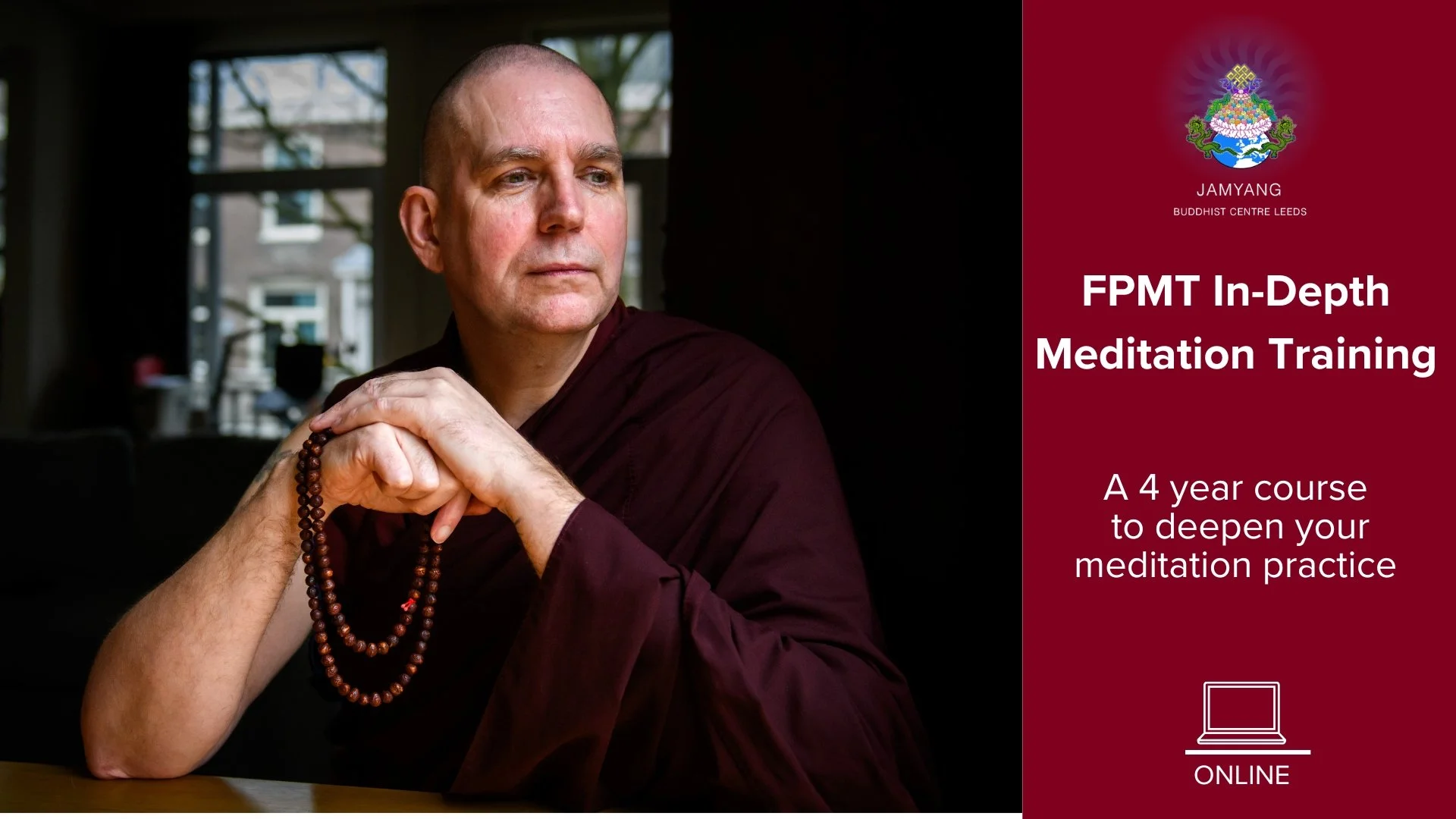
Overview of SESSION
DATE: 2026 / 2027: Year 4
Term 1: September 5th to November 28th 2026
If you are starting as a new student in year 4, don’t worry. You will get some preparatory advice on what previous recordings to have a listen to. Alternatively you may wish to join the new Ngondro Lamrim Meditation course for 2 years before starting In Depth Meditation Training. They are designed to be complementary.
TIME: Saturdays weekly 2:30pm – 5pm UK time
LOCATION: Zoom only
LEVEL: Buddhist Meditation – Intermediate to Advanced
IDMT Year Four, The Vajra Ground: Mahamudra and Kriya Tantra
In this culminating fourth year of our journey, our path turns inward to the mind itself—its empty, luminous nature—and outward to the transformative methods of tantra, where the naturally pure nature of our perception is recognized as the very ground of awakening.
As always, the year will start with generating the mind of awakening, using evocative instructions ranging from Langri Thangpa to Nāgārjuna and Lord Buddha in the famous Bodhisattvapiṭaka. This mind generation we'll cultivate through the four immeasurable thoughts and the support of calm abiding.
Illuminated by the life stories of the masters of the Gelug Mahāmudrā lineage and beyond, we'll explore its roots in the history of the early Indian Mahāsiddhas, such as Saraha and Tilopa, through the Kagyü master Gampopa's and Je Tsongkhapa's Mañjuśrī lineage up to Paṇchen Losang Chökyi Gyaltsen's Highway of the Conquerors and its perspective on this practice. In Sūtra Mahāmudrā we will practice resting attention in the empty nature of awareness, recognizing its clarity and openness as inseparable.
Kriyā Tantra offers a complementary method. Rather than suppress the ordinary, narrow self-narrative that we impose on ourselves and our world, it substitutes for it an extraordinary perspective of pure view. Occasionally, by way of introduction, we'll also taste practices from the higher tantras—glimpsing how afflictive emotions can be met as innate wisdom, and how the dissolution of the death process opens onto the innate mind of clear light. The structured practices of generation and recitation become a rehearsal for transformation, training perception to meet appearances as pure.
These methods rest on a relationship. We will therefore examine the practice of guru devotion candidly—both as the means by which the lineage's realization is transmitted and as a practice with real pitfalls, requiring discernment as much as trust. Through the Ganden Lha Gyāma, the Yoga of the inseparability of guru and Avalokiteśvara, and supporting sādhanas, devotion is approached not as deference but as the ethical road toward the state of Vajradhara: the full integration of wisdom and method.
This final year is an invitation to let realization ripen into a way of being. Grounded in bodhicitta and the four immeasurables, sustained by the preliminary practices, and held by the strength of community, we learn to meet the mind without grasping and to meet the world as pure appearance. Our aim is not to accumulate practices, but to bring the path to maturity—wisdom and compassion no longer cultivated separately, but lived as one.
This four-year online course provides students with long term, in-depth support in their meditative development.
The teacher and course developer is Venerable Losang Gendun. He has trained extensively in meditation in both Theravada and Mahayana Traditions
The In Depth Meditation Training course is also part of The Buddha Project led by Venerable Losang Gendun. You can find out more about Venerable Gendun, the course and who it is suitable for on our FPMT In-Depth Meditation Training webpage
If you have any questions you would like to ask before registering please email our In-Depth Meditation Coordinator Marie Odile on idmt@jamyangleeds.co.uk
The zoom link and all materials for the course are provided to registered students.
Donations:
Generosity is one of the cornerstones of the Buddhist path. With your donation we support The Buddha Project and we keep our centre going for the benefit of all sentient beings.
As the course is a collaboration with other FPMT centres it is not possible to offer this as part of our Jamyang Leeds membership programme.
The recommended donation per calendar month is £45.
If you are able to practice generosity and sponsor other students we recommend £58 per calendar month.
If you are on a reduced income it is £31 per calendar month.
There is also the option to donate annually.
If none of the above options are affordable please do still register, we never turn anyone away from the Dharma for financial reasons and we can agree a donation that is affordable for you right now. Please email Marie Odile our IDMT Coordinator idmt@jamyangleeds.co.uk if you would like to chat.
Vipassana Meditation
Overview of Vipassana Meditation
Join us for a peaceful start to your week with a 30 minute Vipassana meditation session, designed to cultivate mindfulness, self-awareness, and equanimity. Led by Geshe Rinchen
DATE: Mondays weekly (March to May and July to November)
TIME: 7:00 am to 7:30 am
Vipassana (Special Insight Meditation), also called analytical meditation, is primarily a practice of wisdom. It is a form of concentration that focuses single-pointedly on the ultimate nature of phenomena through analytical reasoning. Analysing phenomena is a key aspect of Vipassana practice, as it helps develop a definitive understanding of the nature of reality—such as the self, mind, emotions, and thoughts.
As Je Tsongkhapa explains, shamatha (calm abiding) is like a lamp that remains clear and steady in a place without wind, whereas vipassana (special insight) is like seeing the nature of phenomena clearly through such a steady and clear lamp. Therefore, the usual order of these two meditations is: first, achieving calm abiding or mental stability as a foundation, then engaging in special insight meditation through analysis. However, Vipassana meditation can also be practised by analysing and observing sensations, thoughts, and emotions without first achieving shamatha. This practice should still begin with focusing on the breath or another object of meditation. In our case, we will focus on the breath to start analysing the nature of the mind in relation to our sense of self, emotions, and thoughts.
The session begins by focusing on the breath—either the rise and fall of the abdomen or the sensation of air entering and leaving the nostrils. This practice calms the mind and helps establish a deep sense of presence.
Next, we move into a guided body scan, bringing awareness to different parts of the body and observing subtle sensations without judgement. This helps develop a greater connection to your physical experience.
As we proceed, you will practise observing and analysing sensations, thoughts, and emotions as they arise, learning to witness them without attachment or aversion. This fosters a deeper understanding of the impermanence and interconnectedness of the mind and self. Finally, you will rest your mind either in the natural state of awareness or in the analytical clarity gained through observation and reasoning.
Through regular practice, Vipassana meditation cultivates wisdom, encouraging a balanced and objective view of internal experiences. This session is ideal for those seeking greater insight and calmness in their daily lives.
Morning Prayers
Overview
Start the day by joining us for Morning Prayers recommended by Lama Zopa Rinpoche and HH Dalai Lama, for the benefit of all sentient beings and the swift return of Lama Zopa Rinpoche. Everyone is welcome.
DATE: Monday – Friday all year around
TIME: 8:30am - 9:00am
LOCATION: Zoom
LEVEL: Buddhist Practices – All Welcome
Yamantaka Practice Group
Overview of SESSION
This is a restricted practice, for those who have received the empowerment to practice Solitary Hero Vajrabhairava/Yamantaka.
If you have an interest in joining the group please email yamantakagroup@gmail.com to register.
The Yamantaka practice is held on the Mondays weekly. Please note that some weeks it starts at 2:30pm and some at 6pm it doesn’t always alternate weekly.
Tara Puja for World Peace
Overview of Session
DATE: 2026: Last Monday monthly (break in August)
TIME: 5:45pm-6:30pm
LOCATION: Zoom
LEVEL: Buddhist Practices – All welcome
SUGGESTED DONATION: £6
Tara Puja dedicated to world peace is held on a monthly basis.
Led by Ondy Willson and translated by Venerable Tenzin into Russian for Russian and Ukrainian students
Please join us, occasionally or regularly, at 17.45 UK time to show our support for the courageous spiritual communities both in Ukraine & Russia and also in Israel and Gaza. May we all nurture compassion & peace in the face of destruction & violence.
By coming together like this we send a powerful message that comes from the depths of our being. We value peace, harmony and the enlightened qualities we aspire to embody, as generated in the 21 Taras Sadhana.
By the power of our merit may there be a non-violent and bloodless revolution of consciousness so that enlightened democracies based on social wellbeing flourish everywhere.
Please forward this invitation to anyone who you think may be interested in this free and beneficial session.
The puja will last approximately 45 minutes to include some guidance on harnessing the positive power of the prayers in generating the particular qualities of compassion and fearlessness.
Ondy Willson, a touring FPMT teacher since 2007, has students in Russia & Ukraine, so felt particularly moved to offer these pujas both to connect with & support those who are suffering on the front line. So these pujas have provided, not just an opportunity to deal with fear and pray for peace, but to meet directly together as a global community and interact with our Ukrainian and Russian dharma friends. At the end of one week’s puja, participants in Ukraine & Russia shared their stories & experiences, which was very moving for us all to hear.
Tonglen Loving Kindness meditation Practice
Overview of Tonglen Meditation
The Buddhist practice of Giving & Taking (Tonglen in Tibetan) is at its heart a selfless meditation of loving kindness and compassion.
DATE: Tuesdays
TIME: 7am-7:30am
LOCATION: Zoom
LEVEL: Buddhist Meditation – All Welcome
SUGGESTED DONATION: £4
A beautiful practice led by Chrissie and Di.
The Buddhist practice of Giving & Taking (Tonglen in Tibetan) is at its heart a selfless meditation of loving kindness and compassion. You imagine giving all your happiness to others, sometimes using visualisation with the breath, and then taking all the suffering and its causes from others. It’s a powerful practice for the brave-hearted!
Kshitigarbha Practice
Overview of Kshitigarbha practice
DATE: Tuesdays & Thursdays
TIME: 12pm-12:30pm
LOCATION: Zoom only
LEVEL: Buddhist Practices – All Welcome
SUGGESTED DONATION: £4
Lama Zopa Rinpoche (our organisation’s Spiritual Director) suggested Jamyang Leeds perform these practices to help with the financial obstacles we are currently having. From September 2022, we’ll be reciting this practice as much as we can. See the special newsletter explaining all about the practice here.
Vajrasattva Practice
Overview of The Vajrasattva Practice
DATE: Tuesdays
TIME: 8:00pm-8:30pm
LOCATION: Zoom
LEVEL: Buddhist Practices – All Welcome
SUGGESTED DONATION: £4
Purification here means looking at our past unskillful actions which have created seeds of negative karma in our minds, and using visualisation and mantra recitation to remove those seeds in a healthy and productive way. Vajrasattva is the embodiment of all the Buddha’s cleaning and purifying energy. We all make mistakes, and how we deal with them is key to making spiritual progress. We’ll be using a short text composed by Lama Zopa Rinpoche
the eight verses of thoughts transformation
Overview of the eight verses of thoughts transformation
Everflowing Nectar of Bodhichitta – Annihilating the Demon of the Self-Cherishing Mind
DATE: Wednesdays
TIME: 7am-7:30am
LOCATION: Zoom
LEVEL: Buddhist Practices- All Welcome
SUGGESTED DONATION: £4
Everflowing Nectar of Bodhichitta – Annihilating the Demon of the Self-Cherishing Mind
Led by Di or Sande
This practice is based on the short text” Eight Verses of Thought Transformation”, which contains the entire technique for transforming the mind into relative bodhichitta (i.e., the wish to achieve enlightenment for the benefit of all sentient beings) and absolute bodhichitta (i.e., the wisdom realizing emptiness).
Chanting the Verses of Noble manjushri
Overview of Session
DATE: Thursdays
TIME: 7:45am to 8:25 am
LOCATION: Zoom only
LEVEL: Buddhist Practices – suitable for Lama Zopa Rinpoche’s students
Join us to fulfill His Holiness the Dalai Lama’s wishes and chant the Names of Noble Manjushri for the swift return of Lama Zopa Rinpoche.
Please come along even if you havent done the practice before, its quite wonderful and very energising. Please download the text below, you can also listen and practice with the audio clip of Lama Zopa Rinpoche reciting the Chanting the Names of Noble Manjushri.
Lama Choepa (Guru Puja) and Tsog
Overview of Session
DATES: 2026: 13th January; 11th February; 13th March; 26th April; 12th May; 10th June; 24th July; 8th August; 21st September; 5th October; 4th November; 3rd December
TIME: 60 - 90 minute sessions, start time varies
LOCATION: In Person and Online
LEVEL: Buddhist Ceremonies – All Welcome
Dedicated to the Swift return of Lama Zopa Rinpoche as a bright, unmistaken child.
During the practice of Lama Choepa, we invoke all the lamas of the graduated path lineage, beginning with Shakyamuni Buddha himself, extending to our present direct teachers who have shown us the path. We pay homage to them, make offerings, and request each of them to please bless our minds with the same realizations that they themselves have generated. By offering sincere, heartfelt requests, we make our minds ripe to receive the full blessings of this precious lineage and quickly actualize the realizations we need to attain enlightenment. If we wish to experience realisations quickly, the practice of Lama Choepa is indispensable.
“If you are able to do the practice of Guru Puja in your daily life, it contains all the important points of sutra and tantra. It is a complete practice, and it shows the heart of the instruction of Lama Tsongkhapa’s tradition. Even if one can’t do much else in daily life, Guru Puja is the essential practice.”
Open to all Buddhists, no empowerments needed.
Please arrive early and bring flowers, incense, vegetarian food and drink as offerings for the altar.
More information can also be found on this FPMT page.
Kshitigarbha Practice
Overview of Kshitigarbha practice
DATE: Tuesdays & Thursdays
TIME: 12pm-12:30pm
LOCATION: Zoom only
LEVEL: Buddhist Practices – All Welcome
SUGGESTED DONATION: £4
Lama Zopa Rinpoche (our organisation’s Spiritual Director) suggested Jamyang Leeds perform these practices to help with the financial obstacles we are currently having. From September 2022, we’ll be reciting this practice as much as we can. See the special newsletter explaining all about the practice here.
Kalachakra Practice group
Overview of practice
This is a restricted group for those who have received the Kalachakra empowerment from a qualified Lama. To join the group you need to have either received the full Kalachakra empowerment or another High Yoga Tantra empowerment such as Heruka, as long as you have received a Kalachakra Jenang (permission).
This international group of Kalachakra practitioners meets weekly and alternates with commentary and practice.
Mind Mandala once a month and six session guru yoga for other sessions:
If you’re already part of this group, please use the details sent in the weekly email to join the practice
If you’d like to join us, please email spc@jamyangleeds.co.uk confirming that you have the appropriate empowerments. You will then be sent a registration form to complete.
Shamatha – Meditation on the Breath
Overview of Session
DATE: Fridays
TIME: 7am-7:30am
LOCATION: Zoom
LEVEL: All Welcome
SUGGESTED DONATION: £4
Led by Ruth
Mindfulness of Breathing is universally acknowledged to be of benefit to all living in the modern world. Many feel overloaded with all that is expected of us living this complex and exhausting existence. Developing our awareness in this way is a general prescription for soothing and healing the overworked body and mind.
Practicing focusing the attention on an object such as the breath is also a core practice in Tibetan Buddhism. Gradually over time we are able to hold the object of our attention over longer periods, which enables us to practice other meditations such as Vipassana more successfully.
White Umbrella Deity practice
Overview of practice
DATE: Fridays
TIME: 11:30 am to 12:00 pm
LOCATION: Please note this is online only
LEVEL: Buddhist Practices – see note below
SUGGESTED DONATION: £4
In September 2024, His Eminence Ling Rinpoche gave us this practice to overcome obstacles to the centre flourishing.
In addition to many benefits of engaging in these practices, Lama Zopa Rinpoche recommended that these two practices are beneficial to helping bring peace to situation between Israel and Palestine.
The Sanskrit name for the White Umbrella deity is Ushnisha Sitatapatra which can also be translated as “The Victorious White Parasol.” The White Umbrella Deity, [Skt. Sitatapatra, Tib. gdugs dkar] is a powerful female deity. She is relied upon for protection; healing illness; dispelling interferences, spirit possession, and harmful forces; quelling disasters; averting obstacles; and bringing auspiciousness.
Ushnisha Sitatapatra is a female form of Avalokiteshvara, the Bodhisattva of Compassion. Like this Bodhisattva in an elaborate form, she also has a thousand eyes that watch over living beings, and a thousand arms that protect and assist them. Thus she symbolizes the power of active compassion.
Practices of Arya Sitatapatra includes, “The Supreme Accomplishment of Sitatapatra,” and “Praises and Repelling Practices of Sitatapatra.”
Medicine Buddha Puja
Overview of Medicine Buddha Puja
Medicine Buddha is one of the practices recommended by the FPMT for students to do for the swift return of Kyabje Lama Zopa Rinpoche.
DATE: FRIDAYS
TIME: 7 pm to 8:15 pm
LOCATION: Zoom
LEVEL: Buddhist Practices – All Welcome
SUGGESTED DONATION: £6
This is a longer meditation on Medicine Buddha – to remove obstacles, esp. those relating to health and achieving a favourable rebirth, and activate a swift path to enlightenment.
As Lama Zopa Rinpoche said: “One of the best healing meditations is that on the Medicine Buddha, who is the manifestation of the healing energy of all enlightened beings.”
The puja involves chanting prayers to the Seven Medicine Buddhas and reciting the Medicine Buddha mantras.
It is kindly led by Sande
Morning Prayers
Overview
Start the day by joining us for Morning Prayers recommended by Lama Zopa Rinpoche and HH Dalai Lama, for the benefit of all sentient beings and the swift return of Lama Zopa Rinpoche. Everyone is welcome.
DATE: Monday – Friday all year around
TIME: 8:30am - 9:00am
LOCATION: Zoom
LEVEL: Buddhist Practices – All Welcome
Yamantaka Practice Group
Overview of SESSION
This is a restricted practice, for those who have received the empowerment to practice Solitary Hero Vajrabhairava/Yamantaka.
If you have an interest in joining the group please email yamantakagroup@gmail.com to register.
The Yamantaka practice is held on the Mondays weekly. Please note that some weeks it starts at 2:30pm and some at 6pm it doesn’t always alternate weekly.
Yamantaka Study Group
Overview of SESSION
This study group is for those who have received the empowerment to practice Solitary Hero Vajrabhairava/Yamantaka.
If you have an interest in joining the study group please email yamantakagroup@gmail.com to register.
The Yamantaka study group is held on the first or second Monday monthly at 6pm.
Tonglen Loving Kindness meditation Practice
Overview of Tonglen Meditation
The Buddhist practice of Giving & Taking (Tonglen in Tibetan) is at its heart a selfless meditation of loving kindness and compassion.
DATE: Tuesdays
TIME: 7am-7:30am
LOCATION: Zoom
LEVEL: Buddhist Meditation – All Welcome
SUGGESTED DONATION: £4
A beautiful practice led by Chrissie and Di.
The Buddhist practice of Giving & Taking (Tonglen in Tibetan) is at its heart a selfless meditation of loving kindness and compassion. You imagine giving all your happiness to others, sometimes using visualisation with the breath, and then taking all the suffering and its causes from others. It’s a powerful practice for the brave-hearted!
Kshitigarbha Practice
Overview of Kshitigarbha practice
DATE: Tuesdays & Thursdays
TIME: 12pm-12:30pm
LOCATION: Zoom only
LEVEL: Buddhist Practices – All Welcome
SUGGESTED DONATION: £4
Lama Zopa Rinpoche (our organisation’s Spiritual Director) suggested Jamyang Leeds perform these practices to help with the financial obstacles we are currently having. From September 2022, we’ll be reciting this practice as much as we can. See the special newsletter explaining all about the practice here.
Vajrasattva Practice
Overview of The Vajrasattva Practice
DATE: Tuesdays
TIME: 8:00pm-8:30pm
LOCATION: Zoom
LEVEL: Buddhist Practices – All Welcome
SUGGESTED DONATION: £4
Purification here means looking at our past unskillful actions which have created seeds of negative karma in our minds, and using visualisation and mantra recitation to remove those seeds in a healthy and productive way. Vajrasattva is the embodiment of all the Buddha’s cleaning and purifying energy. We all make mistakes, and how we deal with them is key to making spiritual progress. We’ll be using a short text composed by Lama Zopa Rinpoche
the eight verses of thoughts transformation
Overview of the eight verses of thoughts transformation
Everflowing Nectar of Bodhichitta – Annihilating the Demon of the Self-Cherishing Mind
DATE: Wednesdays
TIME: 7am-7:30am
LOCATION: Zoom
LEVEL: Buddhist Practices- All Welcome
SUGGESTED DONATION: £4
Everflowing Nectar of Bodhichitta – Annihilating the Demon of the Self-Cherishing Mind
Led by Di or Sande
This practice is based on the short text” Eight Verses of Thought Transformation”, which contains the entire technique for transforming the mind into relative bodhichitta (i.e., the wish to achieve enlightenment for the benefit of all sentient beings) and absolute bodhichitta (i.e., the wisdom realizing emptiness).
Chanting the Verses of Noble manjushri
Overview of Session
DATE: Thursdays
TIME: 7:45am to 8:25 am
LOCATION: Zoom only
LEVEL: Buddhist Practices – suitable for Lama Zopa Rinpoche’s students
Join us to fulfill His Holiness the Dalai Lama’s wishes and chant the Names of Noble Manjushri for the swift return of Lama Zopa Rinpoche.
Please come along even if you havent done the practice before, its quite wonderful and very energising. Please download the text below, you can also listen and practice with the audio clip of Lama Zopa Rinpoche reciting the Chanting the Names of Noble Manjushri.
Kshitigarbha Practice
Overview of Kshitigarbha practice
DATE: Tuesdays & Thursdays
TIME: 12pm-12:30pm
LOCATION: Zoom only
LEVEL: Buddhist Practices – All Welcome
SUGGESTED DONATION: £4
Lama Zopa Rinpoche (our organisation’s Spiritual Director) suggested Jamyang Leeds perform these practices to help with the financial obstacles we are currently having. From September 2022, we’ll be reciting this practice as much as we can. See the special newsletter explaining all about the practice here.
Kalachakra Practice group
Overview of practice
This is a restricted group for those who have received the Kalachakra empowerment from a qualified Lama. To join the group you need to have either received the full Kalachakra empowerment or another High Yoga Tantra empowerment such as Heruka, as long as you have received a Kalachakra Jenang (permission).
This international group of Kalachakra practitioners meets weekly and alternates with commentary and practice.
Mind Mandala once a month and six session guru yoga for other sessions:
If you’re already part of this group, please use the details sent in the weekly email to join the practice
If you’d like to join us, please email spc@jamyangleeds.co.uk confirming that you have the appropriate empowerments. You will then be sent a registration form to complete.
Shamatha – Meditation on the Breath
Overview of Session
DATE: Fridays
TIME: 7am-7:30am
LOCATION: Zoom
LEVEL: All Welcome
SUGGESTED DONATION: £4
Led by Ruth
Mindfulness of Breathing is universally acknowledged to be of benefit to all living in the modern world. Many feel overloaded with all that is expected of us living this complex and exhausting existence. Developing our awareness in this way is a general prescription for soothing and healing the overworked body and mind.
Practicing focusing the attention on an object such as the breath is also a core practice in Tibetan Buddhism. Gradually over time we are able to hold the object of our attention over longer periods, which enables us to practice other meditations such as Vipassana more successfully.
White Dzambhala practice
Overview of practice
DATE: Fridays
TIME: 11 am to 11:30 am
LOCATION: Please note this is online only
LEVEL: Buddhist Practices – see note below
SUGGESTED DONATION: £4
Dzambhala practice is said to bring wealth, prosperity, success, good fortune and luck, long life and wisdom.
Please come and join in with this monthly practice to help the centre, the FPMT and Buddha Dharma to flourish and be free from obstacles.
To do this practice in full, it is best to have a Kriya tantra empowerment of Chenrezig. However, one may still do this practice without such an empowerment by simply skipping the
self-generation on page 3. The Torma Offering on page 15 requires empowerment
Dzambhala is an emanation of Ratnasambhava, one of the five buddha families, whose enlightened activity is increasing and whose essence is generosity. Some people practice Dzambhala to
achieve spiritual prosperity, although this deity is also associated with wealth and prosperity in the material world. Dzambhala practice is said to bring wealth, prosperity, success, good fortune
and luck, long life and wisdom. He is depicted holding a mongoose spouting jewels.
There are five different wealth Dzambhala, each has their own practice and mantra to help eliminate poverty and create financial stability.
Through the power of compassionate intention, visualization, and mantra recitation, as well as a wealth-stimulating ritual, this practice ripens and enhances our karma for an abundance of
resources. When done with single-pointed concentration and faith, this ritual easily increases one’s financial prosperity.
White Umbrella Deity practice
Overview of practice
DATE: Fridays
TIME: 11:30 am to 12:00 pm
LOCATION: Please note this is online only
LEVEL: Buddhist Practices – see note below
SUGGESTED DONATION: £4
In September 2024, His Eminence Ling Rinpoche gave us this practice to overcome obstacles to the centre flourishing.
In addition to many benefits of engaging in these practices, Lama Zopa Rinpoche recommended that these two practices are beneficial to helping bring peace to situation between Israel and Palestine.
The Sanskrit name for the White Umbrella deity is Ushnisha Sitatapatra which can also be translated as “The Victorious White Parasol.” The White Umbrella Deity, [Skt. Sitatapatra, Tib. gdugs dkar] is a powerful female deity. She is relied upon for protection; healing illness; dispelling interferences, spirit possession, and harmful forces; quelling disasters; averting obstacles; and bringing auspiciousness.
Ushnisha Sitatapatra is a female form of Avalokiteshvara, the Bodhisattva of Compassion. Like this Bodhisattva in an elaborate form, she also has a thousand eyes that watch over living beings, and a thousand arms that protect and assist them. Thus she symbolizes the power of active compassion.
Practices of Arya Sitatapatra includes, “The Supreme Accomplishment of Sitatapatra,” and “Praises and Repelling Practices of Sitatapatra.”
Medicine Buddha Puja
Overview of Medicine Buddha Puja
Medicine Buddha is one of the practices recommended by the FPMT for students to do for the swift return of Kyabje Lama Zopa Rinpoche.
DATE: FRIDAYS
TIME: 7 pm to 8:15 pm
LOCATION: Zoom
LEVEL: Buddhist Practices – All Welcome
SUGGESTED DONATION: £6
This is a longer meditation on Medicine Buddha – to remove obstacles, esp. those relating to health and achieving a favourable rebirth, and activate a swift path to enlightenment.
As Lama Zopa Rinpoche said: “One of the best healing meditations is that on the Medicine Buddha, who is the manifestation of the healing energy of all enlightened beings.”
The puja involves chanting prayers to the Seven Medicine Buddhas and reciting the Medicine Buddha mantras.
It is kindly led by Sande
Morning Prayers
Overview
Start the day by joining us for Morning Prayers recommended by Lama Zopa Rinpoche and HH Dalai Lama, for the benefit of all sentient beings and the swift return of Lama Zopa Rinpoche. Everyone is welcome.
DATE: Monday – Friday all year around
TIME: 8:30am - 9:00am
LOCATION: Zoom
LEVEL: Buddhist Practices – All Welcome
Yamantaka Practice Group
Overview of SESSION
This is a restricted practice, for those who have received the empowerment to practice Solitary Hero Vajrabhairava/Yamantaka.
If you have an interest in joining the group please email yamantakagroup@gmail.com to register.
The Yamantaka practice is held on Mondays weekly. Please note that some weeks it starts at 2:30pm and some at 6pm it doesn’t always alternate weekly.
Tonglen Loving Kindness meditation Practice
Overview of Tonglen Meditation
The Buddhist practice of Giving & Taking (Tonglen in Tibetan) is at its heart a selfless meditation of loving kindness and compassion.
DATE: Tuesdays
TIME: 7am-7:30am
LOCATION: Zoom
LEVEL: Buddhist Meditation – All Welcome
SUGGESTED DONATION: £4
A beautiful practice led by Chrissie and Di.
The Buddhist practice of Giving & Taking (Tonglen in Tibetan) is at its heart a selfless meditation of loving kindness and compassion. You imagine giving all your happiness to others, sometimes using visualisation with the breath, and then taking all the suffering and its causes from others. It’s a powerful practice for the brave-hearted!
Kshitigarbha Practice
Overview of Kshitigarbha practice
DATE: Tuesdays & Thursdays
TIME: 12pm-12:30pm
LOCATION: Zoom only
LEVEL: Buddhist Practices – All Welcome
SUGGESTED DONATION: £4
Lama Zopa Rinpoche (our organisation’s Spiritual Director) suggested Jamyang Leeds perform these practices to help with the financial obstacles we are currently having. From September 2022, we’ll be reciting this practice as much as we can. See the special newsletter explaining all about the practice here.
Vajrasattva Practice
Overview of The Vajrasattva Practice
DATE: Tuesdays
TIME: 8:00pm-8:30pm
LOCATION: Zoom
LEVEL: Buddhist Practices – All Welcome
SUGGESTED DONATION: £4
Purification here means looking at our past unskillful actions which have created seeds of negative karma in our minds, and using visualisation and mantra recitation to remove those seeds in a healthy and productive way. Vajrasattva is the embodiment of all the Buddha’s cleaning and purifying energy. We all make mistakes, and how we deal with them is key to making spiritual progress. We’ll be using a short text composed by Lama Zopa Rinpoche
the eight verses of thoughts transformation
Overview of the eight verses of thoughts transformation
Everflowing Nectar of Bodhichitta – Annihilating the Demon of the Self-Cherishing Mind
DATE: Wednesdays
TIME: 7am-7:30am
LOCATION: Zoom
LEVEL: Buddhist Practices- All Welcome
SUGGESTED DONATION: £4
Everflowing Nectar of Bodhichitta – Annihilating the Demon of the Self-Cherishing Mind
Led by Di or Sande
This practice is based on the short text” Eight Verses of Thought Transformation”, which contains the entire technique for transforming the mind into relative bodhichitta (i.e., the wish to achieve enlightenment for the benefit of all sentient beings) and absolute bodhichitta (i.e., the wisdom realizing emptiness).
Chanting the Verses of Noble manjushri
Overview of Session
DATE: Thursdays
TIME: 7:45am to 8:25 am
LOCATION: Zoom only
LEVEL: Buddhist Practices – suitable for Lama Zopa Rinpoche’s students
Join us to fulfill His Holiness the Dalai Lama’s wishes and chant the Names of Noble Manjushri for the swift return of Lama Zopa Rinpoche.
Please come along even if you havent done the practice before, its quite wonderful and very energising. Please download the text below, you can also listen and practice with the audio clip of Lama Zopa Rinpoche reciting the Chanting the Names of Noble Manjushri.
Kshitigarbha Practice
Overview of Kshitigarbha practice
DATE: Tuesdays & Thursdays
TIME: 12pm-12:30pm
LOCATION: Zoom only
LEVEL: Buddhist Practices – All Welcome
SUGGESTED DONATION: £4
Lama Zopa Rinpoche (our organisation’s Spiritual Director) suggested Jamyang Leeds perform these practices to help with the financial obstacles we are currently having. From September 2022, we’ll be reciting this practice as much as we can. See the special newsletter explaining all about the practice here.
Kalachakra Practice group
Overview of practice
This is a restricted group for those who have received the Kalachakra empowerment from a qualified Lama. To join the group you need to have either received the full Kalachakra empowerment or another High Yoga Tantra empowerment such as Heruka, as long as you have received a Kalachakra Jenang (permission).
This international group of Kalachakra practitioners meets weekly and alternates with commentary and practice.
Mind Mandala once a month and six session guru yoga for other sessions:
If you’re already part of this group, please use the details sent in the weekly email to join the practice
If you’d like to join us, please email spc@jamyangleeds.co.uk confirming that you have the appropriate empowerments. You will then be sent a registration form to complete.
Shamatha – Meditation on the Breath
Overview of Session
DATE: Fridays
TIME: 7am-7:30am
LOCATION: Zoom
LEVEL: All Welcome
SUGGESTED DONATION: £4
Led by Ruth
Mindfulness of Breathing is universally acknowledged to be of benefit to all living in the modern world. Many feel overloaded with all that is expected of us living this complex and exhausting existence. Developing our awareness in this way is a general prescription for soothing and healing the overworked body and mind.
Practicing focusing the attention on an object such as the breath is also a core practice in Tibetan Buddhism. Gradually over time we are able to hold the object of our attention over longer periods, which enables us to practice other meditations such as Vipassana more successfully.
White Umbrella Deity practice
Overview of practice
DATE: Fridays
TIME: 11:30 am to 12:00 pm
LOCATION: Please note this is online only
LEVEL: Buddhist Practices – see note below
SUGGESTED DONATION: £4
In September 2024, His Eminence Ling Rinpoche gave us this practice to overcome obstacles to the centre flourishing.
In addition to many benefits of engaging in these practices, Lama Zopa Rinpoche recommended that these two practices are beneficial to helping bring peace to situation between Israel and Palestine.
The Sanskrit name for the White Umbrella deity is Ushnisha Sitatapatra which can also be translated as “The Victorious White Parasol.” The White Umbrella Deity, [Skt. Sitatapatra, Tib. gdugs dkar] is a powerful female deity. She is relied upon for protection; healing illness; dispelling interferences, spirit possession, and harmful forces; quelling disasters; averting obstacles; and bringing auspiciousness.
Ushnisha Sitatapatra is a female form of Avalokiteshvara, the Bodhisattva of Compassion. Like this Bodhisattva in an elaborate form, she also has a thousand eyes that watch over living beings, and a thousand arms that protect and assist them. Thus she symbolizes the power of active compassion.
Practices of Arya Sitatapatra includes, “The Supreme Accomplishment of Sitatapatra,” and “Praises and Repelling Practices of Sitatapatra.”
Medicine Buddha Puja
Overview of Medicine Buddha Puja
Medicine Buddha is one of the practices recommended by the FPMT for students to do for the swift return of Kyabje Lama Zopa Rinpoche.
DATE: FRIDAYS
TIME: 7 pm to 8:15 pm
LOCATION: Zoom
LEVEL: Buddhist Practices – All Welcome
SUGGESTED DONATION: £6
This is a longer meditation on Medicine Buddha – to remove obstacles, esp. those relating to health and achieving a favourable rebirth, and activate a swift path to enlightenment.
As Lama Zopa Rinpoche said: “One of the best healing meditations is that on the Medicine Buddha, who is the manifestation of the healing energy of all enlightened beings.”
The puja involves chanting prayers to the Seven Medicine Buddhas and reciting the Medicine Buddha mantras.
It is kindly led by Sande
Morning Prayers
Overview
Start the day by joining us for Morning Prayers recommended by Lama Zopa Rinpoche and HH Dalai Lama, for the benefit of all sentient beings and the swift return of Lama Zopa Rinpoche. Everyone is welcome.
DATE: Monday – Friday all year around
TIME: 8:30am - 9:00am
LOCATION: Zoom
LEVEL: Buddhist Practices – All Welcome
Yamantaka Practice Group
Overview of SESSION
This is a restricted practice, for those who have received the empowerment to practice Solitary Hero Vajrabhairava/Yamantaka.
If you have an interest in joining the group please email yamantakagroup@gmail.com to register.
The Yamantaka practice is held on the Mondays weekly. Please note that some weeks it starts at 2:30pm and some at 6pm it doesn’t always alternate weekly.
Tara Puja for World Peace
Overview of Session
DATE: 2026: Last Monday monthly - December on 21st
TIME: 5:45pm-6:30pm
LOCATION: Zoom
LEVEL: Buddhist Practices – All welcome
SUGGESTED DONATION: £6
Tara Puja dedicated to world peace is held on a monthly basis.
Led by Ondy Willson and translated by Venerable Tenzin into Russian for Russian and Ukrainian students
Please join us, occasionally or regularly, at 17.45 UK time to show our support for the courageous spiritual communities both in Ukraine & Russia and also in Israel and Gaza. May we all nurture compassion & peace in the face of destruction & violence.
By coming together like this we send a powerful message that comes from the depths of our being. We value peace, harmony and the enlightened qualities we aspire to embody, as generated in the 21 Taras Sadhana.
By the power of our merit may there be a non-violent and bloodless revolution of consciousness so that enlightened democracies based on social wellbeing flourish everywhere.
Please forward this invitation to anyone who you think may be interested in this free and beneficial session.
The puja will last approximately 45 minutes to include some guidance on harnessing the positive power of the prayers in generating the particular qualities of compassion and fearlessness.
Ondy Willson, a touring FPMT teacher since 2007, has students in Russia & Ukraine, so felt particularly moved to offer these pujas both to connect with & support those who are suffering on the front line. So these pujas have provided, not just an opportunity to deal with fear and pray for peace, but to meet directly together as a global community and interact with our Ukrainian and Russian dharma friends. At the end of one week’s puja, participants in Ukraine & Russia shared their stories & experiences, which was very moving for us all to hear.
Chanting the Verses of Noble manjushri
Overview of Session
DATE: Thursdays
TIME: 7:45am to 8:25 am
LOCATION: Zoom only
LEVEL: Buddhist Practices – suitable for Lama Zopa Rinpoche’s students
Join us to fulfill His Holiness the Dalai Lama’s wishes and chant the Names of Noble Manjushri for the swift return of Lama Zopa Rinpoche.
Please come along even if you havent done the practice before, its quite wonderful and very energising. Please download the text below, you can also listen and practice with the audio clip of Lama Zopa Rinpoche reciting the Chanting the Names of Noble Manjushri.
Medicine Buddha Puja
Overview of Medicine Buddha Puja
Medicine Buddha is one of the practices recommended by the FPMT for students to do for the swift return of Kyabje Lama Zopa Rinpoche.
DATE: FRIDAYS
TIME: 7 pm to 8:15 pm
LOCATION: Zoom
LEVEL: Buddhist Practices – All Welcome
SUGGESTED DONATION: £6
This is a longer meditation on Medicine Buddha – to remove obstacles, esp. those relating to health and achieving a favourable rebirth, and activate a swift path to enlightenment.
As Lama Zopa Rinpoche said: “One of the best healing meditations is that on the Medicine Buddha, who is the manifestation of the healing energy of all enlightened beings.”
The puja involves chanting prayers to the Seven Medicine Buddhas and reciting the Medicine Buddha mantras.
It is kindly led by Sande
Morning Prayers
Overview
Start the day by joining us for Morning Prayers recommended by Lama Zopa Rinpoche and HH Dalai Lama, for the benefit of all sentient beings and the swift return of Lama Zopa Rinpoche. Everyone is welcome.
DATE: Monday – Friday all year around
TIME: 8:30am - 9:00am
LOCATION: Zoom
LEVEL: Buddhist Practices – All Welcome
Chanting the Verses of Noble manjushri
Overview of Session
DATE: Thursdays
TIME: 7:45am to 8:25 am
LOCATION: Zoom only
LEVEL: Buddhist Practices – suitable for Lama Zopa Rinpoche’s students
Join us to fulfill His Holiness the Dalai Lama’s wishes and chant the Names of Noble Manjushri for the swift return of Lama Zopa Rinpoche.
Please come along even if you havent done the practice before, its quite wonderful and very energising. Please download the text below, you can also listen and practice with the audio clip of Lama Zopa Rinpoche reciting the Chanting the Names of Noble Manjushri.
Medicine Buddha Puja
Overview of Medicine Buddha Puja
Medicine Buddha is one of the practices recommended by the FPMT for students to do for the swift return of Kyabje Lama Zopa Rinpoche.
DATE: FRIDAYS
TIME: 7 pm to 8:15 pm
LOCATION: Zoom
LEVEL: Buddhist Practices – All Welcome
SUGGESTED DONATION: £6
This is a longer meditation on Medicine Buddha – to remove obstacles, esp. those relating to health and achieving a favourable rebirth, and activate a swift path to enlightenment.
As Lama Zopa Rinpoche said: “One of the best healing meditations is that on the Medicine Buddha, who is the manifestation of the healing energy of all enlightened beings.”
The puja involves chanting prayers to the Seven Medicine Buddhas and reciting the Medicine Buddha mantras.
It is kindly led by Sande
Kshitigarbha Practice
Overview of Kshitigarbha practice
DATE: Tuesdays & Thursdays
TIME: 12pm-12:30pm
LOCATION: Zoom only
LEVEL: Buddhist Practices – All Welcome
SUGGESTED DONATION: £4
Lama Zopa Rinpoche (our organisation’s Spiritual Director) suggested Jamyang Leeds perform these practices to help with the financial obstacles we are currently having. From September 2022, we’ll be reciting this practice as much as we can. See the special newsletter explaining all about the practice here.
Tonglen Loving Kindness meditation Practice
Overview of Tonglen Meditation
The Buddhist practice of Giving & Taking (Tonglen in Tibetan) is at its heart a selfless meditation of loving kindness and compassion.
DATE: Tuesdays
TIME: 7am-7:30am
LOCATION: Zoom
LEVEL: Buddhist Meditation – All Welcome
SUGGESTED DONATION: £4
A beautiful practice led by Chrissie and Di.
The Buddhist practice of Giving & Taking (Tonglen in Tibetan) is at its heart a selfless meditation of loving kindness and compassion. You imagine giving all your happiness to others, sometimes using visualisation with the breath, and then taking all the suffering and its causes from others. It’s a powerful practice for the brave-hearted!
Yamantaka Practice Group
Overview of SESSION
This is a restricted practice, for those who have received the empowerment to practice Solitary Hero Vajrabhairava/Yamantaka.
If you have an interest in joining the group please email yamantakagroup@gmail.com to register.
The Yamantaka practice is held on Mondays weekly. Please note that some weeks it starts at 2:30pm and some at 6pm it doesn’t always alternate weekly.
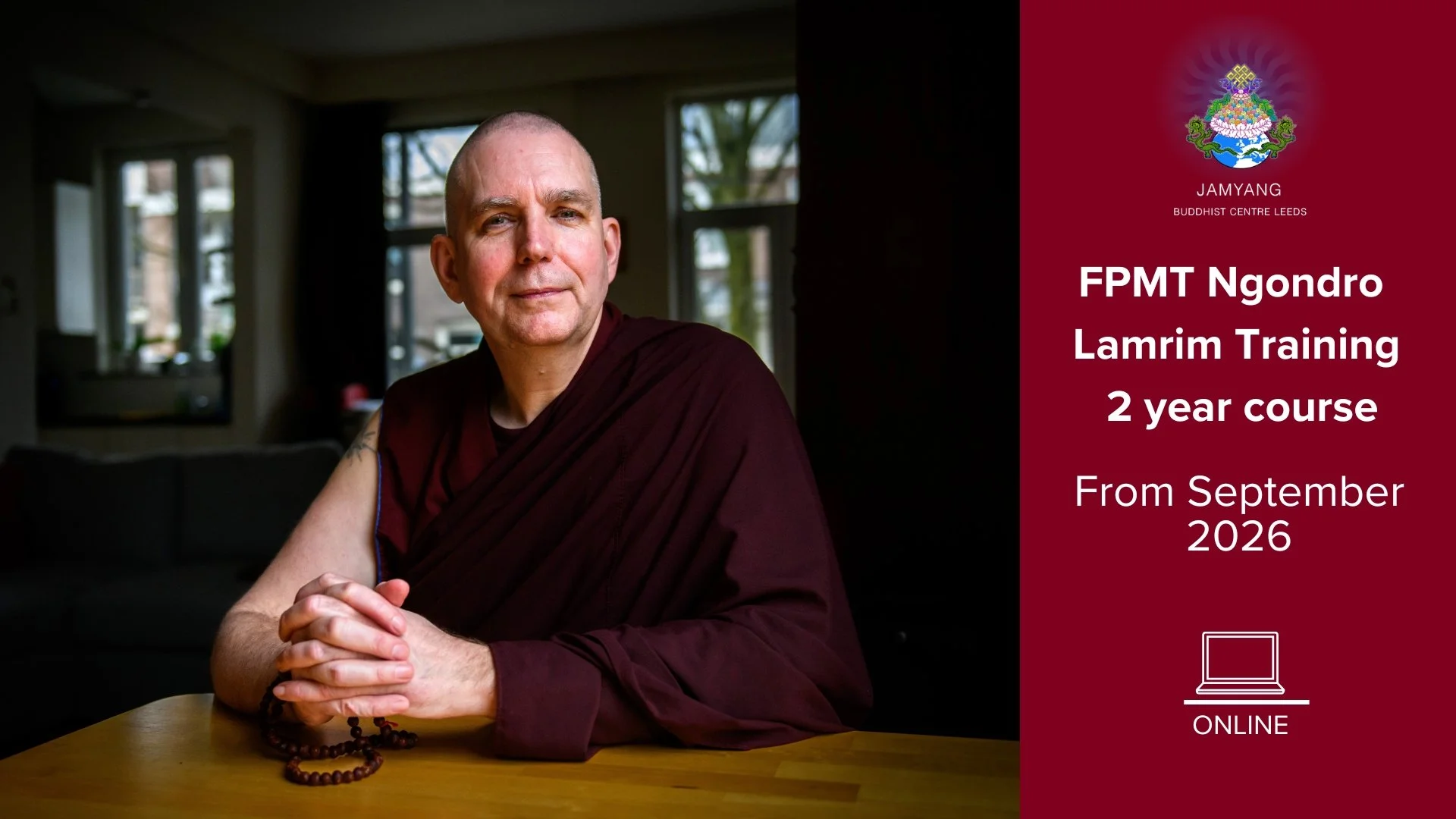
FPMT Ngondro Lamrim Training
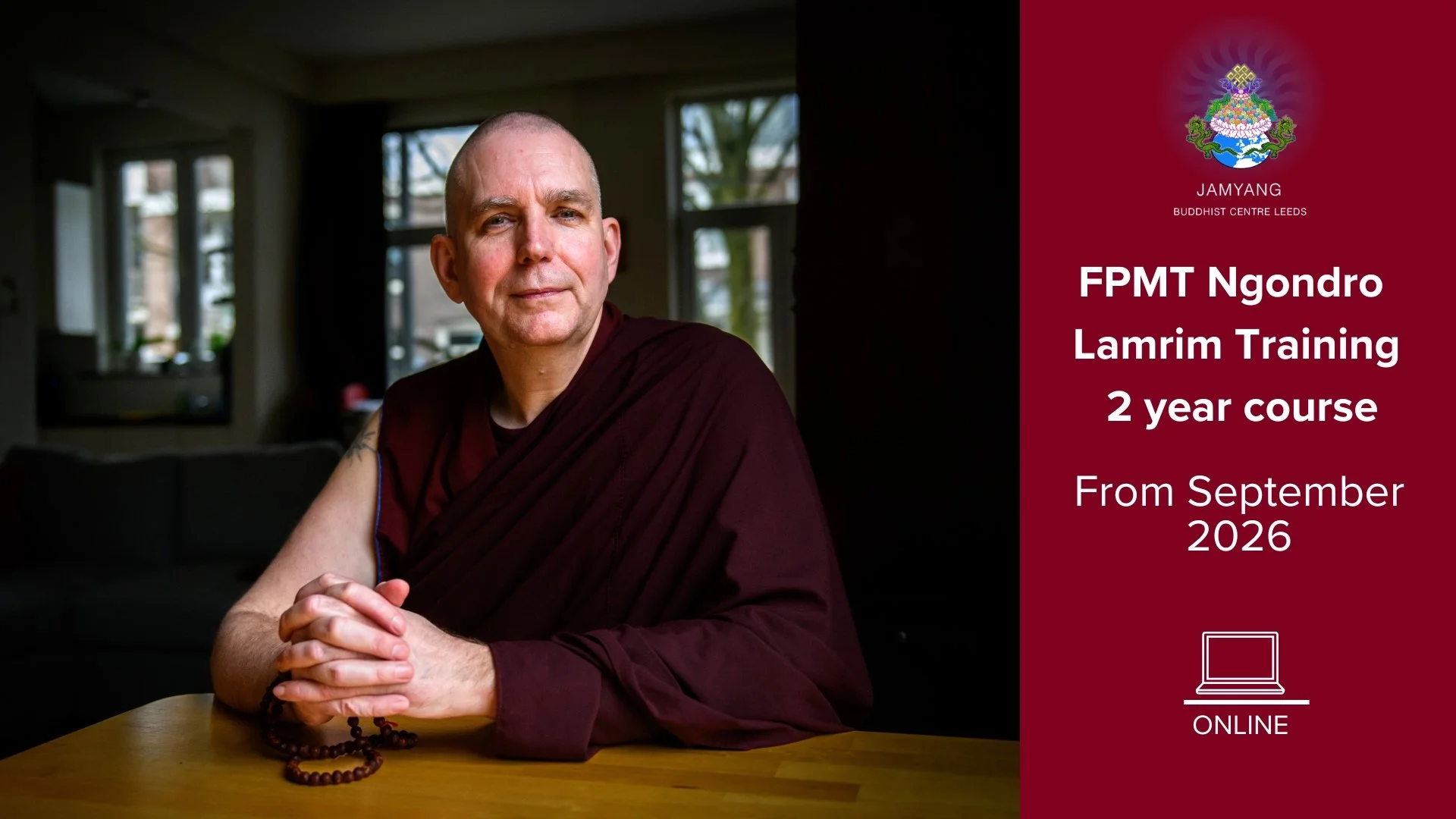
Overview of SESSION
DATE: 2026 / 2027: Year 1
Term 1: September 14th to November 28th 2026
Over a period of two years, the FPMT Ngöndro Lamrim Training (NLRT) offers 16 months of training in the common and uncommon preliminary practices. The training is designed to generate the motivation that supports the development of calm abiding, special insight, and tantra. By cultivating the inner qualities needed to ease unskillful patterns of mind that are the cause of hindrances on the path, it facilitates deep transformation.
An excellent preparation for the FPMT In-Depth Meditation Training (IDMT)
LOCATION: Recordings are released weekly
LEVEL: Buddhist Preliminary Practices
About the Course:
The Lamrim — "Stages of the Path" in Tibetan — is a systematic presentation of the entire Buddhist path to Awakening, written by the great Tibetan master Je Tsongkhapa in the 14th and early 15th century, based on writings of the Indian master Atisha. It arranges every essential teaching of the Buddha into a single, coherent, graduated sequence tailored to your mind, exactly as it is right now. Its true power lies not in study alone, but in practice. Each teaching is carefully arranged to meet the mind where it is and guide it—step by step—toward genuine change.
The uncommon preliminary practices (ngöndro) are powerful methods to purify the mind and prepare it for lasting transformation.
Over the first eleven months the common foundations, renunciation, bodhicitta, and the view of emptiness, are explored based on the Lamrim. For the remaining five months the focus is on the uncommon practices, Vajrasattva purification, mandala offerings, and guru yoga. Weekly sessions each introduce a new topic that examines different ways to meditate and why, in combination with a guided meditation.
The training helps establish a consistent daily meditative practice in supports of its overall aim: to engage in contemplative meditation in a way that genuinely transforms the mind's outlook on the world and gives one's life a new direction. Students gain a deep understanding of how to accumulate merit and purify unskillful karma while cultivating a healthy relationship with the Three Jewels and their teacher. The emphasis is on learning to meditate in a personally tailored way, in accordance with one’s psychological makeup and life conditions.
The Ngondro Lamrim Training teaching sessions are pre-recorded.
Each week, a 90-minute teaching together with two guided meditations are uploaded. On other days, advanced students contribute additional guided meditations. The teacher, Venerable Gendun, offers regular online Q&A sessions. For those who have already studied the Lamrim or the FPMT Basic Program, the training also offers specialized opportunities to learn how to guide others in meditation.
Year 1: Definite Emergence and Mind of Awakening
Prepare the mind for śamatha, vipaśyanā, and tantra
Explore renunciation and bodhicitta, the first two Principles of the Path
Develop genuine urgency through Lamrim contemplation
Cultivate the aspiration to Awakening for all beings
FPMT Ngondro Lamrim Taining is also part of The Buddha Project led by Venerable Losang Gendun. You can find out more about Venerable Gendun, the course and who it is suitable for on our FPMTNgondro Lamrim Training webpage
If you have any questions you would like to ask before registering please email our In-Depth Meditation Coordinator Marie Odile on idmt@jamyangleeds.co.uk
All materials for the course are provided to registered students.
Donations:
Generosity is one of the cornerstones of the Buddhist path. Donations help support both the centre and The Buddha Project as well as providing a donation for the teachings to Venerable Gendun. There are different levels depending on your income. There are three terms a year, each approximately 3 months long
As the course is a collaboration with other FPMT centres it is not possible to offer this as part of our Jamyang Leeds membership programme.
For those with a regular income the recommended donation is £95 per term
The sponsorhsip level is £115 per term
Ordained Sangha are free
If this isn’t affordable please do register, we never turn anyone away from the Dharma for financial reasons and we can agree a donation that is affordable for you at the current time. Please email Marie-Odile our IDMT Coordinator idmt@jamyangleeds.co.uk if you would like to chat.
Vipassana Meditation
Overview of Vipassana Meditation
Join us for a peaceful start to your week with a 30 minute Vipassana meditation session, designed to cultivate mindfulness, self-awareness, and equanimity. Led by Geshe Rinchen
DATE: Mondays weekly (March to May and July to November)
TIME: 7:00 am to 7:30 am
Vipassana (Special Insight Meditation), also called analytical meditation, is primarily a practice of wisdom. It is a form of concentration that focuses single-pointedly on the ultimate nature of phenomena through analytical reasoning. Analysing phenomena is a key aspect of Vipassana practice, as it helps develop a definitive understanding of the nature of reality—such as the self, mind, emotions, and thoughts.
As Je Tsongkhapa explains, shamatha (calm abiding) is like a lamp that remains clear and steady in a place without wind, whereas vipassana (special insight) is like seeing the nature of phenomena clearly through such a steady and clear lamp. Therefore, the usual order of these two meditations is: first, achieving calm abiding or mental stability as a foundation, then engaging in special insight meditation through analysis. However, Vipassana meditation can also be practised by analysing and observing sensations, thoughts, and emotions without first achieving shamatha. This practice should still begin with focusing on the breath or another object of meditation. In our case, we will focus on the breath to start analysing the nature of the mind in relation to our sense of self, emotions, and thoughts.
The session begins by focusing on the breath—either the rise and fall of the abdomen or the sensation of air entering and leaving the nostrils. This practice calms the mind and helps establish a deep sense of presence.
Next, we move into a guided body scan, bringing awareness to different parts of the body and observing subtle sensations without judgement. This helps develop a greater connection to your physical experience.
As we proceed, you will practise observing and analysing sensations, thoughts, and emotions as they arise, learning to witness them without attachment or aversion. This fosters a deeper understanding of the impermanence and interconnectedness of the mind and self. Finally, you will rest your mind either in the natural state of awareness or in the analytical clarity gained through observation and reasoning.
Through regular practice, Vipassana meditation cultivates wisdom, encouraging a balanced and objective view of internal experiences. This session is ideal for those seeking greater insight and calmness in their daily lives.
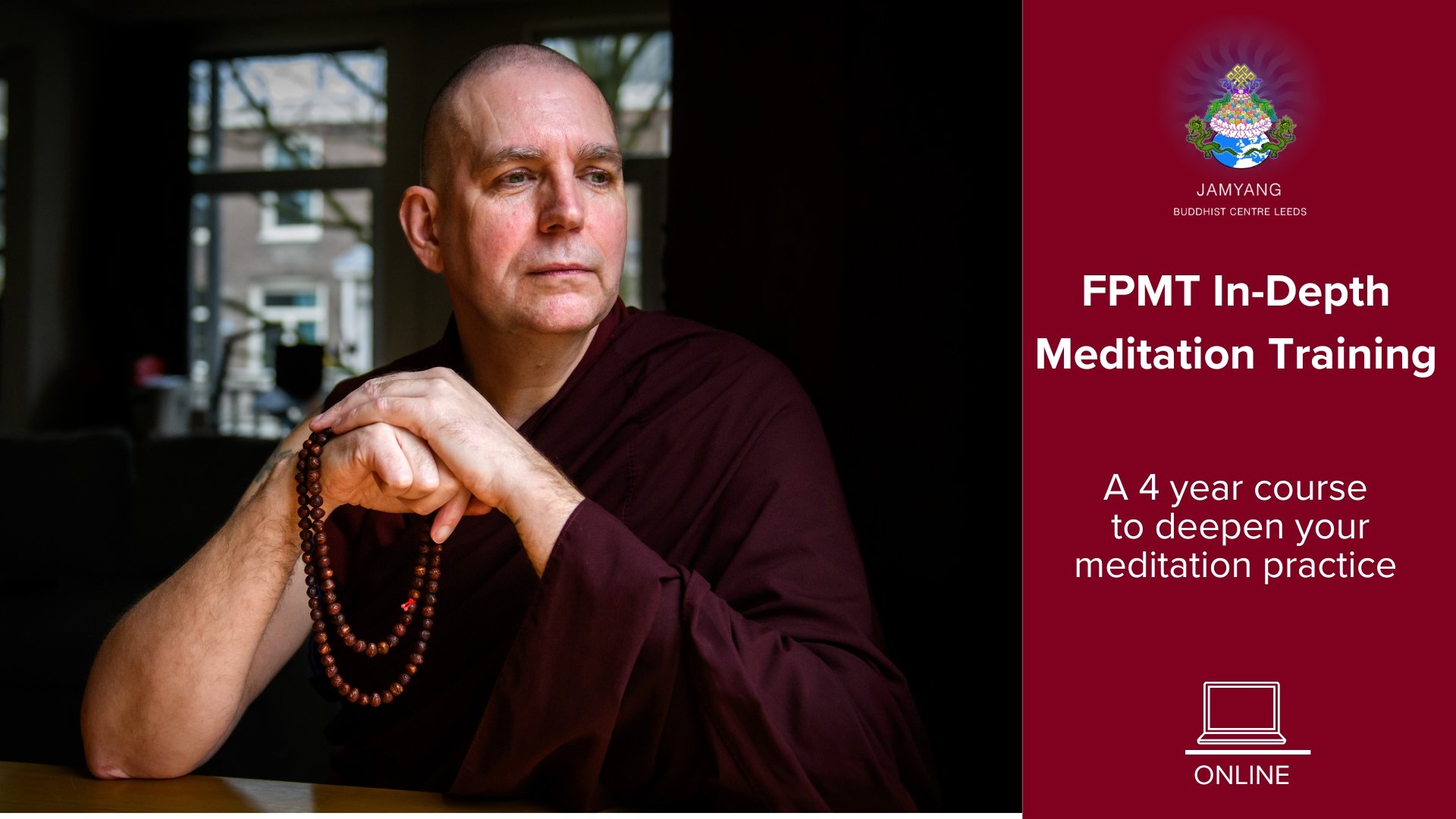
FPMT In-Depth Meditation Training
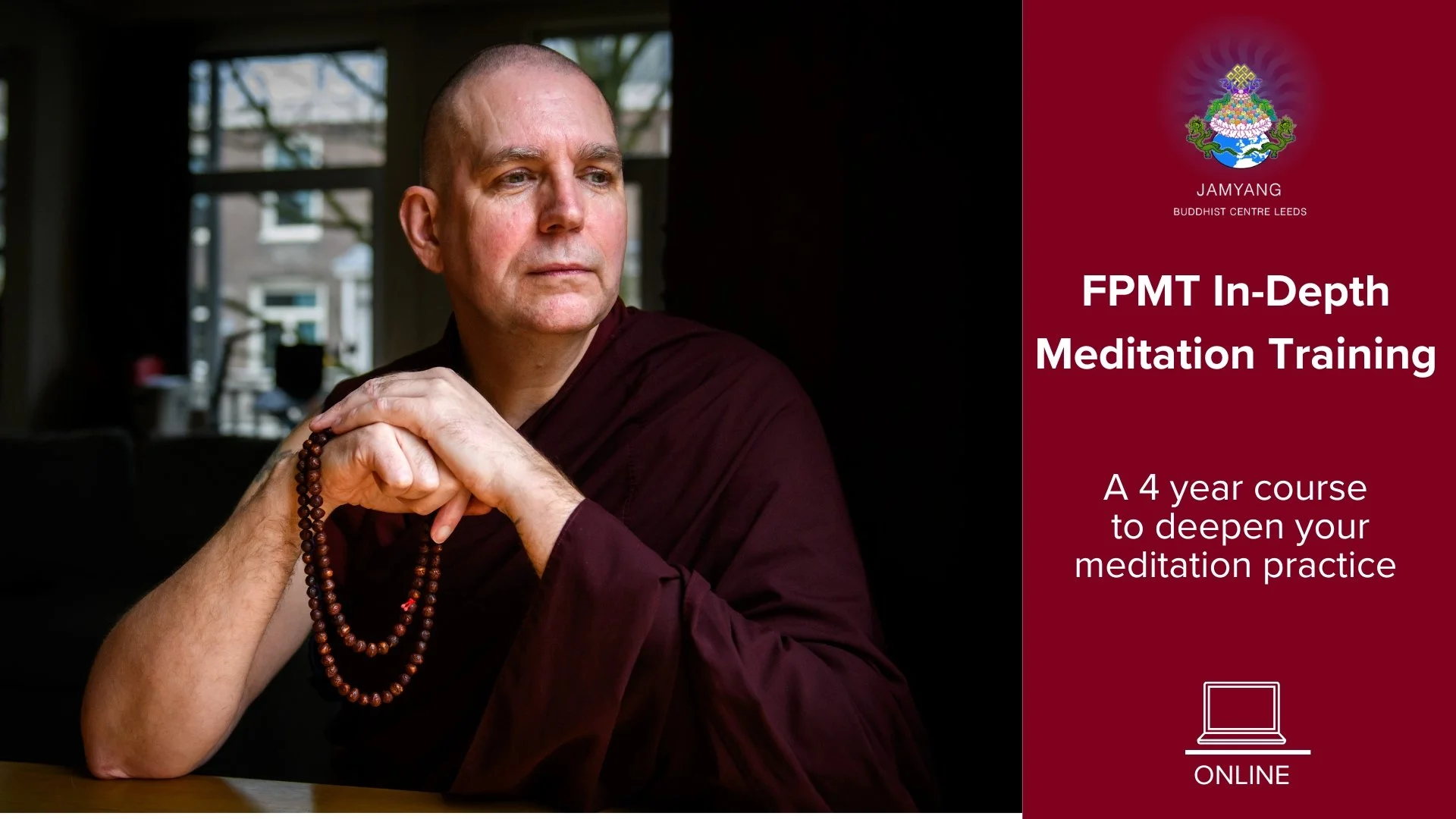
Overview of SESSION
DATE: 2026 / 2027: Year 4
Term 1: September 5th to November 28th 2026
If you are starting as a new student in year 4, don’t worry. You will get some preparatory advice on what previous recordings to have a listen to. Alternatively you may wish to join the new Ngondro Lamrim Meditation course for 2 years before starting In Depth Meditation Training. They are designed to be complementary.
TIME: Saturdays weekly 2:30pm – 5pm UK time
LOCATION: Zoom only
LEVEL: Buddhist Meditation – Intermediate to Advanced
IDMT Year Four, The Vajra Ground: Mahamudra and Kriya Tantra
In this culminating fourth year of our journey, our path turns inward to the mind itself—its empty, luminous nature—and outward to the transformative methods of tantra, where the naturally pure nature of our perception is recognized as the very ground of awakening.
As always, the year will start with generating the mind of awakening, using evocative instructions ranging from Langri Thangpa to Nāgārjuna and Lord Buddha in the famous Bodhisattvapiṭaka. This mind generation we'll cultivate through the four immeasurable thoughts and the support of calm abiding.
Illuminated by the life stories of the masters of the Gelug Mahāmudrā lineage and beyond, we'll explore its roots in the history of the early Indian Mahāsiddhas, such as Saraha and Tilopa, through the Kagyü master Gampopa's and Je Tsongkhapa's Mañjuśrī lineage up to Paṇchen Losang Chökyi Gyaltsen's Highway of the Conquerors and its perspective on this practice. In Sūtra Mahāmudrā we will practice resting attention in the empty nature of awareness, recognizing its clarity and openness as inseparable.
Kriyā Tantra offers a complementary method. Rather than suppress the ordinary, narrow self-narrative that we impose on ourselves and our world, it substitutes for it an extraordinary perspective of pure view. Occasionally, by way of introduction, we'll also taste practices from the higher tantras—glimpsing how afflictive emotions can be met as innate wisdom, and how the dissolution of the death process opens onto the innate mind of clear light. The structured practices of generation and recitation become a rehearsal for transformation, training perception to meet appearances as pure.
These methods rest on a relationship. We will therefore examine the practice of guru devotion candidly—both as the means by which the lineage's realization is transmitted and as a practice with real pitfalls, requiring discernment as much as trust. Through the Ganden Lha Gyāma, the Yoga of the inseparability of guru and Avalokiteśvara, and supporting sādhanas, devotion is approached not as deference but as the ethical road toward the state of Vajradhara: the full integration of wisdom and method.
This final year is an invitation to let realization ripen into a way of being. Grounded in bodhicitta and the four immeasurables, sustained by the preliminary practices, and held by the strength of community, we learn to meet the mind without grasping and to meet the world as pure appearance. Our aim is not to accumulate practices, but to bring the path to maturity—wisdom and compassion no longer cultivated separately, but lived as one.
This four-year online course provides students with long term, in-depth support in their meditative development.
The teacher and course developer is Venerable Losang Gendun. He has trained extensively in meditation in both Theravada and Mahayana Traditions
The In Depth Meditation Training course is also part of The Buddha Project led by Venerable Losang Gendun. You can find out more about Venerable Gendun, the course and who it is suitable for on our FPMT In-Depth Meditation Training webpage
If you have any questions you would like to ask before registering please email our In-Depth Meditation Coordinator Marie Odile on idmt@jamyangleeds.co.uk
The zoom link and all materials for the course are provided to registered students.
Donations:
Generosity is one of the cornerstones of the Buddhist path. With your donation we support The Buddha Project and we keep our centre going for the benefit of all sentient beings.
As the course is a collaboration with other FPMT centres it is not possible to offer this as part of our Jamyang Leeds membership programme.
The recommended donation per calendar month is £45.
If you are able to practice generosity and sponsor other students we recommend £58 per calendar month.
If you are on a reduced income it is £31 per calendar month.
There is also the option to donate annually.
If none of the above options are affordable please do still register, we never turn anyone away from the Dharma for financial reasons and we can agree a donation that is affordable for you right now. Please email Marie Odile our IDMT Coordinator idmt@jamyangleeds.co.uk if you would like to chat.
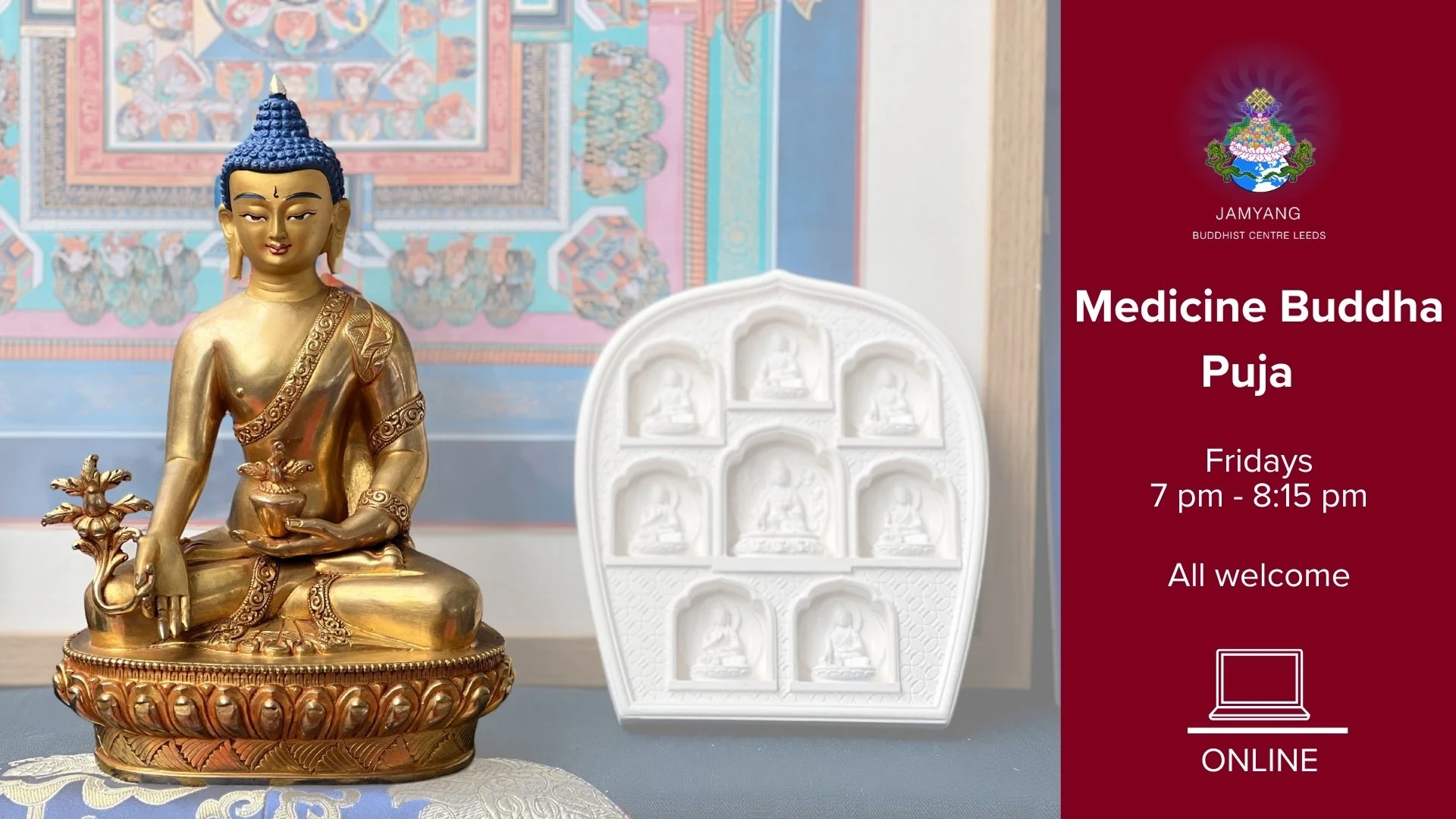
Medicine Buddha Puja
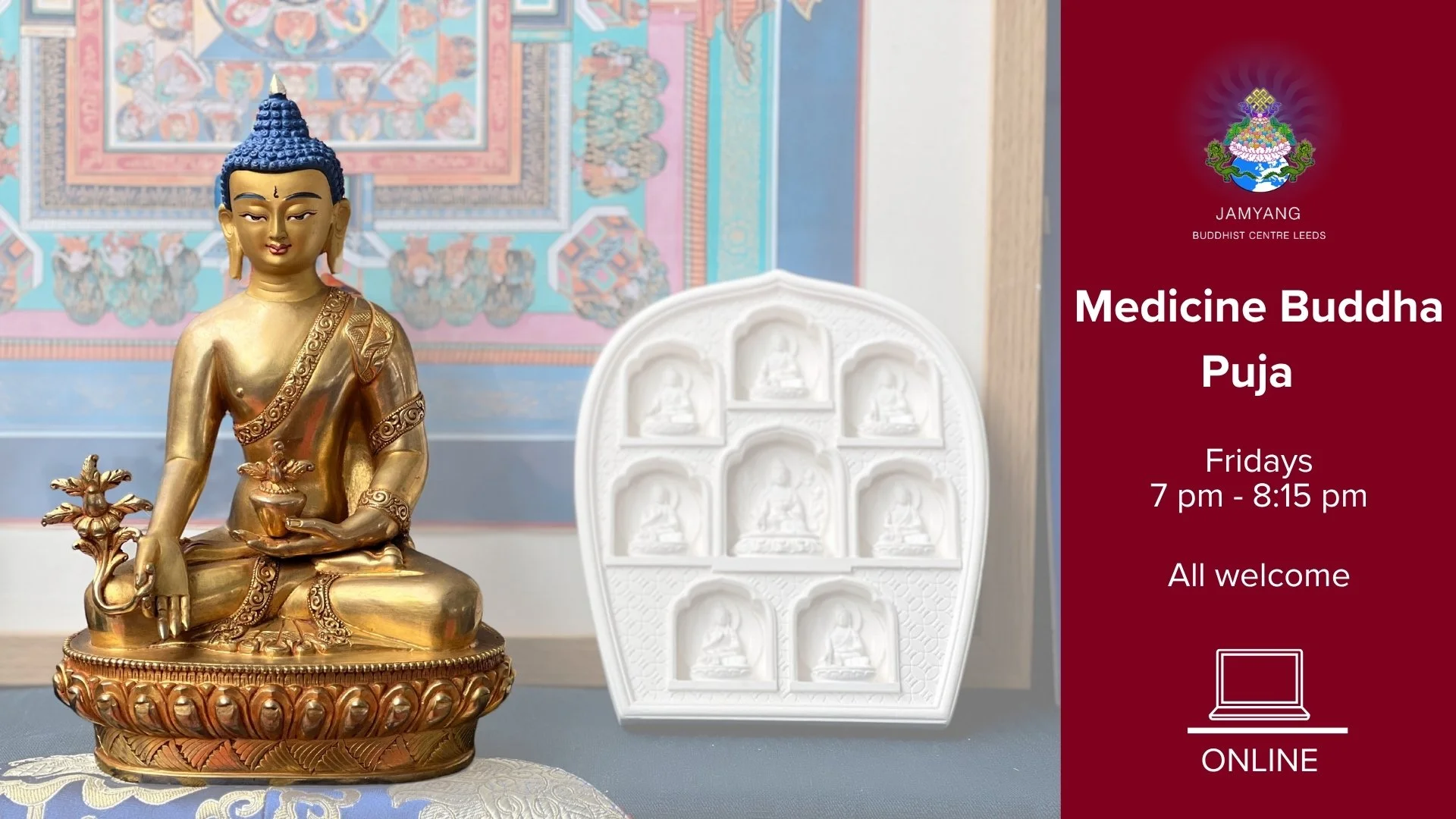
Overview of Medicine Buddha Puja
Medicine Buddha is one of the practices recommended by the FPMT for students to do for the swift return of Kyabje Lama Zopa Rinpoche.
DATE: FRIDAYS
TIME: 7 pm to 8:15 pm
LOCATION: Zoom
LEVEL: Buddhist Practices – All Welcome
SUGGESTED DONATION: £6
This is a longer meditation on Medicine Buddha – to remove obstacles, esp. those relating to health and achieving a favourable rebirth, and activate a swift path to enlightenment.
As Lama Zopa Rinpoche said: “One of the best healing meditations is that on the Medicine Buddha, who is the manifestation of the healing energy of all enlightened beings.”
The puja involves chanting prayers to the Seven Medicine Buddhas and reciting the Medicine Buddha mantras.
It is kindly led by Sande
White Umbrella Deity practice
Overview of practice
DATE: Fridays
TIME: 11:30 am to 12:00 pm
LOCATION: Please note this is online only
LEVEL: Buddhist Practices – see note below
SUGGESTED DONATION: £4
In September 2024, His Eminence Ling Rinpoche gave us this practice to overcome obstacles to the centre flourishing.
In addition to many benefits of engaging in these practices, Lama Zopa Rinpoche recommended that these two practices are beneficial to helping bring peace to situation between Israel and Palestine.
The Sanskrit name for the White Umbrella deity is Ushnisha Sitatapatra which can also be translated as “The Victorious White Parasol.” The White Umbrella Deity, [Skt. Sitatapatra, Tib. gdugs dkar] is a powerful female deity. She is relied upon for protection; healing illness; dispelling interferences, spirit possession, and harmful forces; quelling disasters; averting obstacles; and bringing auspiciousness.
Ushnisha Sitatapatra is a female form of Avalokiteshvara, the Bodhisattva of Compassion. Like this Bodhisattva in an elaborate form, she also has a thousand eyes that watch over living beings, and a thousand arms that protect and assist them. Thus she symbolizes the power of active compassion.
Practices of Arya Sitatapatra includes, “The Supreme Accomplishment of Sitatapatra,” and “Praises and Repelling Practices of Sitatapatra.”
Shamatha – Meditation on the Breath
Overview of Session
DATE: Fridays
TIME: 7am-7:30am
LOCATION: Zoom
LEVEL: All Welcome
SUGGESTED DONATION: £4
Led by Ruth
Mindfulness of Breathing is universally acknowledged to be of benefit to all living in the modern world. Many feel overloaded with all that is expected of us living this complex and exhausting existence. Developing our awareness in this way is a general prescription for soothing and healing the overworked body and mind.
Practicing focusing the attention on an object such as the breath is also a core practice in Tibetan Buddhism. Gradually over time we are able to hold the object of our attention over longer periods, which enables us to practice other meditations such as Vipassana more successfully.
Kalachakra Practice group
Overview of practice
This is a restricted group for those who have received the Kalachakra empowerment from a qualified Lama. To join the group you need to have either received the full Kalachakra empowerment or another High Yoga Tantra empowerment such as Heruka, as long as you have received a Kalachakra Jenang (permission).
This international group of Kalachakra practitioners meets weekly and alternates with commentary and practice.
Mind Mandala once a month and six session guru yoga for other sessions:
If you’re already part of this group, please use the details sent in the weekly email to join the practice
If you’d like to join us, please email spc@jamyangleeds.co.uk confirming that you have the appropriate empowerments. You will then be sent a registration form to complete.
Kshitigarbha Practice
Overview of Kshitigarbha practice
DATE: Tuesdays & Thursdays
TIME: 12pm-12:30pm
LOCATION: Zoom only
LEVEL: Buddhist Practices – All Welcome
SUGGESTED DONATION: £4
Lama Zopa Rinpoche (our organisation’s Spiritual Director) suggested Jamyang Leeds perform these practices to help with the financial obstacles we are currently having. From September 2022, we’ll be reciting this practice as much as we can. See the special newsletter explaining all about the practice here.
Chanting the Verses of Noble manjushri
Overview of Session
DATE: Thursdays
TIME: 7:45am to 8:25 am
LOCATION: Zoom only
LEVEL: Buddhist Practices – suitable for Lama Zopa Rinpoche’s students
Join us to fulfill His Holiness the Dalai Lama’s wishes and chant the Names of Noble Manjushri for the swift return of Lama Zopa Rinpoche.
Please come along even if you havent done the practice before, its quite wonderful and very energising. Please download the text below, you can also listen and practice with the audio clip of Lama Zopa Rinpoche reciting the Chanting the Names of Noble Manjushri.
the eight verses of thoughts transformation
Overview of the eight verses of thoughts transformation
Everflowing Nectar of Bodhichitta – Annihilating the Demon of the Self-Cherishing Mind
DATE: Wednesdays
TIME: 7am-7:30am
LOCATION: Zoom
LEVEL: Buddhist Practices- All Welcome
SUGGESTED DONATION: £4
Everflowing Nectar of Bodhichitta – Annihilating the Demon of the Self-Cherishing Mind
Led by Di or Sande
This practice is based on the short text” Eight Verses of Thought Transformation”, which contains the entire technique for transforming the mind into relative bodhichitta (i.e., the wish to achieve enlightenment for the benefit of all sentient beings) and absolute bodhichitta (i.e., the wisdom realizing emptiness).
Vajrasattva Practice
Overview of The Vajrasattva Practice
DATE: Tuesdays
TIME: 8:00pm-8:30pm
LOCATION: Zoom
LEVEL: Buddhist Practices – All Welcome
SUGGESTED DONATION: £4
Purification here means looking at our past unskillful actions which have created seeds of negative karma in our minds, and using visualisation and mantra recitation to remove those seeds in a healthy and productive way. Vajrasattva is the embodiment of all the Buddha’s cleaning and purifying energy. We all make mistakes, and how we deal with them is key to making spiritual progress. We’ll be using a short text composed by Lama Zopa Rinpoche
Kshitigarbha Practice
Overview of Kshitigarbha practice
DATE: Tuesdays & Thursdays
TIME: 12pm-12:30pm
LOCATION: Zoom only
LEVEL: Buddhist Practices – All Welcome
SUGGESTED DONATION: £4
Lama Zopa Rinpoche (our organisation’s Spiritual Director) suggested Jamyang Leeds perform these practices to help with the financial obstacles we are currently having. From September 2022, we’ll be reciting this practice as much as we can. See the special newsletter explaining all about the practice here.
Tonglen Loving Kindness meditation Practice
Overview of Tonglen Meditation
The Buddhist practice of Giving & Taking (Tonglen in Tibetan) is at its heart a selfless meditation of loving kindness and compassion.
DATE: Tuesdays
TIME: 7am-7:30am
LOCATION: Zoom
LEVEL: Buddhist Meditation – All Welcome
SUGGESTED DONATION: £4
A beautiful practice led by Chrissie and Di.
The Buddhist practice of Giving & Taking (Tonglen in Tibetan) is at its heart a selfless meditation of loving kindness and compassion. You imagine giving all your happiness to others, sometimes using visualisation with the breath, and then taking all the suffering and its causes from others. It’s a powerful practice for the brave-hearted!
Yamantaka Study Group
Overview of SESSION
This study group is for those who have received the empowerment to practice Solitary Hero Vajrabhairava/Yamantaka.
If you have an interest in joining the study group please email yamantakagroup@gmail.com to register.
The Yamantaka study group is held on the first or second Monday monthly at 6pm.
Yamantaka Practice Group
Overview of SESSION
This is a restricted practice, for those who have received the empowerment to practice Solitary Hero Vajrabhairava/Yamantaka.
If you have an interest in joining the group please email yamantakagroup@gmail.com to register.
The Yamantaka practice is held on the Mondays weekly. Please note that some weeks it starts at 2:30pm and some at 6pm it doesn’t always alternate weekly.
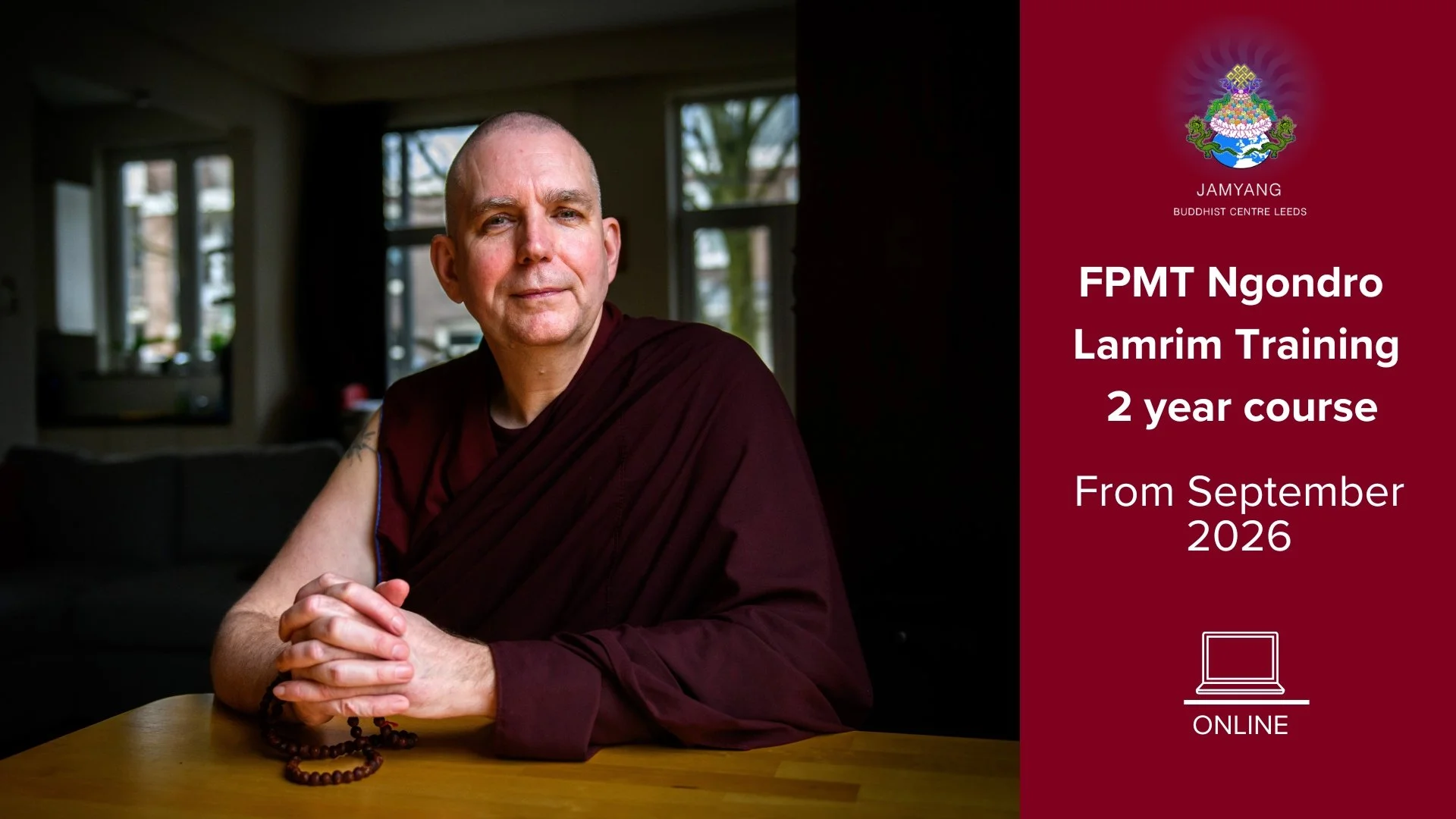
FPMT Ngondro Lamrim Training
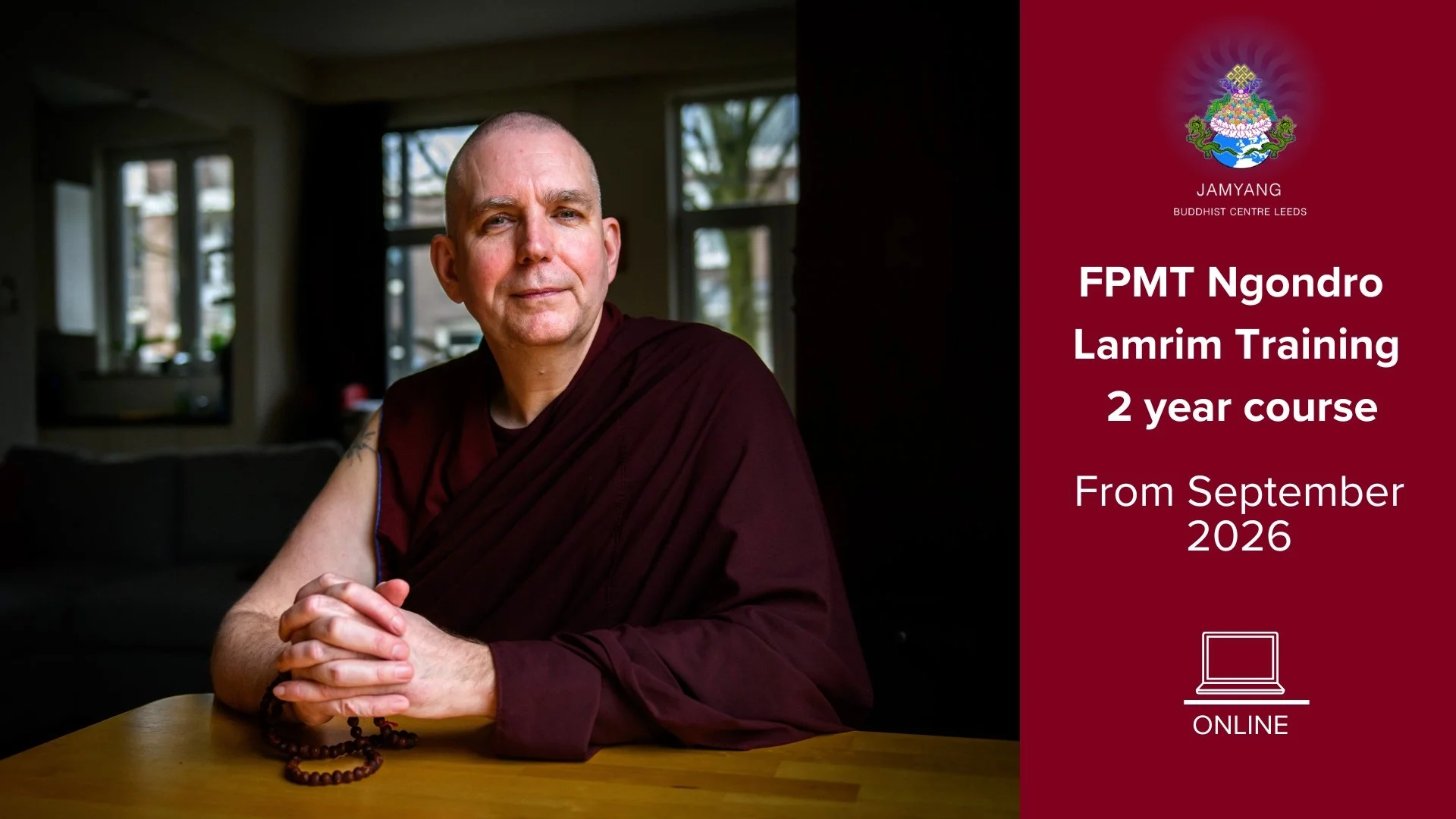
Overview of SESSION
DATE: 2026 / 2027: Year 1
Term 1: September 14th to November 28th 2026
Over a period of two years, the FPMT Ngöndro Lamrim Training (NLRT) offers 16 months of training in the common and uncommon preliminary practices. The training is designed to generate the motivation that supports the development of calm abiding, special insight, and tantra. By cultivating the inner qualities needed to ease unskillful patterns of mind that are the cause of hindrances on the path, it facilitates deep transformation.
An excellent preparation for the FPMT In-Depth Meditation Training (IDMT)
LOCATION: Recordings are released weekly
LEVEL: Buddhist Preliminary Practices
About the Course:
The Lamrim — "Stages of the Path" in Tibetan — is a systematic presentation of the entire Buddhist path to Awakening, written by the great Tibetan master Je Tsongkhapa in the 14th and early 15th century, based on writings of the Indian master Atisha. It arranges every essential teaching of the Buddha into a single, coherent, graduated sequence tailored to your mind, exactly as it is right now. Its true power lies not in study alone, but in practice. Each teaching is carefully arranged to meet the mind where it is and guide it—step by step—toward genuine change.
The uncommon preliminary practices (ngöndro) are powerful methods to purify the mind and prepare it for lasting transformation.
Over the first eleven months the common foundations, renunciation, bodhicitta, and the view of emptiness, are explored based on the Lamrim. For the remaining five months the focus is on the uncommon practices, Vajrasattva purification, mandala offerings, and guru yoga. Weekly sessions each introduce a new topic that examines different ways to meditate and why, in combination with a guided meditation.
The training helps establish a consistent daily meditative practice in supports of its overall aim: to engage in contemplative meditation in a way that genuinely transforms the mind's outlook on the world and gives one's life a new direction. Students gain a deep understanding of how to accumulate merit and purify unskillful karma while cultivating a healthy relationship with the Three Jewels and their teacher. The emphasis is on learning to meditate in a personally tailored way, in accordance with one’s psychological makeup and life conditions.
The Ngondro Lamrim Training teaching sessions are pre-recorded.
Each week, a 90-minute teaching together with two guided meditations are uploaded. On other days, advanced students contribute additional guided meditations. The teacher, Venerable Gendun, offers regular online Q&A sessions. For those who have already studied the Lamrim or the FPMT Basic Program, the training also offers specialized opportunities to learn how to guide others in meditation.
Year 1: Definite Emergence and Mind of Awakening
Prepare the mind for śamatha, vipaśyanā, and tantra
Explore renunciation and bodhicitta, the first two Principles of the Path
Develop genuine urgency through Lamrim contemplation
Cultivate the aspiration to Awakening for all beings
FPMT Ngondro Lamrim Taining is also part of The Buddha Project led by Venerable Losang Gendun. You can find out more about Venerable Gendun, the course and who it is suitable for on our FPMT Ngondro Lamrim Training webpage
If you have any questions you would like to ask before registering please email our In-Depth Meditation Coordinator Marie Odile on idmt@jamyangleeds.co.uk
All materials for the course are provided to registered students.
Donations:
Generosity is one of the cornerstones of the Buddhist path. Donations help support both the centre and The Buddha Project as well as providing a donation for the teachings to Venerable Gendun. There are different levels depending on your income. There are three terms a year, each approximately 3 months long
As the course is a collaboration with other FPMT centres it is not possible to offer this as part of our Jamyang Leeds membership programme.
For those with a regular income the recommended donation is £95 per term
The sponsorhsip level is £115 per term
Ordained Sangha are free
If this isn’t affordable please do register, we never turn anyone away from the Dharma for financial reasons and we can agree a donation that is affordable for you at the current time. Please email Marie-Odile our IDMT Coordinator idmt@jamyangleeds.co.uk if you would like to chat.
Lama Choepa (Guru Puja) and Tsog
Overview of Session
DATES: 2026: 13th January; 11th February; 13th March; 26th April; 12th May; 10th June; 24th July; 8th August; 21st September; 5th October; 4th November; 3rd December
TIME: 60 - 90 minute sessions, start time varies
LOCATION: In Person and Online
LEVEL: Buddhist Ceremonies – All Welcome
Dedicated to the Swift return of Lama Zopa Rinpoche as a bright, unmistaken child.
During the practice of Lama Choepa, we invoke all the lamas of the graduated path lineage, beginning with Shakyamuni Buddha himself, extending to our present direct teachers who have shown us the path. We pay homage to them, make offerings, and request each of them to please bless our minds with the same realizations that they themselves have generated. By offering sincere, heartfelt requests, we make our minds ripe to receive the full blessings of this precious lineage and quickly actualize the realizations we need to attain enlightenment. If we wish to experience realisations quickly, the practice of Lama Choepa is indispensable.
“If you are able to do the practice of Guru Puja in your daily life, it contains all the important points of sutra and tantra. It is a complete practice, and it shows the heart of the instruction of Lama Tsongkhapa’s tradition. Even if one can’t do much else in daily life, Guru Puja is the essential practice.”
Open to all Buddhists, no empowerments needed.
Please arrive early and bring flowers, incense, vegetarian food and drink as offerings for the altar.
More information can also be found on this FPMT page.
Morning Prayers
Overview
Start the day by joining us for Morning Prayers recommended by Lama Zopa Rinpoche and HH Dalai Lama, for the benefit of all sentient beings and the swift return of Lama Zopa Rinpoche. Everyone is welcome.
DATE: Monday – Friday all year around
TIME: 8:30am - 9:00am
LOCATION: Zoom
LEVEL: Buddhist Practices – All Welcome
Vipassana Meditation
Overview of Vipassana Meditation
Join us for a peaceful start to your week with a 30 minute Vipassana meditation session, designed to cultivate mindfulness, self-awareness, and equanimity. Led by Geshe Rinchen
DATE: Mondays weekly (March to May and July to November)
TIME: 7:00 am to 7:30 am
Vipassana (Special Insight Meditation), also called analytical meditation, is primarily a practice of wisdom. It is a form of concentration that focuses single-pointedly on the ultimate nature of phenomena through analytical reasoning. Analysing phenomena is a key aspect of Vipassana practice, as it helps develop a definitive understanding of the nature of reality—such as the self, mind, emotions, and thoughts.
As Je Tsongkhapa explains, shamatha (calm abiding) is like a lamp that remains clear and steady in a place without wind, whereas vipassana (special insight) is like seeing the nature of phenomena clearly through such a steady and clear lamp. Therefore, the usual order of these two meditations is: first, achieving calm abiding or mental stability as a foundation, then engaging in special insight meditation through analysis. However, Vipassana meditation can also be practised by analysing and observing sensations, thoughts, and emotions without first achieving shamatha. This practice should still begin with focusing on the breath or another object of meditation. In our case, we will focus on the breath to start analysing the nature of the mind in relation to our sense of self, emotions, and thoughts.
The session begins by focusing on the breath—either the rise and fall of the abdomen or the sensation of air entering and leaving the nostrils. This practice calms the mind and helps establish a deep sense of presence.
Next, we move into a guided body scan, bringing awareness to different parts of the body and observing subtle sensations without judgement. This helps develop a greater connection to your physical experience.
As we proceed, you will practise observing and analysing sensations, thoughts, and emotions as they arise, learning to witness them without attachment or aversion. This fosters a deeper understanding of the impermanence and interconnectedness of the mind and self. Finally, you will rest your mind either in the natural state of awareness or in the analytical clarity gained through observation and reasoning.
Through regular practice, Vipassana meditation cultivates wisdom, encouraging a balanced and objective view of internal experiences. This session is ideal for those seeking greater insight and calmness in their daily lives.
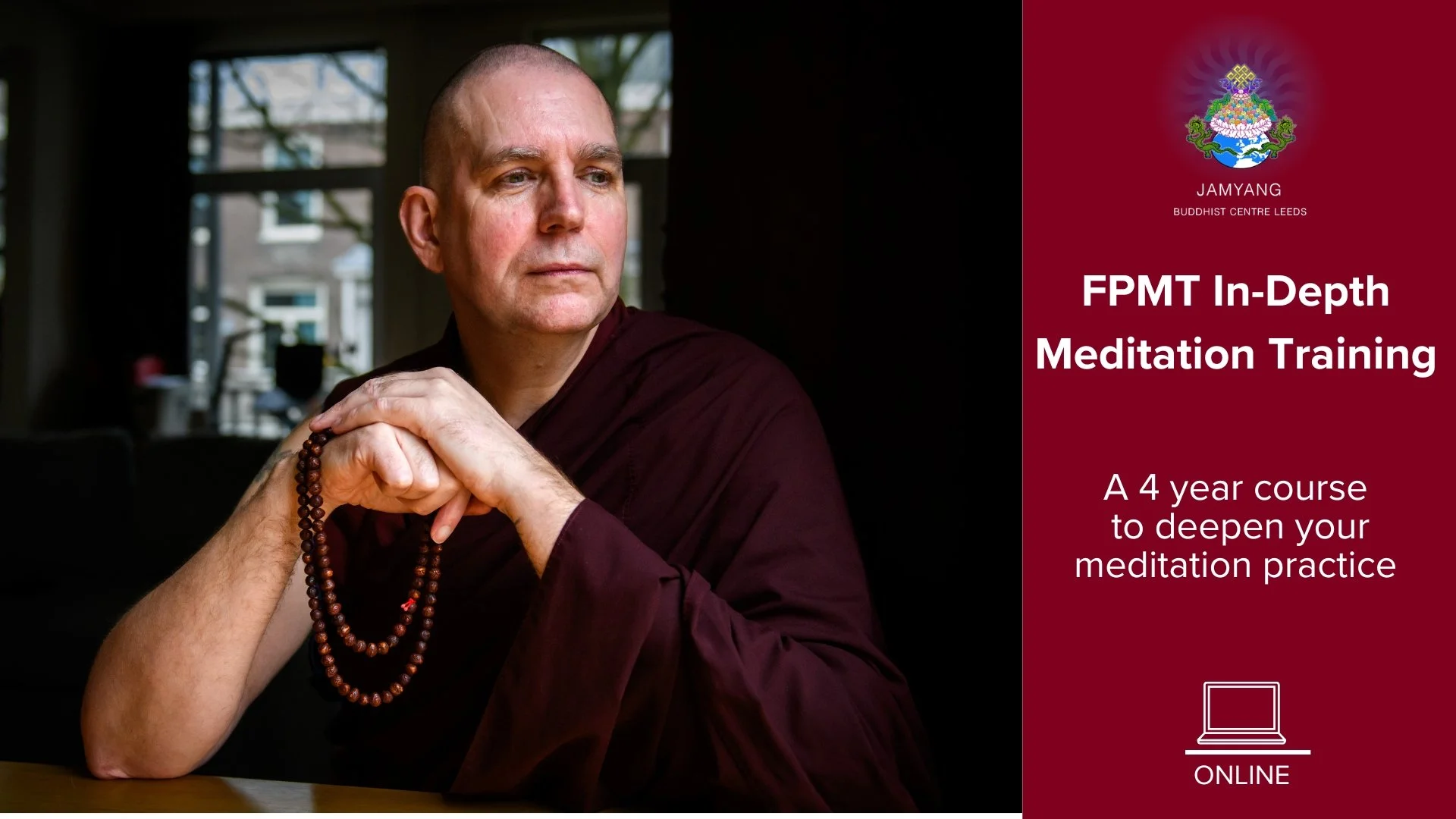
FPMT In-Depth Meditation Training
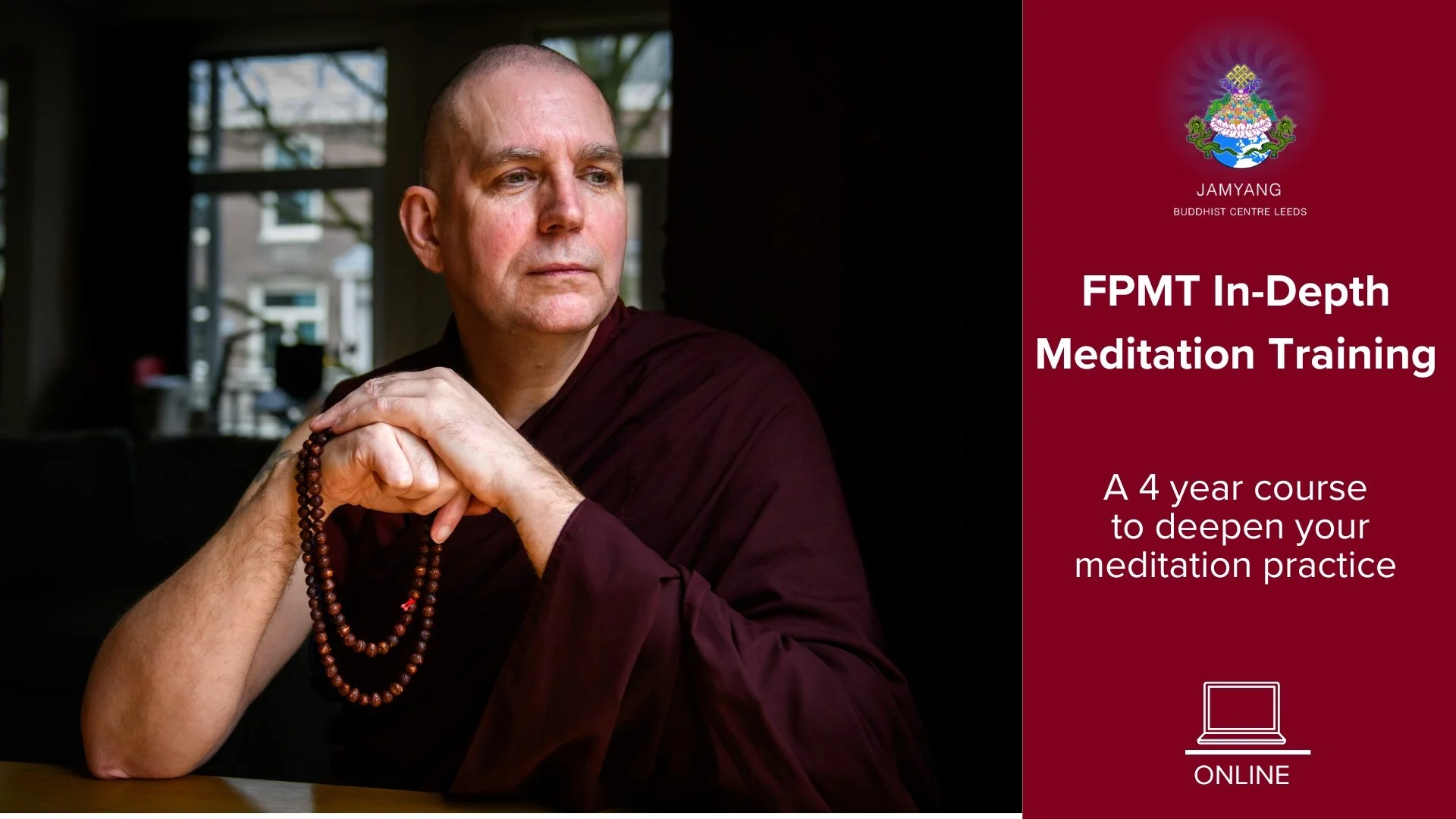
Overview of SESSION
DATE: 2026 / 2027: Year 4
Term 1: September 5th to November 28th 2026
If you are starting as a new student in year 4, don’t worry. You will get some preparatory advice on what previous recordings to have a listen to. Alternatively you may wish to join the new Ngondro Lamrim Meditation course for 2 years before starting In Depth Meditation Training. They are designed to be complementary.
TIME: Saturdays weekly 2:30pm – 5pm UK time
LOCATION: Zoom only
LEVEL: Buddhist Meditation – Intermediate to Advanced
IDMT Year Four, The Vajra Ground: Mahamudra and Kriya Tantra
In this culminating fourth year of our journey, our path turns inward to the mind itself—its empty, luminous nature—and outward to the transformative methods of tantra, where the naturally pure nature of our perception is recognized as the very ground of awakening.
As always, the year will start with generating the mind of awakening, using evocative instructions ranging from Langri Thangpa to Nāgārjuna and Lord Buddha in the famous Bodhisattvapiṭaka. This mind generation we'll cultivate through the four immeasurable thoughts and the support of calm abiding.
Illuminated by the life stories of the masters of the Gelug Mahāmudrā lineage and beyond, we'll explore its roots in the history of the early Indian Mahāsiddhas, such as Saraha and Tilopa, through the Kagyü master Gampopa's and Je Tsongkhapa's Mañjuśrī lineage up to Paṇchen Losang Chökyi Gyaltsen's Highway of the Conquerors and its perspective on this practice. In Sūtra Mahāmudrā we will practice resting attention in the empty nature of awareness, recognizing its clarity and openness as inseparable.
Kriyā Tantra offers a complementary method. Rather than suppress the ordinary, narrow self-narrative that we impose on ourselves and our world, it substitutes for it an extraordinary perspective of pure view. Occasionally, by way of introduction, we'll also taste practices from the higher tantras—glimpsing how afflictive emotions can be met as innate wisdom, and how the dissolution of the death process opens onto the innate mind of clear light. The structured practices of generation and recitation become a rehearsal for transformation, training perception to meet appearances as pure.
These methods rest on a relationship. We will therefore examine the practice of guru devotion candidly—both as the means by which the lineage's realization is transmitted and as a practice with real pitfalls, requiring discernment as much as trust. Through the Ganden Lha Gyāma, the Yoga of the inseparability of guru and Avalokiteśvara, and supporting sādhanas, devotion is approached not as deference but as the ethical road toward the state of Vajradhara: the full integration of wisdom and method.
This final year is an invitation to let realization ripen into a way of being. Grounded in bodhicitta and the four immeasurables, sustained by the preliminary practices, and held by the strength of community, we learn to meet the mind without grasping and to meet the world as pure appearance. Our aim is not to accumulate practices, but to bring the path to maturity—wisdom and compassion no longer cultivated separately, but lived as one.
This four-year online course provides students with long term, in-depth support in their meditative development.
The teacher and course developer is Venerable Losang Gendun. He has trained extensively in meditation in both Theravada and Mahayana Traditions
The In Depth Meditation Training course is also part of The Buddha Project led by Venerable Losang Gendun. You can find out more about Venerable Gendun, the course and who it is suitable for on our FPMT In-Depth Meditation Training webpage
If you have any questions you would like to ask before registering please email our In-Depth Meditation Coordinator Marie Odile on idmt@jamyangleeds.co.uk
The zoom link and all materials for the course are provided to registered students.
Donations:
Generosity is one of the cornerstones of the Buddhist path. With your donation we support The Buddha Project and we keep our centre going for the benefit of all sentient beings.
As the course is a collaboration with other FPMT centres it is not possible to offer this as part of our Jamyang Leeds membership programme.
The recommended donation per calendar month is £45.
If you are able to practice generosity and sponsor other students we recommend £58 per calendar month.
If you are on a reduced income it is £31 per calendar month.
There is also the option to donate annually.
If none of the above options are affordable please do still register, we never turn anyone away from the Dharma for financial reasons and we can agree a donation that is affordable for you right now. Please email Marie Odile our IDMT Coordinator idmt@jamyangleeds.co.uk if you would like to chat.
Medicine Buddha Puja
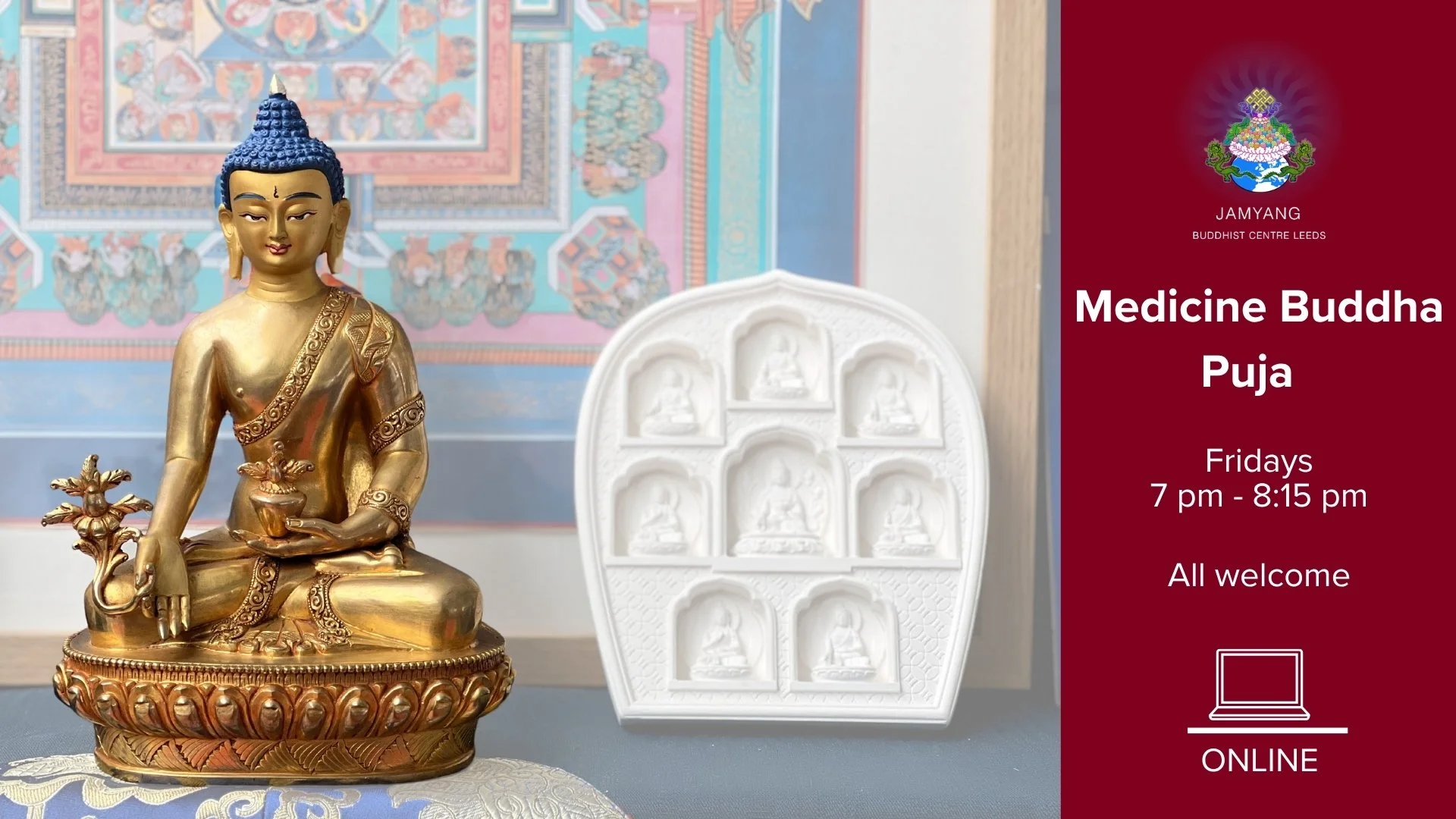
Overview of Medicine Buddha Puja
Medicine Buddha is one of the practices recommended by the FPMT for students to do for the swift return of Kyabje Lama Zopa Rinpoche.
DATE: Fridays
TIME: 7 pm to 8:15 pm
LOCATION: Zoom
LEVEL: Buddhist Practices – All Welcome
SUGGESTED DONATION: £6
This is a longer meditation on Medicine Buddha – to remove obstacles, esp. those relating to health and achieving a favourable rebirth, and activate a swift path to enlightenment.
As Lama Zopa Rinpoche said: “One of the best healing meditations is that on the Medicine Buddha, who is the manifestation of the healing energy of all enlightened beings.”
The puja involves chanting prayers to the Seven Medicine Buddhas and reciting the Medicine Buddha mantras.
It is kindly led by Sande
White Umbrella Deity practice
Overview of practice
DATE: Fridays
TIME: 11:30 am to 12:00 pm
LOCATION: Please note this is online only
LEVEL: Buddhist Practices – see note below
SUGGESTED DONATION: £4
In September 2024, His Eminence Ling Rinpoche gave us this practice to overcome obstacles to the centre flourishing.
In addition to many benefits of engaging in these practices, Lama Zopa Rinpoche recommended that these two practices are beneficial to helping bring peace to situation between Israel and Palestine.
The Sanskrit name for the White Umbrella deity is Ushnisha Sitatapatra which can also be translated as “The Victorious White Parasol.” The White Umbrella Deity, [Skt. Sitatapatra, Tib. gdugs dkar] is a powerful female deity. She is relied upon for protection; healing illness; dispelling interferences, spirit possession, and harmful forces; quelling disasters; averting obstacles; and bringing auspiciousness.
Ushnisha Sitatapatra is a female form of Avalokiteshvara, the Bodhisattva of Compassion. Like this Bodhisattva in an elaborate form, she also has a thousand eyes that watch over living beings, and a thousand arms that protect and assist them. Thus she symbolizes the power of active compassion.
Practices of Arya Sitatapatra includes, “The Supreme Accomplishment of Sitatapatra,” and “Praises and Repelling Practices of Sitatapatra.”
Shamatha – Meditation on the Breath
Overview of Session
DATE: Fridays
TIME: 7am-7:30am
LOCATION: Zoom
LEVEL: All Welcome
SUGGESTED DONATION: £4
Led by Ruth
Mindfulness of Breathing is universally acknowledged to be of benefit to all living in the modern world. Many feel overloaded with all that is expected of us living this complex and exhausting existence. Developing our awareness in this way is a general prescription for soothing and healing the overworked body and mind.
Practicing focusing the attention on an object such as the breath is also a core practice in Tibetan Buddhism. Gradually over time we are able to hold the object of our attention over longer periods, which enables us to practice other meditations such as Vipassana more successfully.
Kalachakra Practice group
Overview of practice
This is a restricted group for those who have received the Kalachakra empowerment from a qualified Lama. To join the group you need to have either received the full Kalachakra empowerment or another High Yoga Tantra empowerment such as Heruka, as long as you have received a Kalachakra Jenang (permission).
This international group of Kalachakra practitioners meets weekly and alternates with commentary and practice.
Mind Mandala once a month and six session guru yoga for other sessions:
If you’re already part of this group, please use the details sent in the weekly email to join the practice
If you’d like to join us, please email spc@jamyangleeds.co.uk confirming that you have the appropriate empowerments. You will then be sent a registration form to complete.
Kshitigarbha Practice
Overview of Kshitigarbha practice
DATE: Tuesdays & Thursdays
TIME: 12pm-12:30pm
LOCATION: Zoom only
LEVEL: Buddhist Practices – All Welcome
SUGGESTED DONATION: £4
Lama Zopa Rinpoche (our organisation’s Spiritual Director) suggested Jamyang Leeds perform these practices to help with the financial obstacles we are currently having. From September 2022, we’ll be reciting this practice as much as we can. See the special newsletter explaining all about the practice here.
Chanting the Verses of Noble manjushri
Overview of Session
DATE: Thursdays
TIME: 7:45am to 8:25 am
LOCATION: Zoom only
LEVEL: Buddhist Practices – suitable for Lama Zopa Rinpoche’s students
Join us to fulfill His Holiness the Dalai Lama’s wishes and chant the Names of Noble Manjushri for the swift return of Lama Zopa Rinpoche.
Please come along even if you havent done the practice before, its quite wonderful and very energising. Please download the text below, you can also listen and practice with the audio clip of Lama Zopa Rinpoche reciting the Chanting the Names of Noble Manjushri.
the eight verses of thoughts transformation
Overview of the eight verses of thoughts transformation
Everflowing Nectar of Bodhichitta – Annihilating the Demon of the Self-Cherishing Mind
DATE: Wednesdays
TIME: 7am-7:30am
LOCATION: Zoom
LEVEL: Buddhist Practices- All Welcome
SUGGESTED DONATION: £4
Everflowing Nectar of Bodhichitta – Annihilating the Demon of the Self-Cherishing Mind
Led by Di or Sande
This practice is based on the short text” Eight Verses of Thought Transformation”, which contains the entire technique for transforming the mind into relative bodhichitta (i.e., the wish to achieve enlightenment for the benefit of all sentient beings) and absolute bodhichitta (i.e., the wisdom realizing emptiness).