

SEARCH Upcoming events
Search by Category
- Buddhist Ceremonies
- Buddhist Retreats
- Buddhist Studies
- Buddhist teachings
- Children's Programme
- Children's Yoga
- Children's mindfulness
- Children's relaxation and breathing
- Children's wellbeing
- Community Events
- Eco Dharma
- External Courses
- Meditation
- Public Talk
- Pujas and Practice
- Retreat
- Tech support
- Wellbeing
- Yoga
UPCOMING EVENTS LIST
Vipassana Meditation
Overview of Vipassana Meditation
Join us for a peaceful start to your week with a 30 minute Vipassana meditation session, designed to cultivate mindfulness, self-awareness, and equanimity. Led by Geshe Rinchen
DATE: Mondays weekly (March to May and July to November)
TIME: 7:00 am to 7:30 am
Vipassana (Special Insight Meditation), also called analytical meditation, is primarily a practice of wisdom. It is a form of concentration that focuses single-pointedly on the ultimate nature of phenomena through analytical reasoning. Analysing phenomena is a key aspect of Vipassana practice, as it helps develop a definitive understanding of the nature of reality—such as the self, mind, emotions, and thoughts.
As Je Tsongkhapa explains, shamatha (calm abiding) is like a lamp that remains clear and steady in a place without wind, whereas vipassana (special insight) is like seeing the nature of phenomena clearly through such a steady and clear lamp. Therefore, the usual order of these two meditations is: first, achieving calm abiding or mental stability as a foundation, then engaging in special insight meditation through analysis. However, Vipassana meditation can also be practised by analysing and observing sensations, thoughts, and emotions without first achieving shamatha. This practice should still begin with focusing on the breath or another object of meditation. In our case, we will focus on the breath to start analysing the nature of the mind in relation to our sense of self, emotions, and thoughts.
The session begins by focusing on the breath—either the rise and fall of the abdomen or the sensation of air entering and leaving the nostrils. This practice calms the mind and helps establish a deep sense of presence.
Next, we move into a guided body scan, bringing awareness to different parts of the body and observing subtle sensations without judgement. This helps develop a greater connection to your physical experience.
As we proceed, you will practise observing and analysing sensations, thoughts, and emotions as they arise, learning to witness them without attachment or aversion. This fosters a deeper understanding of the impermanence and interconnectedness of the mind and self. Finally, you will rest your mind either in the natural state of awareness or in the analytical clarity gained through observation and reasoning.
Through regular practice, Vipassana meditation cultivates wisdom, encouraging a balanced and objective view of internal experiences. This session is ideal for those seeking greater insight and calmness in their daily lives.
Morning Prayers
Overview
Start the day by joining us for Morning Prayers recommended by Lama Zopa Rinpoche and HH Dalai Lama, for the benefit of all sentient beings and the swift return of Lama Zopa Rinpoche. Everyone is welcome.
DATE: Monday – Friday all year around
TIME: 8:30am - 9:00am
LOCATION: Zoom
LEVEL: Buddhist Practices – All Welcome
FPMT Ngondro Lamrim Training
Overview of SESSION
DATE: 2026 / 2027: Year 1
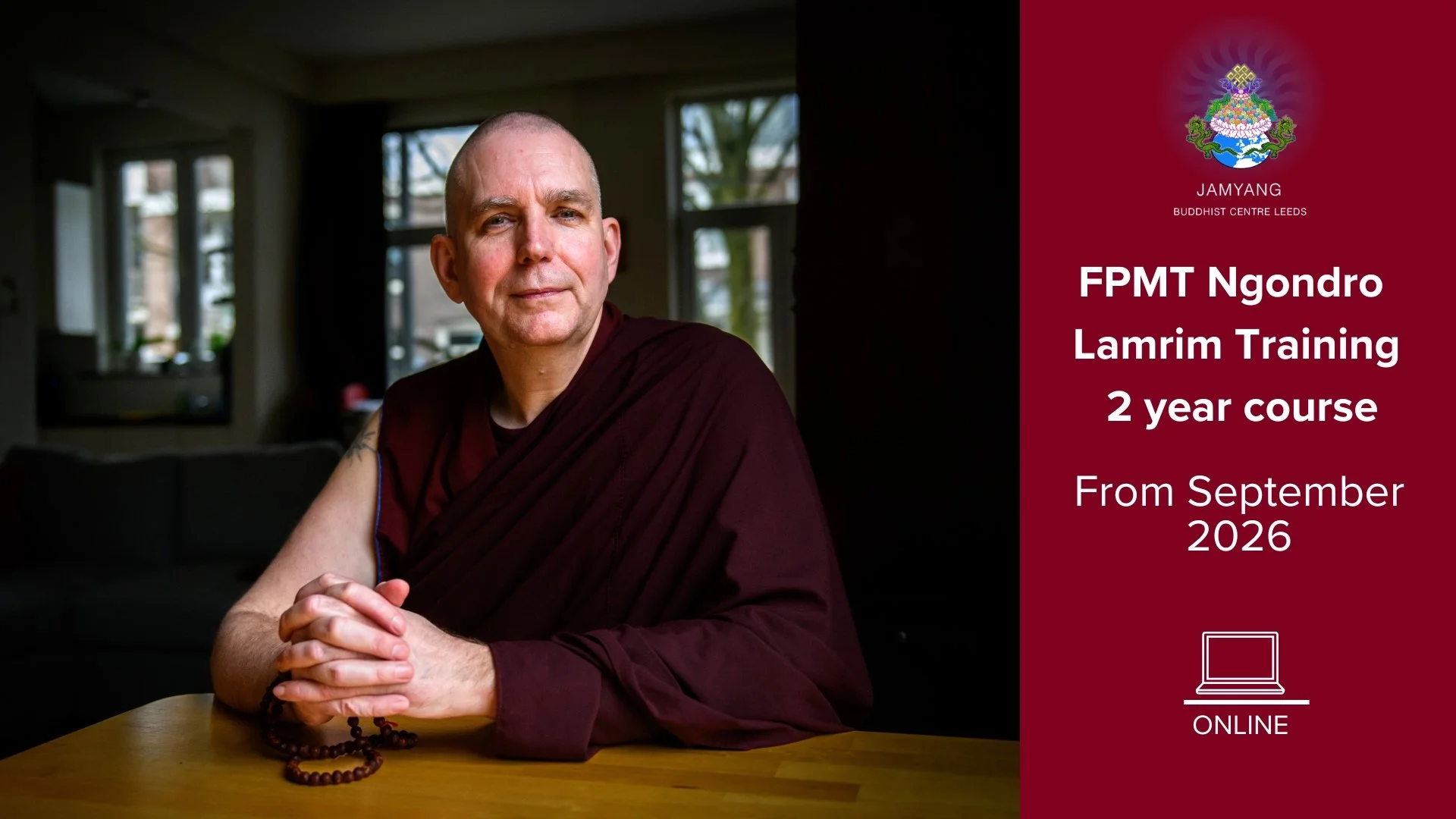
Term 1: September 14th to November 28th 2026
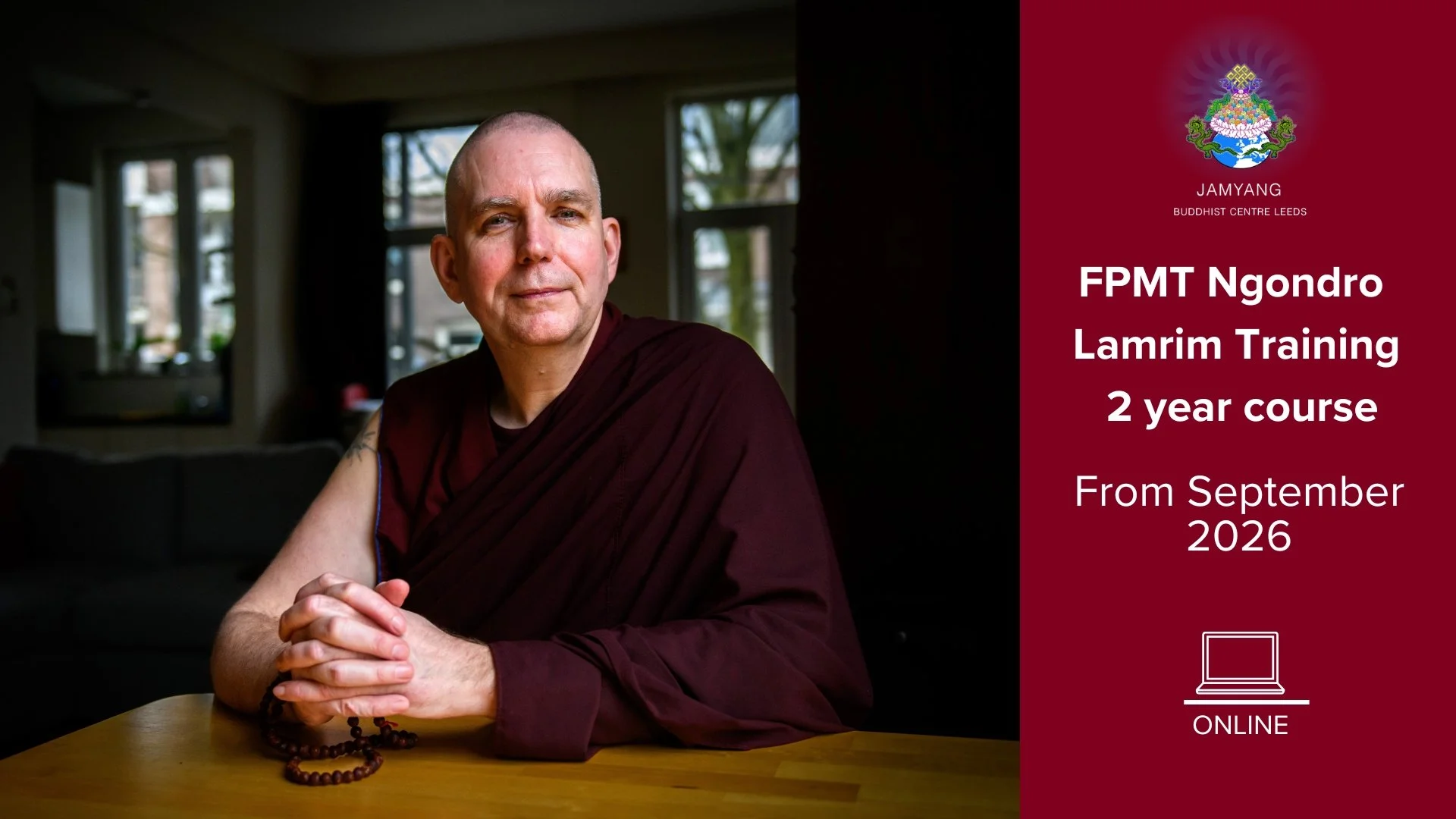
Over a period of two years, the FPMT Ngöndro Lamrim Training (NLRT) offers 16 months of training in the common and uncommon preliminary practices. The training is designed to generate the motivation that supports the development of calm abiding, special insight, and tantra. By cultivating the inner qualities needed to ease unskillful patterns of mind that are the cause of hindrances on the path, it facilitates deep transformation.
An excellent preparation for the FPMT In-Depth Meditation Training (IDMT)
LOCATION: Recordings are released weekly
LEVEL: Buddhist Preliminary Practices
About the Course:
The Lamrim — "Stages of the Path" in Tibetan — is a systematic presentation of the entire Buddhist path to Awakening, written by the great Tibetan master Je Tsongkhapa in the 14th and early 15th century, based on writings of the Indian master Atisha. It arranges every essential teaching of the Buddha into a single, coherent, graduated sequence tailored to your mind, exactly as it is right now. Its true power lies not in study alone, but in practice. Each teaching is carefully arranged to meet the mind where it is and guide it—step by step—toward genuine change.
The uncommon preliminary practices (ngöndro) are powerful methods to purify the mind and prepare it for lasting transformation.
Over the first eleven months the common foundations, renunciation, bodhicitta, and the view of emptiness, are explored based on the Lamrim. For the remaining five months the focus is on the uncommon practices, Vajrasattva purification, mandala offerings, and guru yoga. Weekly sessions each introduce a new topic that examines different ways to meditate and why, in combination with a guided meditation.
The training helps establish a consistent daily meditative practice in supports of its overall aim: to engage in contemplative meditation in a way that genuinely transforms the mind's outlook on the world and gives one's life a new direction. Students gain a deep understanding of how to accumulate merit and purify unskillful karma while cultivating a healthy relationship with the Three Jewels and their teacher. The emphasis is on learning to meditate in a personally tailored way, in accordance with one’s psychological makeup and life conditions.
The Ngondro Lamrim Training teaching sessions are pre-recorded.
Each week, a 90-minute teaching together with two guided meditations are uploaded. On other days, advanced students contribute additional guided meditations. The teacher, Venerable Gendun, offers regular online Q&A sessions. For those who have already studied the Lamrim or the FPMT Basic Program, the training also offers specialized opportunities to learn how to guide others in meditation.
Year 1: Definite Emergence and Mind of Awakening
Prepare the mind for śamatha, vipaśyanā, and tantra
Explore renunciation and bodhicitta, the first two Principles of the Path
Develop genuine urgency through Lamrim contemplation
Cultivate the aspiration to Awakening for all beings
FPMT Ngondro Lamrim Taining is also part of The Buddha Project led by Venerable Losang Gendun. You can find out more about Venerable Gendun, the course and who it is suitable for on our FPMTNgondro Lamrim Training webpage
If you have any questions you would like to ask before registering please email our In-Depth Meditation Coordinator Marie Odile on idmt@jamyangleeds.co.uk
All materials for the course are provided to registered students.
Donations:
Generosity is one of the cornerstones of the Buddhist path. Donations help support both the centre and The Buddha Project as well as providing a donation for the teachings to Venerable Gendun. There are different levels depending on your income. There are three terms a year, each approximately 3 months long
As the course is a collaboration with other FPMT centres it is not possible to offer this as part of our Jamyang Leeds membership programme.
For those with a regular income the recommended donation is £95 per term
The sponsorhsip level is £115 per term
Ordained Sangha are free
If this isn’t affordable please do register, we never turn anyone away from the Dharma for financial reasons and we can agree a donation that is affordable for you at the current time. Please email Marie-Odile our IDMT Coordinator idmt@jamyangleeds.co.uk if you would like to chat.
Lunchtime Meditation
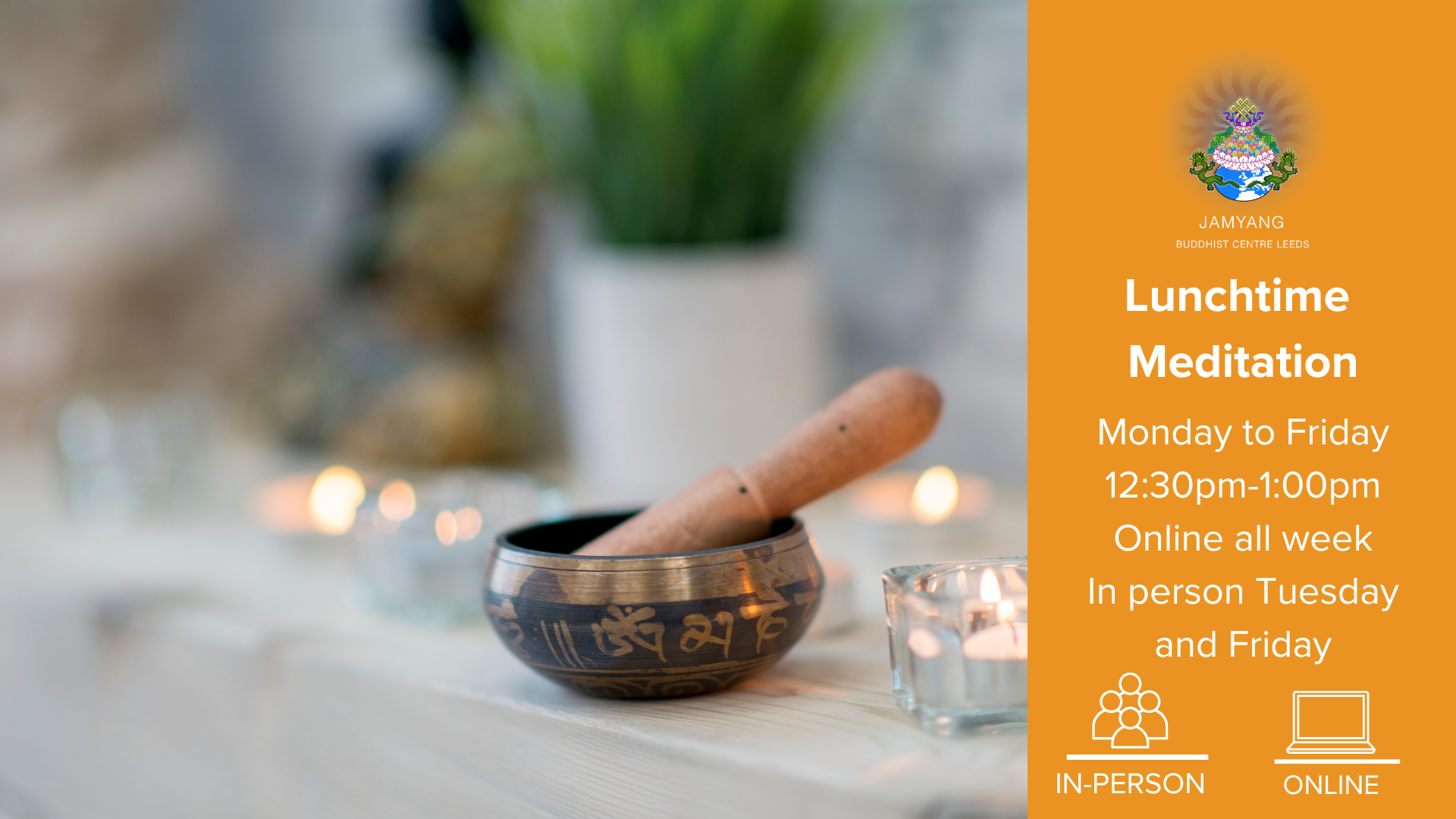
Overview
Make the most of your lunchtime with a guided meditation session to help calm your mind. These secular meditation sessions are a great way to relax and create some space for reflection in the middle of your day.
DATE: Monday- Friday
TIME: 12:30pm-1pm
LOCATION: Online all week and In person Tuesday and Friday
LEVEL: Wellbeing Programme – All levels
Pause, take a breath, and give yourself the midday reset you deserve.
Our lunchtime meditation sessions offer a gentle sanctuary right in the middle of your busy day—a dedicated space to slow down, drop your shoulders, and reconnect with yourself. Guided by a variety of our experienced, friendly meditators, these sessions focus on simple, relaxing breathwork designed to clear your mind, soothe your nervous system, and restore your inner energy.
Whether you are completely new to meditation or have been practicing for years, you are warmly invited to join us just as you are.

Yamantaka Practice Group

Overview of SESSION
This is a restricted practice, for those who have received the empowerment to practice Solitary Hero Vajrabhairava/Yamantaka.
If you have an interest in joining the group please email yamantakagroup@gmail.com to register.
The Yamantaka practice is held on Mondays weekly. Please note that some weeks it starts at 2:30pm and some at 6pm it doesn’t always alternate weekly.

Tonglen Loving Kindness meditation Practice

Overview of Tonglen Meditation
The Buddhist practice of Giving & Taking (Tonglen in Tibetan) is at its heart a selfless meditation of loving kindness and compassion.
DATE: Tuesdays
TIME: 7am-7:30am
LOCATION: Zoom
LEVEL: Buddhist Meditation – All Welcome
SUGGESTED DONATION: £4
A beautiful practice led by Chrissie and Di.
The Buddhist practice of Giving & Taking (Tonglen in Tibetan) is at its heart a selfless meditation of loving kindness and compassion. You imagine giving all your happiness to others, sometimes using visualisation with the breath, and then taking all the suffering and its causes from others. It’s a powerful practice for the brave-hearted!

Kshitigarbha Practice

Overview of Kshitigarbha practice
DATE: Tuesdays & Thursdays
TIME: 12pm-12:30pm
LOCATION: Zoom only
LEVEL: Buddhist Practices – All Welcome
SUGGESTED DONATION: £4
Lama Zopa Rinpoche (our organisation’s Spiritual Director) suggested Jamyang Leeds perform these practices to help with the financial obstacles we are currently having. From September 2022, we’ll be reciting this practice as much as we can. See the special newsletter explaining all about the practice here.
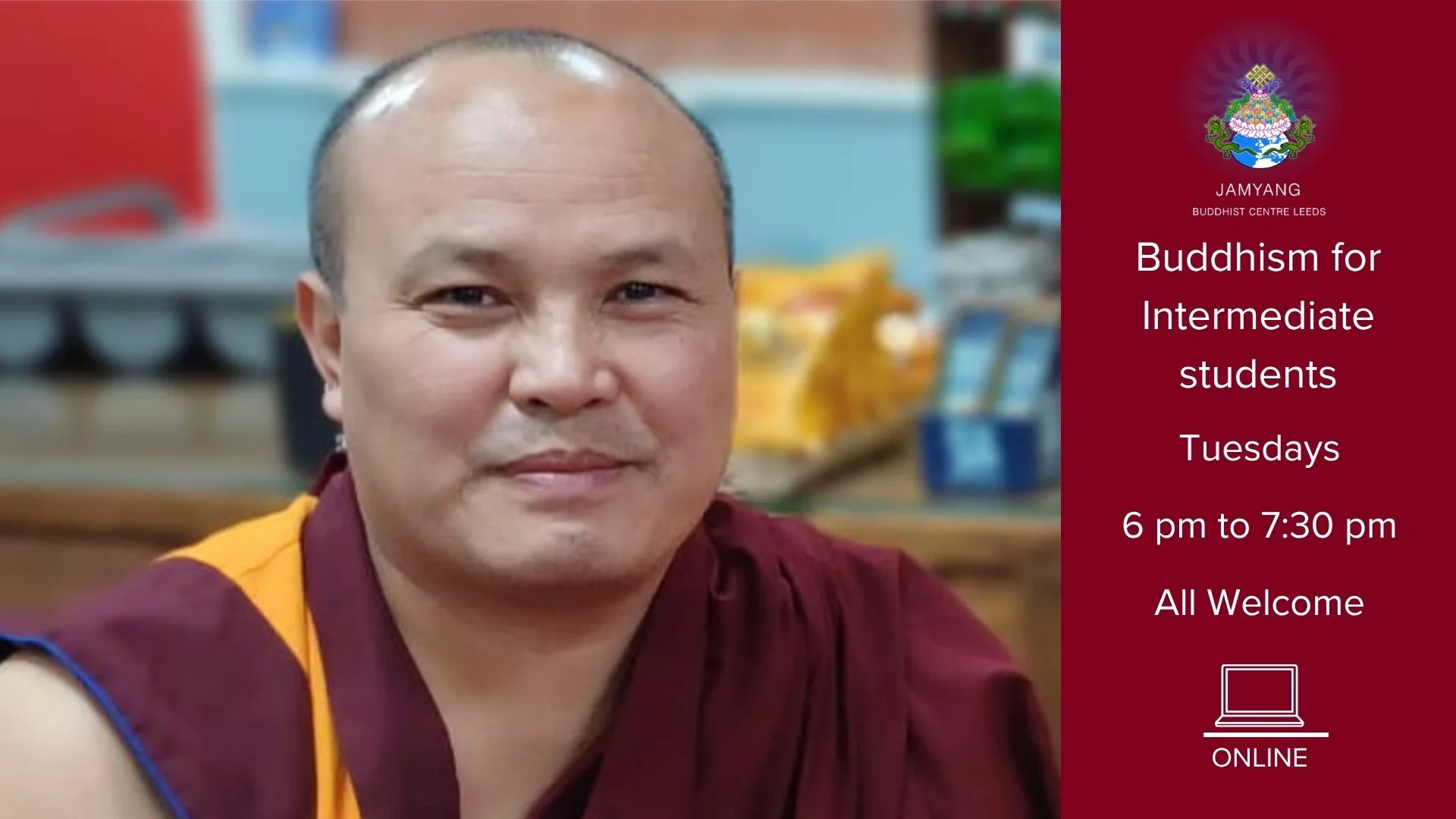
Buddhism for Intermediate Students
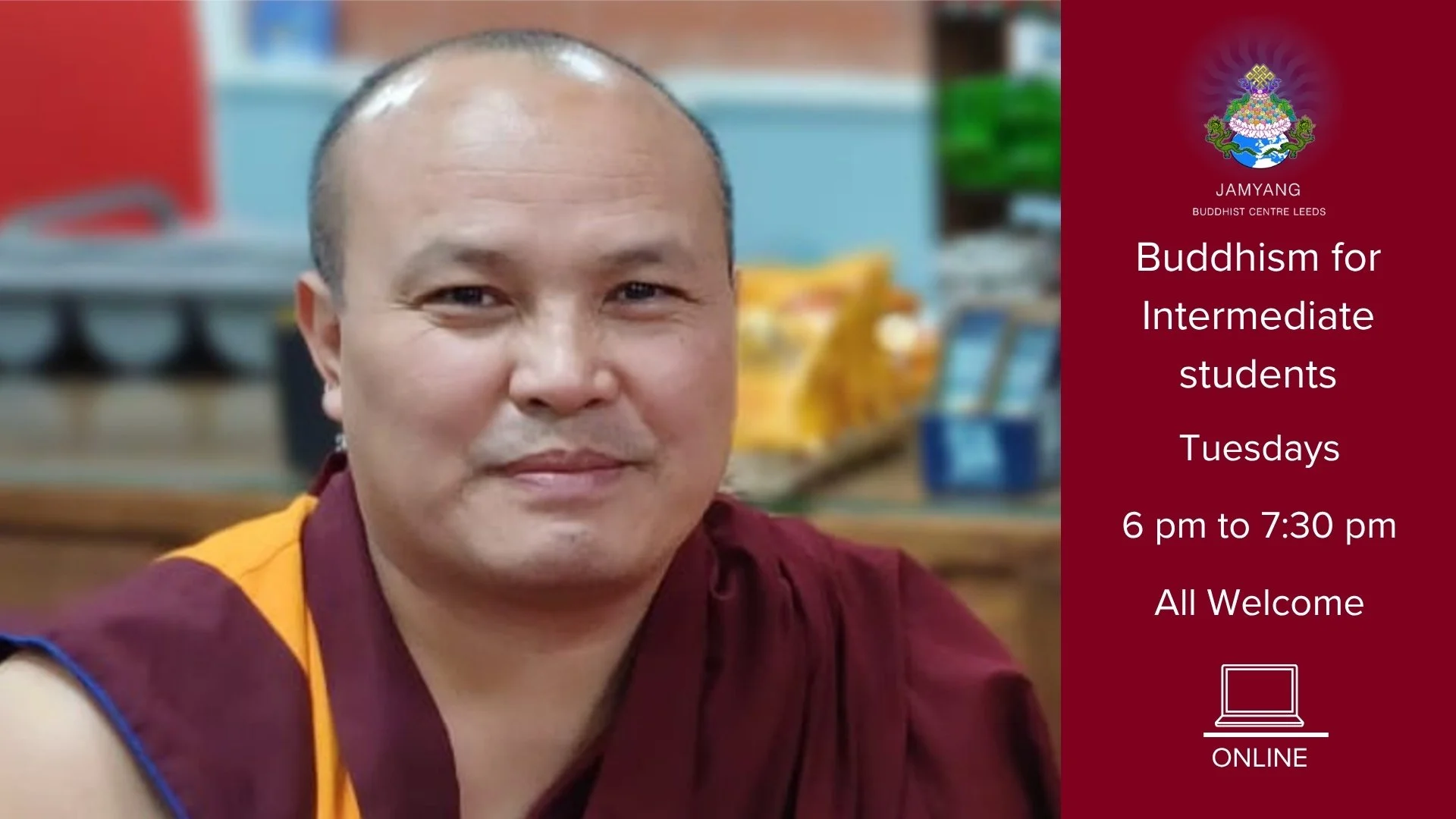
Overview of Programme
DATES: Weekly sessions 7th July to 24th November
TIME: Tuesday weekly 6:00 pm to 7:30 pm
LOCATION: Online
LEVEL: Intermediate students of Buddhism and those interested in Buddhist philosophy
Buddhism for Intermediate students:
This series of teachings aims to provide a comprehensive understanding of key Buddhist texts and practices, offering both theoretical knowledge and practical guidance for those interested in deepening their spiritual practice. Each monthly session is carefully designed to build a holistic understanding of Buddhist philosophy and meditative practices.
This series of sessions will focus upon the key text: Illuminating the Intent: An Exposition of Chandrakirti’s Entering the Middle Way.
Online drop in class – no need to register.
SUGGESTED DONATION FOR DROP IN CLASS:
Non-members – £12 per drop in class. This will contribute to the centre’s running costs and include a donation to the teacher.
Gift Aid: if you are a UK taxpayer we can claim back 25p for every £1 you donate. More information on Gift Aid can be found here.
Free to members of The Jamyang Buddhist Centre Leeds (your membership fees already contribute to our core costs in running the centre). You are invited to make a donation for the teacher, as is customary when receiving Buddhist teachings, in order to support their activity. For your reference we recommend a donation in the region of £4 per class. We will make the donation to the teacher on your behalf.
We never turn anyone away from the Dharma for financial reasons. If you cannot donate the suggested amount, please donate where possible within your means. It’s good to practice generosity where we can.
ABOUT YOUR Teacher: Geshe Rinchen Wangyal
Geshe Rinchen has dedicated his life to the study and practice of the Buddha’s teachings. He completed rigorous training in Buddhist philosophy, debate, and meditation, achieving the esteemed title of Geshe, the doctorate degree in the Tibetan Buddhist tradition.
His teachings are known for their clarity, warmth, and practical applicability, making profound topics accessible to students of all backgrounds.
Currently resident teacher at Jamyang Buddhist Centre Leeds, Geshe Rinchen combines his deep knowledge with genuine compassion, inspiring students to cultivate inner peace and wisdom in their own lives.
SESSION RESOURCES:
About this series:
The great Tsongkhapa wrote three profound texts on Madhyamika philosophy and practice:
The Essence of True Eloquence,
Ocean of Reasoning,
Illuminating the Intent.
Illuminating the Intent is one of these masterpieces, completed shortly before he passed into parinirvana. It is perhaps the most profound text ever written by a Tibetan scholar on Madhyamika philosophy and practice, guiding readers to both understand emptiness intellectually and apply its insights in daily life.
Nagarjuna composed the Fundamental Wisdom of the Middle Way, on which Chandrakirti later wrote his commentary, Entering the Middle Way. Since Chandrakirti’s work consists only of verses, Je Tsongkhapa composed a detailed commentary, making Illuminating the Intent an essential guide for understanding Nagarjuna’s root text. The primary theme of these texts is emptiness—what it is and how to practise it effectively.
Why This Text Matters:
Je Tsongkhapa’s text is invaluable for anyone seeking to understand reality, the self, the nature of the mind, life, the root causes of suffering, and consciousness. Studying it helps uncover practical methods to overcome suffering, find meaning in life, and apply these teachings in daily living.
About the Great Tsongkhapa:
The great Tsongkhapa (1357–1419) was a true genius in interpreting and practising Mahayana teachings as laid down by the ancient Indian Nalanda masters. He founded the Geluk tradition of Tibetan Buddhism, which emphasises both rigorous intellectual analysis and practical application of the Buddha’s teachings, following the approach of the Nalanda masters.
Who This Course Is For:
This course is suitable for both practitioners and academics, as well as anyone with a keen interest in Madhyamika philosophy and the practice of emptiness. In class, we will engage with the text through reading and giving explanation page by page following the Tibetan monastic educational tradition. At times, we will also participate in monastic-style debate to clarify the meaning and implications of the text. This approach allows participants to explore the material both intellectually and practically.
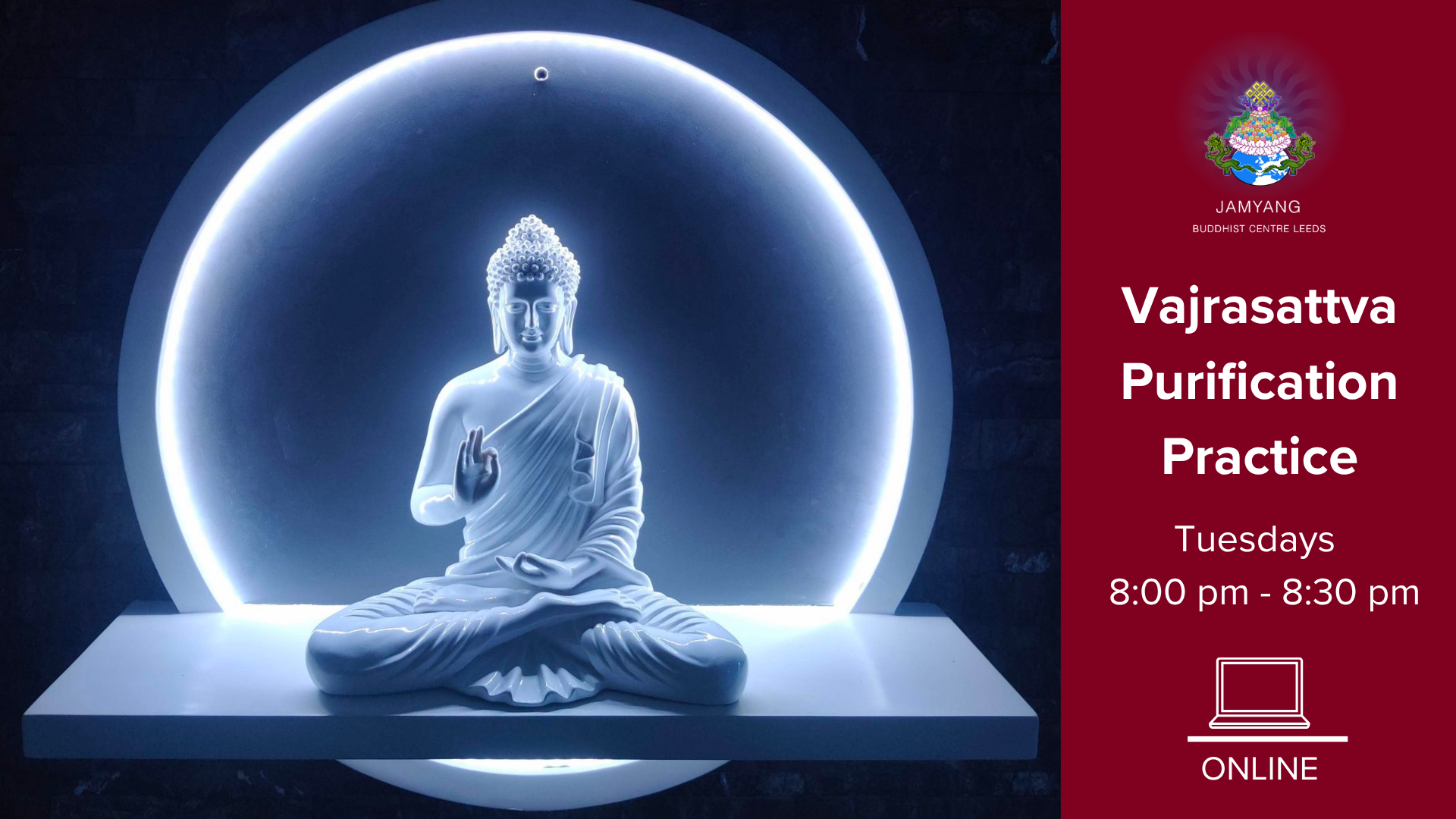
Vajrasattva Practice
Overview of The Vajrasattva Practice
DATE: Tuesdays
TIME: 8:00pm-8:30pm
LOCATION: Zoom
LEVEL: Buddhist Practices – All Welcome
SUGGESTED DONATION: £4
Purification here means looking at our past unskillful actions which have created seeds of negative karma in our minds, and using visualisation and mantra recitation to remove those seeds in a healthy and productive way. Vajrasattva is the embodiment of all the Buddha’s cleaning and purifying energy. We all make mistakes, and how we deal with them is key to making spiritual progress. We’ll be using a short text composed by Lama Zopa Rinpoche

the eight verses of thoughts transformation

Overview of the eight verses of thoughts transformation
Everflowing Nectar of Bodhichitta – Annihilating the Demon of the Self-Cherishing Mind
DATE: Wednesdays
TIME: 7am-7:30am
LOCATION: Zoom
LEVEL: Buddhist Practices- All Welcome
SUGGESTED DONATION: £4
Everflowing Nectar of Bodhichitta – Annihilating the Demon of the Self-Cherishing Mind
Led by Di or Sande
This practice is based on the short text” Eight Verses of Thought Transformation”, which contains the entire technique for transforming the mind into relative bodhichitta (i.e., the wish to achieve enlightenment for the benefit of all sentient beings) and absolute bodhichitta (i.e., the wisdom realizing emptiness).

Chanting the Verses of Noble manjushri
Overview of Session
DATE: Thursdays
TIME: 7:45am to 8:25 am
LOCATION: Zoom only
LEVEL: Buddhist Practices – suitable for Lama Zopa Rinpoche’s students
Join us to fulfill His Holiness the Dalai Lama’s wishes and chant the Names of Noble Manjushri for the swift return of Lama Zopa Rinpoche.
Please come along even if you havent done the practice before, its quite wonderful and very energising. Please download the text below, you can also listen and practice with the audio clip of Lama Zopa Rinpoche reciting the Chanting the Names of Noble Manjushri.
Kshitigarbha Practice
Overview of Kshitigarbha practice
DATE: Tuesdays & Thursdays
TIME: 12pm-12:30pm
LOCATION: Zoom only
LEVEL: Buddhist Practices – All Welcome
SUGGESTED DONATION: £4
Lama Zopa Rinpoche (our organisation’s Spiritual Director) suggested Jamyang Leeds perform these practices to help with the financial obstacles we are currently having. From September 2022, we’ll be reciting this practice as much as we can. See the special newsletter explaining all about the practice here.

Kalachakra Practice group
Overview of practice
This is a restricted group for those who have received the Kalachakra empowerment from a qualified Lama. To join the group you need to have either received the full Kalachakra empowerment or another High Yoga Tantra empowerment such as Heruka, as long as you have received a Kalachakra Jenang (permission).
This international group of Kalachakra practitioners meets weekly and alternates with commentary and practice.
Mind Mandala once a month and six session guru yoga for other sessions:
If you’re already part of this group, please use the details sent in the weekly email to join the practice
If you’d like to join us, please email spc@jamyangleeds.co.uk confirming that you have the appropriate empowerments. You will then be sent a registration form to complete.
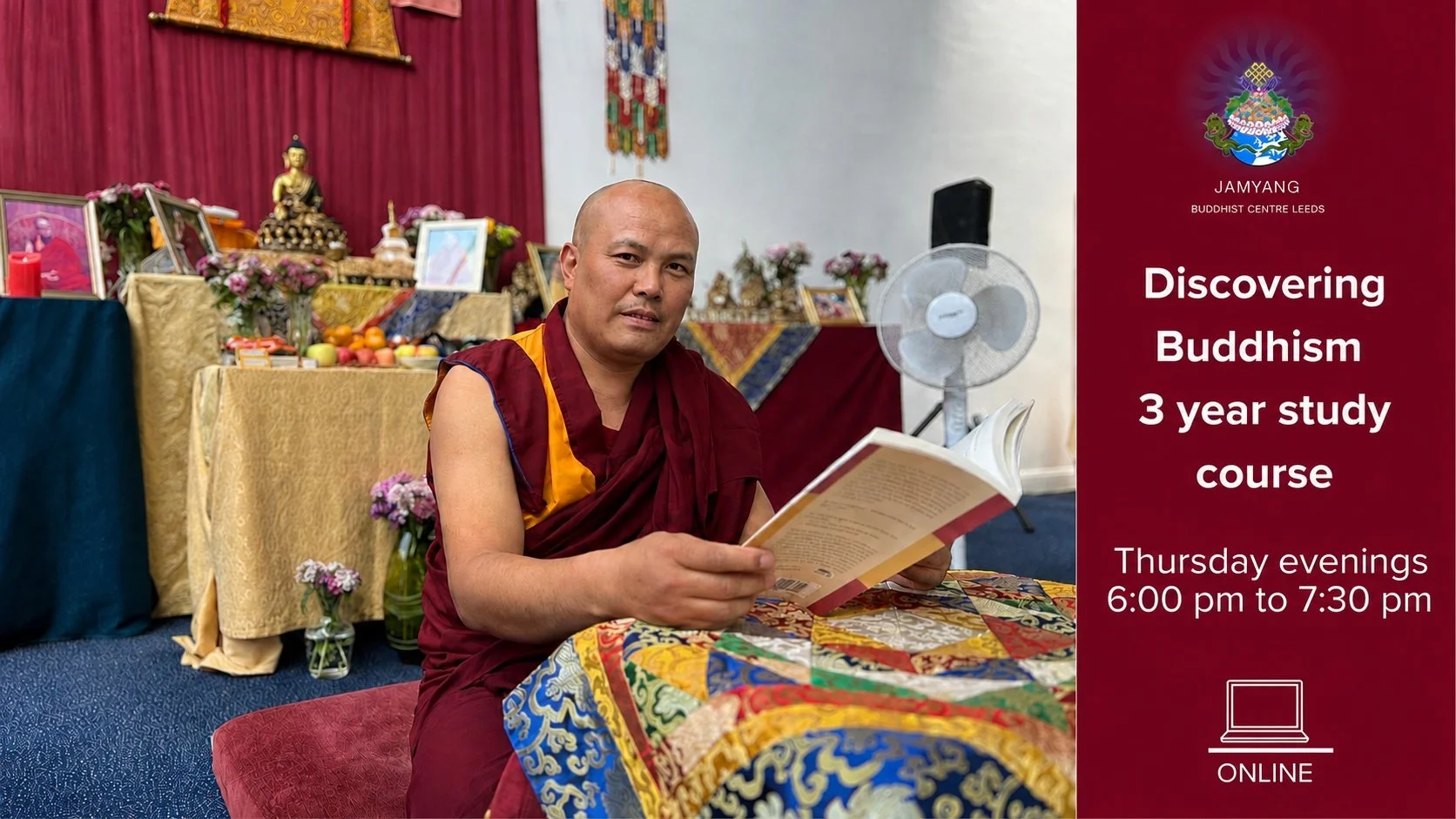
Discovering Buddhism: How to Meditate
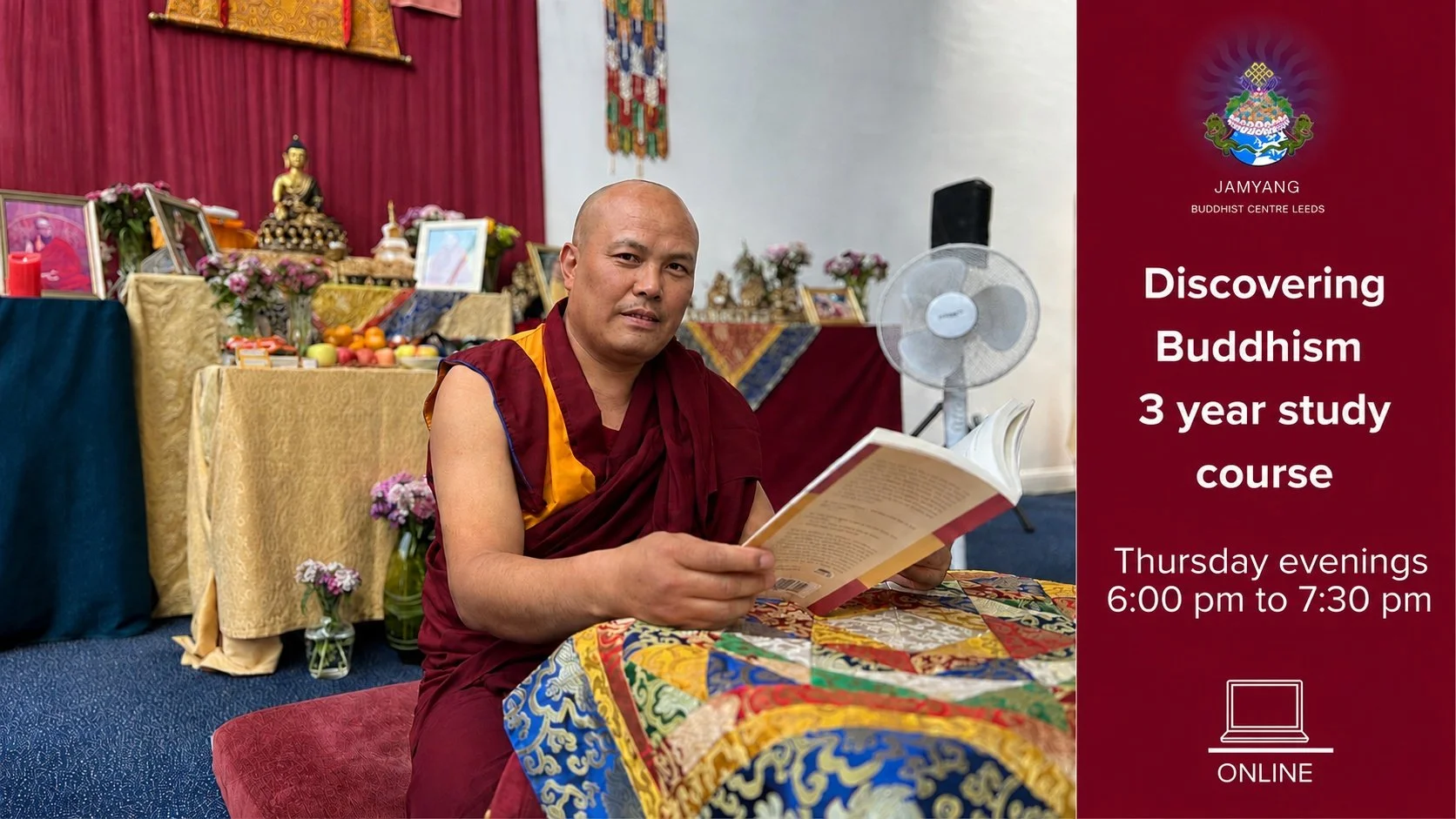
Overview of Programme
DATE: 2026: 15th October, 22nd October, 29th October, (no class on the 5th Nov) 12th November, 19th November, 26th November and Meditation day Sunday 29th November
TIME: Thursday’s weekly 6:00 pm to 7:30 pm
LOCATION: Online
LEVEL: The course is suitable for both beginners and intermediate students, providing a structured approach to Buddhist study.
What to Expect in This Module: How to meditate
Under the guidance of Geshe Rinchen you will learn the definition and purpose of meditation, how to sit, how to set up a meditation session, different meditation techniques, and how to deal with obstacles to meditation.
Through:
Introductory Meditations
Explanatory Teachings - Understand the Foundations and Special features of Meditation.
Reflection and Discussion - Consider how this practice relates to the rest of the path and your own practice.
Supportive Environment - Learn and share with like-minded practitioners, supported by the wisdom and guidance of Geshe Rinchen.
Integration Guidance - Learn ways to connect these Meditation methods with your lamrim meditation and daily spiritual growth.
This module concludes with an online Day of Meditation on Sunday, 29th November, offering time for deeper reflection and integration of the teachings.
Suitable for both new and experienced students ready to delve into the inspiring methods that turn life’s challenges into opportunities for growth, compassion, and wisdom
Awakening the limitless potential of your mind, achieving all peace and happiness
Discovering Buddhism is a beginner to intermediate level, 3 year study programme that will give you a solid foundation in the teachings and practice of Tibetan Mahayana Buddhism. The Mind & its Potential is the 1st Module.
This course was designed by Lama Zopa Rinpoche for students to study, explore and put into practice the graduated path to enlightenment, the lamrim. Originally based on Buddha Shakyamuni’s teachings from 2500 years ago in India. The lamrim was systematically organised by the Indian master Atisha in the 11th Century and by several other great masters from Tibet including Lama Tsongkhapa in the 15th Century.
Our resident teacher Geshe Rinchen Wangyal (Geshe La) will be teaching this module. This is an excellent opportunity to receive these Lamrim teachings directly from Geshe La. We are indeed most fortunate to be able to do so.
This course commences August 2026 and runs for just over 3 years during term time on Thursday evenings online for 90 minutes and has 14 subjects, 13 of which are usually taught over 6 weeks. It is possible to join at any time during the course.
We warmly invite you to join us for this enriching journey with Geshe Rinchen. Together, let us explore how to bring the timeless wisdom of Buddhism into our everyday lives.
Please register for Discovering Buddhism here. For more information contact our course coordinator, Ruth: db@jamyangleeds.co.uk
ABOUT YOUR Teacher: Geshe Rinchen Wangyal
Geshe Rinchen studied at Drepung Losel Ling Monastery in India, then at the Institute of Buddhiust Dialectics. He gained his Geshe degree in 2015.
He then studied at the University of Winchester in the UK, gaining a BA (hons) Degree in Philosophy, Religion and Ethics in 2024
Geshe La has had articles published in The Scientific American in 2020 including 'Hygiene of the mind during the Pandemic’. He has also received awards for essay competitions at the Institute of Buddhist Dialectics.
Geshe La’s teachings are known for their clarity, warmth, and practical applicability, making profound topics accessible to students of all backgrounds. Geshe La combines his deep knowledge with genuine compassion, inspiring students to cultivate inner peace and wisdom in their own lives.
Geshe La teaches in English fluently.
You can read more about Geshe Rinchen here.
SUGGESTED DONATION:
Non-members – £72 per module for the Thursday classes (usually 6 weeks), and £32 for the meditation day at the end of each module. This will contribute to the centre’s running costs and includes a donation to the teacher.
Free to members - Members are invited to make a donation for the teacher, as is customary when receiving Buddhist teachings, in order to support their activity (for your reference we recommend a donation in the region of £20 per module and £10 per meditation day).
We never turn anyone away from the Dharma for financial reasons. If you cannot donate the suggested amount, please contact Ruth on: db@jamyangleeds.co.uk to discuss what would be affordable for you.
It’s good to practice generosity where we can.
How to Donate:
You can make a donation by card using our Donation Portal here. Please put Discovering Buddhism as a reference in the comments box
Alternatively you can donate by Bank Transfer using the details below, please reference Discovering Buddhism
Account Name: Jamyang Buddhist Centre Leeds
Bank Name: Cooperative Bank Plc
Account number: 65178087 Sort-Code: 08-92-99 SWIFT: CPBK GB22 IBAN: GB76 CPBK 0892 9965 1780 87
Gift Aid: if you are a UK taxpayer we can claim back 25p for every £1 you donate. Please indicate when registering if you would like us to claim gift aid on your donations.

Shamatha – Meditation on the Breath
Overview of Session
DATE: Fridays
TIME: 7am-7:30am
LOCATION: Zoom
LEVEL: All Welcome
SUGGESTED DONATION: £4
Led by Ruth
Mindfulness of Breathing is universally acknowledged to be of benefit to all living in the modern world. Many feel overloaded with all that is expected of us living this complex and exhausting existence. Developing our awareness in this way is a general prescription for soothing and healing the overworked body and mind.
Practicing focusing the attention on an object such as the breath is also a core practice in Tibetan Buddhism. Gradually over time we are able to hold the object of our attention over longer periods, which enables us to practice other meditations such as Vipassana more successfully.
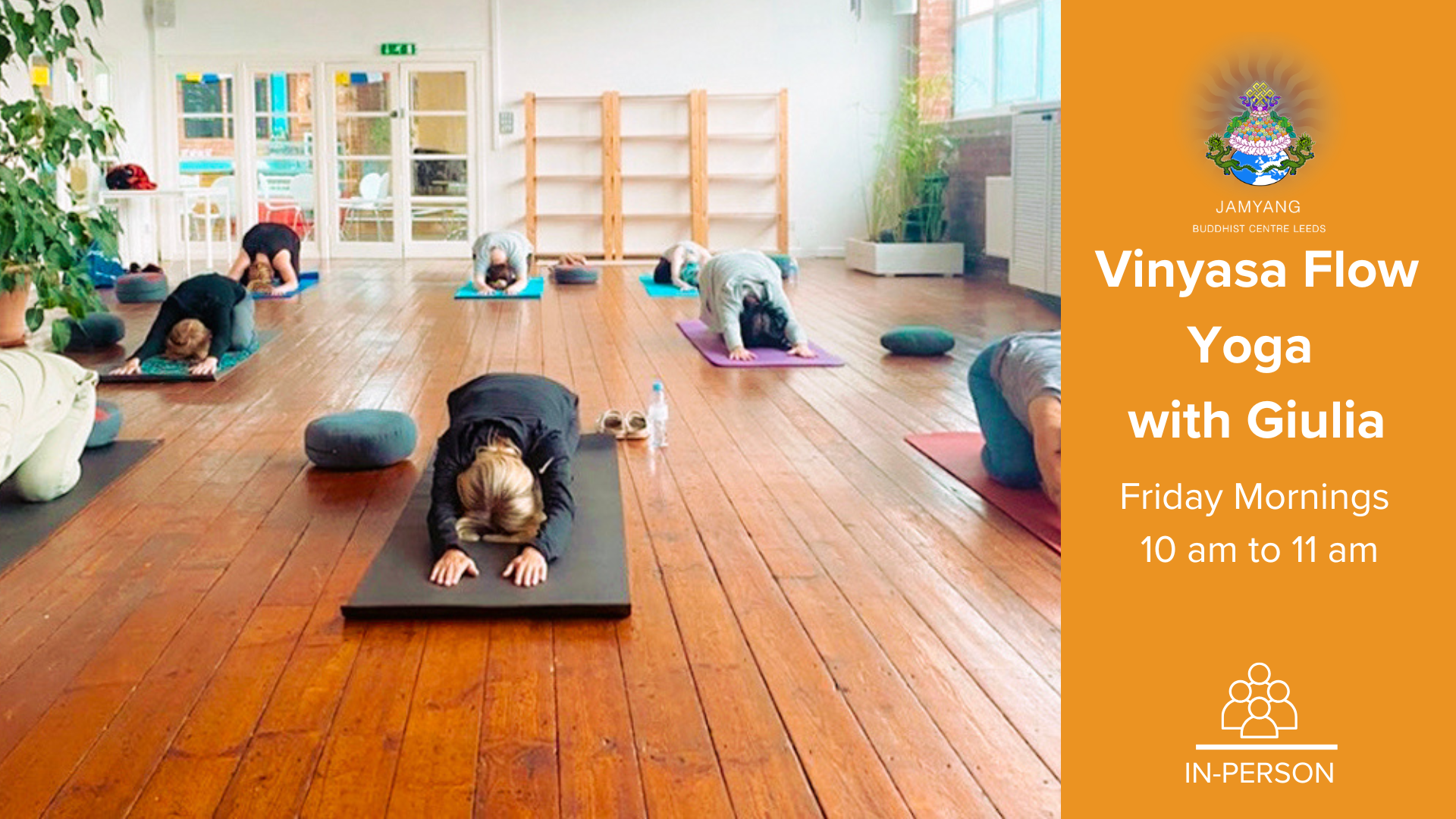
Cancelled Vinyassa Flow Yoga with Giulia

Overview of Session
DATE: Friday weekly
TIME: 10:00 am to 11:00 am
LOCATION: In-person
LEVEL: Everyone welcome - Drop In class
COST: Pay as you feel, everything will be donated to support Jamyang Buddhist Center
About the Class:
These Vinyassa Flow Yoga classes are designed to build strength, stability and balance, both physically and mentally, through creative sequencing and a grounding focus on breath.
This drop in class is suitable for everyone
About the Teacher - Giulia Ferrari:
Giulia is a yoga teacher with a passion for empowering people through dynamic, energising movement and mindful breathing. She strives to create a supportive, inclusive space where students feel safe to express themselves, open their hearts and release what no longer serves them.
With a background in ballet and a passion for rock climbing, Giulia’s approach blends grace, strength, and playful energy. She first came to yoga 20 years ago during a time of difficulty and anxiety, and it became a source of healing and resilience. That transformative experience made Giulia want to give back by sharing the acceptance and encouragement she received through the practice.
In 2025, Giulia completed 200-hour Yoga Flow teacher training at Yoga Hero in Leeds. Outside of the studio, she works as a veterinary surgeon. Giulia’s other passions are the mountains and the great outdoors, and you'll often find her ice or rock climbing when she is not on the mat.
Whether through movement, breath, or stillness, Giulia’s goal is to help you reconnect with yourself, feel empowered, and move through life with greater ease.
Contact:
All enquiries to Giulia on mountainsyoga@gmail.com

White Dzambhala practice
Overview of practice
DATE: Fridays
TIME: 11 am to 11:30 am
LOCATION: Please note this is online only
LEVEL: Buddhist Practices – see note below
SUGGESTED DONATION: £4
Dzambhala practice is said to bring wealth, prosperity, success, good fortune and luck, long life and wisdom.
Please come and join in with this monthly practice to help the centre, the FPMT and Buddha Dharma to flourish and be free from obstacles.
To do this practice in full, it is best to have a Kriya tantra empowerment of Chenrezig. However, one may still do this practice without such an empowerment by simply skipping the
self-generation on page 3. The Torma Offering on page 15 requires empowerment
Dzambhala is an emanation of Ratnasambhava, one of the five buddha families, whose enlightened activity is increasing and whose essence is generosity. Some people practice Dzambhala to
achieve spiritual prosperity, although this deity is also associated with wealth and prosperity in the material world. Dzambhala practice is said to bring wealth, prosperity, success, good fortune
and luck, long life and wisdom. He is depicted holding a mongoose spouting jewels.
There are five different wealth Dzambhala, each has their own practice and mantra to help eliminate poverty and create financial stability.
Through the power of compassionate intention, visualization, and mantra recitation, as well as a wealth-stimulating ritual, this practice ripens and enhances our karma for an abundance of
resources. When done with single-pointed concentration and faith, this ritual easily increases one’s financial prosperity.

White Umbrella Deity practice
Overview of practice
DATE: Fridays
TIME: 11:30 am to 12:00 pm
LOCATION: Please note this is online only
LEVEL: Buddhist Practices – see note below
SUGGESTED DONATION: £4
In September 2024, His Eminence Ling Rinpoche gave us this practice to overcome obstacles to the centre flourishing.
In addition to many benefits of engaging in these practices, Lama Zopa Rinpoche recommended that these two practices are beneficial to helping bring peace to situation between Israel and Palestine.
The Sanskrit name for the White Umbrella deity is Ushnisha Sitatapatra which can also be translated as “The Victorious White Parasol.” The White Umbrella Deity, [Skt. Sitatapatra, Tib. gdugs dkar] is a powerful female deity. She is relied upon for protection; healing illness; dispelling interferences, spirit possession, and harmful forces; quelling disasters; averting obstacles; and bringing auspiciousness.
Ushnisha Sitatapatra is a female form of Avalokiteshvara, the Bodhisattva of Compassion. Like this Bodhisattva in an elaborate form, she also has a thousand eyes that watch over living beings, and a thousand arms that protect and assist them. Thus she symbolizes the power of active compassion.
Practices of Arya Sitatapatra includes, “The Supreme Accomplishment of Sitatapatra,” and “Praises and Repelling Practices of Sitatapatra.”
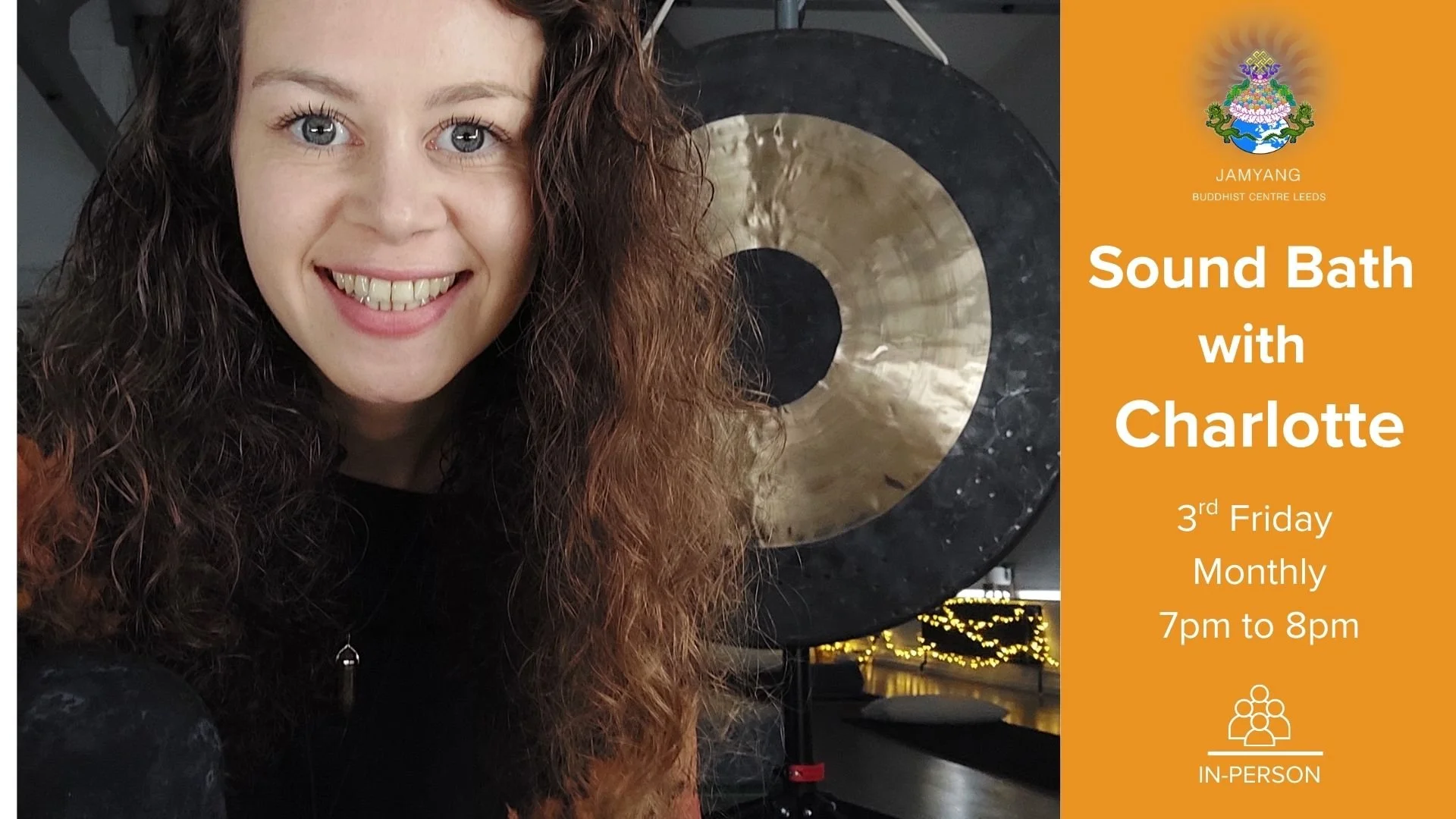
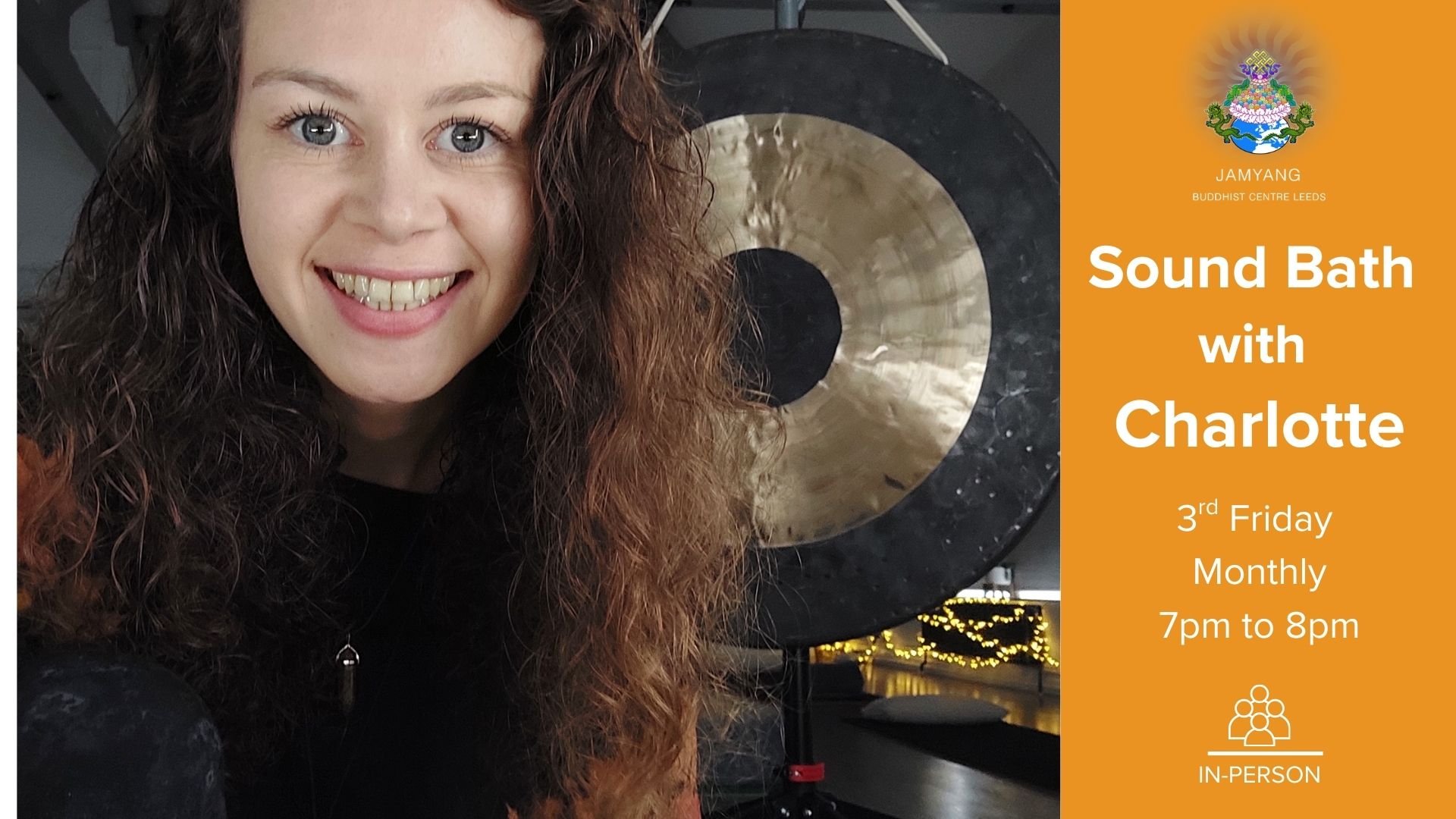
Sound Bath with Charlotte
Overview of Session
DATE: Fridays 16th January; 20th February; 20th March; 17th April; 15th May; 19th June 2026, 10th July, 14th August, 18th September, 16th October, 20th November
TIME: 7pm-8pm
LOCATION: In-person
LEVEL: Wellbeing – All levels
COST: £17
Sound Baths offer a grounding space to slow down, breathe and let the body soften. Each session invites you to settle into stillness as the waves, frequencies and gentle vibrations move through you, supporting deep rest and release. No experience needed — simply arrive in comfortable clothing and get cosy!
Charlotte’s musical journey began at an early age, exploring and playing multiple instruments. This passion led her to the wonderful path of Sound Therapy, which began here at the Jamyang Buddhist Centre - a beautiful whole circle!
In Tibetan, Jamyang འཇམ་དབྱངས།་ means sweet sound, melody, gentle voice. so it has a very beautiful resonance with sound baths. Jamyang is also associated with the name of Manjushri the Buddha of Wisdom.
As a Sound Therapist, Charlotte holds space with care and intention, ensuring every session feels welcoming and deeply connected. Her love for nature naturally infuses her work, creating experiences that are grounding, restorative, and deeply relaxing. The energy, frequencies and vibrations of the earth come alive through the enchanting rumbles of the gong. Charlotte is honoured to support others’ wellbeing and share the transformative power of sound.
Registration essential. Please register using this link https://www.tickettailor.com/events/soundwaveswithcharlotte
£17 per session. Pay by card on registration or cash on the day.
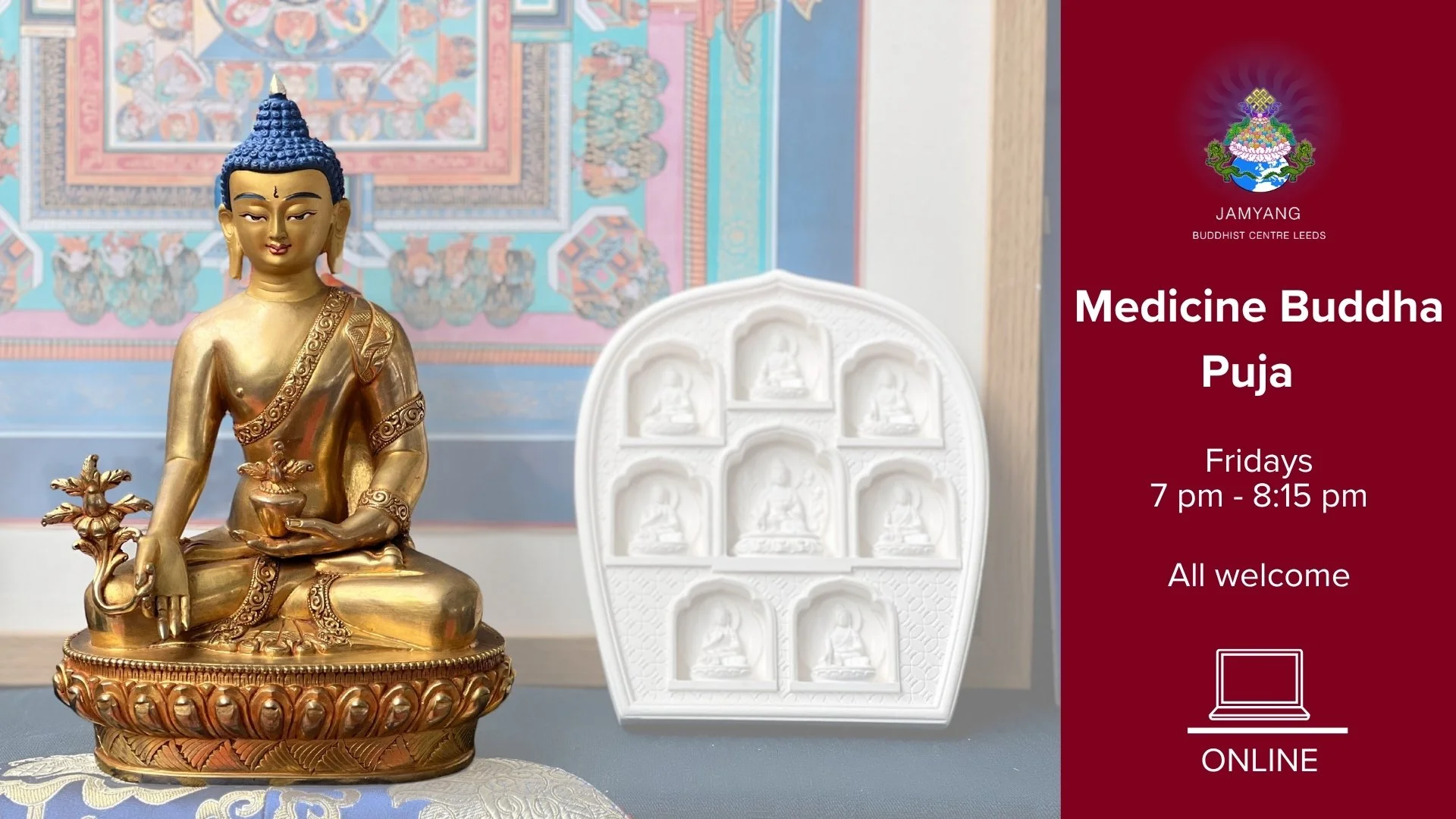
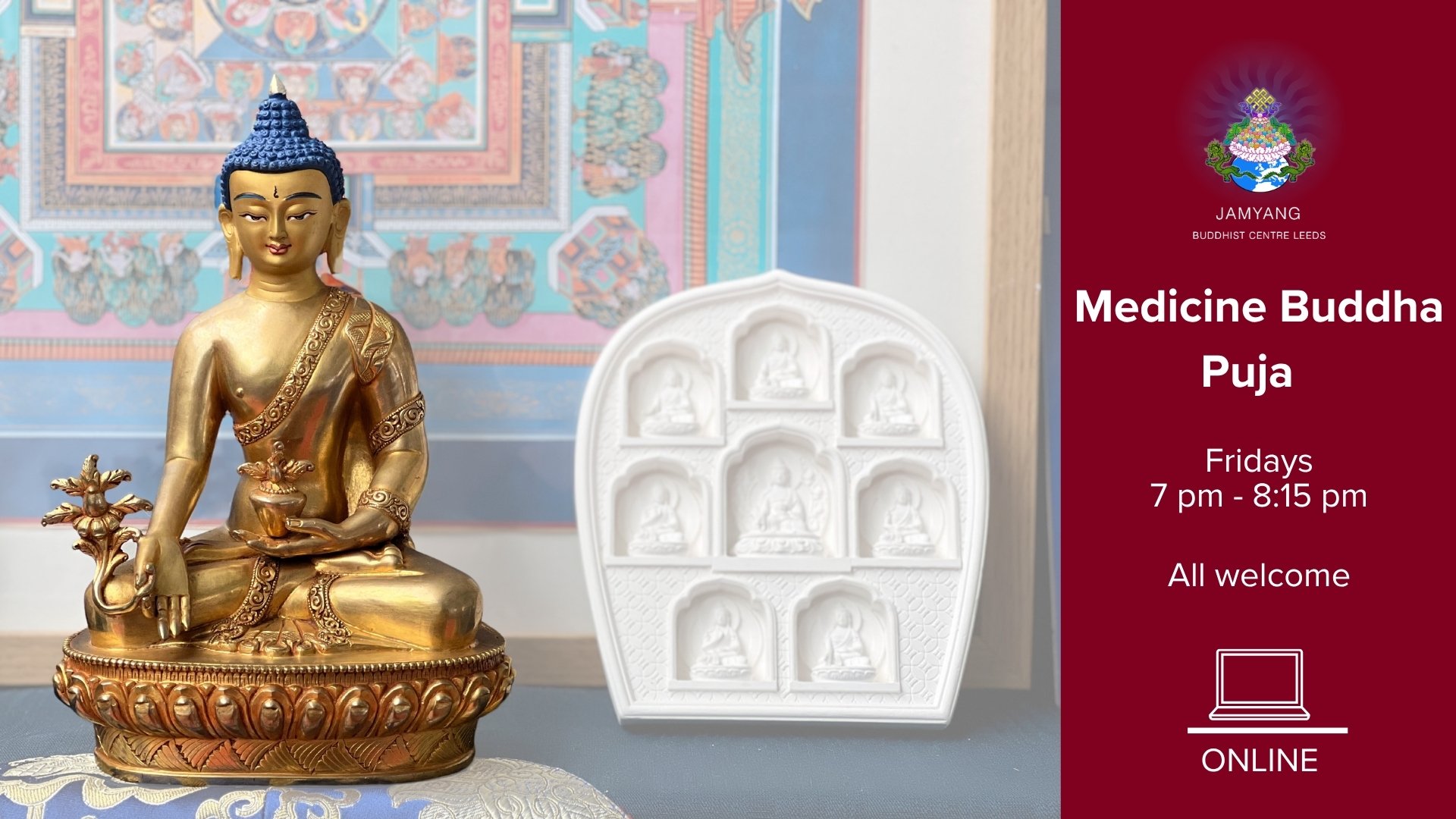
Medicine Buddha Puja
Overview of Medicine Buddha Puja
Medicine Buddha is one of the practices recommended by the FPMT for students to do for the swift return of Kyabje Lama Zopa Rinpoche.
DATE: FRIDAYS
TIME: 7 pm to 8:15 pm
LOCATION: Zoom
LEVEL: Buddhist Practices – All Welcome
SUGGESTED DONATION: £6
This is a longer meditation on Medicine Buddha – to remove obstacles, esp. those relating to health and achieving a favourable rebirth, and activate a swift path to enlightenment.
As Lama Zopa Rinpoche said: “One of the best healing meditations is that on the Medicine Buddha, who is the manifestation of the healing energy of all enlightened beings.”
The puja involves chanting prayers to the Seven Medicine Buddhas and reciting the Medicine Buddha mantras.
It is kindly led by Sande
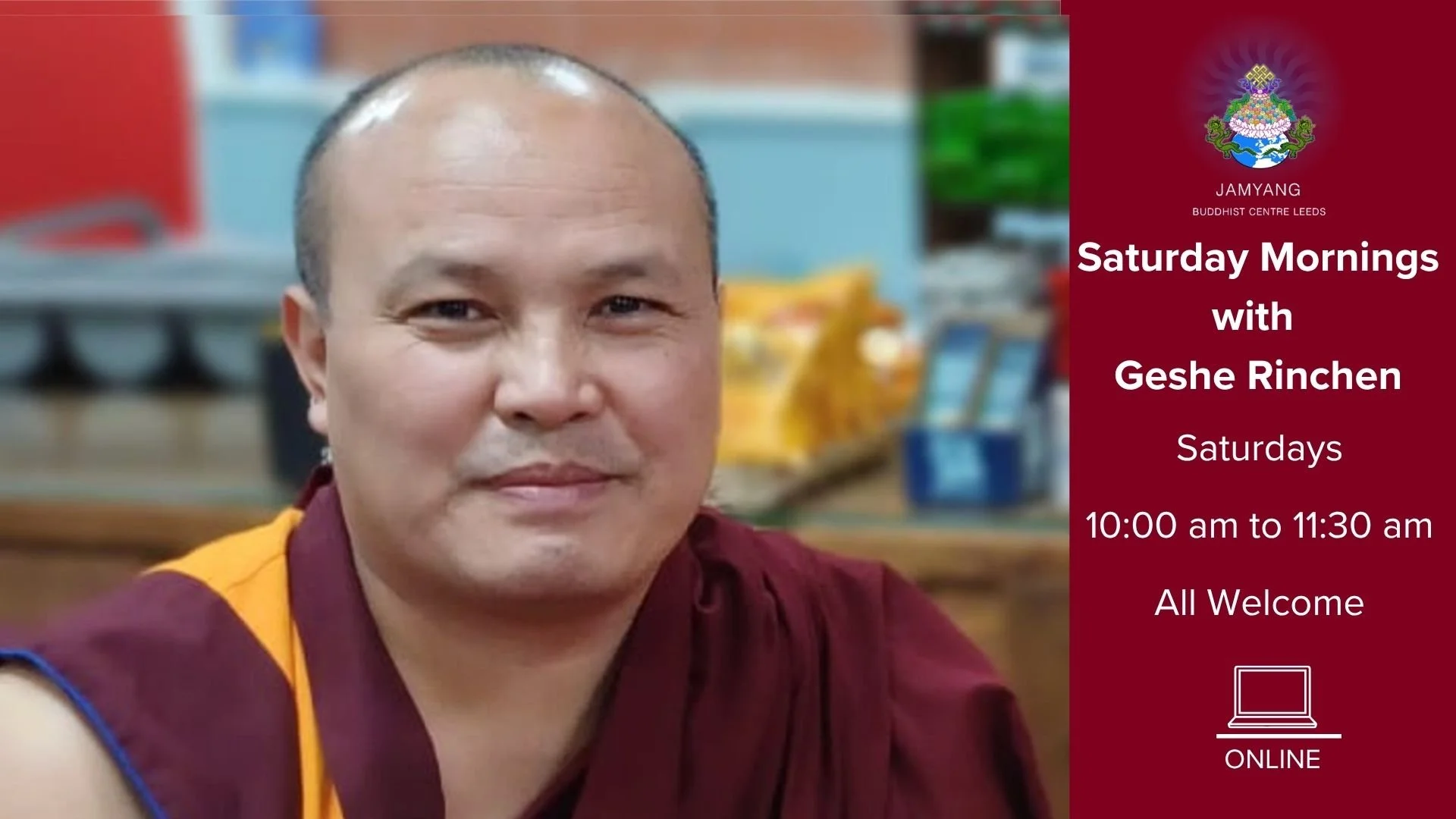
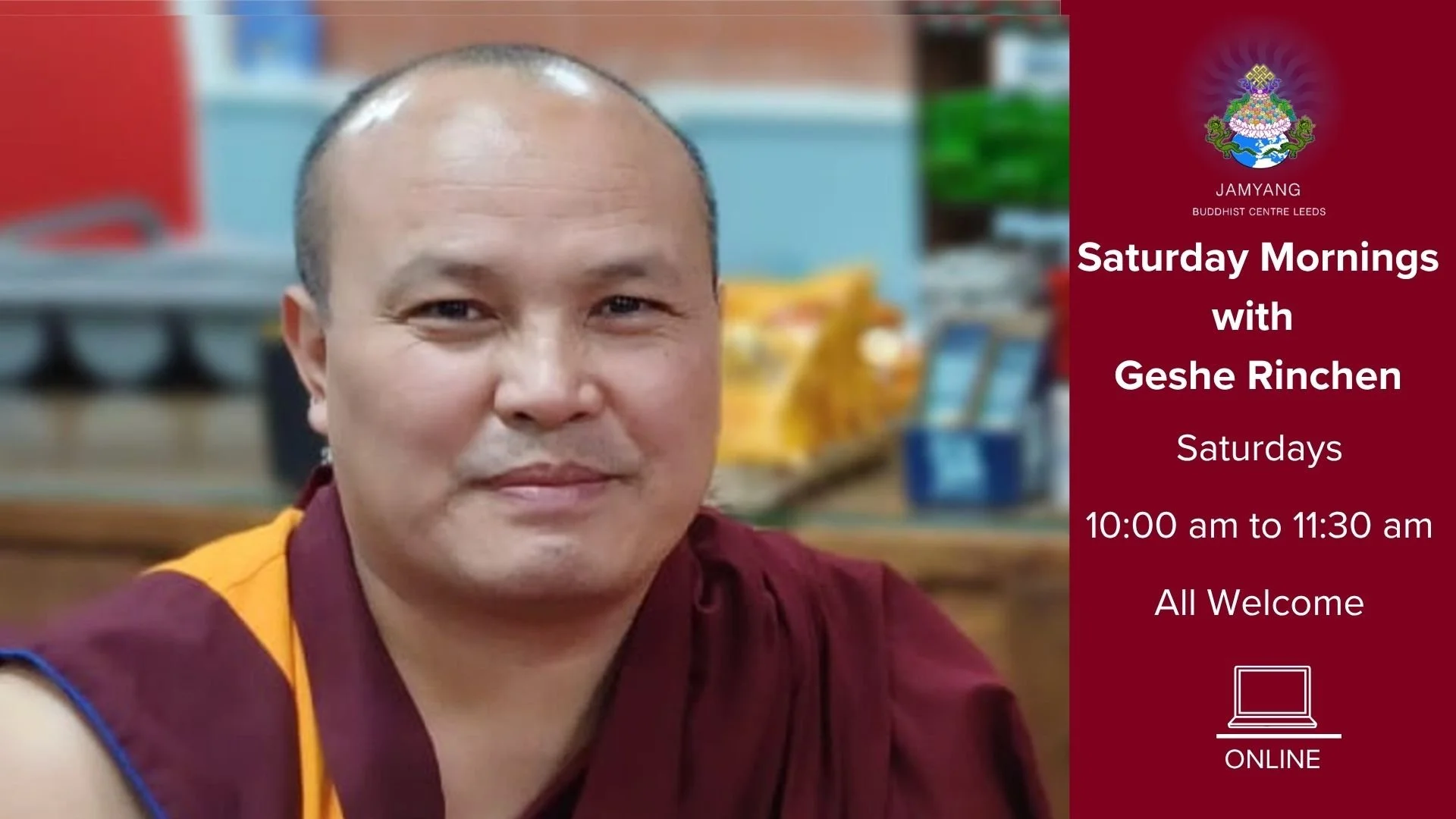
Saturday Mornings with Geshe Rinchen
Overview of Programme
DATES: Saturdays weekly 4th July to 28th November
TIME: 10:00 am to 11:30 am
LOCATION: Online
LEVEL: Everyone interested in exploring Buddhism, from beginners to intermediate.
Saturday Mornings with Geshe Rinchen:
Are you curious about Buddhism and want to know more, or perhaps you already have some understanding but would like to expand on your knowledge. If so this Saturday morning class with Geshe Rinchen (Geshe La) is ideal for you. Designed as a drop in class with a different topic each week, covering key concepts in Buddhism and how they can make a real difference in our lives. Such as how we can deepen our connection with others, and how we can live our lives in the present moment. This is a great opportunity to spend time with Geshe La and ask questions.
Online drop in class – no need to register.
SUGGESTED DONATION FOR DROP IN CLASS:
Non-members – £12 per drop in class. This will contribute to the centre’s running costs and include a donation to the teacher.
Gift Aid: if you are a UK taxpayer we can claim back 25p for every £1 you donate. More information on Gift Aid can be found here.
Free to members of The Jamyang Buddhist Centre Leeds (your membership fees already contribute to our core costs in running the centre). You are invited to make a donation for the teacher, as is customary when receiving Buddhist teachings, in order to support their activity. For your reference we recommend a donation in the region of £4 per class. We will make the donation to the teacher on your behalf.
We never turn anyone away from the Dharma for financial reasons. If you cannot donate the suggested amount, please donate where possible within your means. It’s good to practice generosity where we can.
ABOUT YOUR Teacher: Geshe Rinchen Wangyal
Geshe Rinchen has dedicated his life to the study and practice of the Buddha’s teachings. He completed rigorous training in Buddhist philosophy, debate, and meditation, achieving the esteemed title of Geshe, the doctorate degree in the Tibetan Buddhist tradition.
His teachings are known for their clarity, warmth, and practical applicability, making profound topics accessible to students of all backgrounds.
Currently resident teacher at Jamyang Buddhist Centre Leeds, Geshe Rinchen combines his deep knowledge with genuine compassion, inspiring students to cultivate inner peace and wisdom in their own lives.
SESSION RESOURCES:
About this series:
July 2026
4 July – What did the Buddha Discover?
11 July – Buddha Nature – the Seed of Enlightenment
18 July – Understanding the Mind and Mental Factors
25 July – The Story of Milarepa: Transformation and Enlightenment
August 2026
1 August – The Four Noble Truths: An overview
8 August – Understanding Suffering
15 August – The Causes: Karma and Afflictive Emotions
22 August – The End of Suffering: What is Possible?
29 August – The Path: A Practical Way Forward
September 2026
5 September - Calm Abiding (Samatha)
12 September - Insightful Meditation (Vipassana)
19 September - the Mind of Awakening (Bodhicitta)
26 September – The Wisdom of Emptiness
October 2026
3 October – The Two Accumulations: Merit and Wisdom
10 October – Offering to the Three Jewels
17 October – Circumambulation Practice
24 October – Prostration Practice
31 October – Reciting Mantras and Their Benefits
November 2026
7 November – Introduction to Visualisation Practice
14 November – Medicine Buddha Practice
21 November – Tara Practice
28 November – Establishing Daily Practices
Who This Course Is For:
This is a wonderful opportunity to hear Geshe La teach each weekend online and to ask him questions.
These topics have been carefully selected for beginners,
They are also very suitable for all students of Buddhism to refresh and expand on their understanding.
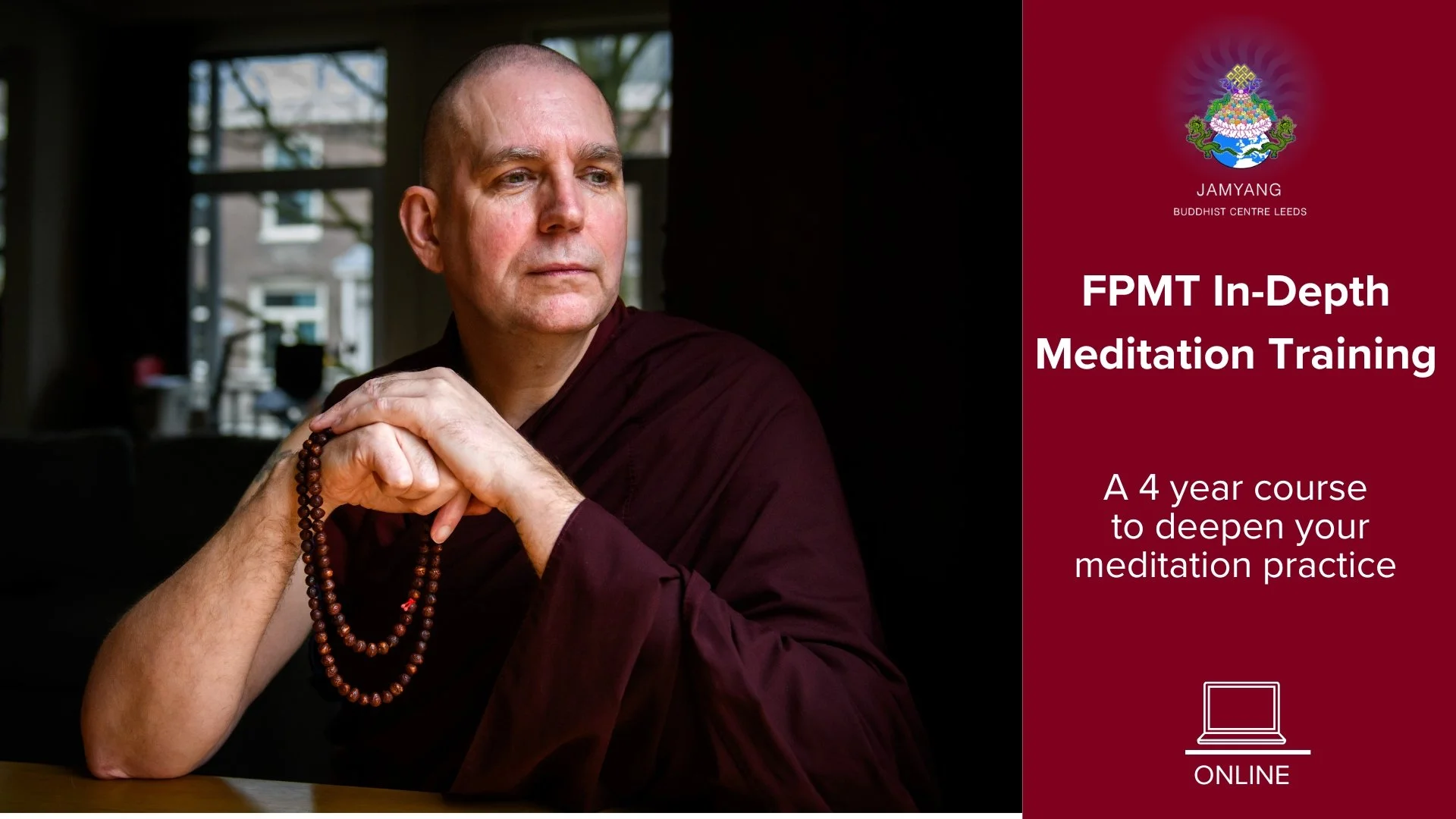
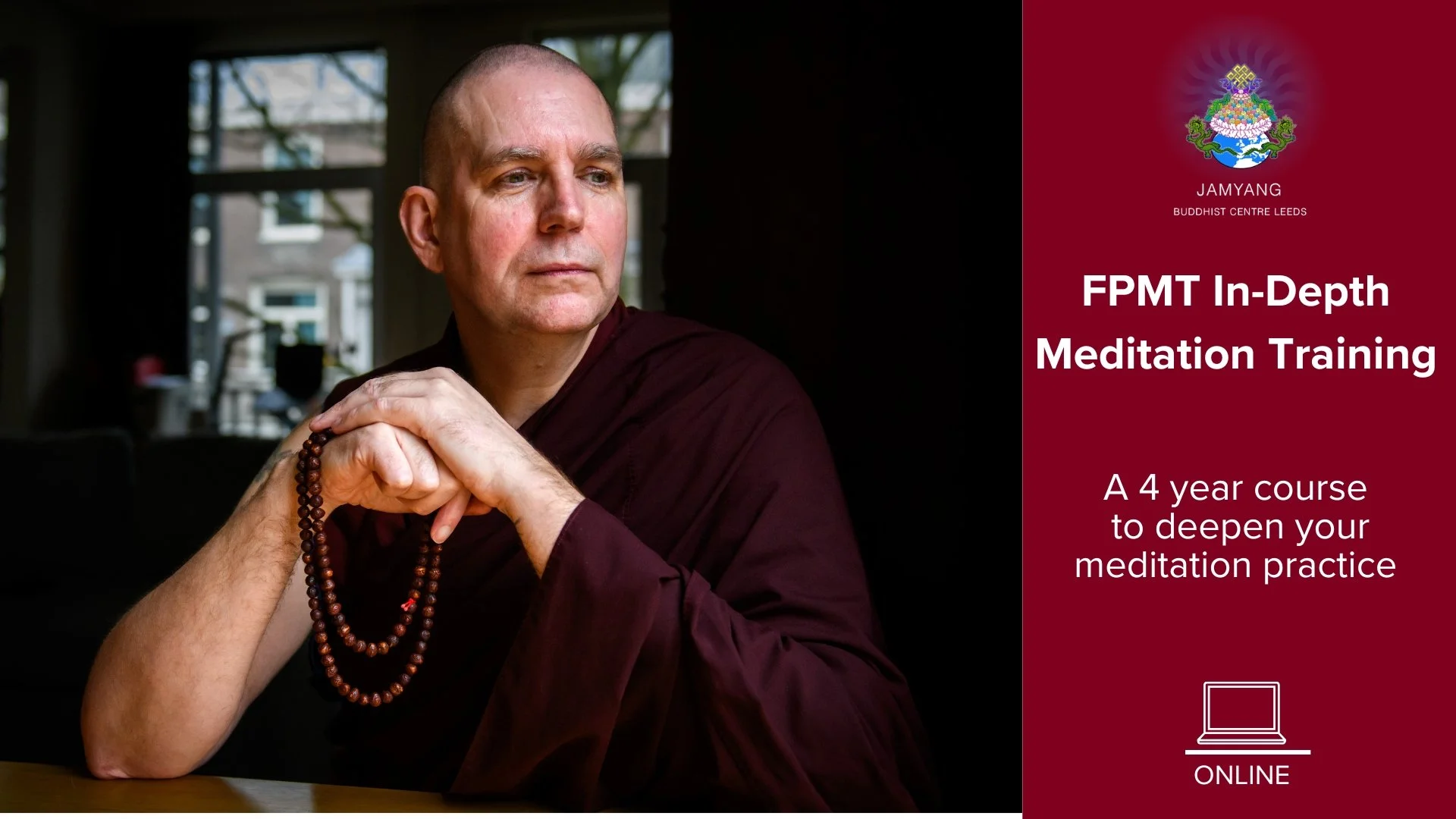
FPMT In-Depth Meditation Training
Overview of SESSION
DATE: 2026 / 2027: Year 4
Term 1: September 5th to November 28th 2026
If you are starting as a new student in year 4, don’t worry. You will get some preparatory advice on what previous recordings to have a listen to. Alternatively you may wish to join the new Ngondro Lamrim Meditation course for 2 years before starting In Depth Meditation Training. They are designed to be complementary.
TIME: Saturdays weekly 2:30pm – 5pm UK time
LOCATION: Zoom only
LEVEL: Buddhist Meditation – Intermediate to Advanced
IDMT Year Four, The Vajra Ground: Mahamudra and Kriya Tantra
In this culminating fourth year of our journey, our path turns inward to the mind itself—its empty, luminous nature—and outward to the transformative methods of tantra, where the naturally pure nature of our perception is recognized as the very ground of awakening.
As always, the year will start with generating the mind of awakening, using evocative instructions ranging from Langri Thangpa to Nāgārjuna and Lord Buddha in the famous Bodhisattvapiṭaka. This mind generation we'll cultivate through the four immeasurable thoughts and the support of calm abiding.
Illuminated by the life stories of the masters of the Gelug Mahāmudrā lineage and beyond, we'll explore its roots in the history of the early Indian Mahāsiddhas, such as Saraha and Tilopa, through the Kagyü master Gampopa's and Je Tsongkhapa's Mañjuśrī lineage up to Paṇchen Losang Chökyi Gyaltsen's Highway of the Conquerors and its perspective on this practice. In Sūtra Mahāmudrā we will practice resting attention in the empty nature of awareness, recognizing its clarity and openness as inseparable.
Kriyā Tantra offers a complementary method. Rather than suppress the ordinary, narrow self-narrative that we impose on ourselves and our world, it substitutes for it an extraordinary perspective of pure view. Occasionally, by way of introduction, we'll also taste practices from the higher tantras—glimpsing how afflictive emotions can be met as innate wisdom, and how the dissolution of the death process opens onto the innate mind of clear light. The structured practices of generation and recitation become a rehearsal for transformation, training perception to meet appearances as pure.
These methods rest on a relationship. We will therefore examine the practice of guru devotion candidly—both as the means by which the lineage's realization is transmitted and as a practice with real pitfalls, requiring discernment as much as trust. Through the Ganden Lha Gyāma, the Yoga of the inseparability of guru and Avalokiteśvara, and supporting sādhanas, devotion is approached not as deference but as the ethical road toward the state of Vajradhara: the full integration of wisdom and method.
This final year is an invitation to let realization ripen into a way of being. Grounded in bodhicitta and the four immeasurables, sustained by the preliminary practices, and held by the strength of community, we learn to meet the mind without grasping and to meet the world as pure appearance. Our aim is not to accumulate practices, but to bring the path to maturity—wisdom and compassion no longer cultivated separately, but lived as one.
This four-year online course provides students with long term, in-depth support in their meditative development.
The teacher and course developer is Venerable Losang Gendun. He has trained extensively in meditation in both Theravada and Mahayana Traditions
The In Depth Meditation Training course is also part of The Buddha Project led by Venerable Losang Gendun. You can find out more about Venerable Gendun, the course and who it is suitable for on our FPMT In-Depth Meditation Training webpage
If you have any questions you would like to ask before registering please email our In-Depth Meditation Coordinator Marie Odile on idmt@jamyangleeds.co.uk
The zoom link and all materials for the course are provided to registered students.
Donations:
Generosity is one of the cornerstones of the Buddhist path. With your donation we support The Buddha Project and we keep our centre going for the benefit of all sentient beings.
As the course is a collaboration with other FPMT centres it is not possible to offer this as part of our Jamyang Leeds membership programme.
The recommended donation per calendar month is £45.
If you are able to practice generosity and sponsor other students we recommend £58 per calendar month.
If you are on a reduced income it is £31 per calendar month.
There is also the option to donate annually.
If none of the above options are affordable please do still register, we never turn anyone away from the Dharma for financial reasons and we can agree a donation that is affordable for you right now. Please email Marie Odile our IDMT Coordinator idmt@jamyangleeds.co.uk if you would like to chat.
A Mindful Heart - Sunday Community Meditation
overview of sunday Community Meditation
DATE & TIME: Sunday 10:30-11:30
LOCATION: In-person at the centre
LEVEL: Meditation – All Welcome
SUGGESTED DONATION: Generosity model - please donate as you feel affordable and as generously as is manageable
Discover your best self every Sunday morning
Are you keen to work on your well-being and connect with others trying to make their life a little better for themselves and those around them? Join our uplifting Sunday Community Meditation Sessions.
Each hour-long gathering begins with a soothing meditation to calm your mind, followed by an inspiring discussion on a way of being such as interconnection, that enriches your everyday life. We then dive into a focused meditation designed to help you embrace that way of being fully.
Wrap up your morning with a cup of tea and friendly conversation in a welcoming, relaxed atmosphere. Absolutely everyone welcome.
Meet us every Sunday at 10:30 AM and start your week feeling refreshed, connected, and inspired. Your journey to a happier, more mindful life begins here!
Cost: Generosity Model: Pay as you feel.
From September 2026 to February 2027 we will focus on ‘A Mindful Heart’.
Inspired by the Creating Compassionate Cultures program (“CCC”) by Pam Cayton, and developed by the Foundation for Developing Compassion and Wisdom. Grounded in three core pathways of learning: Knowledge, Strength, and Compassion. These pathways guide you towards a happier, more meaningful life by fostering inner growth and a warmer connection with others.
Designed to help you develop a deeper understanding of how the mind works. The aim is to gradually let go of destructive patterns of thought and behaviour while cultivating a healthy sense of self-confidence and a deep, compassionate connection with others.
You are invited to reflect on your attitudes, perceptions, and emotional patterns. By exploring the workings of our own minds and the nature of our interdependence with others and the world around us, we begin to see how deeply connected our inner and outer realities truly are. We examine both logical and scientific perspectives on the nature of the self and our relationships with others.
To deepen the learning, you are encouraged to reflect between sessions, pausing to notice your inner experiences and reconnect with your deepest values. This supports the integration of insights and ways to act with greater mindfulness and wisdom.
Ultimately, the transformation we foster in ourselves contributes to building more compassionate cultures. How can one person influence a whole culture? The answer lies in understanding interdependence. Every action we take, every choice, interaction, and intention, affects others and the broader environment, this principle of cause and effect lies at the heart of all life, reminding us that our individual transformation ripples outward in meaningful ways.
The Creating Compassionate Cultures programme has 7 steps:
Mindful Intention
Interconnection
Change
Perception
Transforming harmful emotions
Empathy
Compassion
Session overview:
Welcome, Introduction and Motivation 5 mins
Settling Meditation 10 mins
Meditation topic introduced then participants briefly share their experience 15 mins
Guided meditation 15 mins
Feedback from participants 10 mins
Closing and Dedication 5 mins
September 2026
6th and 13th: The Pursuit of Happiness
20th and 27th: Understanding how things exist
October 2026:
4th and 11th: Developing Healthy Self Confidence
18th and 25th: Compassion - Opening the heart
November 2026:
1st and 8th: Mindfulness, reflection and critical thinking
15th and 22nd: Mindful intention - what do I really want
29th: Interconnection (week 1)
December 2026:
6th: Interconnection (week 2)
13th and 20th: Embracing Change
January 2027:
10th and 17th: Perception
24th and 31st Transforming harmful emotions
February 2027:
7th and 14th: Empathy
21st and 28th: Cultivating Compassion
Vipassana Meditation
Overview of Vipassana Meditation
Join us for a peaceful start to your week with a 30 minute Vipassana meditation session, designed to cultivate mindfulness, self-awareness, and equanimity. Led by Geshe Rinchen
DATE: Mondays weekly (March to May and July to November)
TIME: 7:00 am to 7:30 am
Vipassana (Special Insight Meditation), also called analytical meditation, is primarily a practice of wisdom. It is a form of concentration that focuses single-pointedly on the ultimate nature of phenomena through analytical reasoning. Analysing phenomena is a key aspect of Vipassana practice, as it helps develop a definitive understanding of the nature of reality—such as the self, mind, emotions, and thoughts.
As Je Tsongkhapa explains, shamatha (calm abiding) is like a lamp that remains clear and steady in a place without wind, whereas vipassana (special insight) is like seeing the nature of phenomena clearly through such a steady and clear lamp. Therefore, the usual order of these two meditations is: first, achieving calm abiding or mental stability as a foundation, then engaging in special insight meditation through analysis. However, Vipassana meditation can also be practised by analysing and observing sensations, thoughts, and emotions without first achieving shamatha. This practice should still begin with focusing on the breath or another object of meditation. In our case, we will focus on the breath to start analysing the nature of the mind in relation to our sense of self, emotions, and thoughts.
The session begins by focusing on the breath—either the rise and fall of the abdomen or the sensation of air entering and leaving the nostrils. This practice calms the mind and helps establish a deep sense of presence.
Next, we move into a guided body scan, bringing awareness to different parts of the body and observing subtle sensations without judgement. This helps develop a greater connection to your physical experience.
As we proceed, you will practise observing and analysing sensations, thoughts, and emotions as they arise, learning to witness them without attachment or aversion. This fosters a deeper understanding of the impermanence and interconnectedness of the mind and self. Finally, you will rest your mind either in the natural state of awareness or in the analytical clarity gained through observation and reasoning.
Through regular practice, Vipassana meditation cultivates wisdom, encouraging a balanced and objective view of internal experiences. This session is ideal for those seeking greater insight and calmness in their daily lives.
Morning Prayers
Overview
Start the day by joining us for Morning Prayers recommended by Lama Zopa Rinpoche and HH Dalai Lama, for the benefit of all sentient beings and the swift return of Lama Zopa Rinpoche. Everyone is welcome.
DATE: Monday – Friday all year around
TIME: 8:30am - 9:00am
LOCATION: Zoom
LEVEL: Buddhist Practices – All Welcome
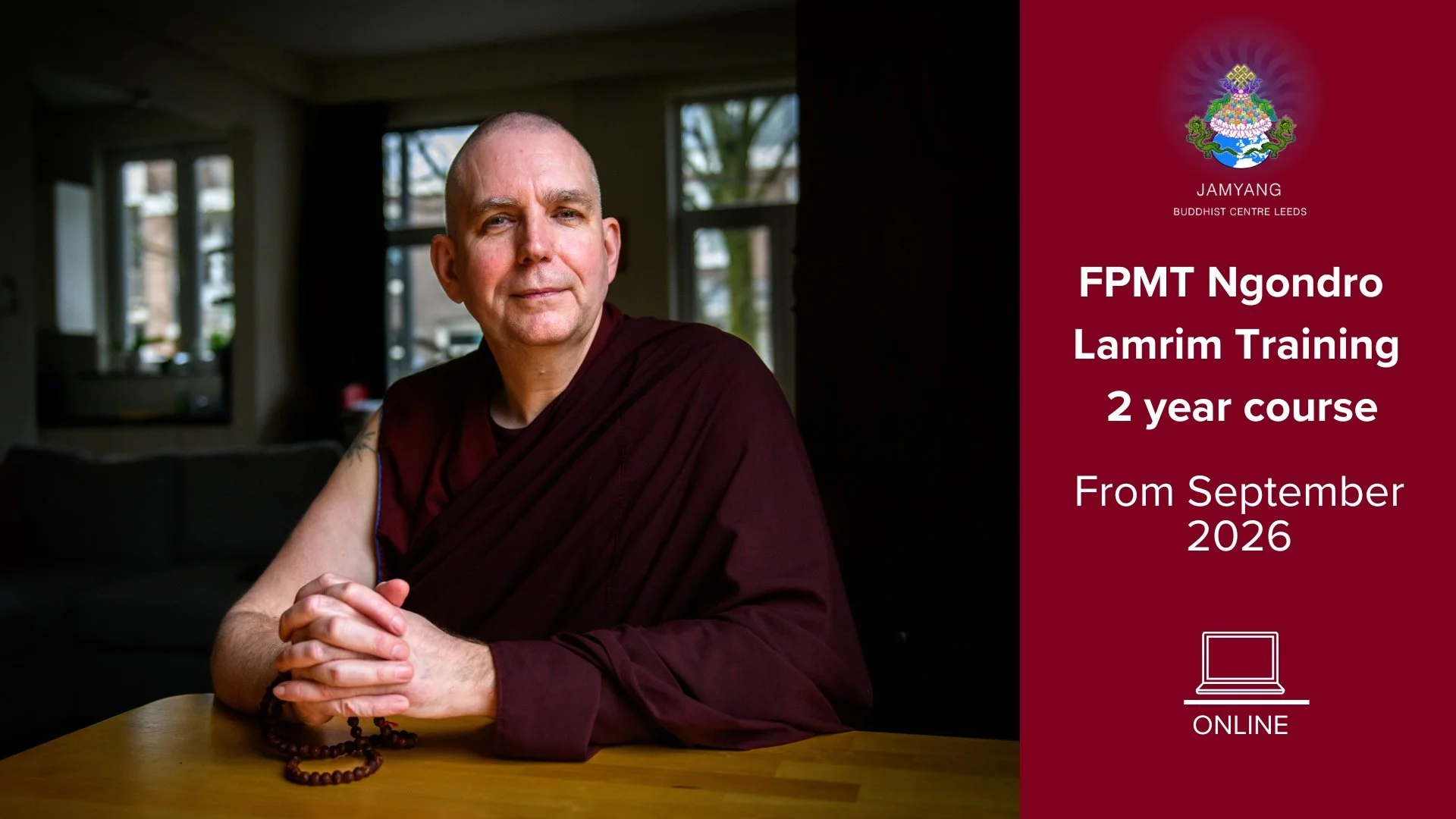
FPMT Ngondro Lamrim Training
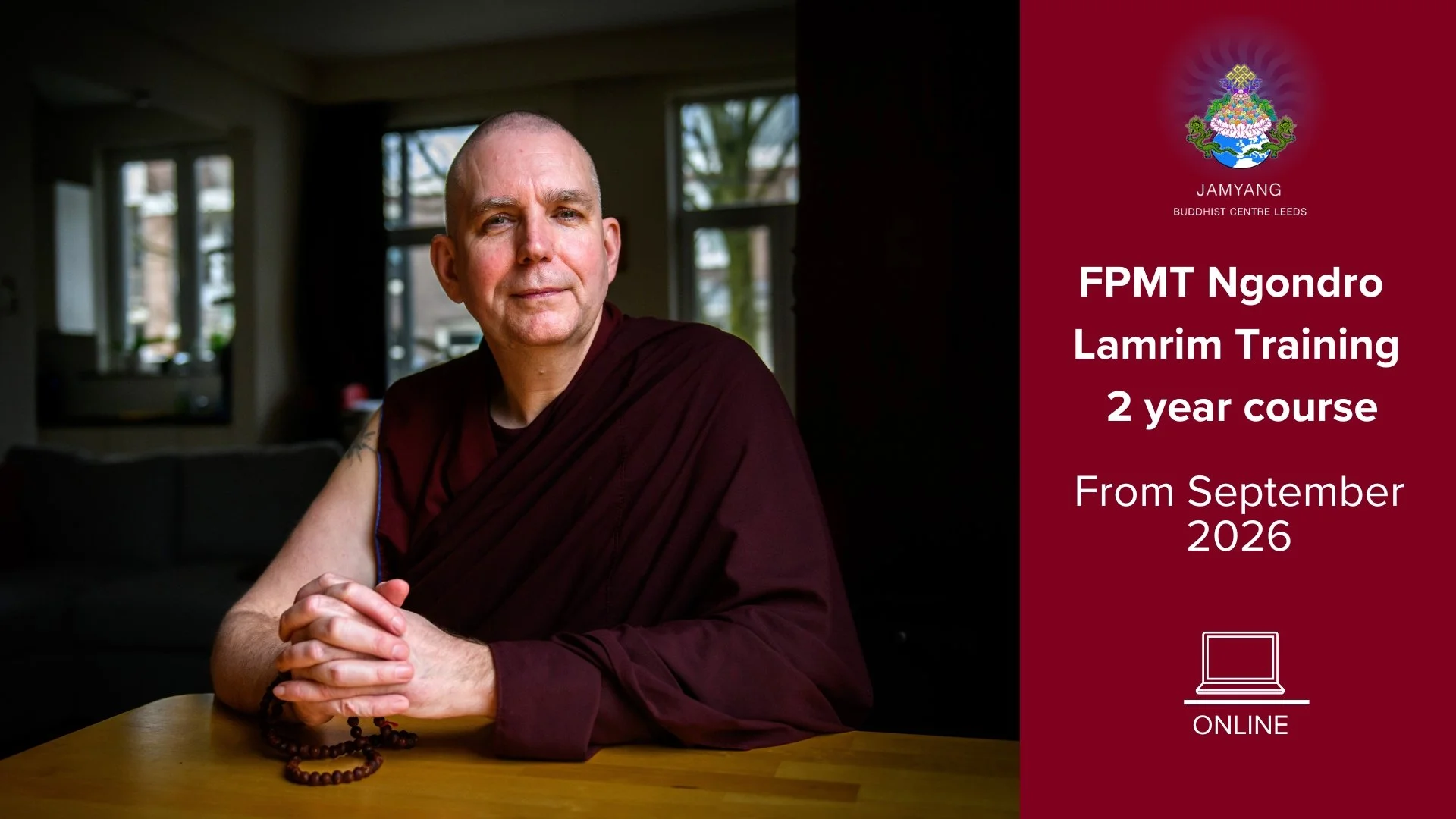
Overview of SESSION
DATE: 2026 / 2027: Year 1
Term 1: September 14th to November 28th 2026
Over a period of two years, the FPMT Ngöndro Lamrim Training (NLRT) offers 16 months of training in the common and uncommon preliminary practices. The training is designed to generate the motivation that supports the development of calm abiding, special insight, and tantra. By cultivating the inner qualities needed to ease unskillful patterns of mind that are the cause of hindrances on the path, it facilitates deep transformation.
An excellent preparation for the FPMT In-Depth Meditation Training (IDMT)
LOCATION: Recordings are released weekly
LEVEL: Buddhist Preliminary Practices
About the Course:
The Lamrim — "Stages of the Path" in Tibetan — is a systematic presentation of the entire Buddhist path to Awakening, written by the great Tibetan master Je Tsongkhapa in the 14th and early 15th century, based on writings of the Indian master Atisha. It arranges every essential teaching of the Buddha into a single, coherent, graduated sequence tailored to your mind, exactly as it is right now. Its true power lies not in study alone, but in practice. Each teaching is carefully arranged to meet the mind where it is and guide it—step by step—toward genuine change.
The uncommon preliminary practices (ngöndro) are powerful methods to purify the mind and prepare it for lasting transformation.
Over the first eleven months the common foundations, renunciation, bodhicitta, and the view of emptiness, are explored based on the Lamrim. For the remaining five months the focus is on the uncommon practices, Vajrasattva purification, mandala offerings, and guru yoga. Weekly sessions each introduce a new topic that examines different ways to meditate and why, in combination with a guided meditation.
The training helps establish a consistent daily meditative practice in supports of its overall aim: to engage in contemplative meditation in a way that genuinely transforms the mind's outlook on the world and gives one's life a new direction. Students gain a deep understanding of how to accumulate merit and purify unskillful karma while cultivating a healthy relationship with the Three Jewels and their teacher. The emphasis is on learning to meditate in a personally tailored way, in accordance with one’s psychological makeup and life conditions.
The Ngondro Lamrim Training teaching sessions are pre-recorded.
Each week, a 90-minute teaching together with two guided meditations are uploaded. On other days, advanced students contribute additional guided meditations. The teacher, Venerable Gendun, offers regular online Q&A sessions. For those who have already studied the Lamrim or the FPMT Basic Program, the training also offers specialized opportunities to learn how to guide others in meditation.
Year 1: Definite Emergence and Mind of Awakening
Prepare the mind for śamatha, vipaśyanā, and tantra
Explore renunciation and bodhicitta, the first two Principles of the Path
Develop genuine urgency through Lamrim contemplation
Cultivate the aspiration to Awakening for all beings
FPMT Ngondro Lamrim Taining is also part of The Buddha Project led by Venerable Losang Gendun. You can find out more about Venerable Gendun, the course and who it is suitable for on our FPMTNgondro Lamrim Training webpage
If you have any questions you would like to ask before registering please email our In-Depth Meditation Coordinator Marie Odile on idmt@jamyangleeds.co.uk
All materials for the course are provided to registered students.
Donations:
Generosity is one of the cornerstones of the Buddhist path. Donations help support both the centre and The Buddha Project as well as providing a donation for the teachings to Venerable Gendun. There are different levels depending on your income. There are three terms a year, each approximately 3 months long
As the course is a collaboration with other FPMT centres it is not possible to offer this as part of our Jamyang Leeds membership programme.
For those with a regular income the recommended donation is £95 per term
The sponsorhsip level is £115 per term
Ordained Sangha are free
If this isn’t affordable please do register, we never turn anyone away from the Dharma for financial reasons and we can agree a donation that is affordable for you at the current time. Please email Marie-Odile our IDMT Coordinator idmt@jamyangleeds.co.uk if you would like to chat.
Lunchtime Meditation
Overview
Make the most of your lunchtime with a guided meditation session to help calm your mind. These secular meditation sessions are a great way to relax and create some space for reflection in the middle of your day.
DATE: Monday- Friday
TIME: 12:30pm-1pm
LOCATION: Online all week and In person Tuesday and Friday
LEVEL: Wellbeing Programme – All levels
Pause, take a breath, and give yourself the midday reset you deserve.
Our lunchtime meditation sessions offer a gentle sanctuary right in the middle of your busy day—a dedicated space to slow down, drop your shoulders, and reconnect with yourself. Guided by a variety of our experienced, friendly meditators, these sessions focus on simple, relaxing breathwork designed to clear your mind, soothe your nervous system, and restore your inner energy.
Whether you are completely new to meditation or have been practicing for years, you are warmly invited to join us just as you are.
Yamantaka Practice Group
Overview of SESSION
This is a restricted practice, for those who have received the empowerment to practice Solitary Hero Vajrabhairava/Yamantaka.
If you have an interest in joining the group please email yamantakagroup@gmail.com to register.
The Yamantaka practice is held on the Mondays weekly. Please note that some weeks it starts at 2:30pm and some at 6pm it doesn’t always alternate weekly.
Tonglen Loving Kindness meditation Practice
Overview of Tonglen Meditation
The Buddhist practice of Giving & Taking (Tonglen in Tibetan) is at its heart a selfless meditation of loving kindness and compassion.
DATE: Tuesdays
TIME: 7am-7:30am
LOCATION: Zoom
LEVEL: Buddhist Meditation – All Welcome
SUGGESTED DONATION: £4
A beautiful practice led by Chrissie and Di.
The Buddhist practice of Giving & Taking (Tonglen in Tibetan) is at its heart a selfless meditation of loving kindness and compassion. You imagine giving all your happiness to others, sometimes using visualisation with the breath, and then taking all the suffering and its causes from others. It’s a powerful practice for the brave-hearted!
Kshitigarbha Practice
Overview of Kshitigarbha practice
DATE: Tuesdays & Thursdays
TIME: 12pm-12:30pm
LOCATION: Zoom only
LEVEL: Buddhist Practices – All Welcome
SUGGESTED DONATION: £4
Lama Zopa Rinpoche (our organisation’s Spiritual Director) suggested Jamyang Leeds perform these practices to help with the financial obstacles we are currently having. From September 2022, we’ll be reciting this practice as much as we can. See the special newsletter explaining all about the practice here.
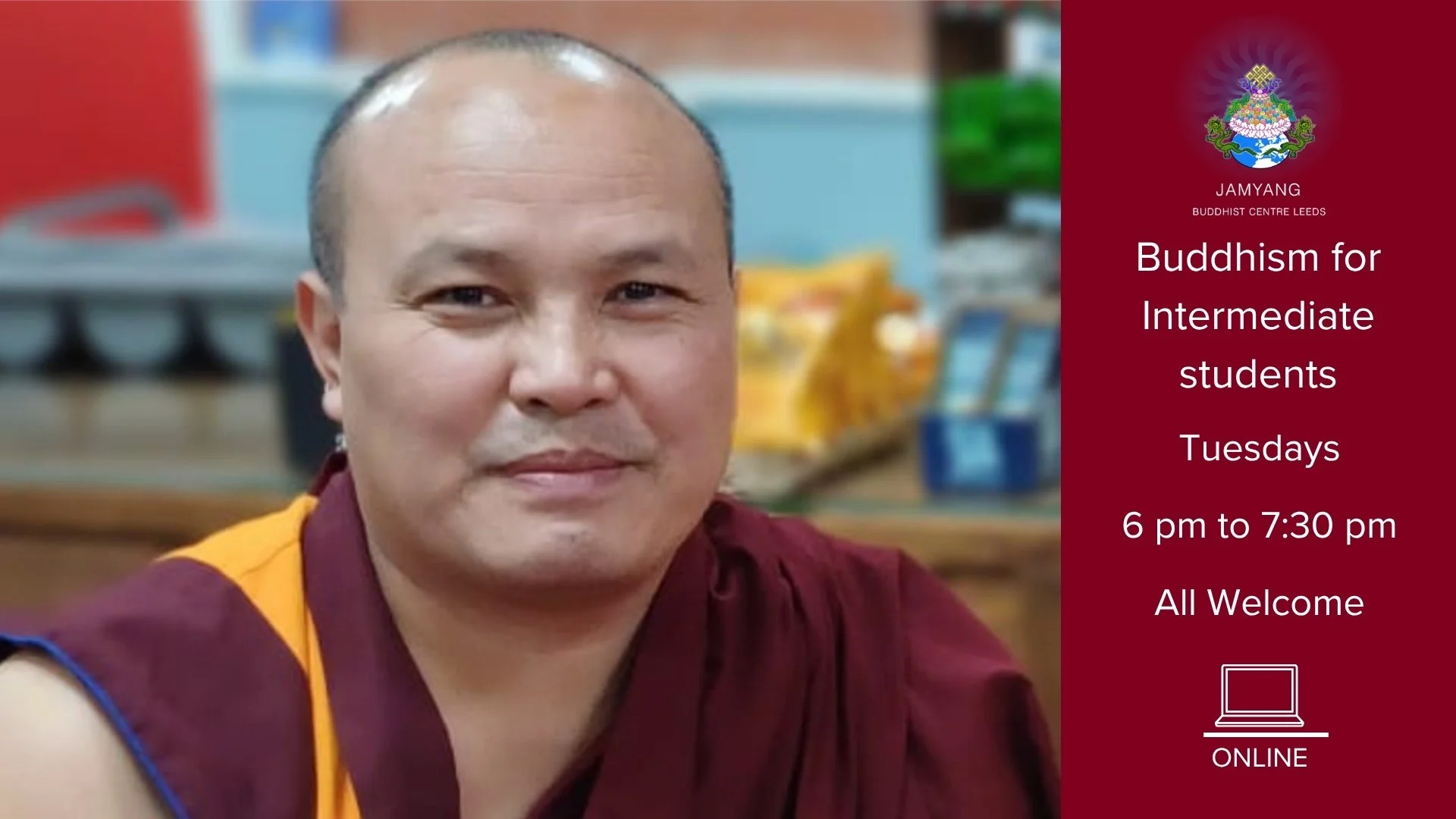
Buddhism for Intermediate Students
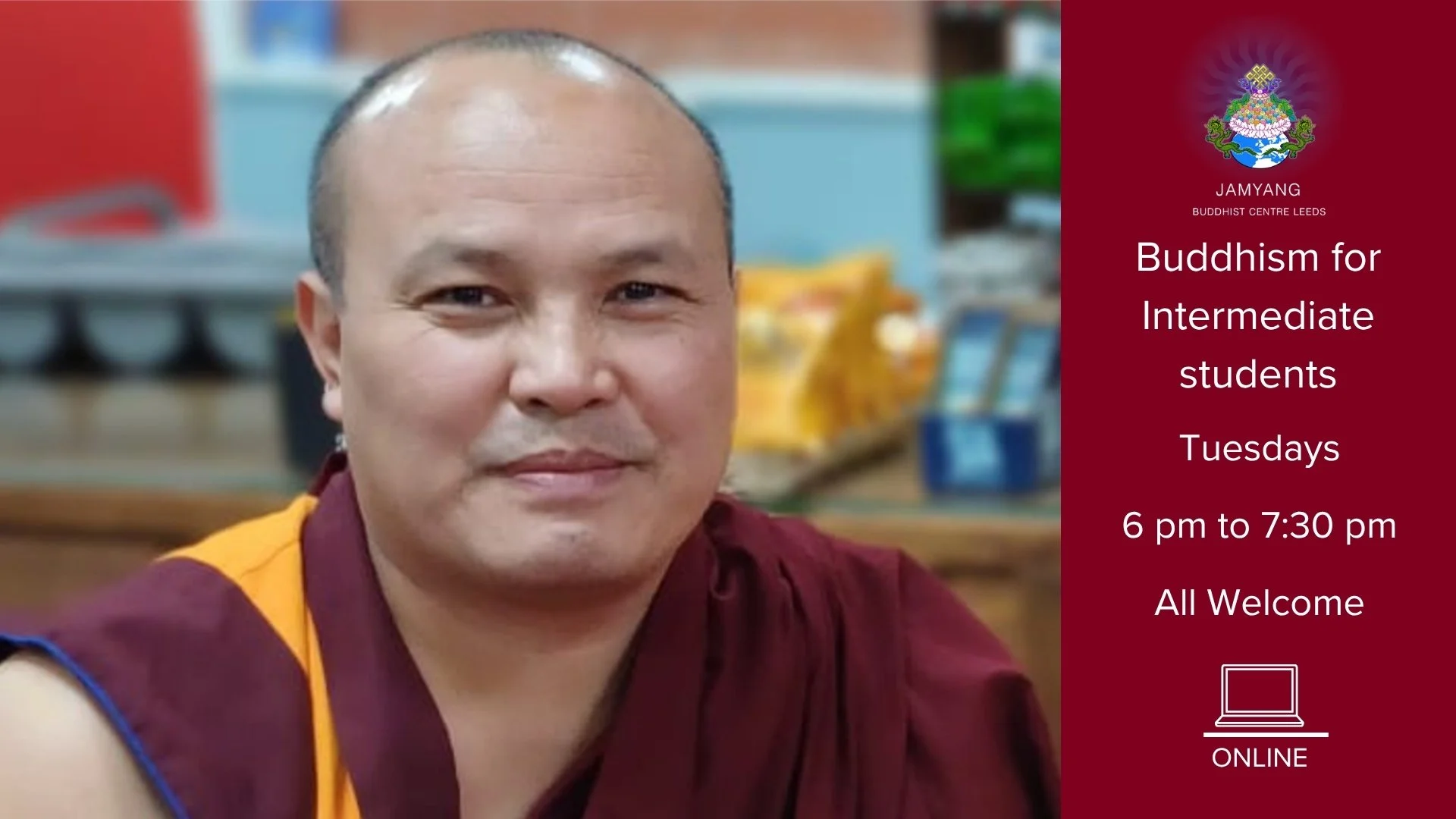
Overview of Programme
DATES: Weekly sessions 7th July to 24th November
TIME: Tuesday weekly 6:00 pm to 7:30 pm
LOCATION: Online
LEVEL: Intermediate students of Buddhism and those interested in Buddhist philosophy
Buddhism for Intermediate students:
This series of teachings aims to provide a comprehensive understanding of key Buddhist texts and practices, offering both theoretical knowledge and practical guidance for those interested in deepening their spiritual practice. Each monthly session is carefully designed to build a holistic understanding of Buddhist philosophy and meditative practices.
This series of sessions will focus upon the key text: Illuminating the Intent: An Exposition of Chandrakirti’s Entering the Middle Way.
Online drop in class – no need to register.
SUGGESTED DONATION FOR DROP IN CLASS:
Non-members – £12 per drop in class. This will contribute to the centre’s running costs and include a donation to the teacher.
Gift Aid: if you are a UK taxpayer we can claim back 25p for every £1 you donate. More information on Gift Aid can be found here.
Free to members of The Jamyang Buddhist Centre Leeds (your membership fees already contribute to our core costs in running the centre). You are invited to make a donation for the teacher, as is customary when receiving Buddhist teachings, in order to support their activity. For your reference we recommend a donation in the region of £4 per class. We will make the donation to the teacher on your behalf.
We never turn anyone away from the Dharma for financial reasons. If you cannot donate the suggested amount, please donate where possible within your means. It’s good to practice generosity where we can.
ABOUT YOUR Teacher: Geshe Rinchen Wangyal
Geshe Rinchen has dedicated his life to the study and practice of the Buddha’s teachings. He completed rigorous training in Buddhist philosophy, debate, and meditation, achieving the esteemed title of Geshe, the doctorate degree in the Tibetan Buddhist tradition.
His teachings are known for their clarity, warmth, and practical applicability, making profound topics accessible to students of all backgrounds.
Currently resident teacher at Jamyang Buddhist Centre Leeds, Geshe Rinchen combines his deep knowledge with genuine compassion, inspiring students to cultivate inner peace and wisdom in their own lives.
SESSION RESOURCES:
About this series:
The great Tsongkhapa wrote three profound texts on Madhyamika philosophy and practice:
The Essence of True Eloquence,
Ocean of Reasoning,
Illuminating the Intent.
Illuminating the Intent is one of these masterpieces, completed shortly before he passed into parinirvana. It is perhaps the most profound text ever written by a Tibetan scholar on Madhyamika philosophy and practice, guiding readers to both understand emptiness intellectually and apply its insights in daily life.
Nagarjuna composed the Fundamental Wisdom of the Middle Way, on which Chandrakirti later wrote his commentary, Entering the Middle Way. Since Chandrakirti’s work consists only of verses, Je Tsongkhapa composed a detailed commentary, making Illuminating the Intent an essential guide for understanding Nagarjuna’s root text. The primary theme of these texts is emptiness—what it is and how to practise it effectively.
Why This Text Matters:
Je Tsongkhapa’s text is invaluable for anyone seeking to understand reality, the self, the nature of the mind, life, the root causes of suffering, and consciousness. Studying it helps uncover practical methods to overcome suffering, find meaning in life, and apply these teachings in daily living.
About the Great Tsongkhapa:
The great Tsongkhapa (1357–1419) was a true genius in interpreting and practising Mahayana teachings as laid down by the ancient Indian Nalanda masters. He founded the Geluk tradition of Tibetan Buddhism, which emphasises both rigorous intellectual analysis and practical application of the Buddha’s teachings, following the approach of the Nalanda masters.
Who This Course Is For:
This course is suitable for both practitioners and academics, as well as anyone with a keen interest in Madhyamika philosophy and the practice of emptiness. In class, we will engage with the text through reading and giving explanation page by page following the Tibetan monastic educational tradition. At times, we will also participate in monastic-style debate to clarify the meaning and implications of the text. This approach allows participants to explore the material both intellectually and practically.
Vajrasattva Practice
Overview of The Vajrasattva Practice
DATE: Tuesdays
TIME: 8:00pm-8:30pm
LOCATION: Zoom
LEVEL: Buddhist Practices – All Welcome
SUGGESTED DONATION: £4
Purification here means looking at our past unskillful actions which have created seeds of negative karma in our minds, and using visualisation and mantra recitation to remove those seeds in a healthy and productive way. Vajrasattva is the embodiment of all the Buddha’s cleaning and purifying energy. We all make mistakes, and how we deal with them is key to making spiritual progress. We’ll be using a short text composed by Lama Zopa Rinpoche
the eight verses of thoughts transformation
Overview of the eight verses of thoughts transformation
Everflowing Nectar of Bodhichitta – Annihilating the Demon of the Self-Cherishing Mind
DATE: Wednesdays
TIME: 7am-7:30am
LOCATION: Zoom
LEVEL: Buddhist Practices- All Welcome
SUGGESTED DONATION: £4
Everflowing Nectar of Bodhichitta – Annihilating the Demon of the Self-Cherishing Mind
Led by Di or Sande
This practice is based on the short text” Eight Verses of Thought Transformation”, which contains the entire technique for transforming the mind into relative bodhichitta (i.e., the wish to achieve enlightenment for the benefit of all sentient beings) and absolute bodhichitta (i.e., the wisdom realizing emptiness).
Chanting the Verses of Noble manjushri
Overview of Session
DATE: Thursdays
TIME: 7:45am to 8:25 am
LOCATION: Zoom only
LEVEL: Buddhist Practices – suitable for Lama Zopa Rinpoche’s students
Join us to fulfill His Holiness the Dalai Lama’s wishes and chant the Names of Noble Manjushri for the swift return of Lama Zopa Rinpoche.
Please come along even if you havent done the practice before, its quite wonderful and very energising. Please download the text below, you can also listen and practice with the audio clip of Lama Zopa Rinpoche reciting the Chanting the Names of Noble Manjushri.
Kshitigarbha Practice
Overview of Kshitigarbha practice
DATE: Tuesdays & Thursdays
TIME: 12pm-12:30pm
LOCATION: Zoom only
LEVEL: Buddhist Practices – All Welcome
SUGGESTED DONATION: £4
Lama Zopa Rinpoche (our organisation’s Spiritual Director) suggested Jamyang Leeds perform these practices to help with the financial obstacles we are currently having. From September 2022, we’ll be reciting this practice as much as we can. See the special newsletter explaining all about the practice here.
Kalachakra Practice group
Overview of practice
This is a restricted group for those who have received the Kalachakra empowerment from a qualified Lama. To join the group you need to have either received the full Kalachakra empowerment or another High Yoga Tantra empowerment such as Heruka, as long as you have received a Kalachakra Jenang (permission).
This international group of Kalachakra practitioners meets weekly and alternates with commentary and practice.
Mind Mandala once a month and six session guru yoga for other sessions:
If you’re already part of this group, please use the details sent in the weekly email to join the practice
If you’d like to join us, please email spc@jamyangleeds.co.uk confirming that you have the appropriate empowerments. You will then be sent a registration form to complete.
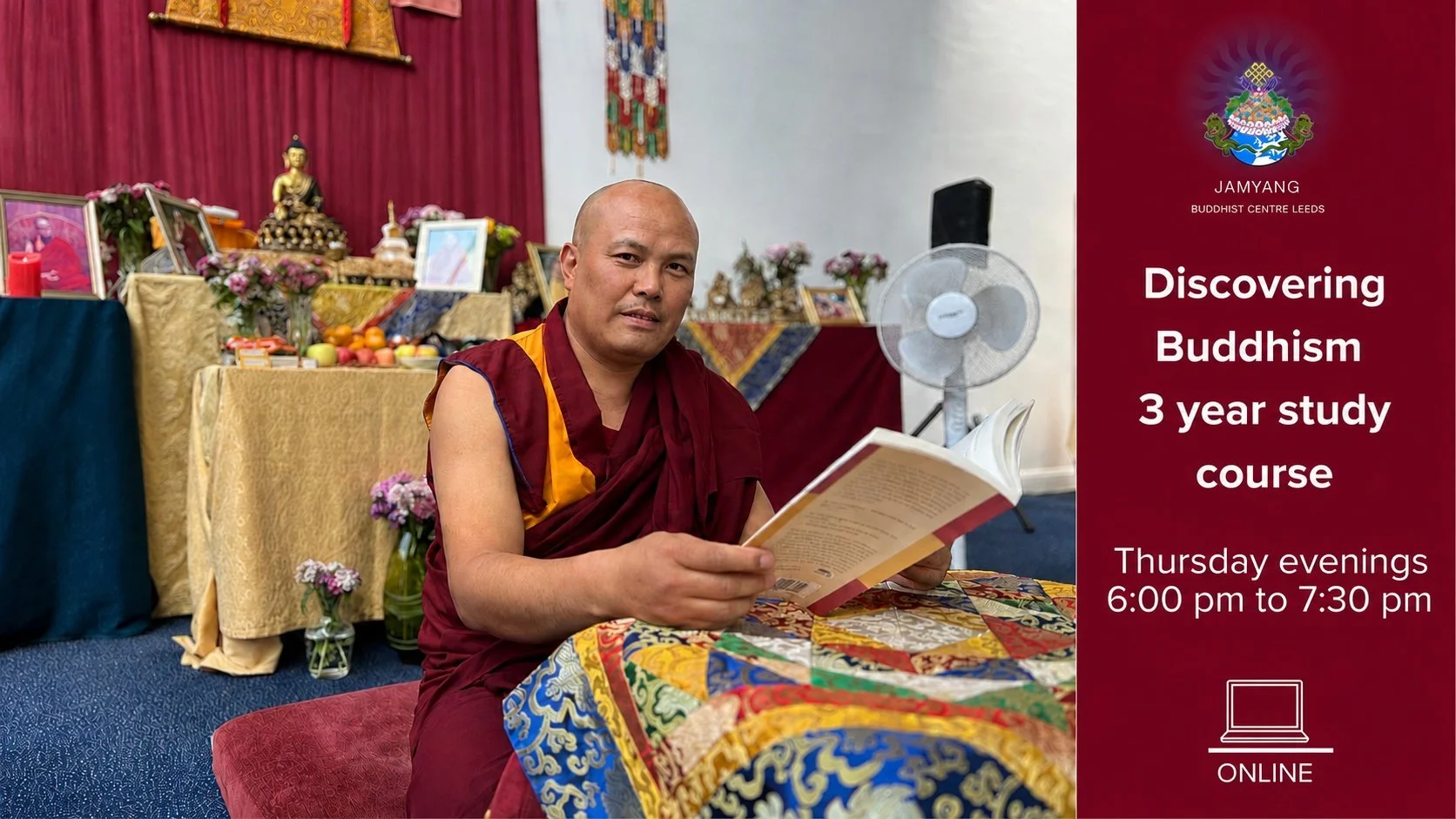
Discovering Buddhism: how to meditate
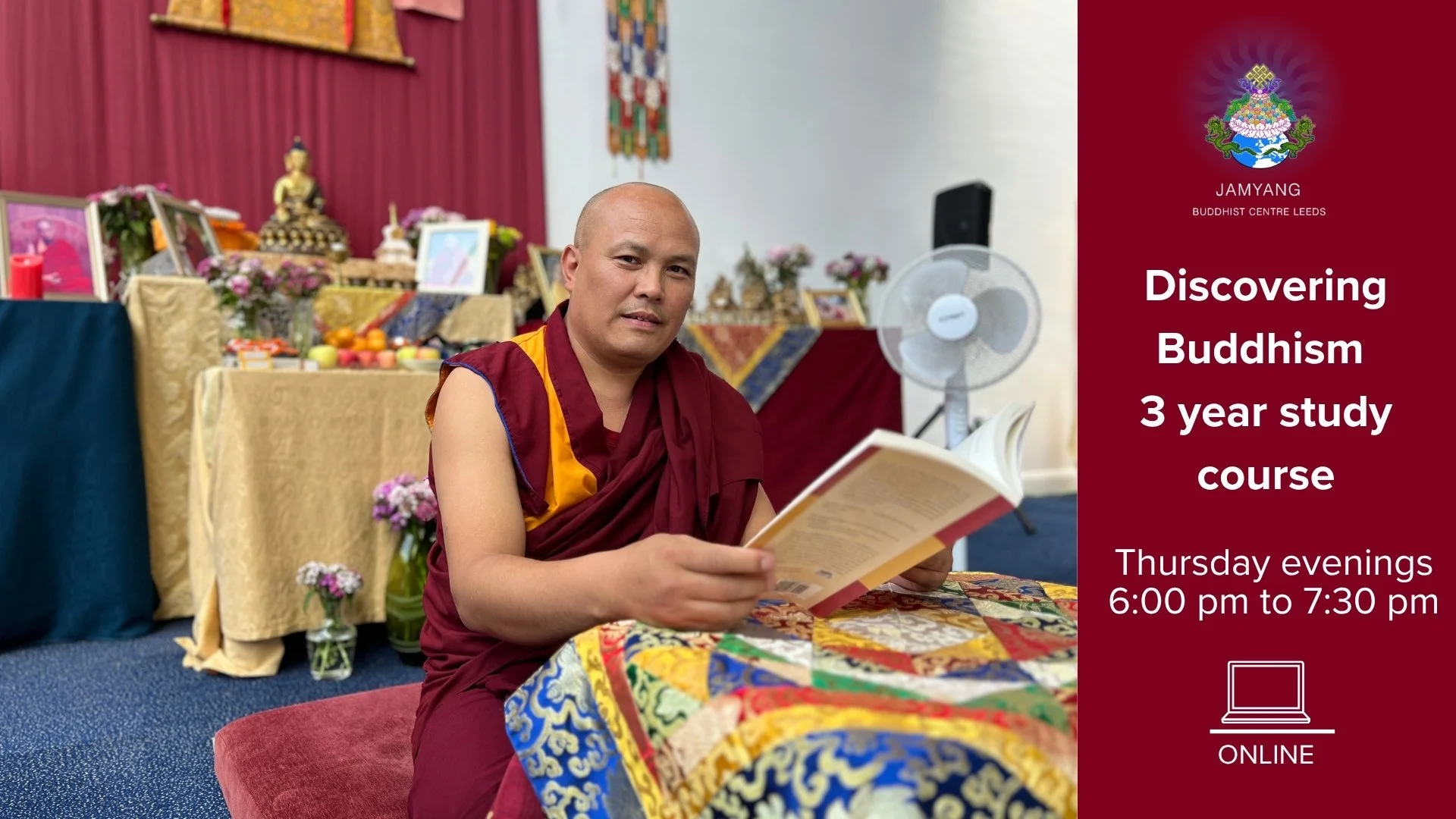
Overview of Programme
DATE: 2026: 15th October, 22nd October, 29th October, (no class on the 5th Nov) 12th November, 19th November, 26th November and Meditation day Sunday 29th November
TIME: Thursday’s weekly 6:00 pm to 7:30 pm
LOCATION: Online
LEVEL: The course is suitable for both beginners and intermediate students, providing a structured approach to Buddhist study.
What to Expect in This Module: How to meditate
Under the guidance of Geshe Rinchen you will learn the definition and purpose of meditation, how to sit, how to set up a meditation session, different meditation techniques, and how to deal with obstacles to meditation.
Through:
Introductory Meditations
Explanatory Teachings - Understand the Foundations and Special features of Meditation.
Reflection and Discussion - Consider how this practice relates to the rest of the path and your own practice.
Supportive Environment - Learn and share with like-minded practitioners, supported by the wisdom and guidance of Geshe Rinchen.
Integration Guidance - Learn ways to connect these Meditation methods with your lamrim meditation and daily spiritual growth.
This module concludes with an online Day of Meditation on Sunday, 29th November, offering time for deeper reflection and integration of the teachings.
Suitable for both new and experienced students ready to delve into the inspiring methods that turn life’s challenges into opportunities for growth, compassion, and wisdom
Awakening the limitless potential of your mind, achieving all peace and happiness
Discovering Buddhism is a beginner to intermediate level, 3 year study programme that will give you a solid foundation in the teachings and practice of Tibetan Mahayana Buddhism. The Mind & its Potential is the 1st Module.
This course was designed by Lama Zopa Rinpoche for students to study, explore and put into practice the graduated path to enlightenment, the lamrim. Originally based on Buddha Shakyamuni’s teachings from 2500 years ago in India. The lamrim was systematically organised by the Indian master Atisha in the 11th Century and by several other great masters from Tibet including Lama Tsongkhapa in the 15th Century.
Our resident teacher Geshe Rinchen Wangyal (Geshe La) will be teaching this module. This is an excellent opportunity to receive these Lamrim teachings directly from Geshe La. We are indeed most fortunate to be able to do so.
This course commences August 2026 and runs for just over 3 years during term time on Thursday evenings online for 90 minutes and has 14 subjects, 13 of which are usually taught over 6 weeks. It is possible to join at any time during the course.
We warmly invite you to join us for this enriching journey with Geshe Rinchen. Together, let us explore how to bring the timeless wisdom of Buddhism into our everyday lives.
Please register for Discovering Buddhism here. For more information contact our course coordinator, Ruth: db@jamyangleeds.co.uk
ABOUT YOUR Teacher: Geshe Rinchen Wangyal
Geshe Rinchen studied at Drepung Losel Ling Monastery in India, then at the Institute of Buddhiust Dialectics. He gained his Geshe degree in 2015.
He then studied at the University of Winchester in the UK, gaining a BA (hons) Degree in Philosophy, Religion and Ethics in 2024
Geshe La has had articles published in The Scientific American in 2020 including 'Hygiene of the mind during the Pandemic’. He has also received awards for essay competitions at the Institute of Buddhist Dialectics.
Geshe La’s teachings are known for their clarity, warmth, and practical applicability, making profound topics accessible to students of all backgrounds. Geshe La combines his deep knowledge with genuine compassion, inspiring students to cultivate inner peace and wisdom in their own lives.
Geshe La teaches in English fluently.
You can read more about Geshe Rinchen here.
SUGGESTED DONATION:
Non-members – £72 per module for the Thursday classes (usually 6 weeks), and £32 for the meditation day at the end of each module. This will contribute to the centre’s running costs and includes a donation to the teacher.
Free to members - Members are invited to make a donation for the teacher, as is customary when receiving Buddhist teachings, in order to support their activity (for your reference we recommend a donation in the region of £20 per module and £10 per meditation day).
We never turn anyone away from the Dharma for financial reasons. If you cannot donate the suggested amount, please contact Ruth on: db@jamyangleeds.co.uk to discuss what would be affordable for you.
It’s good to practice generosity where we can.
How to Donate:
You can make a donation by card using our Donation Portal here. Please put Discovering Buddhism as a reference in the comments box
Alternatively you can donate by Bank Transfer using the details below, please reference Discovering Buddhism
Account Name: Jamyang Buddhist Centre Leeds
Bank Name: Cooperative Bank Plc
Account number: 65178087 Sort-Code: 08-92-99 SWIFT: CPBK GB22 IBAN: GB76 CPBK 0892 9965 1780 87
Gift Aid: if you are a UK taxpayer we can claim back 25p for every £1 you donate. Please indicate when registering if you would like us to claim gift aid on your donations.
Shamatha – Meditation on the Breath
Overview of Session
DATE: Fridays
TIME: 7am-7:30am
LOCATION: Zoom
LEVEL: All Welcome
SUGGESTED DONATION: £4
Led by Ruth
Mindfulness of Breathing is universally acknowledged to be of benefit to all living in the modern world. Many feel overloaded with all that is expected of us living this complex and exhausting existence. Developing our awareness in this way is a general prescription for soothing and healing the overworked body and mind.
Practicing focusing the attention on an object such as the breath is also a core practice in Tibetan Buddhism. Gradually over time we are able to hold the object of our attention over longer periods, which enables us to practice other meditations such as Vipassana more successfully.
Cancelled Vinyassa Flow Yoga with Giulia
Overview of Session
DATE: Friday weekly
TIME: 10:00 am to 11:00 am
LOCATION: In-person
LEVEL: Everyone welcome - Drop In class
COST: Pay as you feel, everything will be donated to support Jamyang Buddhist Center
About the Class:
These Vinyassa Flow Yoga classes are designed to build strength, stability and balance, both physically and mentally, through creative sequencing and a grounding focus on breath.
This drop in class is suitable for everyone
About the Teacher - Giulia Ferrari:
Giulia is a yoga teacher with a passion for empowering people through dynamic, energising movement and mindful breathing. She strives to create a supportive, inclusive space where students feel safe to express themselves, open their hearts and release what no longer serves them.
With a background in ballet and a passion for rock climbing, Giulia’s approach blends grace, strength, and playful energy. She first came to yoga 20 years ago during a time of difficulty and anxiety, and it became a source of healing and resilience. That transformative experience made Giulia want to give back by sharing the acceptance and encouragement she received through the practice.
In 2025, Giulia completed 200-hour Yoga Flow teacher training at Yoga Hero in Leeds. Outside of the studio, she works as a veterinary surgeon. Giulia’s other passions are the mountains and the great outdoors, and you'll often find her ice or rock climbing when she is not on the mat.
Whether through movement, breath, or stillness, Giulia’s goal is to help you reconnect with yourself, feel empowered, and move through life with greater ease.
Contact:
All enquiries to Giulia on mountainsyoga@gmail.com
White Umbrella Deity practice
Overview of practice
DATE: Fridays
TIME: 11:30 am to 12:00 pm
LOCATION: Please note this is online only
LEVEL: Buddhist Practices – see note below
SUGGESTED DONATION: £4
In September 2024, His Eminence Ling Rinpoche gave us this practice to overcome obstacles to the centre flourishing.
In addition to many benefits of engaging in these practices, Lama Zopa Rinpoche recommended that these two practices are beneficial to helping bring peace to situation between Israel and Palestine.
The Sanskrit name for the White Umbrella deity is Ushnisha Sitatapatra which can also be translated as “The Victorious White Parasol.” The White Umbrella Deity, [Skt. Sitatapatra, Tib. gdugs dkar] is a powerful female deity. She is relied upon for protection; healing illness; dispelling interferences, spirit possession, and harmful forces; quelling disasters; averting obstacles; and bringing auspiciousness.
Ushnisha Sitatapatra is a female form of Avalokiteshvara, the Bodhisattva of Compassion. Like this Bodhisattva in an elaborate form, she also has a thousand eyes that watch over living beings, and a thousand arms that protect and assist them. Thus she symbolizes the power of active compassion.
Practices of Arya Sitatapatra includes, “The Supreme Accomplishment of Sitatapatra,” and “Praises and Repelling Practices of Sitatapatra.”
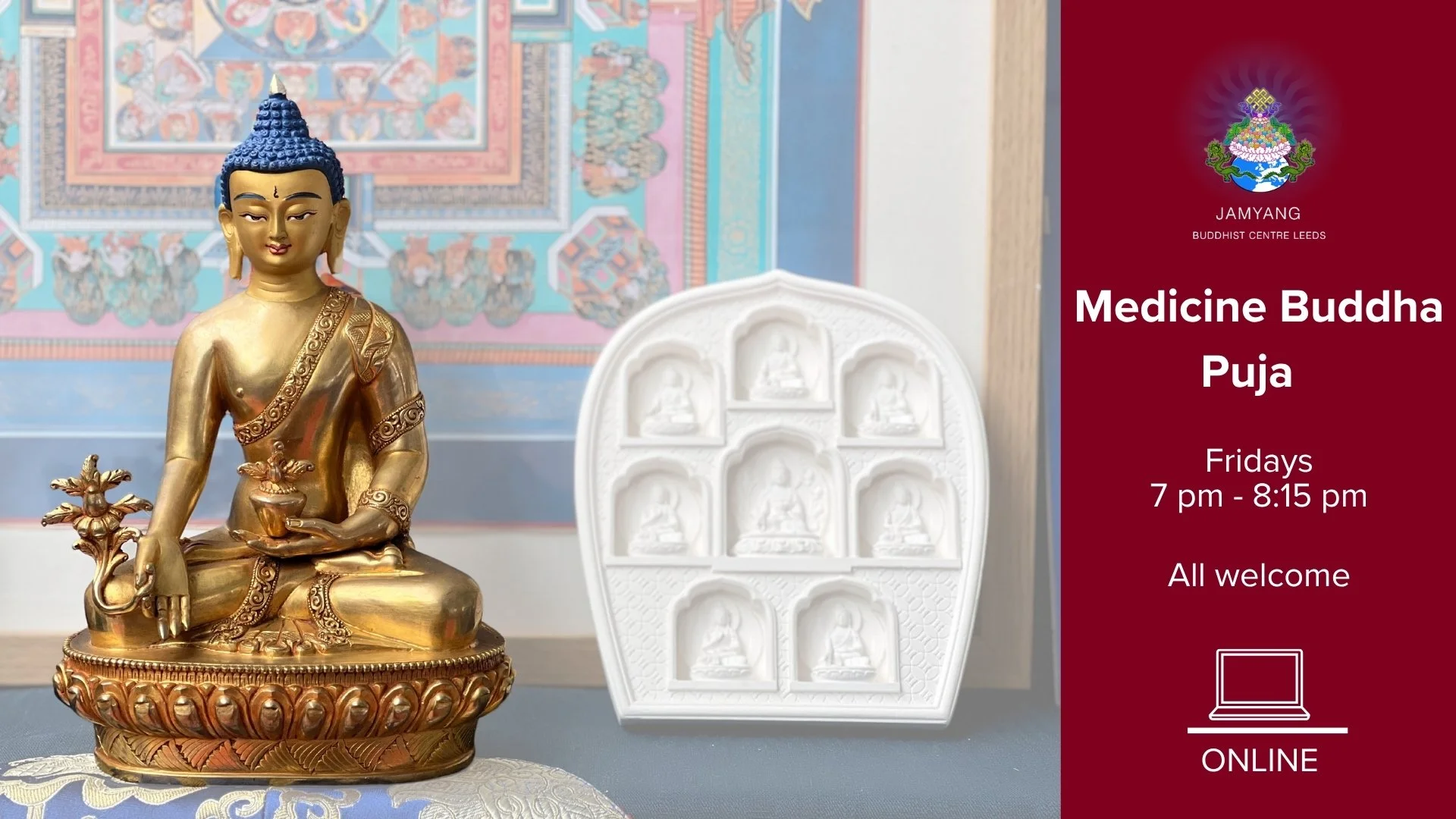
Medicine Buddha Puja
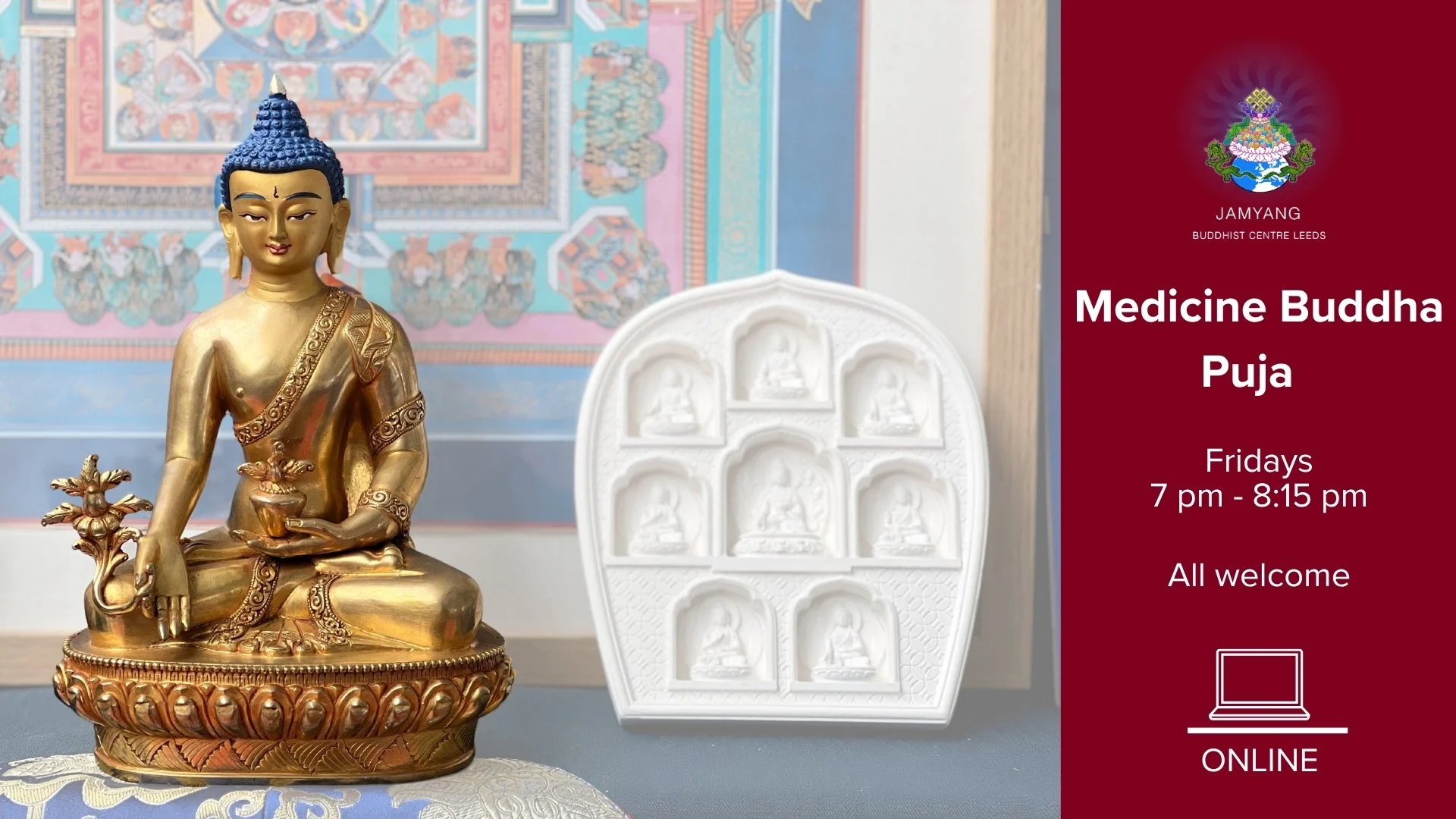
Overview of Medicine Buddha Puja
Medicine Buddha is one of the practices recommended by the FPMT for students to do for the swift return of Kyabje Lama Zopa Rinpoche.
DATE: FRIDAYS
TIME: 7 pm to 8:15 pm
LOCATION: Zoom
LEVEL: Buddhist Practices – All Welcome
SUGGESTED DONATION: £6
This is a longer meditation on Medicine Buddha – to remove obstacles, esp. those relating to health and achieving a favourable rebirth, and activate a swift path to enlightenment.
As Lama Zopa Rinpoche said: “One of the best healing meditations is that on the Medicine Buddha, who is the manifestation of the healing energy of all enlightened beings.”
The puja involves chanting prayers to the Seven Medicine Buddhas and reciting the Medicine Buddha mantras.
It is kindly led by Sande
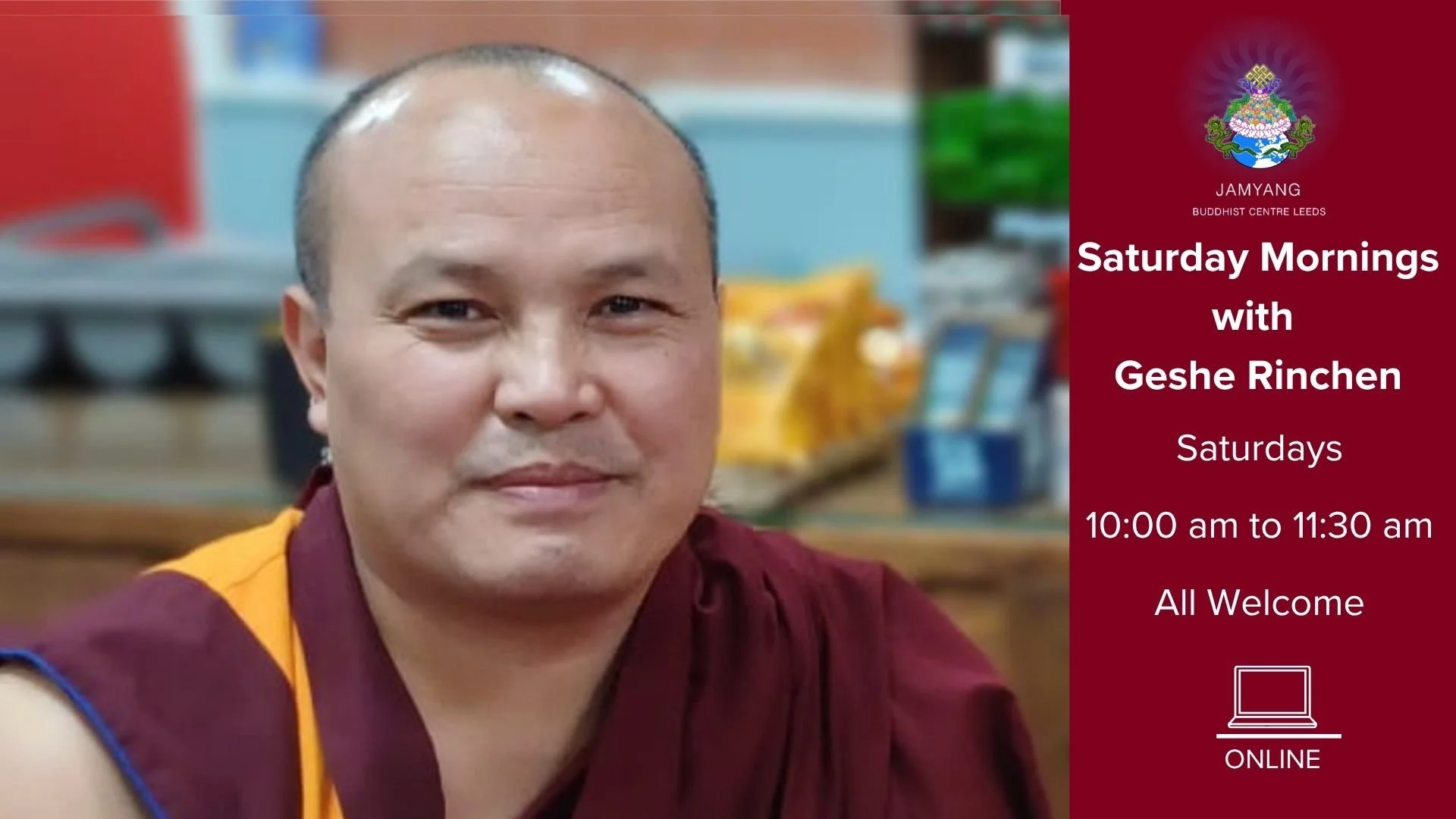
Saturday Mornings with Geshe Rinchen
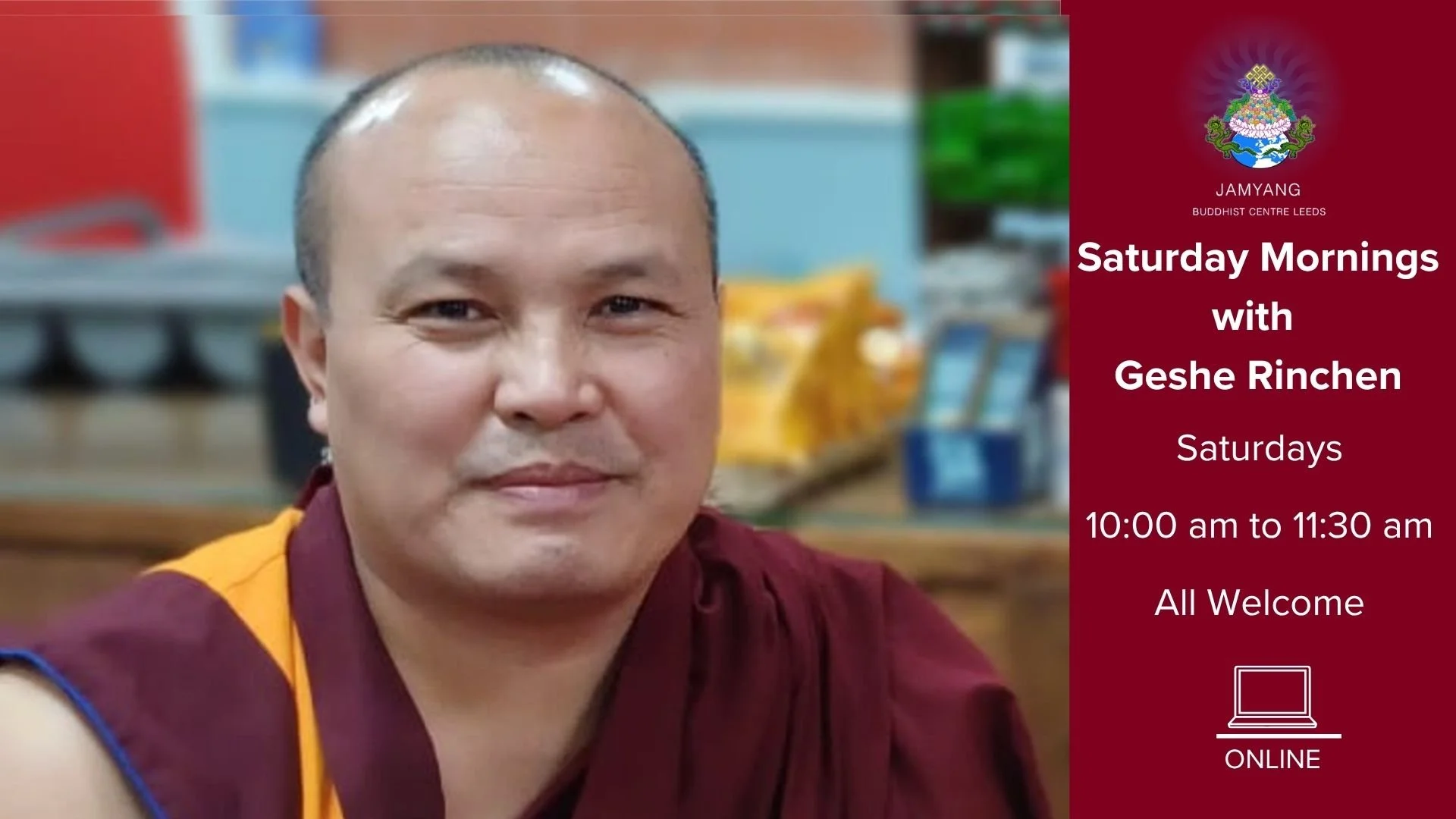
Overview of Programme
DATES: Saturdays weekly 4th July to 28th November
TIME: 10:00 am to 11:30 am
LOCATION: Online
LEVEL: Everyone interested in exploring Buddhism, from beginners to intermediate.
Saturday Mornings with Geshe Rinchen:
Are you curious about Buddhism and want to know more, or perhaps you already have some understanding but would like to expand on your knowledge. If so this Saturday morning class with Geshe Rinchen (Geshe La) is ideal for you. Designed as a drop in class with a different topic each week, covering key concepts in Buddhism and how they can make a real difference in our lives. Such as how we can deepen our connection with others, and how we can live our lives in the present moment. This is a great opportunity to spend time with Geshe La and ask questions.
Online drop in class – no need to register.
Registration will be required for the retreat in November at Land of Joy.
SUGGESTED DONATION FOR DROP IN CLASS:
Non-members – £12 per drop in class. This will contribute to the centre’s running costs and include a donation to the teacher.
Gift Aid: if you are a UK taxpayer we can claim back 25p for every £1 you donate. More information on Gift Aid can be found here.
Free to members of The Jamyang Buddhist Centre Leeds (your membership fees already contribute to our core costs in running the centre). You are invited to make a donation for the teacher, as is customary when receiving Buddhist teachings, in order to support their activity. For your reference we recommend a donation in the region of £4 per class. We will make the donation to the teacher on your behalf.
We never turn anyone away from the Dharma for financial reasons. If you cannot donate the suggested amount, please donate where possible within your means. It’s good to practice generosity where we can.
ABOUT YOUR Teacher: Geshe Rinchen Wangyal
Geshe Rinchen has dedicated his life to the study and practice of the Buddha’s teachings. He completed rigorous training in Buddhist philosophy, debate, and meditation, achieving the esteemed title of Geshe, the doctorate degree in the Tibetan Buddhist tradition.
His teachings are known for their clarity, warmth, and practical applicability, making profound topics accessible to students of all backgrounds.
Currently resident teacher at Jamyang Buddhist Centre Leeds, Geshe Rinchen combines his deep knowledge with genuine compassion, inspiring students to cultivate inner peace and wisdom in their own lives.
SESSION RESOURCES:
About this series:
July 2026
4 July – What did the Buddha Discover?
11 July – Buddha Nature – the Seed of Enlightenment
18 July – Understanding the Mind and Mental Factors
25 July – The Story of Milarepa: Transformation and Enlightenment
August 2026
1 August – The Four Noble Truths: An overview
8 August – Understanding Suffering
15 August – The Causes: Karma and Afflictive Emotions
22 August – The End of Suffering: What is Possible?
29 August – The Path: A Practical Way Forward
September 2026
5 September - Calm Abiding (Samatha)
12 September - Insightful Meditation (Vipassana)
19 September - the Mind of Awakening (Bodhicitta)
26 September – The Wisdom of Emptiness
October 2026
3 October – The Two Accumulations: Merit and Wisdom
10 October – Offering to the Three Jewels
17 October – Circumambulation Practice
24 October – Prostration Practice
31 October – Reciting Mantras and Their Benefits
November 2026
7 November – Introduction to Visualisation Practice
14 November – Medicine Buddha Practice
21 November – Tara Practice
28 November – Establishing Daily Practices
Who This Course Is For:
This is a wonderful opportunity to hear Geshe La teach each weekend online and to ask him questions.
These topics have been carefully selected for beginners,
They are also very suitable for all students of Buddhism to refresh and expand on their understanding.
FPMT In-Depth Meditation Training
Overview of SESSION
DATE: 2026 / 2027: Year 4
Term 1: September 5th to November 28th 2026
If you are starting as a new student in year 4, don’t worry. You will get some preparatory advice on what previous recordings to have a listen to. Alternatively you may wish to join the new Ngondro Lamrim Meditation course for 2 years before starting In Depth Meditation Training. They are designed to be complementary.
TIME: Saturdays weekly 2:30pm – 5pm UK time
LOCATION: Zoom only
LEVEL: Buddhist Meditation – Intermediate to Advanced
IDMT Year Four, The Vajra Ground: Mahamudra and Kriya Tantra
In this culminating fourth year of our journey, our path turns inward to the mind itself—its empty, luminous nature—and outward to the transformative methods of tantra, where the naturally pure nature of our perception is recognized as the very ground of awakening.
As always, the year will start with generating the mind of awakening, using evocative instructions ranging from Langri Thangpa to Nāgārjuna and Lord Buddha in the famous Bodhisattvapiṭaka. This mind generation we'll cultivate through the four immeasurable thoughts and the support of calm abiding.
Illuminated by the life stories of the masters of the Gelug Mahāmudrā lineage and beyond, we'll explore its roots in the history of the early Indian Mahāsiddhas, such as Saraha and Tilopa, through the Kagyü master Gampopa's and Je Tsongkhapa's Mañjuśrī lineage up to Paṇchen Losang Chökyi Gyaltsen's Highway of the Conquerors and its perspective on this practice. In Sūtra Mahāmudrā we will practice resting attention in the empty nature of awareness, recognizing its clarity and openness as inseparable.
Kriyā Tantra offers a complementary method. Rather than suppress the ordinary, narrow self-narrative that we impose on ourselves and our world, it substitutes for it an extraordinary perspective of pure view. Occasionally, by way of introduction, we'll also taste practices from the higher tantras—glimpsing how afflictive emotions can be met as innate wisdom, and how the dissolution of the death process opens onto the innate mind of clear light. The structured practices of generation and recitation become a rehearsal for transformation, training perception to meet appearances as pure.
These methods rest on a relationship. We will therefore examine the practice of guru devotion candidly—both as the means by which the lineage's realization is transmitted and as a practice with real pitfalls, requiring discernment as much as trust. Through the Ganden Lha Gyāma, the Yoga of the inseparability of guru and Avalokiteśvara, and supporting sādhanas, devotion is approached not as deference but as the ethical road toward the state of Vajradhara: the full integration of wisdom and method.
This final year is an invitation to let realization ripen into a way of being. Grounded in bodhicitta and the four immeasurables, sustained by the preliminary practices, and held by the strength of community, we learn to meet the mind without grasping and to meet the world as pure appearance. Our aim is not to accumulate practices, but to bring the path to maturity—wisdom and compassion no longer cultivated separately, but lived as one.
This four-year online course provides students with long term, in-depth support in their meditative development.
The teacher and course developer is Venerable Losang Gendun. He has trained extensively in meditation in both Theravada and Mahayana Traditions
The In Depth Meditation Training course is also part of The Buddha Project led by Venerable Losang Gendun. You can find out more about Venerable Gendun, the course and who it is suitable for on our FPMT In-Depth Meditation Training webpage
If you have any questions you would like to ask before registering please email our In-Depth Meditation Coordinator Marie Odile on idmt@jamyangleeds.co.uk
The zoom link and all materials for the course are provided to registered students.
Donations:
Generosity is one of the cornerstones of the Buddhist path. With your donation we support The Buddha Project and we keep our centre going for the benefit of all sentient beings.
As the course is a collaboration with other FPMT centres it is not possible to offer this as part of our Jamyang Leeds membership programme.
The recommended donation per calendar month is £45.
If you are able to practice generosity and sponsor other students we recommend £58 per calendar month.
If you are on a reduced income it is £31 per calendar month.
There is also the option to donate annually.
If none of the above options are affordable please do still register, we never turn anyone away from the Dharma for financial reasons and we can agree a donation that is affordable for you right now. Please email Marie Odile our IDMT Coordinator idmt@jamyangleeds.co.uk if you would like to chat.
A Mindful Heart - Sunday Community Meditation
overview of sunday Community Meditation
DATE & TIME: Sunday 10:30-11:30
LOCATION: In-person at the centre
LEVEL: Meditation – All Welcome
SUGGESTED DONATION: Generosity model - please donate as you feel affordable and as generously as is manageable
Discover your best self every Sunday morning
Are you keen to work on your well-being and connect with others trying to make their life a little better for themselves and those around them? Join our uplifting Sunday Community Meditation Sessions.
Each hour-long gathering begins with a soothing meditation to calm your mind, followed by an inspiring discussion on a way of being such as interconnection, that enriches your everyday life. We then dive into a focused meditation designed to help you embrace that way of being fully.
Wrap up your morning with a cup of tea and friendly conversation in a welcoming, relaxed atmosphere. Absolutely everyone welcome.
Meet us every Sunday at 10:30 AM and start your week feeling refreshed, connected, and inspired. Your journey to a happier, more mindful life begins here!
Cost: Generosity Model: Pay as you feel.
From September 2026 to February 2027 we will focus on ‘A Mindful Heart’.
Inspired by the Creating Compassionate Cultures program (“CCC”) by Pam Cayton, and developed by the Foundation for Developing Compassion and Wisdom. Grounded in three core pathways of learning: Knowledge, Strength, and Compassion. These pathways guide you towards a happier, more meaningful life by fostering inner growth and a warmer connection with others.
Designed to help you develop a deeper understanding of how the mind works. The aim is to gradually let go of destructive patterns of thought and behaviour while cultivating a healthy sense of self-confidence and a deep, compassionate connection with others.
You are invited to reflect on your attitudes, perceptions, and emotional patterns. By exploring the workings of our own minds and the nature of our interdependence with others and the world around us, we begin to see how deeply connected our inner and outer realities truly are. We examine both logical and scientific perspectives on the nature of the self and our relationships with others.
To deepen the learning, you are encouraged to reflect between sessions, pausing to notice your inner experiences and reconnect with your deepest values. This supports the integration of insights and ways to act with greater mindfulness and wisdom.
Ultimately, the transformation we foster in ourselves contributes to building more compassionate cultures. How can one person influence a whole culture? The answer lies in understanding interdependence. Every action we take, every choice, interaction, and intention, affects others and the broader environment, this principle of cause and effect lies at the heart of all life, reminding us that our individual transformation ripples outward in meaningful ways.
The Creating Compassionate Cultures programme has 7 steps:
Mindful Intention
Interconnection
Change
Perception
Transforming harmful emotions
Empathy
Compassion
Session overview:
Welcome, Introduction and Motivation 5 mins
Settling Meditation 10 mins
Meditation topic introduced then participants briefly share their experience 15 mins
Guided meditation 15 mins
Feedback from participants 10 mins
Closing and Dedication 5 mins
September 2026
6th and 13th: The Pursuit of Happiness
20th and 27th: Understanding how things exist
October 2026:
4th and 11th: Developing Healthy Self Confidence
18th and 25th: Compassion - Opening the heart
November 2026:
1st and 8th: Mindfulness, reflection and critical thinking
15th and 22nd: Mindful intention - what do I really want
29th: Interconnection (week 1)
December 2026:
6th: Interconnection (week 2)
13th and 20th: Embracing Change
January 2027:
10th and 17th: Perception
24th and 31st Transforming harmful emotions
February 2027:
7th and 14th: Empathy
21st and 28th: Cultivating Compassion
Vipassana Meditation
Overview of Vipassana Meditation
Join us for a peaceful start to your week with a 30 minute Vipassana meditation session, designed to cultivate mindfulness, self-awareness, and equanimity. Led by Geshe Rinchen
DATE: Mondays weekly (March to May and July to November)
TIME: 7:00 am to 7:30 am
Vipassana (Special Insight Meditation), also called analytical meditation, is primarily a practice of wisdom. It is a form of concentration that focuses single-pointedly on the ultimate nature of phenomena through analytical reasoning. Analysing phenomena is a key aspect of Vipassana practice, as it helps develop a definitive understanding of the nature of reality—such as the self, mind, emotions, and thoughts.
As Je Tsongkhapa explains, shamatha (calm abiding) is like a lamp that remains clear and steady in a place without wind, whereas vipassana (special insight) is like seeing the nature of phenomena clearly through such a steady and clear lamp. Therefore, the usual order of these two meditations is: first, achieving calm abiding or mental stability as a foundation, then engaging in special insight meditation through analysis. However, Vipassana meditation can also be practised by analysing and observing sensations, thoughts, and emotions without first achieving shamatha. This practice should still begin with focusing on the breath or another object of meditation. In our case, we will focus on the breath to start analysing the nature of the mind in relation to our sense of self, emotions, and thoughts.
The session begins by focusing on the breath—either the rise and fall of the abdomen or the sensation of air entering and leaving the nostrils. This practice calms the mind and helps establish a deep sense of presence.
Next, we move into a guided body scan, bringing awareness to different parts of the body and observing subtle sensations without judgement. This helps develop a greater connection to your physical experience.
As we proceed, you will practise observing and analysing sensations, thoughts, and emotions as they arise, learning to witness them without attachment or aversion. This fosters a deeper understanding of the impermanence and interconnectedness of the mind and self. Finally, you will rest your mind either in the natural state of awareness or in the analytical clarity gained through observation and reasoning.
Through regular practice, Vipassana meditation cultivates wisdom, encouraging a balanced and objective view of internal experiences. This session is ideal for those seeking greater insight and calmness in their daily lives.
Morning Prayers
Overview
Start the day by joining us for Morning Prayers recommended by Lama Zopa Rinpoche and HH Dalai Lama, for the benefit of all sentient beings and the swift return of Lama Zopa Rinpoche. Everyone is welcome.
DATE: Monday – Friday all year around
TIME: 8:30am - 9:00am
LOCATION: Zoom
LEVEL: Buddhist Practices – All Welcome
FPMT Ngondro Lamrim Training
Overview of SESSION
DATE: 2026 / 2027: Year 1
Term 1: September 14th to November 28th 2026
Over a period of two years, the FPMT Ngöndro Lamrim Training (NLRT) offers 16 months of training in the common and uncommon preliminary practices. The training is designed to generate the motivation that supports the development of calm abiding, special insight, and tantra. By cultivating the inner qualities needed to ease unskillful patterns of mind that are the cause of hindrances on the path, it facilitates deep transformation.
An excellent preparation for the FPMT In-Depth Meditation Training (IDMT)
LOCATION: Recordings are released weekly
LEVEL: Buddhist Preliminary Practices
About the Course:
The Lamrim — "Stages of the Path" in Tibetan — is a systematic presentation of the entire Buddhist path to Awakening, written by the great Tibetan master Je Tsongkhapa in the 14th and early 15th century, based on writings of the Indian master Atisha. It arranges every essential teaching of the Buddha into a single, coherent, graduated sequence tailored to your mind, exactly as it is right now. Its true power lies not in study alone, but in practice. Each teaching is carefully arranged to meet the mind where it is and guide it—step by step—toward genuine change.
The uncommon preliminary practices (ngöndro) are powerful methods to purify the mind and prepare it for lasting transformation.
Over the first eleven months the common foundations, renunciation, bodhicitta, and the view of emptiness, are explored based on the Lamrim. For the remaining five months the focus is on the uncommon practices, Vajrasattva purification, mandala offerings, and guru yoga. Weekly sessions each introduce a new topic that examines different ways to meditate and why, in combination with a guided meditation.
The training helps establish a consistent daily meditative practice in supports of its overall aim: to engage in contemplative meditation in a way that genuinely transforms the mind's outlook on the world and gives one's life a new direction. Students gain a deep understanding of how to accumulate merit and purify unskillful karma while cultivating a healthy relationship with the Three Jewels and their teacher. The emphasis is on learning to meditate in a personally tailored way, in accordance with one’s psychological makeup and life conditions.
The Ngondro Lamrim Training teaching sessions are pre-recorded.
Each week, a 90-minute teaching together with two guided meditations are uploaded. On other days, advanced students contribute additional guided meditations. The teacher, Venerable Gendun, offers regular online Q&A sessions. For those who have already studied the Lamrim or the FPMT Basic Program, the training also offers specialized opportunities to learn how to guide others in meditation.
Year 1: Definite Emergence and Mind of Awakening
Prepare the mind for śamatha, vipaśyanā, and tantra
Explore renunciation and bodhicitta, the first two Principles of the Path
Develop genuine urgency through Lamrim contemplation
Cultivate the aspiration to Awakening for all beings
FPMT Ngondro Lamrim Taining is also part of The Buddha Project led by Venerable Losang Gendun. You can find out more about Venerable Gendun, the course and who it is suitable for on our FPMTNgondro Lamrim Training webpage
If you have any questions you would like to ask before registering please email our In-Depth Meditation Coordinator Marie Odile on idmt@jamyangleeds.co.uk
All materials for the course are provided to registered students.
Donations:
Generosity is one of the cornerstones of the Buddhist path. Donations help support both the centre and The Buddha Project as well as providing a donation for the teachings to Venerable Gendun. There are different levels depending on your income. There are three terms a year, each approximately 3 months long
As the course is a collaboration with other FPMT centres it is not possible to offer this as part of our Jamyang Leeds membership programme.
For those with a regular income the recommended donation is £95 per term
The sponsorhsip level is £115 per term
Ordained Sangha are free
If this isn’t affordable please do register, we never turn anyone away from the Dharma for financial reasons and we can agree a donation that is affordable for you at the current time. Please email Marie-Odile our IDMT Coordinator idmt@jamyangleeds.co.uk if you would like to chat.
Lunchtime Meditation
Overview
Make the most of your lunchtime with a guided meditation session to help calm your mind. These secular meditation sessions are a great way to relax and create some space for reflection in the middle of your day.
DATE: Monday- Friday
TIME: 12:30pm-1pm
LOCATION: Online each weekday and In person Tuesday and Friday
LEVEL: Wellbeing Programme – All levels
Pause, take a breath, and give yourself the midday reset you deserve.
Our lunchtime meditation sessions offer a gentle sanctuary right in the middle of your busy day—a dedicated space to slow down, drop your shoulders, and reconnect with yourself. Guided by a variety of our experienced, friendly meditators, these sessions focus on simple, relaxing breathwork designed to clear your mind, soothe your nervous system, and restore your inner energy.
Whether you are completely new to meditation or have been practicing for years, you are warmly invited to join us just as you are.
Yamantaka Practice Group
Overview of SESSION
This is a restricted practice, for those who have received the empowerment to practice Solitary Hero Vajrabhairava/Yamantaka.
If you have an interest in joining the group please email yamantakagroup@gmail.com to register.
The Yamantaka practice is held on Mondays weekly. Please note that some weeks it starts at 2:30pm and some at 6pm it doesn’t always alternate weekly.

Tara Puja for World Peace

Overview of Session
DATE: 2026: Last Monday monthly (break in August)
TIME: 5:45pm-6:30pm
LOCATION: Zoom
LEVEL: Buddhist Practices – All welcome
SUGGESTED DONATION: £6
Tara Puja dedicated to world peace is held on a monthly basis.
Led by Ondy Willson and translated by Venerable Tenzin into Russian for Russian and Ukrainian students
Please join us, occasionally or regularly, at 17.45 UK time to show our support for the courageous spiritual communities both in Ukraine & Russia and also in Israel and Gaza. May we all nurture compassion & peace in the face of destruction & violence.
By coming together like this we send a powerful message that comes from the depths of our being. We value peace, harmony and the enlightened qualities we aspire to embody, as generated in the 21 Taras Sadhana.
By the power of our merit may there be a non-violent and bloodless revolution of consciousness so that enlightened democracies based on social wellbeing flourish everywhere.
Please forward this invitation to anyone who you think may be interested in this free and beneficial session.
The puja will last approximately 45 minutes to include some guidance on harnessing the positive power of the prayers in generating the particular qualities of compassion and fearlessness.
Ondy Willson, a touring FPMT teacher since 2007, has students in Russia & Ukraine, so felt particularly moved to offer these pujas both to connect with & support those who are suffering on the front line. So these pujas have provided, not just an opportunity to deal with fear and pray for peace, but to meet directly together as a global community and interact with our Ukrainian and Russian dharma friends. At the end of one week’s puja, participants in Ukraine & Russia shared their stories & experiences, which was very moving for us all to hear.
Tonglen Loving Kindness meditation Practice
Overview of Tonglen Meditation
The Buddhist practice of Giving & Taking (Tonglen in Tibetan) is at its heart a selfless meditation of loving kindness and compassion.
DATE: Tuesdays
TIME: 7am-7:30am
LOCATION: Zoom
LEVEL: Buddhist Meditation – All Welcome
SUGGESTED DONATION: £4
A beautiful practice led by Chrissie and Di.
The Buddhist practice of Giving & Taking (Tonglen in Tibetan) is at its heart a selfless meditation of loving kindness and compassion. You imagine giving all your happiness to others, sometimes using visualisation with the breath, and then taking all the suffering and its causes from others. It’s a powerful practice for the brave-hearted!
Kshitigarbha Practice
Overview of Kshitigarbha practice
DATE: Tuesdays & Thursdays
TIME: 12pm-12:30pm
LOCATION: Zoom only
LEVEL: Buddhist Practices – All Welcome
SUGGESTED DONATION: £4
Lama Zopa Rinpoche (our organisation’s Spiritual Director) suggested Jamyang Leeds perform these practices to help with the financial obstacles we are currently having. From September 2022, we’ll be reciting this practice as much as we can. See the special newsletter explaining all about the practice here.
Buddhism for Intermediate Students
Overview of Programme
DATES: Weekly sessions 7th July to 24th November
TIME: Tuesday weekly 6:00 pm to 7:30 pm
LOCATION: Online
LEVEL: Intermediate students of Buddhism and those interested in Buddhist philosophy
Buddhism for Intermediate students:
This series of teachings aims to provide a comprehensive understanding of key Buddhist texts and practices, offering both theoretical knowledge and practical guidance for those interested in deepening their spiritual practice. Each monthly session is carefully designed to build a holistic understanding of Buddhist philosophy and meditative practices.
This series of sessions will focus upon the key text: Illuminating the Intent: An Exposition of Chandrakirti’s Entering the Middle Way.
Online drop in class – no need to register.
Registration will be required for the retreat in November at Land of Joy.
SUGGESTED DONATION FOR DROP IN CLASS:
Non-members – £12 per drop in class. This will contribute to the centre’s running costs and include a donation to the teacher.
Gift Aid: if you are a UK taxpayer we can claim back 25p for every £1 you donate. More information on Gift Aid can be found here.
Free to members of The Jamyang Buddhist Centre Leeds (your membership fees already contribute to our core costs in running the centre). You are invited to make a donation for the teacher, as is customary when receiving Buddhist teachings, in order to support their activity. For your reference we recommend a donation in the region of £4 per class. We will make the donation to the teacher on your behalf.
We never turn anyone away from the Dharma for financial reasons. If you cannot donate the suggested amount, please donate where possible within your means. It’s good to practice generosity where we can.
ABOUT YOUR Teacher: Geshe Rinchen Wangyal
Geshe Rinchen has dedicated his life to the study and practice of the Buddha’s teachings. He completed rigorous training in Buddhist philosophy, debate, and meditation, achieving the esteemed title of Geshe, the doctorate degree in the Tibetan Buddhist tradition.
His teachings are known for their clarity, warmth, and practical applicability, making profound topics accessible to students of all backgrounds.
Currently resident teacher at Jamyang Buddhist Centre Leeds, Geshe Rinchen combines his deep knowledge with genuine compassion, inspiring students to cultivate inner peace and wisdom in their own lives.
SESSION RESOURCES:
About this series:
The great Tsongkhapa wrote three profound texts on Madhyamika philosophy and practice:
The Essence of True Eloquence,
Ocean of Reasoning,
Illuminating the Intent.
Illuminating the Intent is one of these masterpieces, completed shortly before he passed into parinirvana. It is perhaps the most profound text ever written by a Tibetan scholar on Madhyamika philosophy and practice, guiding readers to both understand emptiness intellectually and apply its insights in daily life.
Nagarjuna composed the Fundamental Wisdom of the Middle Way, on which Chandrakirti later wrote his commentary, Entering the Middle Way. Since Chandrakirti’s work consists only of verses, Je Tsongkhapa composed a detailed commentary, making Illuminating the Intent an essential guide for understanding Nagarjuna’s root text. The primary theme of these texts is emptiness—what it is and how to practise it effectively.
Why This Text Matters:
Je Tsongkhapa’s text is invaluable for anyone seeking to understand reality, the self, the nature of the mind, life, the root causes of suffering, and consciousness. Studying it helps uncover practical methods to overcome suffering, find meaning in life, and apply these teachings in daily living.
About the Great Tsongkhapa:
The great Tsongkhapa (1357–1419) was a true genius in interpreting and practising Mahayana teachings as laid down by the ancient Indian Nalanda masters. He founded the Geluk tradition of Tibetan Buddhism, which emphasises both rigorous intellectual analysis and practical application of the Buddha’s teachings, following the approach of the Nalanda masters.
Who This Course Is For:
This course is suitable for both practitioners and academics, as well as anyone with a keen interest in Madhyamika philosophy and the practice of emptiness. In class, we will engage with the text through reading and giving explanation page by page following the Tibetan monastic educational tradition. At times, we will also participate in monastic-style debate to clarify the meaning and implications of the text. This approach allows participants to explore the material both intellectually and practically.
Vajrasattva Practice
Overview of The Vajrasattva Practice
DATE: Tuesdays
TIME: 8:00pm-8:30pm
LOCATION: Zoom
LEVEL: Buddhist Practices – All Welcome
SUGGESTED DONATION: £4
Purification here means looking at our past unskillful actions which have created seeds of negative karma in our minds, and using visualisation and mantra recitation to remove those seeds in a healthy and productive way. Vajrasattva is the embodiment of all the Buddha’s cleaning and purifying energy. We all make mistakes, and how we deal with them is key to making spiritual progress. We’ll be using a short text composed by Lama Zopa Rinpoche
the eight verses of thoughts transformation
Overview of the eight verses of thoughts transformation
Everflowing Nectar of Bodhichitta – Annihilating the Demon of the Self-Cherishing Mind
DATE: Wednesdays
TIME: 7am-7:30am
LOCATION: Zoom
LEVEL: Buddhist Practices- All Welcome
SUGGESTED DONATION: £4
Everflowing Nectar of Bodhichitta – Annihilating the Demon of the Self-Cherishing Mind
Led by Di or Sande
This practice is based on the short text” Eight Verses of Thought Transformation”, which contains the entire technique for transforming the mind into relative bodhichitta (i.e., the wish to achieve enlightenment for the benefit of all sentient beings) and absolute bodhichitta (i.e., the wisdom realizing emptiness).
Chanting the Verses of Noble manjushri
Overview of Session
DATE: Thursdays
TIME: 7:45am to 8:25 am
LOCATION: Zoom only
LEVEL: Buddhist Practices – suitable for Lama Zopa Rinpoche’s students
Join us to fulfill His Holiness the Dalai Lama’s wishes and chant the Names of Noble Manjushri for the swift return of Lama Zopa Rinpoche.
Please come along even if you havent done the practice before, its quite wonderful and very energising. Please download the text below, you can also listen and practice with the audio clip of Lama Zopa Rinpoche reciting the Chanting the Names of Noble Manjushri.
Kshitigarbha Practice
Overview of Kshitigarbha practice
DATE: Tuesdays & Thursdays
TIME: 12pm-12:30pm
LOCATION: Zoom only
LEVEL: Buddhist Practices – All Welcome
SUGGESTED DONATION: £4
Lama Zopa Rinpoche (our organisation’s Spiritual Director) suggested Jamyang Leeds perform these practices to help with the financial obstacles we are currently having. From September 2022, we’ll be reciting this practice as much as we can. See the special newsletter explaining all about the practice here.
Kalachakra Practice group
Overview of practice
This is a restricted group for those who have received the Kalachakra empowerment from a qualified Lama. To join the group you need to have either received the full Kalachakra empowerment or another High Yoga Tantra empowerment such as Heruka, as long as you have received a Kalachakra Jenang (permission).
This international group of Kalachakra practitioners meets weekly and alternates with commentary and practice.
Mind Mandala once a month and six session guru yoga for other sessions:
If you’re already part of this group, please use the details sent in the weekly email to join the practice
If you’d like to join us, please email spc@jamyangleeds.co.uk confirming that you have the appropriate empowerments. You will then be sent a registration form to complete.
Discovering Buddhism: how to meditate
Overview of Programme
DATE: 2026: 15th October, 22nd October, 29th October, (no class on the 5th Nov) 12th November, 19th November, 26th November and Meditation day Sunday 29th November
TIME: Thursday’s weekly 6:00 pm to 7:30 pm
LOCATION: Online
LEVEL: The course is suitable for both beginners and intermediate students, providing a structured approach to Buddhist study.
What to Expect in This Module: How to meditate
Under the guidance of Geshe Rinchen you will learn the definition and purpose of meditation, how to sit, how to set up a meditation session, different meditation techniques, and how to deal with obstacles to meditation.
Through:
Introductory Meditations
Explanatory Teachings - Understand the Foundations and Special features of Meditation.
Reflection and Discussion - Consider how this practice relates to the rest of the path and your own practice.
Supportive Environment - Learn and share with like-minded practitioners, supported by the wisdom and guidance of Geshe Rinchen.
Integration Guidance - Learn ways to connect these Meditation methods with your lamrim meditation and daily spiritual growth.
This module concludes with an online Day of Meditation on Sunday, 29th November, offering time for deeper reflection and integration of the teachings.
Suitable for both new and experienced students ready to delve into the inspiring methods that turn life’s challenges into opportunities for growth, compassion, and wisdom
Awakening the limitless potential of your mind, achieving all peace and happiness
Discovering Buddhism is a beginner to intermediate level, 2 year study programme that will give you a solid foundation in the teachings and practice of Tibetan Mahayana Buddhism. The Mind & its Potential is the 1st Module.
This course was designed by Lama Zopa Rinpoche for students to study, explore and put into practice the graduated path to enlightenment, the lamrim. Originally based on Buddha Shakyamuni’s teachings from 2500 years ago in India. The lamrim was systematically organised by the Indian master Atisha in the 11th Century and by several other great masters from Tibet including Lama Tsongkhapa in the 15th Century.
Our resident teacher Geshe Rinchen Wangyal (Geshe La) will be teaching this module. This is an excellent opportunity to receive these Lamrim teachings directly from Geshe La. We are indeed most fortunate to be able to do so.
This course commences August 2026 and runs for just over 2 years during term time on Thursday evenings online for 90 minutes and has 14 subjects, 13 of which are usually taught over 6 weeks. It is possible to join at any time during the course.
We warmly invite you to join us for this enriching journey with Geshe Rinchen. Together, let us explore how to bring the timeless wisdom of Buddhism into our everyday lives.
Please register for Discovering Buddhism here. For more information contact our course coordinator, Ruth: db@jamyangleeds.co.uk
ABOUT YOUR Teacher: Geshe Rinchen Wangyal
Geshe Rinchen studied at Drepung Losel Ling Monastery in India, then at the Institute of Buddhiust Dialectics. He gained his Geshe degree in 2015.
He then studied at the University of Winchester in the UK, gaining a BA (hons) Degree in Philosophy, Religion and Ethics in 2024
Geshe La has had articles published in The Scientific American in 2020 including 'Hygiene of the mind during the Pandemic’. He has also received awards for essay competitions at the Institute of Buddhist Dialectics.
Geshe La’s teachings are known for their clarity, warmth, and practical applicability, making profound topics accessible to students of all backgrounds. Geshe La combines his deep knowledge with genuine compassion, inspiring students to cultivate inner peace and wisdom in their own lives.
Geshe La teaches in English fluently.
You can read more about Geshe Rinchen here.
SUGGESTED DONATION:
Non-members – £72 per module for the Thursday classes (usually 6 weeks), and £32 for the meditation day at the end of each module. This will contribute to the centre’s running costs and includes a donation to the teacher.
Free to members - Members are invited to make a donation for the teacher, as is customary when receiving Buddhist teachings, in order to support their activity (for your reference we recommend a donation in the region of £20 per module and £10 per meditation day).
We never turn anyone away from the Dharma for financial reasons. If you cannot donate the suggested amount, please contact Ruth on: db@jamyangleeds.co.uk to discuss what would be affordable for you.
It’s good to practice generosity where we can.
How to Donate:
You can make a donation by card using our Donation Portal here. Please put Discovering Buddhism as a reference in the comments box
Alternatively you can donate by Bank Transfer using the details below, please reference Discovering Buddhism
Account Name: Jamyang Buddhist Centre Leeds
Bank Name: Cooperative Bank Plc
Account number: 65178087 Sort-Code: 08-92-99 SWIFT: CPBK GB22 IBAN: GB76 CPBK 0892 9965 1780 87
Gift Aid: if you are a UK taxpayer we can claim back 25p for every £1 you donate. Please indicate when registering if you would like us to claim gift aid on your donations.
Shamatha – Meditation on the Breath
Overview of Session
DATE: Fridays
TIME: 7am-7:30am
LOCATION: Zoom
LEVEL: All Welcome
SUGGESTED DONATION: £4
Led by Ruth
Mindfulness of Breathing is universally acknowledged to be of benefit to all living in the modern world. Many feel overloaded with all that is expected of us living this complex and exhausting existence. Developing our awareness in this way is a general prescription for soothing and healing the overworked body and mind.
Practicing focusing the attention on an object such as the breath is also a core practice in Tibetan Buddhism. Gradually over time we are able to hold the object of our attention over longer periods, which enables us to practice other meditations such as Vipassana more successfully.
Cancelled Vinyassa Flow Yoga with Giulia
Overview of Session
DATE: Friday weekly
TIME: 10:00 am to 11:00 am
LOCATION: In-person
LEVEL: Everyone welcome - Drop In class
COST: Pay as you feel, everything will be donated to support Jamyang Buddhist Center
About the Class:
These Vinyassa Flow Yoga classes are designed to build strength, stability and balance, both physically and mentally, through creative sequencing and a grounding focus on breath.
This drop in class is suitable for everyone
About the Teacher - Giulia Ferrari:
Giulia is a yoga teacher with a passion for empowering people through dynamic, energising movement and mindful breathing. She strives to create a supportive, inclusive space where students feel safe to express themselves, open their hearts and release what no longer serves them.
With a background in ballet and a passion for rock climbing, Giulia’s approach blends grace, strength, and playful energy. She first came to yoga 20 years ago during a time of difficulty and anxiety, and it became a source of healing and resilience. That transformative experience made Giulia want to give back by sharing the acceptance and encouragement she received through the practice.
In 2025, Giulia completed 200-hour Yoga Flow teacher training at Yoga Hero in Leeds. Outside of the studio, she works as a veterinary surgeon. Giulia’s other passions are the mountains and the great outdoors, and you'll often find her ice or rock climbing when she is not on the mat.
Whether through movement, breath, or stillness, Giulia’s goal is to help you reconnect with yourself, feel empowered, and move through life with greater ease.
Contact:
All enquiries to Giulia on mountainsyoga@gmail.com
White Umbrella Deity practice
Overview of practice
DATE: Fridays
TIME: 11:30 am to 12:00 pm
LOCATION: Please note this is online only
LEVEL: Buddhist Practices – see note below
SUGGESTED DONATION: £4
In September 2024, His Eminence Ling Rinpoche gave us this practice to overcome obstacles to the centre flourishing.
In addition to many benefits of engaging in these practices, Lama Zopa Rinpoche recommended that these two practices are beneficial to helping bring peace to situation between Israel and Palestine.
The Sanskrit name for the White Umbrella deity is Ushnisha Sitatapatra which can also be translated as “The Victorious White Parasol.” The White Umbrella Deity, [Skt. Sitatapatra, Tib. gdugs dkar] is a powerful female deity. She is relied upon for protection; healing illness; dispelling interferences, spirit possession, and harmful forces; quelling disasters; averting obstacles; and bringing auspiciousness.
Ushnisha Sitatapatra is a female form of Avalokiteshvara, the Bodhisattva of Compassion. Like this Bodhisattva in an elaborate form, she also has a thousand eyes that watch over living beings, and a thousand arms that protect and assist them. Thus she symbolizes the power of active compassion.
Practices of Arya Sitatapatra includes, “The Supreme Accomplishment of Sitatapatra,” and “Praises and Repelling Practices of Sitatapatra.”
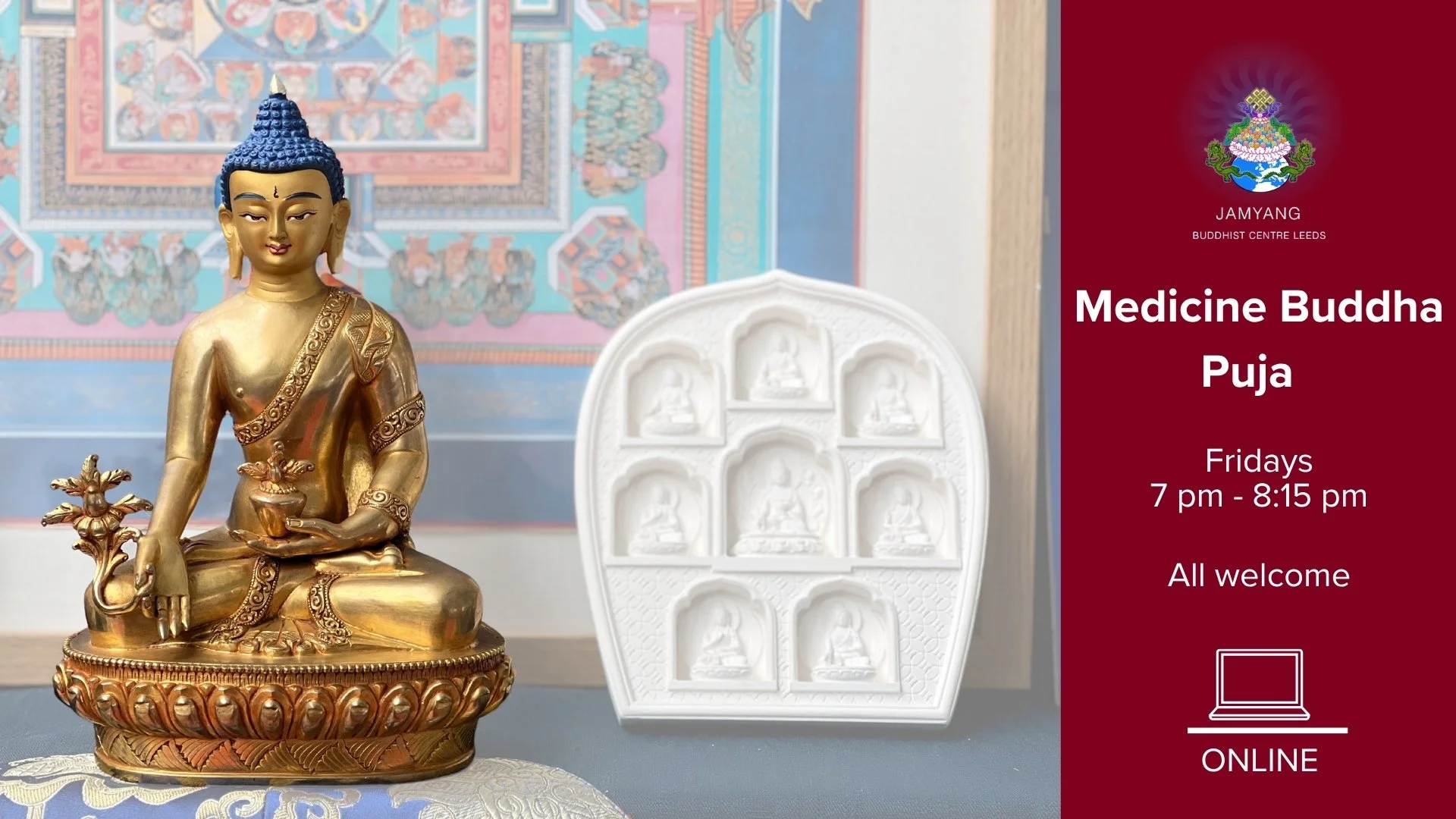
Medicine Buddha Puja
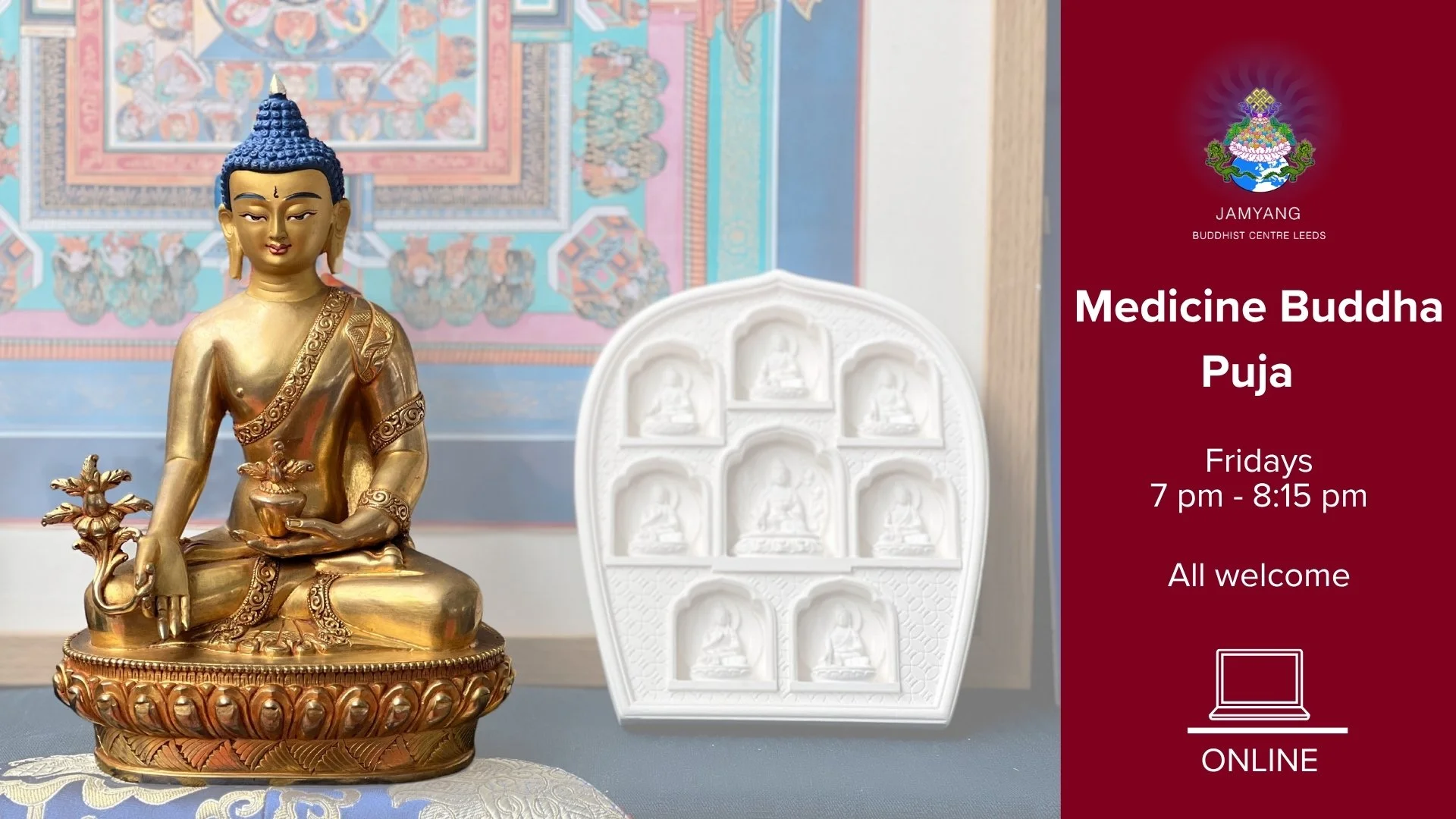
Overview of Medicine Buddha Puja
Medicine Buddha is one of the practices recommended by the FPMT for students to do for the swift return of Kyabje Lama Zopa Rinpoche.
DATE: FRIDAYS
TIME: 7 pm to 8:15 pm
LOCATION: Zoom
LEVEL: Buddhist Practices – All Welcome
SUGGESTED DONATION: £6
This is a longer meditation on Medicine Buddha – to remove obstacles, esp. those relating to health and achieving a favourable rebirth, and activate a swift path to enlightenment.
As Lama Zopa Rinpoche said: “One of the best healing meditations is that on the Medicine Buddha, who is the manifestation of the healing energy of all enlightened beings.”
The puja involves chanting prayers to the Seven Medicine Buddhas and reciting the Medicine Buddha mantras.
It is kindly led by Sande
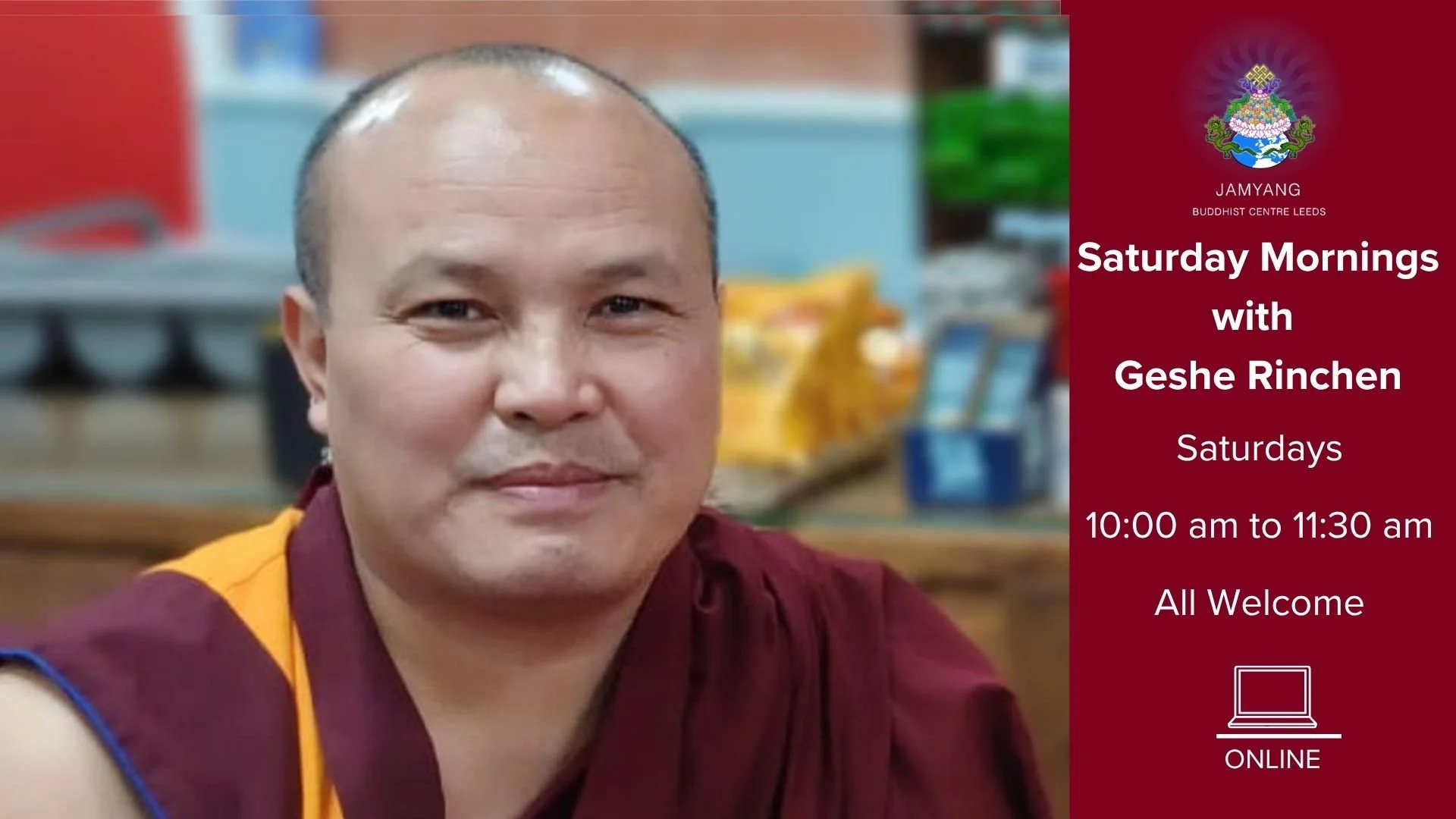
Saturday Mornings with Geshe Rinchen
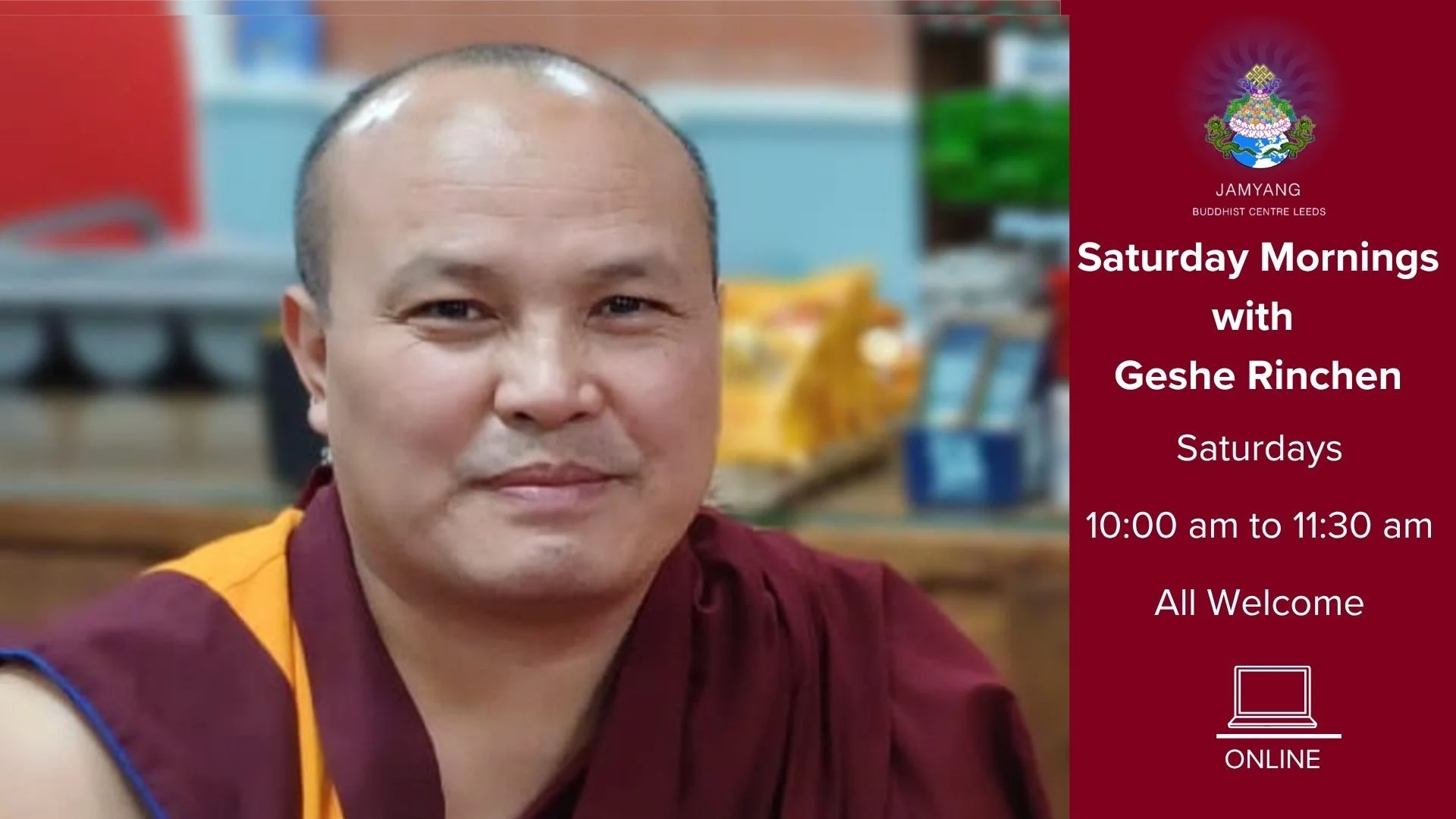
Overview of Programme
DATES: Saturdays weekly 4th July to 28th November
TIME: 10:00 am to 11:30 am
LOCATION: Online
LEVEL: Everyone interested in exploring Buddhism, from beginners to intermediate.
Saturday Mornings with Geshe Rinchen:
Are you curious about Buddhism and want to know more, or perhaps you already have some understanding but would like to expand on your knowledge. If so this Saturday morning class with Geshe Rinchen (Geshe La) is ideal for you. Designed as a drop in class with a different topic each week, covering key concepts in Buddhism and how they can make a real difference in our lives. Such as how we can deepen our connection with others, and how we can live our lives in the present moment. This is a great opportunity to spend time with Geshe La and ask questions.
Online drop in class – no need to register.
Registration will be required for the retreat in November at Land of Joy.
SUGGESTED DONATION FOR DROP IN CLASS:
Non-members – £12 per drop in class. This will contribute to the centre’s running costs and include a donation to the teacher.
Gift Aid: if you are a UK taxpayer we can claim back 25p for every £1 you donate. More information on Gift Aid can be found here.
Free to members of The Jamyang Buddhist Centre Leeds (your membership fees already contribute to our core costs in running the centre). You are invited to make a donation for the teacher, as is customary when receiving Buddhist teachings, in order to support their activity. For your reference we recommend a donation in the region of £4 per class. We will make the donation to the teacher on your behalf.
We never turn anyone away from the Dharma for financial reasons. If you cannot donate the suggested amount, please donate where possible within your means. It’s good to practice generosity where we can.
ABOUT YOUR Teacher: Geshe Rinchen Wangyal
Geshe Rinchen has dedicated his life to the study and practice of the Buddha’s teachings. He completed rigorous training in Buddhist philosophy, debate, and meditation, achieving the esteemed title of Geshe, the doctorate degree in the Tibetan Buddhist tradition.
His teachings are known for their clarity, warmth, and practical applicability, making profound topics accessible to students of all backgrounds.
Currently resident teacher at Jamyang Buddhist Centre Leeds, Geshe Rinchen combines his deep knowledge with genuine compassion, inspiring students to cultivate inner peace and wisdom in their own lives.
SESSION RESOURCES:
About this series:
July 2026
4 July – What did the Buddha Discover?
11 July – Buddha Nature – the Seed of Enlightenment
18 July – Understanding the Mind and Mental Factors
25 July – The Story of Milarepa: Transformation and Enlightenment
August 2026
1 August – The Four Noble Truths: An overview
8 August – Understanding Suffering
15 August – The Causes: Karma and Afflictive Emotions
22 August – The End of Suffering: What is Possible?
29 August – The Path: A Practical Way Forward
September 2026
5 September - Calm Abiding (Samatha)
12 September - Insightful Meditation (Vipassana)
19 September - the Mind of Awakening (Bodhicitta)
26 September – The Wisdom of Emptiness
October 2026
3 October – The Two Accumulations: Merit and Wisdom
10 October – Offering to the Three Jewels
17 October – Circumambulation Practice
24 October – Prostration Practice
31 October – Reciting Mantras and Their Benefits
November 2026
7 November – Introduction to Visualisation Practice
14 November – Medicine Buddha Practice
21 November – Tara Practice
28 November – Establishing Daily Practices
Who This Course Is For:
This is a wonderful opportunity to hear Geshe La teach each weekend online and to ask him questions.
These topics have been carefully selected for beginners,
They are also very suitable for all students of Buddhism to refresh and expand on their understanding.
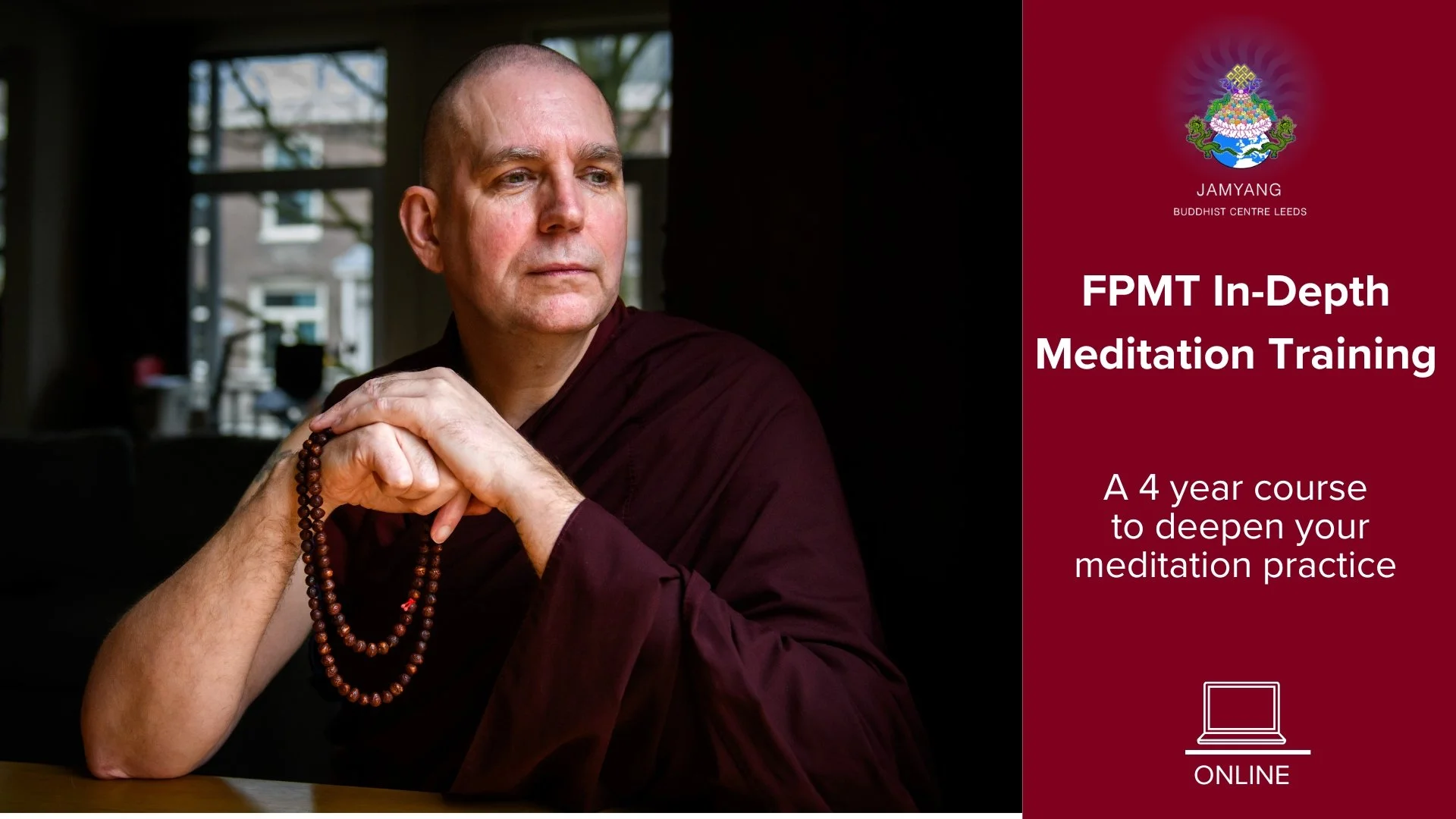
FPMT In-Depth Meditation Training
Overview of SESSION
DATE: 2026 / 2027: Year 4
Term 1: September 5th to November 28th 2026
If you are starting as a new student in year 4, don’t worry. You will get some preparatory advice on what previous recordings to have a listen to. Alternatively you may wish to join the new Ngondro Lamrim Meditation course for 2 years before starting In Depth Meditation Training. They are designed to be complementary.
TIME: Saturdays weekly 2:30pm – 5pm UK time
LOCATION: Zoom only
LEVEL: Buddhist Meditation – Intermediate to Advanced
IDMT Year Four: The Vajra Ground: Mahamudra and Kriya Tantra
In this culminating fourth year of our journey, our path turns inward to the mind itself—its empty, luminous nature—and outward to the transformative methods of tantra, where the naturally pure nature of our perception is recognized as the very ground of awakening.
As always, the year will start with generating the mind of awakening, using evocative instructions ranging from Langri Thangpa to Nāgārjuna and Lord Buddha in the famous Bodhisattvapiṭaka. This mind generation we'll cultivate through the four immeasurable thoughts and the support of calm abiding.
Illuminated by the life stories of the masters of the Gelug Mahāmudrā lineage and beyond, we'll explore its roots in the history of the early Indian Mahāsiddhas, such as Saraha and Tilopa, through the Kagyü master Gampopa's and Je Tsongkhapa's Mañjuśrī lineage up to Paṇchen Losang Chökyi Gyaltsen's Highway of the Conquerors and its perspective on this practice. In Sūtra Mahāmudrā we will practice resting attention in the empty nature of awareness, recognizing its clarity and openness as inseparable.
Kriyā Tantra offers a complementary method. Rather than suppress the ordinary, narrow self-narrative that we impose on ourselves and our world, it substitutes for it an extraordinary perspective of pure view. Occasionally, by way of introduction, we'll also taste practices from the higher tantras—glimpsing how afflictive emotions can be met as innate wisdom, and how the dissolution of the death process opens onto the innate mind of clear light. The structured practices of generation and recitation become a rehearsal for transformation, training perception to meet appearances as pure.
These methods rest on a relationship. We will therefore examine the practice of guru devotion candidly—both as the means by which the lineage's realization is transmitted and as a practice with real pitfalls, requiring discernment as much as trust. Through the Ganden Lha Gyāma, the Yoga of the inseparability of guru and Avalokiteśvara, and supporting sādhanas, devotion is approached not as deference but as the ethical road toward the state of Vajradhara: the full integration of wisdom and method.
This final year is an invitation to let realization ripen into a way of being. Grounded in bodhicitta and the four immeasurables, sustained by the preliminary practices, and held by the strength of community, we learn to meet the mind without grasping and to meet the world as pure appearance. Our aim is not to accumulate practices, but to bring the path to maturity—wisdom and compassion no longer cultivated separately, but lived as one.
This four-year online course provides students with long term, in-depth support in their meditative development.
The teacher and course developer is Venerable Losang Gendun. He has trained extensively in meditation in both Theravada and Mahayana Traditions
The In Depth Meditation Training course is also part of The Buddha Project led by Venerable Losang Gendun. You can find out more about Venerable Gendun, the course and who it is suitable for on our FPMT In-Depth Meditation Training webpage
If you have any questions you would like to ask before registering please email our In-Depth Meditation Coordinator Marie Odile on idmt@jamyangleeds.co.uk
The zoom link and all materials for the course are provided to registered students.
Donations:
Generosity is one of the cornerstones of the Buddhist path. With your donation we support The Buddha Project and we keep our centre going for the benefit of all sentient beings.
As the course is a collaboration with other FPMT centres it is not possible to offer this as part of our Jamyang Leeds membership programme.
The recommended donation per calendar month is £45.
If you are able to practice generosity and sponsor other students we recommend £58 per calendar month.
If you are on a reduced income it is £31 per calendar month.
There is also the option to donate annually.
If none of the above options are affordable please do still register, we never turn anyone away from the Dharma for financial reasons and we can agree a donation that is affordable for you right now. Please email Marie Odile our IDMT Coordinator idmt@jamyangleeds.co.uk if you would like to chat.
A Mindful Heart - Sunday Community Meditation
overview of sunday Community Meditation
DATE & TIME: Sunday 10:30-11:30
LOCATION: In-person at the centre
LEVEL: Meditation – All Welcome
SUGGESTED DONATION: Generosity model - please donate as you feel affordable and as generously as is manageable
Discover your best self every Sunday morning
Are you keen to work on your well-being and connect with others trying to make their life a little better for themselves and those around them? Join our uplifting Sunday Community Meditation Sessions.
Each hour-long gathering begins with a soothing meditation to calm your mind, followed by an inspiring discussion on a way of being such as interconnection, that enriches your everyday life. We then dive into a focused meditation designed to help you embrace that way of being fully.
Wrap up your morning with a cup of tea and friendly conversation in a welcoming, relaxed atmosphere. Absolutely everyone welcome.
Meet us every Sunday at 10:30 AM and start your week feeling refreshed, connected, and inspired. Your journey to a happier, more mindful life begins here!
Cost: Generosity Model: Pay as you feel.
From September 2026 to February 2027 we will focus on ‘A Mindful Heart’.
Inspired by the Creating Compassionate Cultures program (“CCC”) by Pam Cayton, and developed by the Foundation for Developing Compassion and Wisdom. Grounded in three core pathways of learning: Knowledge, Strength, and Compassion. These pathways guide you towards a happier, more meaningful life by fostering inner growth and a warmer connection with others.
Designed to help you develop a deeper understanding of how the mind works. The aim is to gradually let go of destructive patterns of thought and behaviour while cultivating a healthy sense of self-confidence and a deep, compassionate connection with others.
You are invited to reflect on your attitudes, perceptions, and emotional patterns. By exploring the workings of our own minds and the nature of our interdependence with others and the world around us, we begin to see how deeply connected our inner and outer realities truly are. We examine both logical and scientific perspectives on the nature of the self and our relationships with others.
To deepen the learning, you are encouraged to reflect between sessions, pausing to notice your inner experiences and reconnect with your deepest values. This supports the integration of insights and ways to act with greater mindfulness and wisdom.
Ultimately, the transformation we foster in ourselves contributes to building more compassionate cultures. How can one person influence a whole culture? The answer lies in understanding interdependence. Every action we take, every choice, interaction, and intention, affects others and the broader environment, this principle of cause and effect lies at the heart of all life, reminding us that our individual transformation ripples outward in meaningful ways.
The Creating Compassionate Cultures programme has 7 steps:
Mindful Intention
Interconnection
Change
Perception
Transforming harmful emotions
Empathy
Compassion
Session overview:
Welcome, Introduction and Motivation 5 mins
Settling Meditation 10 mins
Meditation topic introduced then participants briefly share their experience 15 mins
Guided meditation 15 mins
Feedback from participants 10 mins
Closing and Dedication 5 mins
September 2026
6th and 13th: The Pursuit of Happiness
20th and 27th: Understanding how things exist
October 2026:
4th and 11th: Developing Healthy Self Confidence
18th and 25th: Compassion - Opening the heart
November 2026:
1st and 8th: Mindfulness, reflection and critical thinking
15th and 22nd: Mindful intention - what do I really want
29th: Interconnection (week 1)
December 2026:
6th: Interconnection (week 2)
13th and 20th: Embracing Change
January 2027:
10th and 17th: Perception
24th and 31st Transforming harmful emotions
February 2027:
7th and 14th: Empathy
21st and 28th: Cultivating Compassion
Vipassana Meditation
Overview of Vipassana Meditation
Join us for a peaceful start to your week with a 30 minute Vipassana meditation session, designed to cultivate mindfulness, self-awareness, and equanimity. Led by Geshe Rinchen
DATE: Mondays weekly (March to May and July to November)
TIME: 7:00 am to 7:30 am
Vipassana (Special Insight Meditation), also called analytical meditation, is primarily a practice of wisdom. It is a form of concentration that focuses single-pointedly on the ultimate nature of phenomena through analytical reasoning. Analysing phenomena is a key aspect of Vipassana practice, as it helps develop a definitive understanding of the nature of reality—such as the self, mind, emotions, and thoughts.
As Je Tsongkhapa explains, shamatha (calm abiding) is like a lamp that remains clear and steady in a place without wind, whereas vipassana (special insight) is like seeing the nature of phenomena clearly through such a steady and clear lamp. Therefore, the usual order of these two meditations is: first, achieving calm abiding or mental stability as a foundation, then engaging in special insight meditation through analysis. However, Vipassana meditation can also be practised by analysing and observing sensations, thoughts, and emotions without first achieving shamatha. This practice should still begin with focusing on the breath or another object of meditation. In our case, we will focus on the breath to start analysing the nature of the mind in relation to our sense of self, emotions, and thoughts.
The session begins by focusing on the breath—either the rise and fall of the abdomen or the sensation of air entering and leaving the nostrils. This practice calms the mind and helps establish a deep sense of presence.
Next, we move into a guided body scan, bringing awareness to different parts of the body and observing subtle sensations without judgement. This helps develop a greater connection to your physical experience.
As we proceed, you will practise observing and analysing sensations, thoughts, and emotions as they arise, learning to witness them without attachment or aversion. This fosters a deeper understanding of the impermanence and interconnectedness of the mind and self. Finally, you will rest your mind either in the natural state of awareness or in the analytical clarity gained through observation and reasoning.
Through regular practice, Vipassana meditation cultivates wisdom, encouraging a balanced and objective view of internal experiences. This session is ideal for those seeking greater insight and calmness in their daily lives.
Morning Prayers
Overview
Start the day by joining us for Morning Prayers recommended by Lama Zopa Rinpoche and HH Dalai Lama, for the benefit of all sentient beings and the swift return of Lama Zopa Rinpoche. Everyone is welcome.
DATE: Monday – Friday all year around
TIME: 8:30am - 9:00am
LOCATION: Zoom
LEVEL: Buddhist Practices – All Welcome
FPMT Ngondro Lamrim Training
Overview of SESSION
DATE: 2026 / 2027: Year 1
Term 1: September 14th to November 28th 2026
Over a period of two years, the FPMT Ngöndro Lamrim Training (NLRT) offers 16 months of training in the common and uncommon preliminary practices. The training is designed to generate the motivation that supports the development of calm abiding, special insight, and tantra. By cultivating the inner qualities needed to ease unskillful patterns of mind that are the cause of hindrances on the path, it facilitates deep transformation.
An excellent preparation for the FPMT In-Depth Meditation Training (IDMT)
LOCATION: Recordings are released weekly
LEVEL: Buddhist Preliminary Practices
About the Course:
The Lamrim — "Stages of the Path" in Tibetan — is a systematic presentation of the entire Buddhist path to Awakening, written by the great Tibetan master Je Tsongkhapa in the 14th and early 15th century, based on writings of the Indian master Atisha. It arranges every essential teaching of the Buddha into a single, coherent, graduated sequence tailored to your mind, exactly as it is right now. Its true power lies not in study alone, but in practice. Each teaching is carefully arranged to meet the mind where it is and guide it—step by step—toward genuine change.
The uncommon preliminary practices (ngöndro) are powerful methods to purify the mind and prepare it for lasting transformation.
Over the first eleven months the common foundations, renunciation, bodhicitta, and the view of emptiness, are explored based on the Lamrim. For the remaining five months the focus is on the uncommon practices, Vajrasattva purification, mandala offerings, and guru yoga. Weekly sessions each introduce a new topic that examines different ways to meditate and why, in combination with a guided meditation.
The training helps establish a consistent daily meditative practice in supports of its overall aim: to engage in contemplative meditation in a way that genuinely transforms the mind's outlook on the world and gives one's life a new direction. Students gain a deep understanding of how to accumulate merit and purify unskillful karma while cultivating a healthy relationship with the Three Jewels and their teacher. The emphasis is on learning to meditate in a personally tailored way, in accordance with one’s psychological makeup and life conditions.
The Ngondro Lamrim Training teaching sessions are pre-recorded.
Each week, a 90-minute teaching together with two guided meditations are uploaded. On other days, advanced students contribute additional guided meditations. The teacher, Venerable Gendun, offers regular online Q&A sessions. For those who have already studied the Lamrim or the FPMT Basic Program, the training also offers specialized opportunities to learn how to guide others in meditation.
Year 1: Definite Emergence and Mind of Awakening
Prepare the mind for śamatha, vipaśyanā, and tantra
Explore renunciation and bodhicitta, the first two Principles of the Path
Develop genuine urgency through Lamrim contemplation
Cultivate the aspiration to Awakening for all beings
FPMT Ngondro Lamrim Taining is also part of The Buddha Project led by Venerable Losang Gendun. You can find out more about Venerable Gendun, the course and who it is suitable for on our FPMT Ngondro Lamrim Training webpage
If you have any questions you would like to ask before registering please email our In-Depth Meditation Coordinator Marie Odile on idmt@jamyangleeds.co.uk
All materials for the course are provided to registered students.
Donations:
Generosity is one of the cornerstones of the Buddhist path. Donations help support both the centre and The Buddha Project as well as providing a donation for the teachings to Venerable Gendun. There are different levels depending on your income. There are three terms a year, each approximately 3 months long
As the course is a collaboration with other FPMT centres it is not possible to offer this as part of our Jamyang Leeds membership programme.
For those with a regular income the recommended donation is £95 per term
The sponsorhsip level is £115 per term
Ordained Sangha are free
If this isn’t affordable please do register, we never turn anyone away from the Dharma for financial reasons and we can agree a donation that is affordable for you at the current time. Please email Marie-Odile our IDMT Coordinator idmt@jamyangleeds.co.uk if you would like to chat.
Lunchtime Meditation
Overview
Make the most of your lunchtime with a guided meditation session to help calm your mind. These secular meditation sessions are a great way to relax and create some space for reflection in the middle of your day.
DATE: Monday- Friday
TIME: 12:30pm-1pm
LOCATION: Online each weekday and In person Tuesday and Friday
LEVEL: Wellbeing Programme – All levels
Pause, take a breath, and give yourself the midday reset you deserve.
Our lunchtime meditation sessions offer a gentle sanctuary right in the middle of your busy day—a dedicated space to slow down, drop your shoulders, and reconnect with yourself. Guided by a variety of our experienced, friendly meditators, these sessions focus on simple, relaxing breathwork designed to clear your mind, soothe your nervous system, and restore your inner energy.
Whether you are completely new to meditation or have been practicing for years, you are warmly invited to join us just as you are.
Yamantaka Practice Group
Overview of SESSION
This is a restricted practice, for those who have received the empowerment to practice Solitary Hero Vajrabhairava/Yamantaka.
If you have an interest in joining the group please email yamantakagroup@gmail.com to register.
The Yamantaka practice is held on the Mondays weekly. Please note that some weeks it starts at 2:30pm and some at 6pm it doesn’t always alternate weekly.
Tonglen Loving Kindness meditation Practice
Overview of Tonglen Meditation
The Buddhist practice of Giving & Taking (Tonglen in Tibetan) is at its heart a selfless meditation of loving kindness and compassion.
DATE: Tuesdays
TIME: 7am-7:30am
LOCATION: Zoom
LEVEL: Buddhist Meditation – All Welcome
SUGGESTED DONATION: £4
A beautiful practice led by Chrissie and Di.
The Buddhist practice of Giving & Taking (Tonglen in Tibetan) is at its heart a selfless meditation of loving kindness and compassion. You imagine giving all your happiness to others, sometimes using visualisation with the breath, and then taking all the suffering and its causes from others. It’s a powerful practice for the brave-hearted!
Cancelled: Tech Tuesday with Steve
Overview of Session
DATE: 1st Tuesday monthly
TIME: 10 am to 2pm
LOCATION: In-person ( online appointments can be arranged)
LEVEL: Everyone
COST: Donation for Sangha
Are you struggling with your computer?
Are there things you would like to know more about e.g. email or browsing the internet?
Have you got questions about how it works?
We will be running a monthly workshop on the first Tuesday of every month starting in January, bring your computer plus the charger to the session and we can go through any questions or issues you have.
The workshop is being run by Steve Holton who has 30 years experience in the IT industry, is Microsoft qualified and is keen to help you. He can also look at Apple devices.
Kshitigarbha Practice
Overview of Kshitigarbha practice
DATE: Tuesdays & Thursdays
TIME: 12pm-12:30pm
LOCATION: Zoom only
LEVEL: Buddhist Practices – All Welcome
SUGGESTED DONATION: £4
Lama Zopa Rinpoche (our organisation’s Spiritual Director) suggested Jamyang Leeds perform these practices to help with the financial obstacles we are currently having. From September 2022, we’ll be reciting this practice as much as we can. See the special newsletter explaining all about the practice here.
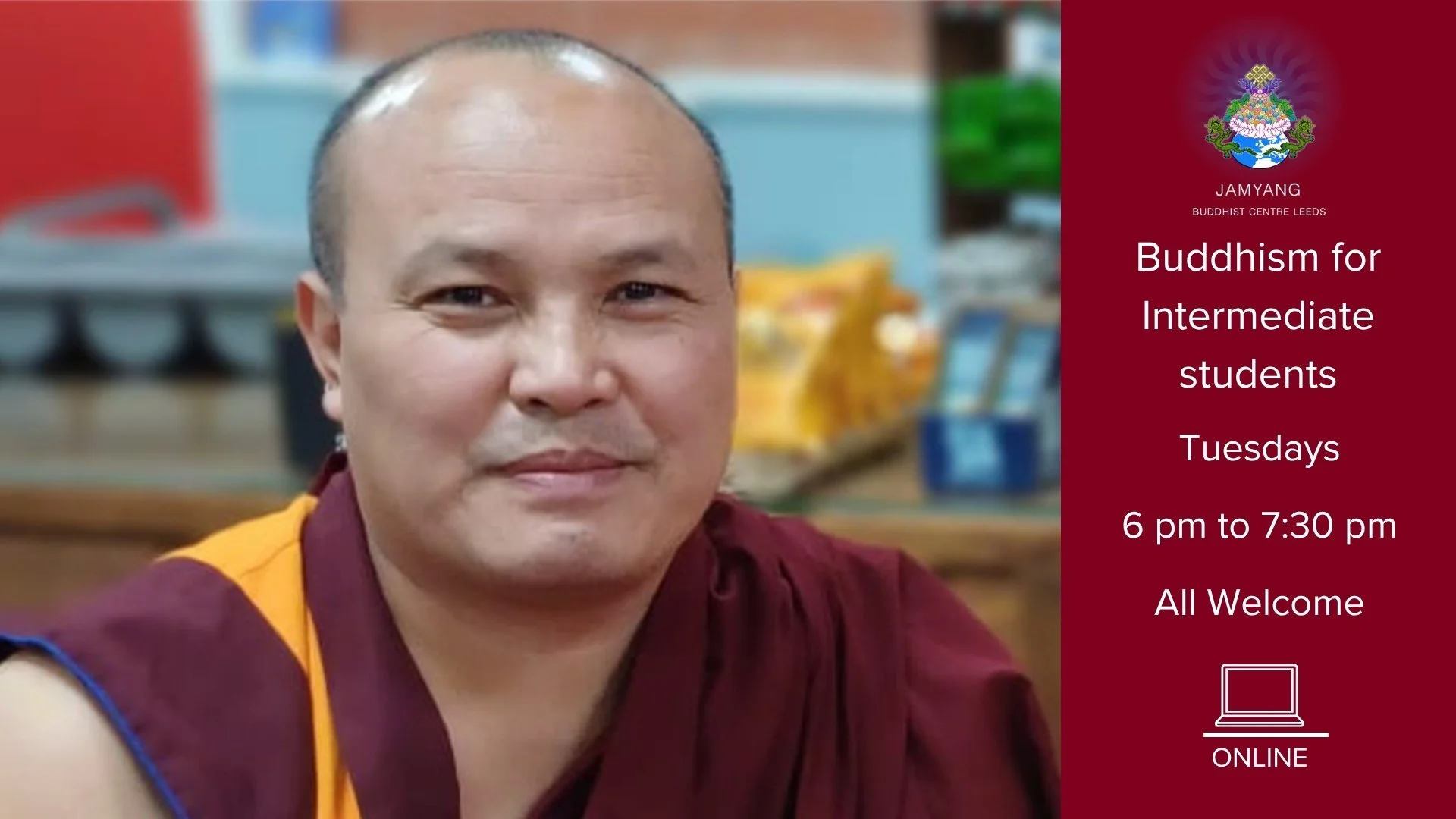
Buddhism for Intermediate Students
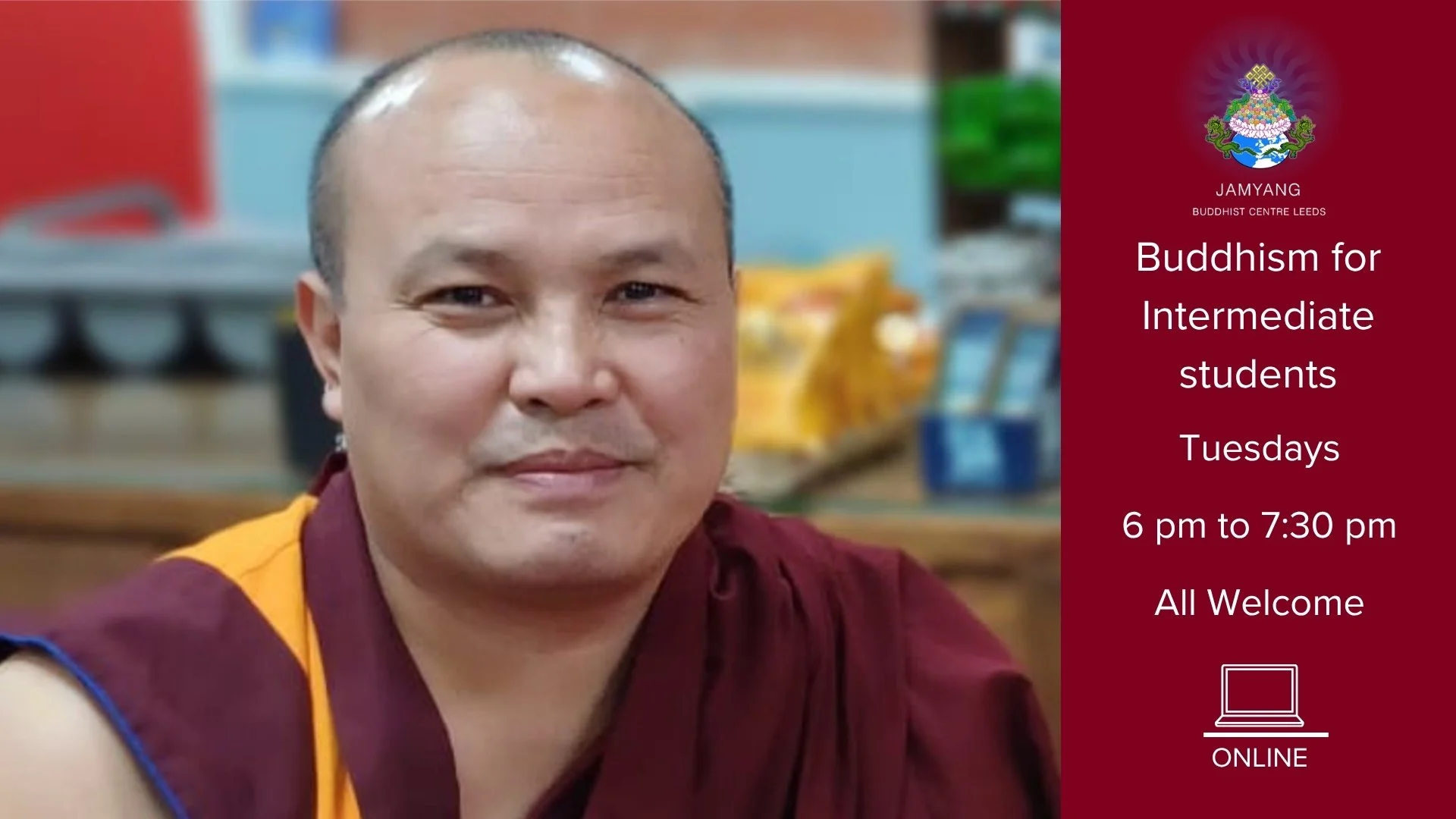
Overview of Programme
DATES: Weekly sessions 7th July to 24th November
TIME: Tuesday weekly 6:00 pm to 7:30 pm
LOCATION: Online
LEVEL: Intermediate students of Buddhism and those interested in Buddhist philosophy
Buddhism for Intermediate students:
This series of teachings aims to provide a comprehensive understanding of key Buddhist texts and practices, offering both theoretical knowledge and practical guidance for those interested in deepening their spiritual practice. Each monthly session is carefully designed to build a holistic understanding of Buddhist philosophy and meditative practices.
This series of sessions will focus upon the key text: Illuminating the Intent: An Exposition of Chandrakirti’s Entering the Middle Way.
Online drop in class – no need to register.
SUGGESTED DONATION FOR DROP IN CLASS:
Non-members – £12 per drop in class. This will contribute to the centre’s running costs and include a donation to the teacher.
Gift Aid: if you are a UK taxpayer we can claim back 25p for every £1 you donate. More information on Gift Aid can be found here.
Free to members of The Jamyang Buddhist Centre Leeds (your membership fees already contribute to our core costs in running the centre). You are invited to make a donation for the teacher, as is customary when receiving Buddhist teachings, in order to support their activity. For your reference we recommend a donation in the region of £4 per class. We will make the donation to the teacher on your behalf.
We never turn anyone away from the Dharma for financial reasons. If you cannot donate the suggested amount, please donate where possible within your means. It’s good to practice generosity where we can.
ABOUT YOUR Teacher: Geshe Rinchen Wangyal
Geshe Rinchen has dedicated his life to the study and practice of the Buddha’s teachings. He completed rigorous training in Buddhist philosophy, debate, and meditation, achieving the esteemed title of Geshe, the doctorate degree in the Tibetan Buddhist tradition.
His teachings are known for their clarity, warmth, and practical applicability, making profound topics accessible to students of all backgrounds.
Currently resident teacher at Jamyang Buddhist Centre Leeds, Geshe Rinchen combines his deep knowledge with genuine compassion, inspiring students to cultivate inner peace and wisdom in their own lives.
SESSION RESOURCES:
About this series:
The great Tsongkhapa wrote three profound texts on Madhyamika philosophy and practice:
The Essence of True Eloquence,
Ocean of Reasoning,
Illuminating the Intent.
Illuminating the Intent is one of these masterpieces, completed shortly before he passed into parinirvana. It is perhaps the most profound text ever written by a Tibetan scholar on Madhyamika philosophy and practice, guiding readers to both understand emptiness intellectually and apply its insights in daily life.
Nagarjuna composed the Fundamental Wisdom of the Middle Way, on which Chandrakirti later wrote his commentary, Entering the Middle Way. Since Chandrakirti’s work consists only of verses, Je Tsongkhapa composed a detailed commentary, making Illuminating the Intent an essential guide for understanding Nagarjuna’s root text. The primary theme of these texts is emptiness—what it is and how to practise it effectively.
Why This Text Matters:
Je Tsongkhapa’s text is invaluable for anyone seeking to understand reality, the self, the nature of the mind, life, the root causes of suffering, and consciousness. Studying it helps uncover practical methods to overcome suffering, find meaning in life, and apply these teachings in daily living.
About the Great Tsongkhapa:
The great Tsongkhapa (1357–1419) was a true genius in interpreting and practising Mahayana teachings as laid down by the ancient Indian Nalanda masters. He founded the Geluk tradition of Tibetan Buddhism, which emphasises both rigorous intellectual analysis and practical application of the Buddha’s teachings, following the approach of the Nalanda masters.
Who This Course Is For:
This course is suitable for both practitioners and academics, as well as anyone with a keen interest in Madhyamika philosophy and the practice of emptiness. In class, we will engage with the text through reading and giving explanation page by page following the Tibetan monastic educational tradition. At times, we will also participate in monastic-style debate to clarify the meaning and implications of the text. This approach allows participants to explore the material both intellectually and practically.
Vajrasattva Practice
Overview of The Vajrasattva Practice
DATE: Tuesdays
TIME: 8:00pm-8:30pm
LOCATION: Zoom
LEVEL: Buddhist Practices – All Welcome
SUGGESTED DONATION: £4
Purification here means looking at our past unskillful actions which have created seeds of negative karma in our minds, and using visualisation and mantra recitation to remove those seeds in a healthy and productive way. Vajrasattva is the embodiment of all the Buddha’s cleaning and purifying energy. We all make mistakes, and how we deal with them is key to making spiritual progress. We’ll be using a short text composed by Lama Zopa Rinpoche
the eight verses of thoughts transformation
Overview of the eight verses of thoughts transformation
Everflowing Nectar of Bodhichitta – Annihilating the Demon of the Self-Cherishing Mind
DATE: Wednesdays
TIME: 7am-7:30am
LOCATION: Zoom
LEVEL: Buddhist Practices- All Welcome
SUGGESTED DONATION: £4
Everflowing Nectar of Bodhichitta – Annihilating the Demon of the Self-Cherishing Mind
Led by Di or Sande
This practice is based on the short text” Eight Verses of Thought Transformation”, which contains the entire technique for transforming the mind into relative bodhichitta (i.e., the wish to achieve enlightenment for the benefit of all sentient beings) and absolute bodhichitta (i.e., the wisdom realizing emptiness).
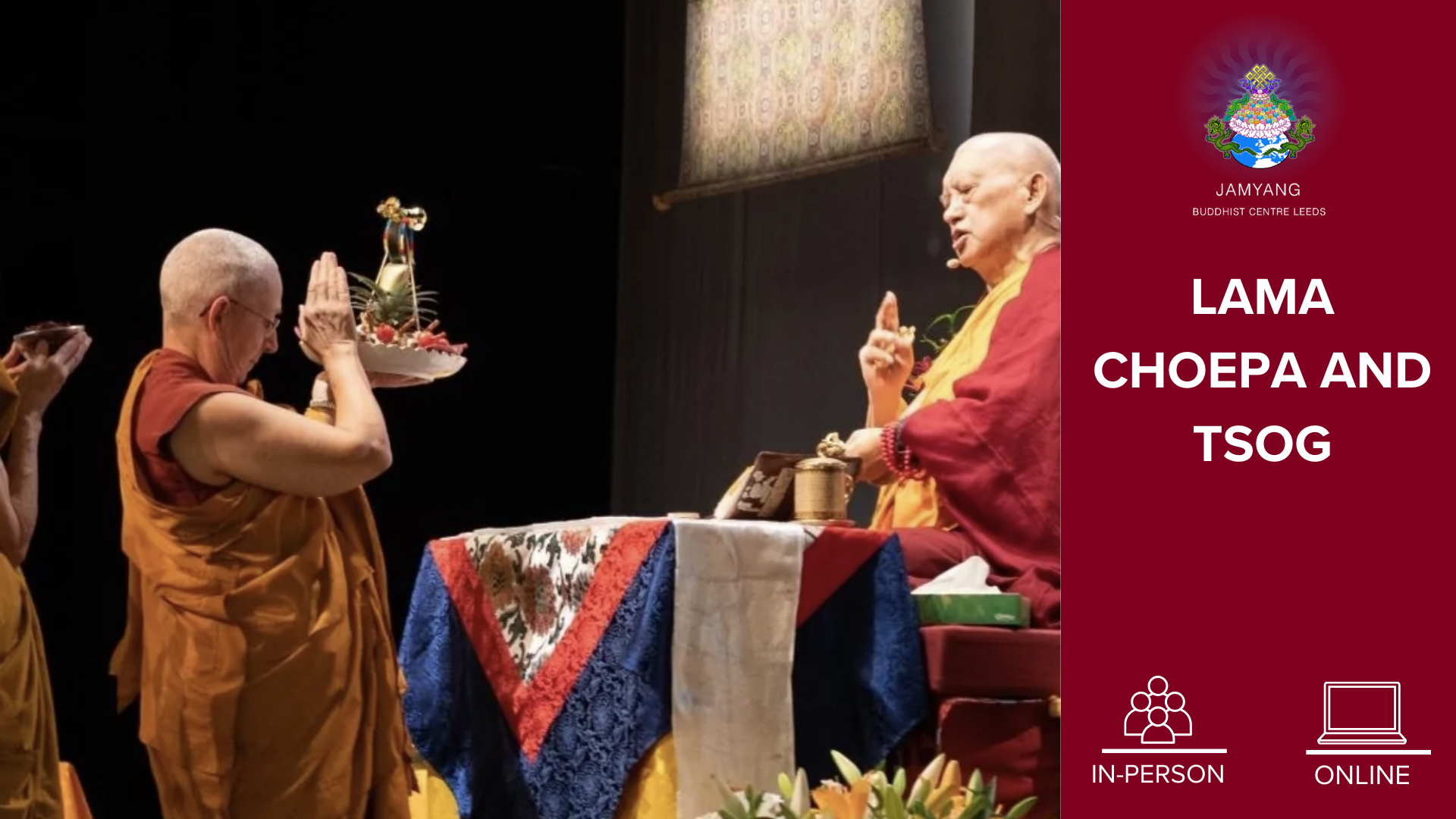
Lama Choepa (Guru Puja) and Tsog
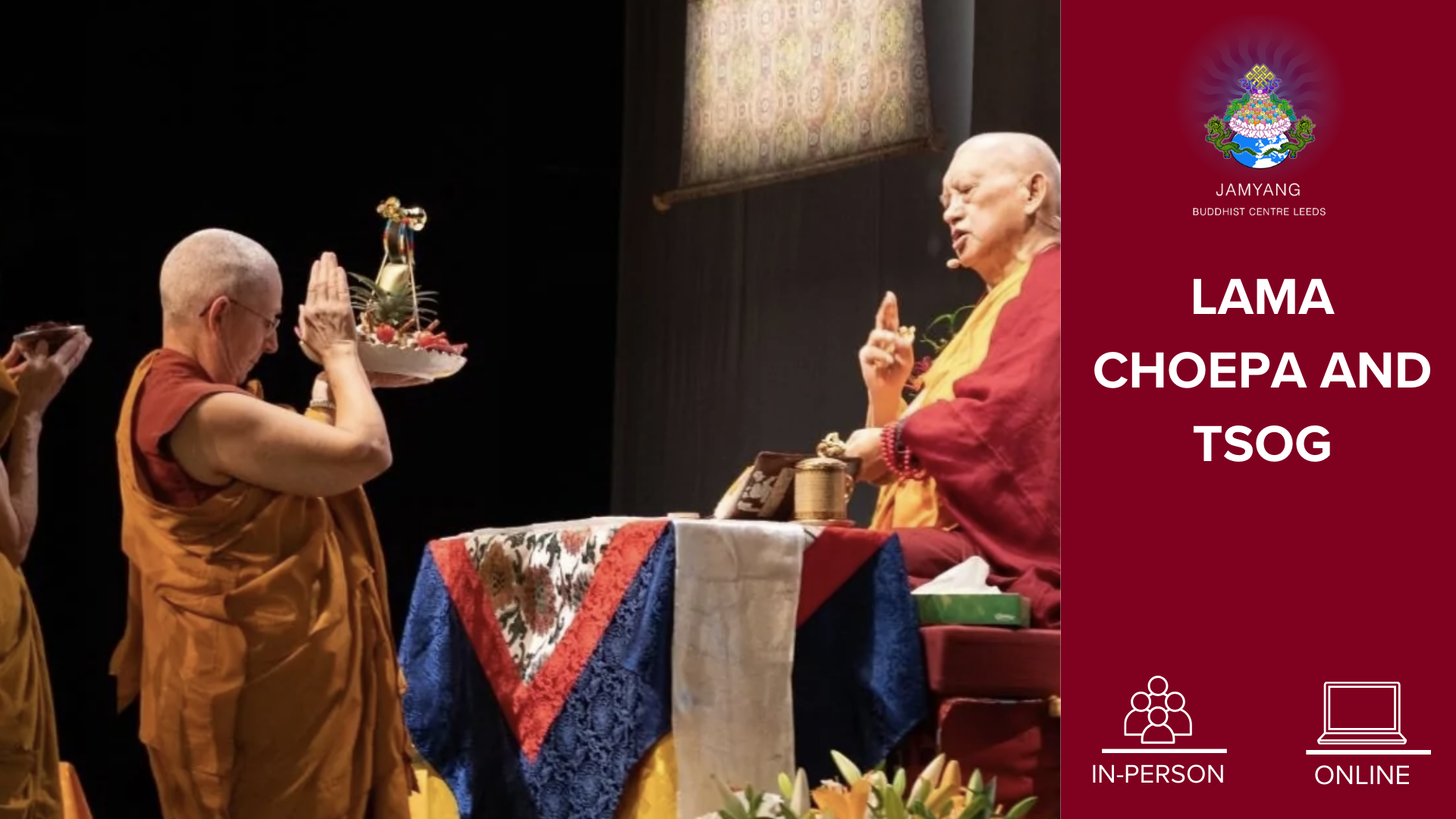
Overview of Session
DATES: 2026: 13th January; 11th February; 13th March; 26th April; 12th May; 10th June; 24th July; 8th August; 21st September; 5th October; 4th November; 3rd December
TIME: 60 - 90 minute sessions, start time varies
LOCATION: In Person and Online
LEVEL: Buddhist Ceremonies – All Welcome
Dedicated to the Swift return of Lama Zopa Rinpoche as a bright, unmistaken child.
During the practice of Lama Choepa, we invoke all the lamas of the graduated path lineage, beginning with Shakyamuni Buddha himself, extending to our present direct teachers who have shown us the path. We pay homage to them, make offerings, and request each of them to please bless our minds with the same realizations that they themselves have generated. By offering sincere, heartfelt requests, we make our minds ripe to receive the full blessings of this precious lineage and quickly actualize the realizations we need to attain enlightenment. If we wish to experience realisations quickly, the practice of Lama Choepa is indispensable.
“If you are able to do the practice of Guru Puja in your daily life, it contains all the important points of sutra and tantra. It is a complete practice, and it shows the heart of the instruction of Lama Tsongkhapa’s tradition. Even if one can’t do much else in daily life, Guru Puja is the essential practice.”
Open to all Buddhists, no empowerments needed.
Please arrive early and bring flowers, incense, vegetarian food and drink as offerings for the altar.
More information can also be found on this FPMT page.
Chanting the Verses of Noble manjushri
Overview of Session
DATE: Thursdays
TIME: 7:45am to 8:25 am
LOCATION: Zoom only
LEVEL: Buddhist Practices – suitable for Lama Zopa Rinpoche’s students
Join us to fulfill His Holiness the Dalai Lama’s wishes and chant the Names of Noble Manjushri for the swift return of Lama Zopa Rinpoche.
Please come along even if you havent done the practice before, its quite wonderful and very energising. Please download the text below, you can also listen and practice with the audio clip of Lama Zopa Rinpoche reciting the Chanting the Names of Noble Manjushri.
Kshitigarbha Practice
Overview of Kshitigarbha practice
DATE: Tuesdays & Thursdays
TIME: 12pm-12:30pm
LOCATION: Zoom only
LEVEL: Buddhist Practices – All Welcome
SUGGESTED DONATION: £4
Lama Zopa Rinpoche (our organisation’s Spiritual Director) suggested Jamyang Leeds perform these practices to help with the financial obstacles we are currently having. From September 2022, we’ll be reciting this practice as much as we can. See the special newsletter explaining all about the practice here.
Kalachakra Practice group
Overview of practice
This is a restricted group for those who have received the Kalachakra empowerment from a qualified Lama. To join the group you need to have either received the full Kalachakra empowerment or another High Yoga Tantra empowerment such as Heruka, as long as you have received a Kalachakra Jenang (permission).
This international group of Kalachakra practitioners meets weekly and alternates with commentary and practice.
Mind Mandala once a month and six session guru yoga for other sessions:
If you’re already part of this group, please use the details sent in the weekly email to join the practice
If you’d like to join us, please email spc@jamyangleeds.co.uk confirming that you have the appropriate empowerments. You will then be sent a registration form to complete.
Shamatha – Meditation on the Breath
Overview of Session
DATE: Fridays
TIME: 7am-7:30am
LOCATION: Zoom
LEVEL: All Welcome
SUGGESTED DONATION: £4
Led by Ruth
Mindfulness of Breathing is universally acknowledged to be of benefit to all living in the modern world. Many feel overloaded with all that is expected of us living this complex and exhausting existence. Developing our awareness in this way is a general prescription for soothing and healing the overworked body and mind.
Practicing focusing the attention on an object such as the breath is also a core practice in Tibetan Buddhism. Gradually over time we are able to hold the object of our attention over longer periods, which enables us to practice other meditations such as Vipassana more successfully.
White Umbrella Deity practice
Overview of practice
DATE: Fridays
TIME: 11:30 am to 12:00 pm
LOCATION: Please note this is online only
LEVEL: Buddhist Practices – see note below
SUGGESTED DONATION: £4
In September 2024, His Eminence Ling Rinpoche gave us this practice to overcome obstacles to the centre flourishing.
In addition to many benefits of engaging in these practices, Lama Zopa Rinpoche recommended that these two practices are beneficial to helping bring peace to situation between Israel and Palestine.
The Sanskrit name for the White Umbrella deity is Ushnisha Sitatapatra which can also be translated as “The Victorious White Parasol.” The White Umbrella Deity, [Skt. Sitatapatra, Tib. gdugs dkar] is a powerful female deity. She is relied upon for protection; healing illness; dispelling interferences, spirit possession, and harmful forces; quelling disasters; averting obstacles; and bringing auspiciousness.
Ushnisha Sitatapatra is a female form of Avalokiteshvara, the Bodhisattva of Compassion. Like this Bodhisattva in an elaborate form, she also has a thousand eyes that watch over living beings, and a thousand arms that protect and assist them. Thus she symbolizes the power of active compassion.
Practices of Arya Sitatapatra includes, “The Supreme Accomplishment of Sitatapatra,” and “Praises and Repelling Practices of Sitatapatra.”
Medicine Buddha Puja
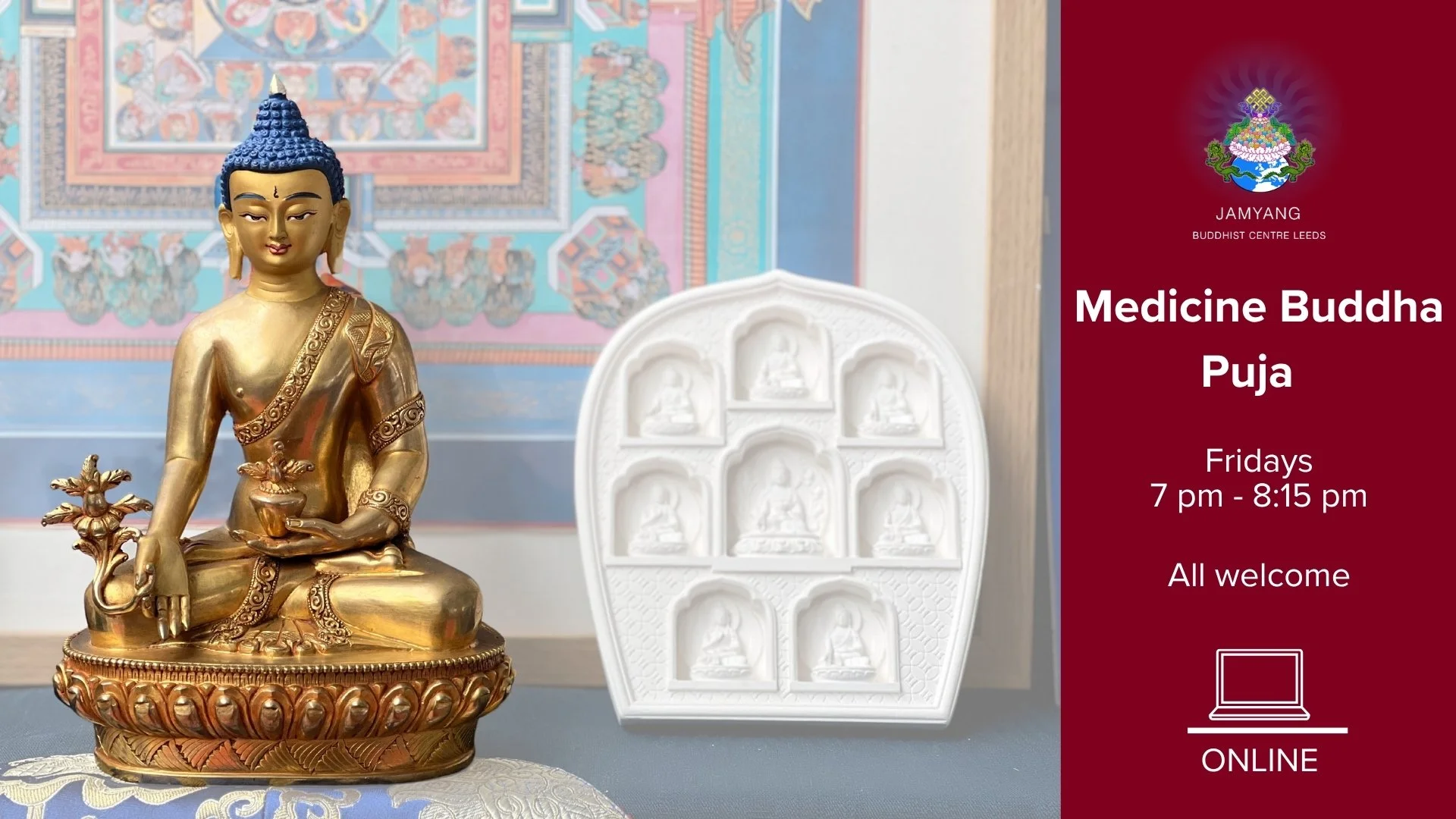
Overview of Medicine Buddha Puja
Medicine Buddha is one of the practices recommended by the FPMT for students to do for the swift return of Kyabje Lama Zopa Rinpoche.
DATE: FRIDAYS
TIME: 7 pm to 8:15 pm
LOCATION: Zoom
LEVEL: Buddhist Practices – All Welcome
SUGGESTED DONATION: £6
This is a longer meditation on Medicine Buddha – to remove obstacles, esp. those relating to health and achieving a favourable rebirth, and activate a swift path to enlightenment.
As Lama Zopa Rinpoche said: “One of the best healing meditations is that on the Medicine Buddha, who is the manifestation of the healing energy of all enlightened beings.”
The puja involves chanting prayers to the Seven Medicine Buddhas and reciting the Medicine Buddha mantras.
It is kindly led by Sande
Saturday Mornings with Geshe Rinchen
Overview of Programme
DATES: Saturdays weekly 4th July to 28th November
TIME: 10:00 am to 11:30 am
LOCATION: Online
LEVEL: Everyone interested in exploring Buddhism, from beginners to intermediate.
Saturday Mornings with Geshe Rinchen:
Are you curious about Buddhism and want to know more, or perhaps you already have some understanding but would like to expand on your knowledge. If so this Saturday morning class with Geshe Rinchen (Geshe La) is ideal for you. Designed as a drop in class with a different topic each week, covering key concepts in Buddhism and how they can make a real difference in our lives. Such as how we can deepen our connection with others, and how we can live our lives in the present moment. This is a great opportunity to spend time with Geshe La and ask questions.
Online drop in class – no need to register.
Registration will be required for the retreat in November at Land of Joy.
SUGGESTED DONATION FOR DROP IN CLASS:
Non-members – £12 per drop in class. This will contribute to the centre’s running costs and include a donation to the teacher.
Gift Aid: if you are a UK taxpayer we can claim back 25p for every £1 you donate. More information on Gift Aid can be found here.
Free to members of The Jamyang Buddhist Centre Leeds (your membership fees already contribute to our core costs in running the centre). You are invited to make a donation for the teacher, as is customary when receiving Buddhist teachings, in order to support their activity. For your reference we recommend a donation in the region of £4 per class. We will make the donation to the teacher on your behalf.
We never turn anyone away from the Dharma for financial reasons. If you cannot donate the suggested amount, please donate where possible within your means. It’s good to practice generosity where we can.
ABOUT YOUR Teacher: Geshe Rinchen Wangyal
Geshe Rinchen has dedicated his life to the study and practice of the Buddha’s teachings. He completed rigorous training in Buddhist philosophy, debate, and meditation, achieving the esteemed title of Geshe, the doctorate degree in the Tibetan Buddhist tradition.
His teachings are known for their clarity, warmth, and practical applicability, making profound topics accessible to students of all backgrounds.
Currently resident teacher at Jamyang Buddhist Centre Leeds, Geshe Rinchen combines his deep knowledge with genuine compassion, inspiring students to cultivate inner peace and wisdom in their own lives.
SESSION RESOURCES:
About this series:
July 2026
4 July – What did the Buddha Discover?
11 July – Buddha Nature – the Seed of Enlightenment
18 July – Understanding the Mind and Mental Factors
25 July – The Story of Milarepa: Transformation and Enlightenment
August 2026
1 August – The Four Noble Truths: An overview
8 August – Understanding Suffering
15 August – The Causes: Karma and Afflictive Emotions
22 August – The End of Suffering: What is Possible?
29 August – The Path: A Practical Way Forward
September 2026
5 September - Calm Abiding (Samatha)
12 September - Insightful Meditation (Vipassana)
19 September - the Mind of Awakening (Bodhicitta)
26 September – The Wisdom of Emptiness
October 2026
3 October – The Two Accumulations: Merit and Wisdom
10 October – Offering to the Three Jewels
17 October – Circumambulation Practice
24 October – Prostration Practice
31 October – Reciting Mantras and Their Benefits
November 2026
7 November – Introduction to Visualisation Practice
14 November – Medicine Buddha Practice
21 November – Tara Practice
28 November – Establishing Daily Practices
Who This Course Is For:
This is a wonderful opportunity to hear Geshe La teach each weekend online and to ask him questions.
These topics have been carefully selected for beginners,
They are also very suitable for all students of Buddhism to refresh and expand on their understanding.
FPMT In-Depth Meditation Training
Overview of SESSION
DATE: 2026 / 2027: Year 4
Term 1: September 5th to November 28th 2026
If you are starting as a new student in year 4, don’t worry. You will get some preparatory advice on what previous recordings to have a listen to. Alternatively you may wish to join the new Ngondro Lamrim Meditation course for 2 years before starting In Depth Meditation Training. They are designed to be complementary.
TIME: Saturdays weekly 2:30pm – 5pm UK time
LOCATION: Zoom only
LEVEL: Buddhist Meditation – Intermediate to Advanced
IDMT Year Four, The Vajra Ground: Mahamudra and Kriya Tantra
In this culminating fourth year of our journey, our path turns inward to the mind itself—its empty, luminous nature—and outward to the transformative methods of tantra, where the naturally pure nature of our perception is recognized as the very ground of awakening.
As always, the year will start with generating the mind of awakening, using evocative instructions ranging from Langri Thangpa to Nāgārjuna and Lord Buddha in the famous Bodhisattvapiṭaka. This mind generation we'll cultivate through the four immeasurable thoughts and the support of calm abiding.
Illuminated by the life stories of the masters of the Gelug Mahāmudrā lineage and beyond, we'll explore its roots in the history of the early Indian Mahāsiddhas, such as Saraha and Tilopa, through the Kagyü master Gampopa's and Je Tsongkhapa's Mañjuśrī lineage up to Paṇchen Losang Chökyi Gyaltsen's Highway of the Conquerors and its perspective on this practice. In Sūtra Mahāmudrā we will practice resting attention in the empty nature of awareness, recognizing its clarity and openness as inseparable.
Kriyā Tantra offers a complementary method. Rather than suppress the ordinary, narrow self-narrative that we impose on ourselves and our world, it substitutes for it an extraordinary perspective of pure view. Occasionally, by way of introduction, we'll also taste practices from the higher tantras—glimpsing how afflictive emotions can be met as innate wisdom, and how the dissolution of the death process opens onto the innate mind of clear light. The structured practices of generation and recitation become a rehearsal for transformation, training perception to meet appearances as pure.
These methods rest on a relationship. We will therefore examine the practice of guru devotion candidly—both as the means by which the lineage's realization is transmitted and as a practice with real pitfalls, requiring discernment as much as trust. Through the Ganden Lha Gyāma, the Yoga of the inseparability of guru and Avalokiteśvara, and supporting sādhanas, devotion is approached not as deference but as the ethical road toward the state of Vajradhara: the full integration of wisdom and method.
This final year is an invitation to let realization ripen into a way of being. Grounded in bodhicitta and the four immeasurables, sustained by the preliminary practices, and held by the strength of community, we learn to meet the mind without grasping and to meet the world as pure appearance. Our aim is not to accumulate practices, but to bring the path to maturity—wisdom and compassion no longer cultivated separately, but lived as one.
This four-year online course provides students with long term, in-depth support in their meditative development.
The teacher and course developer is Venerable Losang Gendun. He has trained extensively in meditation in both Theravada and Mahayana Traditions
The In Depth Meditation Training course is also part of The Buddha Project led by Venerable Losang Gendun. You can find out more about Venerable Gendun, the course and who it is suitable for on our FPMT In-Depth Meditation Training webpage
If you have any questions you would like to ask before registering please email our In-Depth Meditation Coordinator Marie Odile on idmt@jamyangleeds.co.uk
The zoom link and all materials for the course are provided to registered students.
Donations:
Generosity is one of the cornerstones of the Buddhist path. With your donation we support The Buddha Project and we keep our centre going for the benefit of all sentient beings.
As the course is a collaboration with other FPMT centres it is not possible to offer this as part of our Jamyang Leeds membership programme.
The recommended donation per calendar month is £45.
If you are able to practice generosity and sponsor other students we recommend £58 per calendar month.
If you are on a reduced income it is £31 per calendar month.
There is also the option to donate annually.
If none of the above options are affordable please do still register, we never turn anyone away from the Dharma for financial reasons and we can agree a donation that is affordable for you right now. Please email Marie Odile our IDMT Coordinator idmt@jamyangleeds.co.uk if you would like to chat.
A Mindful Heart - Sunday Community Meditation
overview of sunday Community Meditation
DATE & TIME: Sunday 10:30-11:30
LOCATION: In-person at the centre
LEVEL: Meditation – All Welcome
SUGGESTED DONATION: Generosity model - please donate as you feel affordable and as generously as is manageable
Discover your best self every Sunday morning
Are you keen to work on your well-being and connect with others trying to make their life a little better for themselves and those around them? Join our uplifting Sunday Community Meditation Sessions.
Each hour-long gathering begins with a soothing meditation to calm your mind, followed by an inspiring discussion on a way of being such as interconnection, that enriches your everyday life. We then dive into a focused meditation designed to help you embrace that way of being fully.
Wrap up your morning with a cup of tea and friendly conversation in a welcoming, relaxed atmosphere. Absolutely everyone welcome.
Meet us every Sunday at 10:30 AM and start your week feeling refreshed, connected, and inspired. Your journey to a happier, more mindful life begins here!
Cost: Generosity Model: Pay as you feel.
From September 2026 to February 2027 we will focus on ‘A Mindful Heart’.
Inspired by the Creating Compassionate Cultures program (“CCC”) by Pam Cayton, and developed by the Foundation for Developing Compassion and Wisdom. Grounded in three core pathways of learning: Knowledge, Strength, and Compassion. These pathways guide you towards a happier, more meaningful life by fostering inner growth and a warmer connection with others.
Designed to help you develop a deeper understanding of how the mind works. The aim is to gradually let go of destructive patterns of thought and behaviour while cultivating a healthy sense of self-confidence and a deep, compassionate connection with others.
You are invited to reflect on your attitudes, perceptions, and emotional patterns. By exploring the workings of our own minds and the nature of our interdependence with others and the world around us, we begin to see how deeply connected our inner and outer realities truly are. We examine both logical and scientific perspectives on the nature of the self and our relationships with others.
To deepen the learning, you are encouraged to reflect between sessions, pausing to notice your inner experiences and reconnect with your deepest values. This supports the integration of insights and ways to act with greater mindfulness and wisdom.
Ultimately, the transformation we foster in ourselves contributes to building more compassionate cultures. How can one person influence a whole culture? The answer lies in understanding interdependence. Every action we take, every choice, interaction, and intention, affects others and the broader environment, this principle of cause and effect lies at the heart of all life, reminding us that our individual transformation ripples outward in meaningful ways.
The Creating Compassionate Cultures programme has 7 steps:
Mindful Intention
Interconnection
Change
Perception
Transforming harmful emotions
Empathy
Compassion
Session overview:
Welcome, Introduction and Motivation 5 mins
Settling Meditation 10 mins
Meditation topic introduced then participants briefly share their experience 15 mins
Guided meditation 15 mins
Feedback from participants 10 mins
Closing and Dedication 5 mins
September 2026
6th and 13th: The Pursuit of Happiness
20th and 27th: Understanding how things exist
October 2026:
4th and 11th: Developing Healthy Self Confidence
18th and 25th: Compassion - Opening the heart
November 2026:
1st and 8th: Mindfulness, reflection and critical thinking
15th and 22nd: Mindful intention - what do I really want
29th: Interconnection (week 1)
December 2026:
6th: Interconnection (week 2)
13th and 20th: Embracing Change
January 2027:
10th and 17th: Perception
24th and 31st Transforming harmful emotions
February 2027:
7th and 14th: Empathy
21st and 28th: Cultivating Compassion
Hatha Yoga with Sally Brown
Overview of Session
DATE: Sunday Monthly 20th September; 11th October; 8th November
TIME: 11:45 am to 12:45 pm
LOCATION: In-person
LEVEL: Everyone welcome - Drop In class
COST: Free or Donate as you feel, Sally will make donations to Jamyang from each class to raise funds for the centre.
About the Class:
This friendly and accessible community Hatha Yoga class is suitable for all bodies and abilities.
Everyone is welcome – beginners, chair-users, seniors and people starting or returning to exercise.
It’s all about moving steadily, getting more flexible and feeling more relaxed.
About the Teacher - Sally Brown:
Sally is an Accessible and Community yoga teacher living and working in north-east Leeds.
She teaches and runs inclusive, affordable yoga classes for under-represented groups and challenged local communities.
A 200-hour qualified yoga teacher, Sally is registered with the British Wheel of Yoga, an ambassador for Accessible Yoga and has been teaching for nine years.
She teaches the slower, more accessible and mindful styles including Hatha, Yin, Restorative, Nidra, Gentle and Chair, as well as Steady yoga and yoga-inspired Flex and Move sessions.
Contact:
Dr Sally SJ Brown.
Vipassana Meditation
Overview of Vipassana Meditation
Join us for a peaceful start to your week with a 30 minute Vipassana meditation session, designed to cultivate mindfulness, self-awareness, and equanimity. Led by Geshe Rinchen
DATE: Mondays weekly (March to May and July to November)
TIME: 7:00 am to 7:30 am
Vipassana (Special Insight Meditation), also called analytical meditation, is primarily a practice of wisdom. It is a form of concentration that focuses single-pointedly on the ultimate nature of phenomena through analytical reasoning. Analysing phenomena is a key aspect of Vipassana practice, as it helps develop a definitive understanding of the nature of reality—such as the self, mind, emotions, and thoughts.
As Je Tsongkhapa explains, shamatha (calm abiding) is like a lamp that remains clear and steady in a place without wind, whereas vipassana (special insight) is like seeing the nature of phenomena clearly through such a steady and clear lamp. Therefore, the usual order of these two meditations is: first, achieving calm abiding or mental stability as a foundation, then engaging in special insight meditation through analysis. However, Vipassana meditation can also be practised by analysing and observing sensations, thoughts, and emotions without first achieving shamatha. This practice should still begin with focusing on the breath or another object of meditation. In our case, we will focus on the breath to start analysing the nature of the mind in relation to our sense of self, emotions, and thoughts.
The session begins by focusing on the breath—either the rise and fall of the abdomen or the sensation of air entering and leaving the nostrils. This practice calms the mind and helps establish a deep sense of presence.
Next, we move into a guided body scan, bringing awareness to different parts of the body and observing subtle sensations without judgement. This helps develop a greater connection to your physical experience.
As we proceed, you will practise observing and analysing sensations, thoughts, and emotions as they arise, learning to witness them without attachment or aversion. This fosters a deeper understanding of the impermanence and interconnectedness of the mind and self. Finally, you will rest your mind either in the natural state of awareness or in the analytical clarity gained through observation and reasoning.
Through regular practice, Vipassana meditation cultivates wisdom, encouraging a balanced and objective view of internal experiences. This session is ideal for those seeking greater insight and calmness in their daily lives.
Morning Prayers
Overview
Start the day by joining us for Morning Prayers recommended by Lama Zopa Rinpoche and HH Dalai Lama, for the benefit of all sentient beings and the swift return of Lama Zopa Rinpoche. Everyone is welcome.
DATE: Monday – Friday all year around
TIME: 8:30am - 9:00am
LOCATION: Zoom
LEVEL: Buddhist Practices – All Welcome
FPMT Ngondro Lamrim Training
Overview of SESSION
DATE: 2026 / 2027: Year 1
Term 1: September 14th to November 28th 2026
Over a period of two years, the FPMT Ngöndro Lamrim Training (NLRT) offers 16 months of training in the common and uncommon preliminary practices. The training is designed to generate the motivation that supports the development of calm abiding, special insight, and tantra. By cultivating the inner qualities needed to ease unskillful patterns of mind that are the cause of hindrances on the path, it facilitates deep transformation.
An excellent preparation for the FPMT In-Depth Meditation Training (IDMT)
LOCATION: Recordings are released weekly
LEVEL: Buddhist Preliminary Practices
About the Course:
The Lamrim — "Stages of the Path" in Tibetan — is a systematic presentation of the entire Buddhist path to Awakening, written by the great Tibetan master Je Tsongkhapa in the 14th and early 15th century, based on writings of the Indian master Atisha. It arranges every essential teaching of the Buddha into a single, coherent, graduated sequence tailored to your mind, exactly as it is right now. Its true power lies not in study alone, but in practice. Each teaching is carefully arranged to meet the mind where it is and guide it—step by step—toward genuine change.
The uncommon preliminary practices (ngöndro) are powerful methods to purify the mind and prepare it for lasting transformation.
Over the first eleven months the common foundations, renunciation, bodhicitta, and the view of emptiness, are explored based on the Lamrim. For the remaining five months the focus is on the uncommon practices, Vajrasattva purification, mandala offerings, and guru yoga. Weekly sessions each introduce a new topic that examines different ways to meditate and why, in combination with a guided meditation.
The training helps establish a consistent daily meditative practice in supports of its overall aim: to engage in contemplative meditation in a way that genuinely transforms the mind's outlook on the world and gives one's life a new direction. Students gain a deep understanding of how to accumulate merit and purify unskillful karma while cultivating a healthy relationship with the Three Jewels and their teacher. The emphasis is on learning to meditate in a personally tailored way, in accordance with one’s psychological makeup and life conditions.
The Ngondro Lamrim Training teaching sessions are pre-recorded.
Each week, a 90-minute teaching together with two guided meditations are uploaded. On other days, advanced students contribute additional guided meditations. The teacher, Venerable Gendun, offers regular online Q&A sessions. For those who have already studied the Lamrim or the FPMT Basic Program, the training also offers specialized opportunities to learn how to guide others in meditation.
Year 1: Definite Emergence and Mind of Awakening
Prepare the mind for śamatha, vipaśyanā, and tantra
Explore renunciation and bodhicitta, the first two Principles of the Path
Develop genuine urgency through Lamrim contemplation
Cultivate the aspiration to Awakening for all beings
FPMT Ngondro Lamrim Taining is also part of The Buddha Project led by Venerable Losang Gendun. You can find out more about Venerable Gendun, the course and who it is suitable for on our FPMT Ngondro Lamrim Training webpage
If you have any questions you would like to ask before registering please email our In-Depth Meditation Coordinator Marie Odile on idmt@jamyangleeds.co.uk
All materials for the course are provided to registered students.
Donations:
Generosity is one of the cornerstones of the Buddhist path. Donations help support both the centre and The Buddha Project as well as providing a donation for the teachings to Venerable Gendun. There are different levels depending on your income. There are three terms a year, each approximately 3 months long
As the course is a collaboration with other FPMT centres it is not possible to offer this as part of our Jamyang Leeds membership programme.
For those with a regular income the recommended donation is £95 per term
The sponsorhsip level is £115 per term
Ordained Sangha are free
If this isn’t affordable please do register, we never turn anyone away from the Dharma for financial reasons and we can agree a donation that is affordable for you at the current time. Please email Marie-Odile our IDMT Coordinator idmt@jamyangleeds.co.uk if you would like to chat.
Lunchtime Meditation
Overview
Make the most of your lunchtime with a guided meditation session to help calm your mind. These secular meditation sessions are a great way to relax and create some space for reflection in the middle of your day.
DATE: Monday- Friday
TIME: 12:30pm-1pm
LOCATION: Online all week and In person Tuesday and Friday
LEVEL: Wellbeing Programme – All levels
Yamantaka Practice Group
Overview of SESSION
This is a restricted practice, for those who have received the empowerment to practice Solitary Hero Vajrabhairava/Yamantaka.
If you have an interest in joining the group please email yamantakagroup@gmail.com to register.
The Yamantaka practice is held on the Mondays weekly. Please note that some weeks it starts at 2:30pm and some at 6pm it doesn’t always alternate weekly.
Yamantaka Study Group
Overview of SESSION
This study group is for those who have received the empowerment to practice Solitary Hero Vajrabhairava/Yamantaka.
If you have an interest in joining the study group please email yamantakagroup@gmail.com to register.
The Yamantaka study group is held on the first or second Monday monthly at 6pm.
Tonglen Loving Kindness meditation Practice
Overview of Tonglen Meditation
The Buddhist practice of Giving & Taking (Tonglen in Tibetan) is at its heart a selfless meditation of loving kindness and compassion.
DATE: Tuesdays
TIME: 7am-7:30am
LOCATION: Zoom
LEVEL: Buddhist Meditation – All Welcome
SUGGESTED DONATION: £4
A beautiful practice led by Chrissie and Di.
The Buddhist practice of Giving & Taking (Tonglen in Tibetan) is at its heart a selfless meditation of loving kindness and compassion. You imagine giving all your happiness to others, sometimes using visualisation with the breath, and then taking all the suffering and its causes from others. It’s a powerful practice for the brave-hearted!
Kshitigarbha Practice
Overview of Kshitigarbha practice
DATE: Tuesdays & Thursdays
TIME: 12pm-12:30pm
LOCATION: Zoom only
LEVEL: Buddhist Practices – All Welcome
SUGGESTED DONATION: £4
Lama Zopa Rinpoche (our organisation’s Spiritual Director) suggested Jamyang Leeds perform these practices to help with the financial obstacles we are currently having. From September 2022, we’ll be reciting this practice as much as we can. See the special newsletter explaining all about the practice here.
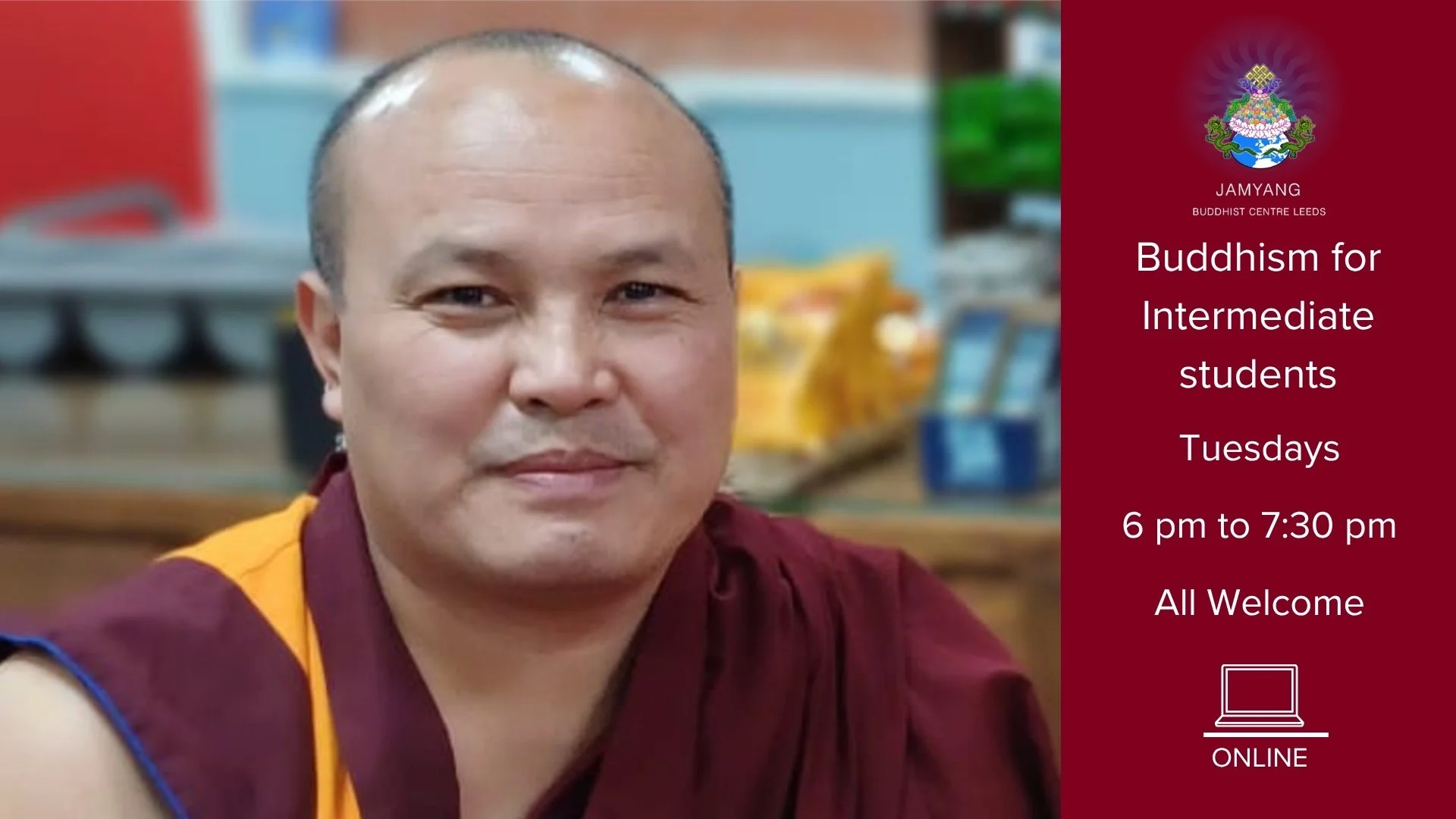
Buddhism for Intermediate Students
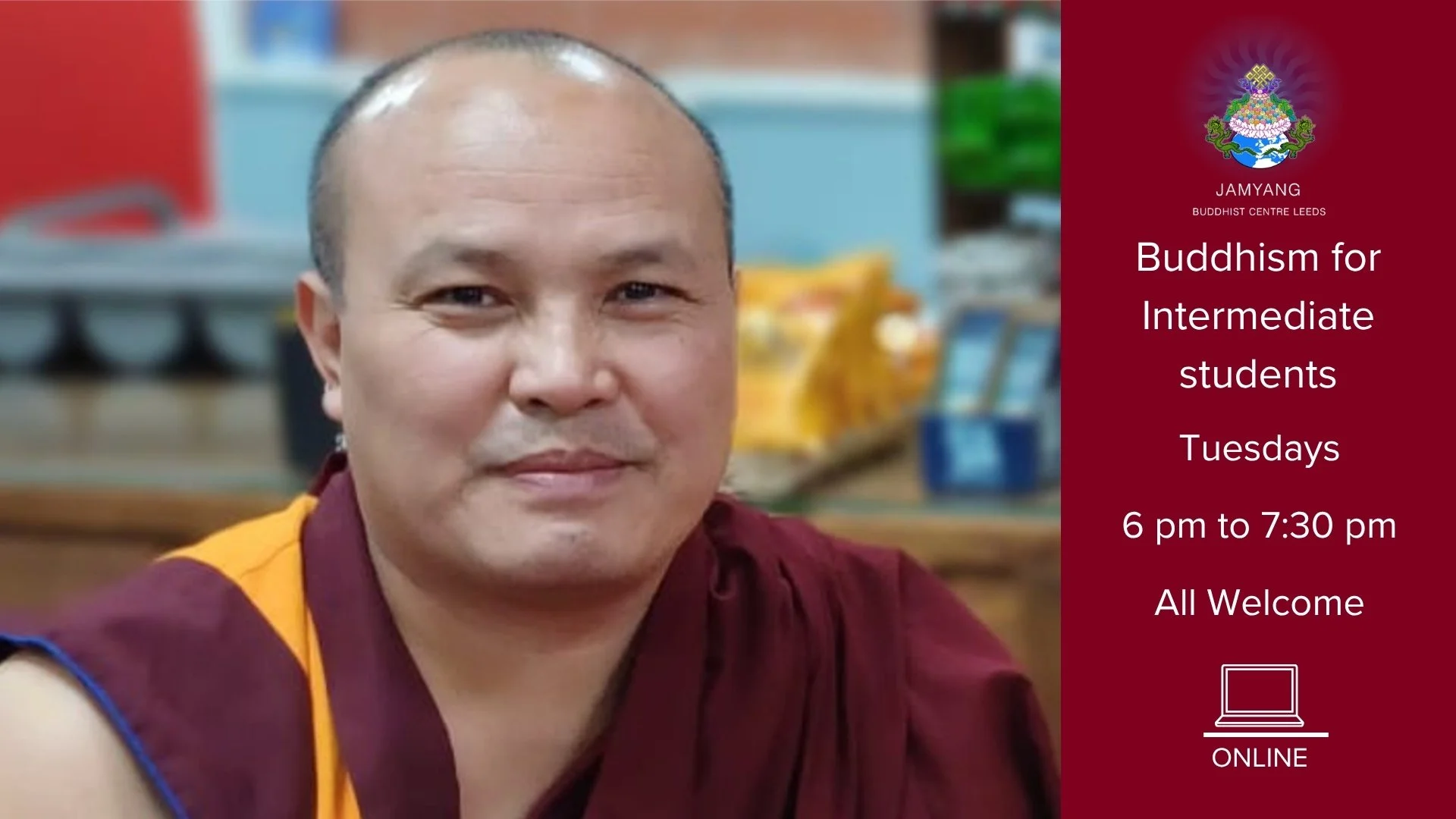
Overview of Programme
DATES: Weekly sessions 7th July to 24th November
TIME: Tuesday weekly 6:00 pm to 7:30 pm
LOCATION: Online
LEVEL: Intermediate students of Buddhism and those interested in Buddhist philosophy
Buddhism for Intermediate students:
This series of teachings aims to provide a comprehensive understanding of key Buddhist texts and practices, offering both theoretical knowledge and practical guidance for those interested in deepening their spiritual practice. Each monthly session is carefully designed to build a holistic understanding of Buddhist philosophy and meditative practices.
This series of sessions will focus upon the key text: Illuminating the Intent: An Exposition of Chandrakirti’s Entering the Middle Way.
Online drop in class – no need to register.
SUGGESTED DONATION FOR DROP IN CLASS:
Non-members – £12 per drop in class. This will contribute to the centre’s running costs and include a donation to the teacher.
Gift Aid: if you are a UK taxpayer we can claim back 25p for every £1 you donate. More information on Gift Aid can be found here.
Free to members of The Jamyang Buddhist Centre Leeds (your membership fees already contribute to our core costs in running the centre). You are invited to make a donation for the teacher, as is customary when receiving Buddhist teachings, in order to support their activity. For your reference we recommend a donation in the region of £4 per class. We will make the donation to the teacher on your behalf.
We never turn anyone away from the Dharma for financial reasons. If you cannot donate the suggested amount, please donate where possible within your means. It’s good to practice generosity where we can.
ABOUT YOUR Teacher: Geshe Rinchen Wangyal
Geshe Rinchen has dedicated his life to the study and practice of the Buddha’s teachings. He completed rigorous training in Buddhist philosophy, debate, and meditation, achieving the esteemed title of Geshe, the doctorate degree in the Tibetan Buddhist tradition.
His teachings are known for their clarity, warmth, and practical applicability, making profound topics accessible to students of all backgrounds.
Currently resident teacher at Jamyang Buddhist Centre Leeds, Geshe Rinchen combines his deep knowledge with genuine compassion, inspiring students to cultivate inner peace and wisdom in their own lives.
SESSION RESOURCES:
About this series:
The great Tsongkhapa wrote three profound texts on Madhyamika philosophy and practice:
The Essence of True Eloquence,
Ocean of Reasoning,
Illuminating the Intent.
Illuminating the Intent is one of these masterpieces, completed shortly before he passed into parinirvana. It is perhaps the most profound text ever written by a Tibetan scholar on Madhyamika philosophy and practice, guiding readers to both understand emptiness intellectually and apply its insights in daily life.
Nagarjuna composed the Fundamental Wisdom of the Middle Way, on which Chandrakirti later wrote his commentary, Entering the Middle Way. Since Chandrakirti’s work consists only of verses, Je Tsongkhapa composed a detailed commentary, making Illuminating the Intent an essential guide for understanding Nagarjuna’s root text. The primary theme of these texts is emptiness—what it is and how to practise it effectively.
Why This Text Matters:
Je Tsongkhapa’s text is invaluable for anyone seeking to understand reality, the self, the nature of the mind, life, the root causes of suffering, and consciousness. Studying it helps uncover practical methods to overcome suffering, find meaning in life, and apply these teachings in daily living.
About the Great Tsongkhapa:
The great Tsongkhapa (1357–1419) was a true genius in interpreting and practising Mahayana teachings as laid down by the ancient Indian Nalanda masters. He founded the Geluk tradition of Tibetan Buddhism, which emphasises both rigorous intellectual analysis and practical application of the Buddha’s teachings, following the approach of the Nalanda masters.
Who This Course Is For:
This course is suitable for both practitioners and academics, as well as anyone with a keen interest in Madhyamika philosophy and the practice of emptiness. In class, we will engage with the text through reading and giving explanation page by page following the Tibetan monastic educational tradition. At times, we will also participate in monastic-style debate to clarify the meaning and implications of the text. This approach allows participants to explore the material both intellectually and practically.
Vajrasattva Practice
Overview of The Vajrasattva Practice
DATE: Tuesdays
TIME: 8:00pm-8:30pm
LOCATION: Zoom
LEVEL: Buddhist Practices – All Welcome
SUGGESTED DONATION: £4
Purification here means looking at our past unskillful actions which have created seeds of negative karma in our minds, and using visualisation and mantra recitation to remove those seeds in a healthy and productive way. Vajrasattva is the embodiment of all the Buddha’s cleaning and purifying energy. We all make mistakes, and how we deal with them is key to making spiritual progress. We’ll be using a short text composed by Lama Zopa Rinpoche
the eight verses of thoughts transformation
Overview of the eight verses of thoughts transformation
Everflowing Nectar of Bodhichitta – Annihilating the Demon of the Self-Cherishing Mind
DATE: Wednesdays
TIME: 7am-7:30am
LOCATION: Zoom
LEVEL: Buddhist Practices- All Welcome
SUGGESTED DONATION: £4
Everflowing Nectar of Bodhichitta – Annihilating the Demon of the Self-Cherishing Mind
Led by Di or Sande
This practice is based on the short text” Eight Verses of Thought Transformation”, which contains the entire technique for transforming the mind into relative bodhichitta (i.e., the wish to achieve enlightenment for the benefit of all sentient beings) and absolute bodhichitta (i.e., the wisdom realizing emptiness).
Chanting the Verses of Noble manjushri
Overview of Session
DATE: Thursdays
TIME: 7:45am to 8:25 am
LOCATION: Zoom only
LEVEL: Buddhist Practices – suitable for Lama Zopa Rinpoche’s students
Join us to fulfill His Holiness the Dalai Lama’s wishes and chant the Names of Noble Manjushri for the swift return of Lama Zopa Rinpoche.
Please come along even if you havent done the practice before, its quite wonderful and very energising. Please download the text below, you can also listen and practice with the audio clip of Lama Zopa Rinpoche reciting the Chanting the Names of Noble Manjushri.
Kshitigarbha Practice
Overview of Kshitigarbha practice
DATE: Tuesdays & Thursdays
TIME: 12pm-12:30pm
LOCATION: Zoom only
LEVEL: Buddhist Practices – All Welcome
SUGGESTED DONATION: £4
Lama Zopa Rinpoche (our organisation’s Spiritual Director) suggested Jamyang Leeds perform these practices to help with the financial obstacles we are currently having. From September 2022, we’ll be reciting this practice as much as we can. See the special newsletter explaining all about the practice here.
Kalachakra Practice group
Overview of practice
This is a restricted group for those who have received the Kalachakra empowerment from a qualified Lama. To join the group you need to have either received the full Kalachakra empowerment or another High Yoga Tantra empowerment such as Heruka, as long as you have received a Kalachakra Jenang (permission).
This international group of Kalachakra practitioners meets weekly and alternates with commentary and practice.
Mind Mandala once a month and six session guru yoga for other sessions:
If you’re already part of this group, please use the details sent in the weekly email to join the practice
If you’d like to join us, please email spc@jamyangleeds.co.uk confirming that you have the appropriate empowerments. You will then be sent a registration form to complete.
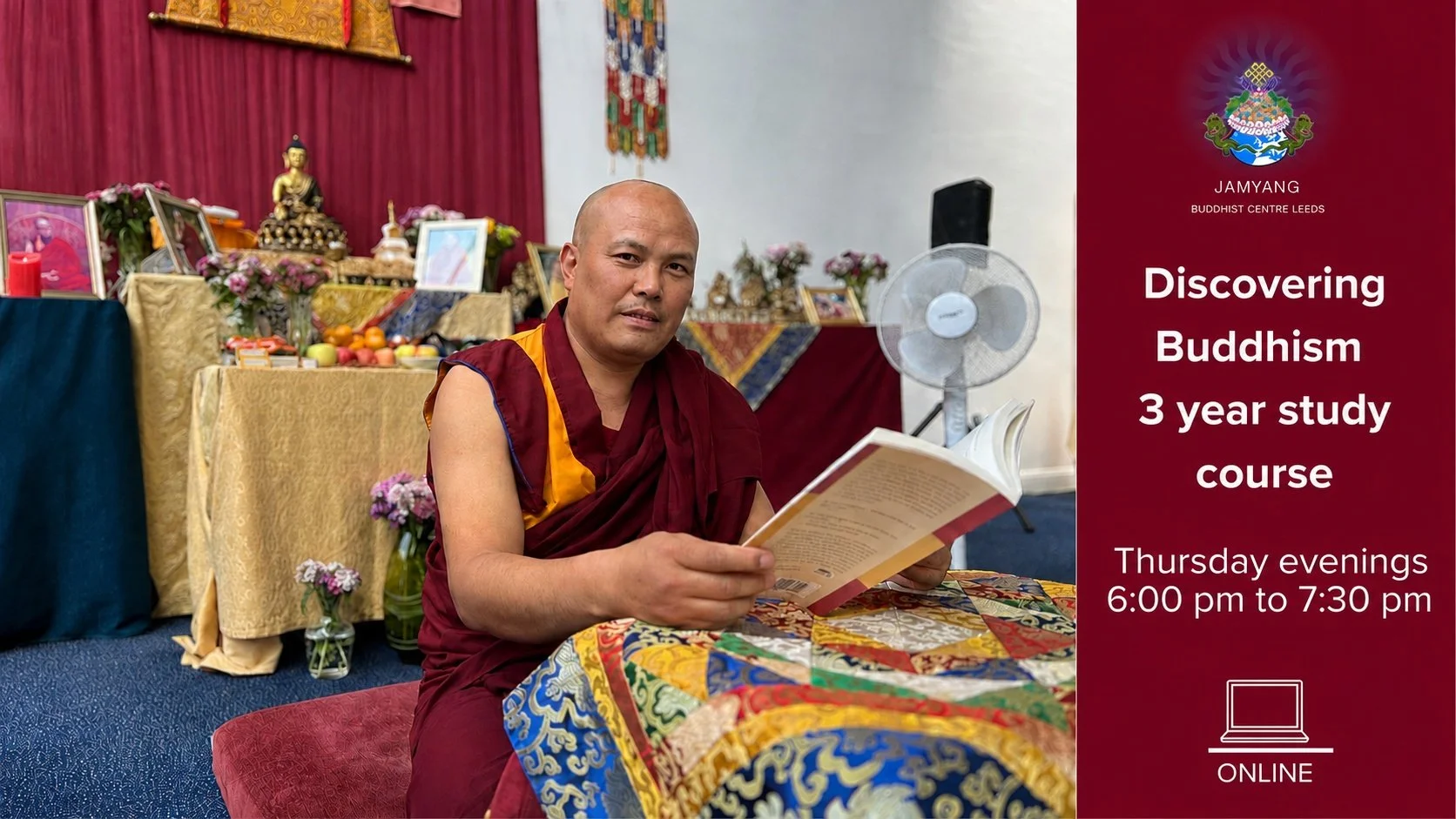
Discovering Buddhism: how to meditate
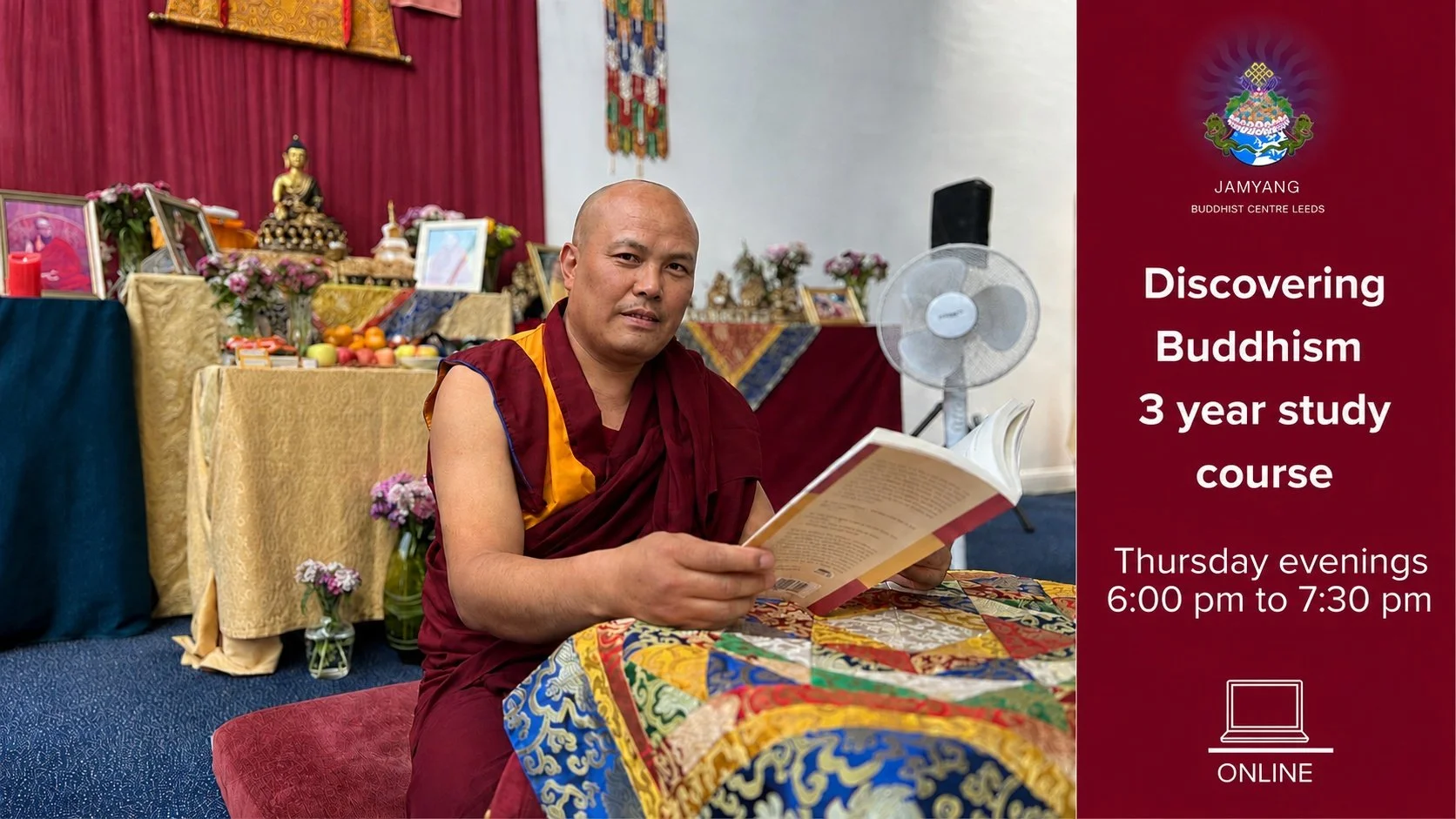
Overview of Programme
DATE: 2026: 15th October, 22nd October, 29th October, (no class on the 5th Nov) 12th November, 19th November, 26th November and Meditation day Sunday 29th November
TIME: Thursday’s weekly 6:00 pm to 7:30 pm
LOCATION: Online
LEVEL: The course is suitable for both beginners and intermediate students, providing a structured approach to Buddhist study.
What to Expect in This Module: How to meditate
Under the guidance of Geshe Rinchen you will learn the definition and purpose of meditation, how to sit, how to set up a meditation session, different meditation techniques, and how to deal with obstacles to meditation.
Through:
Introductory Meditations
Explanatory Teachings - Understand the Foundations and Special features of Meditation.
Reflection and Discussion - Consider how this practice relates to the rest of the path and your own practice.
Supportive Environment - Learn and share with like-minded practitioners, supported by the wisdom and guidance of Geshe Rinchen.
Integration Guidance - Learn ways to connect these Meditation methods with your lamrim meditation and daily spiritual growth.
This module concludes with an online Day of Meditation on Sunday, 29th November, offering time for deeper reflection and integration of the teachings.
Suitable for both new and experienced students ready to delve into the inspiring methods that turn life’s challenges into opportunities for growth, compassion, and wisdom
Awakening the limitless potential of your mind, achieving all peace and happiness
Discovering Buddhism is a beginner to intermediate level, 2 year study programme that will give you a solid foundation in the teachings and practice of Tibetan Mahayana Buddhism. The Mind & its Potential is the 1st Module.
This course was designed by Lama Zopa Rinpoche for students to study, explore and put into practice the graduated path to enlightenment, the lamrim. Originally based on Buddha Shakyamuni’s teachings from 2500 years ago in India. The lamrim was systematically organised by the Indian master Atisha in the 11th Century and by several other great masters from Tibet including Lama Tsongkhapa in the 15th Century.
Our resident teacher Geshe Rinchen Wangyal (Geshe La) will be teaching this module. This is an excellent opportunity to receive these Lamrim teachings directly from Geshe La. We are indeed most fortunate to be able to do so.
This course commences August 2026 and runs for just over 2 years during term time on Thursday evenings online for 90 minutes and has 14 subjects, 13 of which are usually taught over 6 weeks. It is possible to join at any time during the course.
We warmly invite you to join us for this enriching journey with Geshe Rinchen. Together, let us explore how to bring the timeless wisdom of Buddhism into our everyday lives.
Please register for Discovering Buddhism here. For more information contact our course coordinator, Ruth: db@jamyangleeds.co.uk
ABOUT YOUR Teacher: Geshe Rinchen Wangyal
Geshe Rinchen studied at Drepung Losel Ling Monastery in India, then at the Institute of Buddhiust Dialectics. He gained his Geshe degree in 2015.
He then studied at the University of Winchester in the UK, gaining a BA (hons) Degree in Philosophy, Religion and Ethics in 2024
Geshe La has had articles published in The Scientific American in 2020 including 'Hygiene of the mind during the Pandemic’. He has also received awards for essay competitions at the Institute of Buddhist Dialectics.
Geshe La’s teachings are known for their clarity, warmth, and practical applicability, making profound topics accessible to students of all backgrounds. Geshe La combines his deep knowledge with genuine compassion, inspiring students to cultivate inner peace and wisdom in their own lives.
Geshe La teaches in English fluently.
You can read more about Geshe Rinchen here.
SUGGESTED DONATION:
Non-members – £72 per module for the Thursday classes (usually 6 weeks), and £32 for the meditation day at the end of each module. This will contribute to the centre’s running costs and includes a donation to the teacher.
Free to members - Members are invited to make a donation for the teacher, as is customary when receiving Buddhist teachings, in order to support their activity (for your reference we recommend a donation in the region of £20 per module and £10 per meditation day).
We never turn anyone away from the Dharma for financial reasons. If you cannot donate the suggested amount, please contact Ruth on: db@jamyangleeds.co.uk to discuss what would be affordable for you.
It’s good to practice generosity where we can.
How to Donate:
You can make a donation by card using our Donation Portal here. Please put Discovering Buddhism as a reference in the comments box
Alternatively you can donate by Bank Transfer using the details below, please reference Discovering Buddhism
Account Name: Jamyang Buddhist Centre Leeds
Bank Name: Cooperative Bank Plc
Account number: 65178087 Sort-Code: 08-92-99 SWIFT: CPBK GB22 IBAN: GB76 CPBK 0892 9965 1780 87
Gift Aid: if you are a UK taxpayer we can claim back 25p for every £1 you donate. Please indicate when registering if you would like us to claim gift aid on your donations.
Shamatha – Meditation on the Breath
Overview of Session
DATE: Fridays
TIME: 7am-7:30am
LOCATION: Zoom
LEVEL: All Welcome
SUGGESTED DONATION: £4
Led by Ruth
Mindfulness of Breathing is universally acknowledged to be of benefit to all living in the modern world. Many feel overloaded with all that is expected of us living this complex and exhausting existence. Developing our awareness in this way is a general prescription for soothing and healing the overworked body and mind.
Practicing focusing the attention on an object such as the breath is also a core practice in Tibetan Buddhism. Gradually over time we are able to hold the object of our attention over longer periods, which enables us to practice other meditations such as Vipassana more successfully.
White Dzambhala practice
Overview of practice
DATE: Fridays
TIME: 11 am to 11:30 am
LOCATION: Please note this is online only
LEVEL: Buddhist Practices – see note below
SUGGESTED DONATION: £4
Dzambhala practice is said to bring wealth, prosperity, success, good fortune and luck, long life and wisdom.
Please come and join in with this monthly practice to help the centre, the FPMT and Buddha Dharma to flourish and be free from obstacles.
To do this practice in full, it is best to have a Kriya tantra empowerment of Chenrezig. However, one may still do this practice without such an empowerment by simply skipping the
self-generation on page 3. The Torma Offering on page 15 requires empowerment
Dzambhala is an emanation of Ratnasambhava, one of the five buddha families, whose enlightened activity is increasing and whose essence is generosity. Some people practice Dzambhala to
achieve spiritual prosperity, although this deity is also associated with wealth and prosperity in the material world. Dzambhala practice is said to bring wealth, prosperity, success, good fortune
and luck, long life and wisdom. He is depicted holding a mongoose spouting jewels.
There are five different wealth Dzambhala, each has their own practice and mantra to help eliminate poverty and create financial stability.
Through the power of compassionate intention, visualization, and mantra recitation, as well as a wealth-stimulating ritual, this practice ripens and enhances our karma for an abundance of
resources. When done with single-pointed concentration and faith, this ritual easily increases one’s financial prosperity.
White Umbrella Deity practice
Overview of practice
DATE: Fridays
TIME: 11:30 am to 12:00 pm
LOCATION: Please note this is online only
LEVEL: Buddhist Practices – see note below
SUGGESTED DONATION: £4
In September 2024, His Eminence Ling Rinpoche gave us this practice to overcome obstacles to the centre flourishing.
In addition to many benefits of engaging in these practices, Lama Zopa Rinpoche recommended that these two practices are beneficial to helping bring peace to situation between Israel and Palestine.
The Sanskrit name for the White Umbrella deity is Ushnisha Sitatapatra which can also be translated as “The Victorious White Parasol.” The White Umbrella Deity, [Skt. Sitatapatra, Tib. gdugs dkar] is a powerful female deity. She is relied upon for protection; healing illness; dispelling interferences, spirit possession, and harmful forces; quelling disasters; averting obstacles; and bringing auspiciousness.
Ushnisha Sitatapatra is a female form of Avalokiteshvara, the Bodhisattva of Compassion. Like this Bodhisattva in an elaborate form, she also has a thousand eyes that watch over living beings, and a thousand arms that protect and assist them. Thus she symbolizes the power of active compassion.
Practices of Arya Sitatapatra includes, “The Supreme Accomplishment of Sitatapatra,” and “Praises and Repelling Practices of Sitatapatra.”
Medicine Buddha Puja
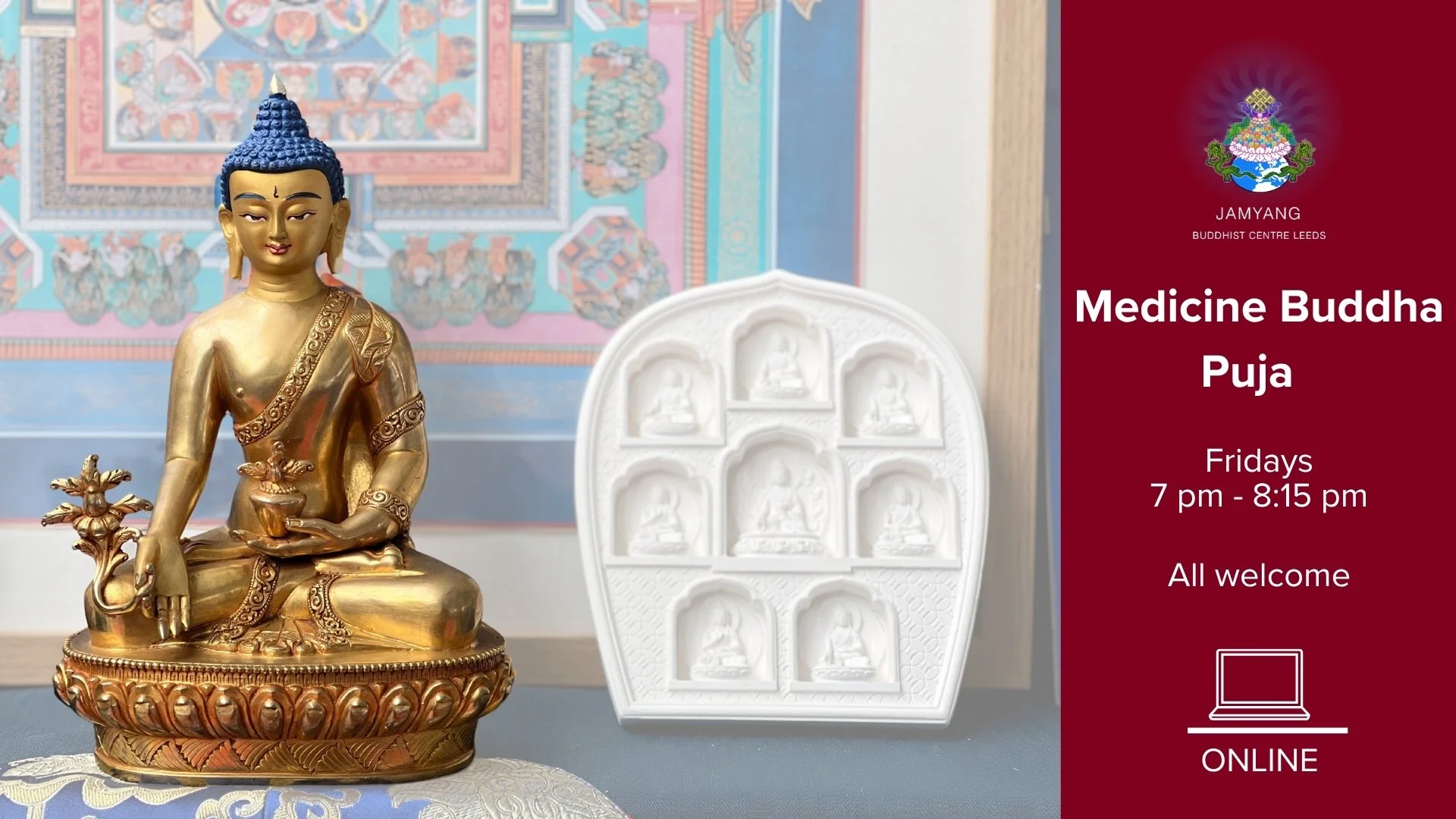
Overview of Medicine Buddha Puja
Medicine Buddha is one of the practices recommended by the FPMT for students to do for the swift return of Kyabje Lama Zopa Rinpoche.
DATE: FRIDAYS
TIME: 7 pm to 8:15 pm
LOCATION: Zoom
LEVEL: Buddhist Practices – All Welcome
SUGGESTED DONATION: £6
This is a longer meditation on Medicine Buddha – to remove obstacles, esp. those relating to health and achieving a favourable rebirth, and activate a swift path to enlightenment.
As Lama Zopa Rinpoche said: “One of the best healing meditations is that on the Medicine Buddha, who is the manifestation of the healing energy of all enlightened beings.”
The puja involves chanting prayers to the Seven Medicine Buddhas and reciting the Medicine Buddha mantras.
It is kindly led by Sande
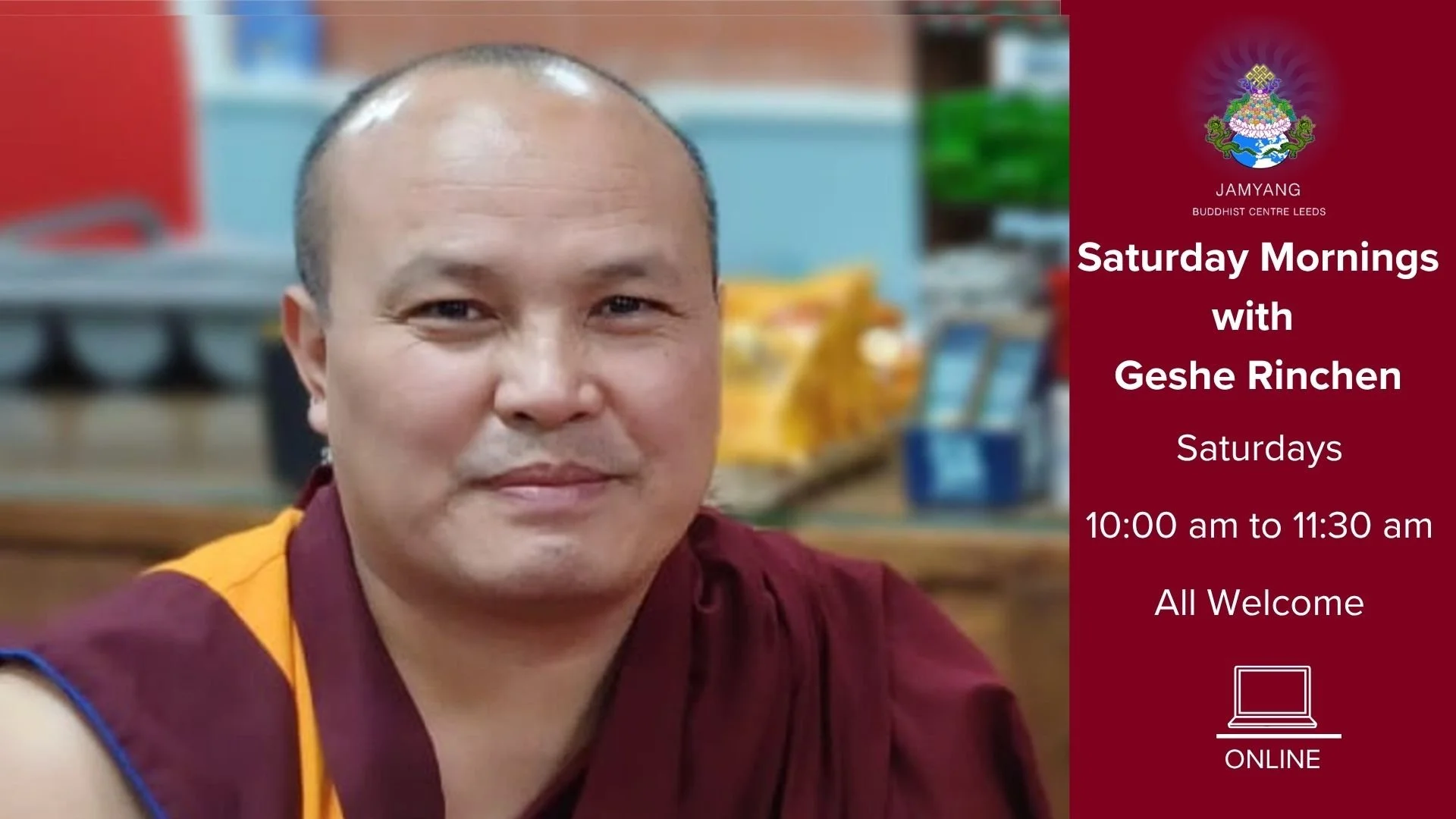
Saturday Mornings with Geshe Rinchen
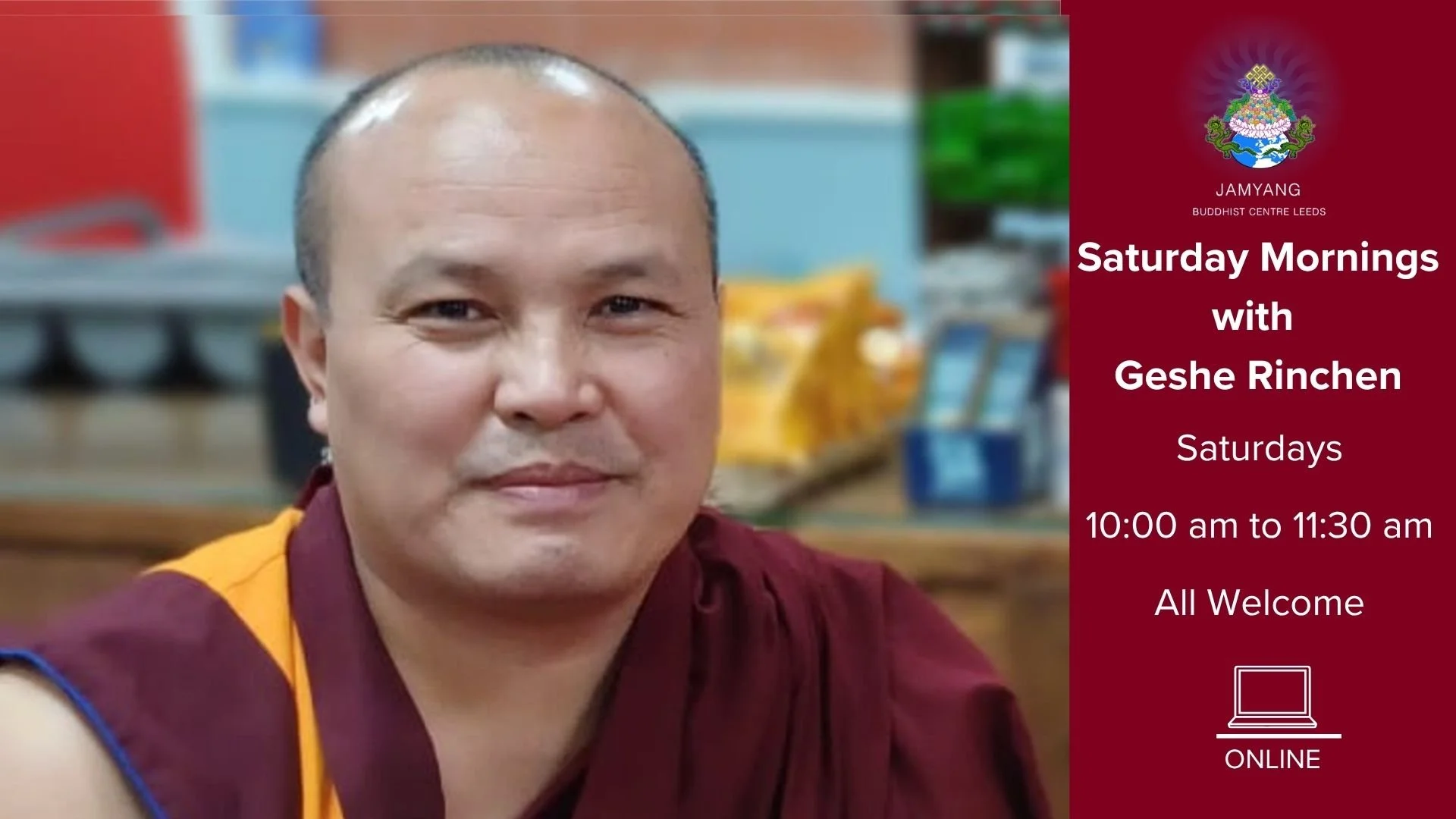
Overview of Programme
DATES: Saturdays weekly 4th July to 28th November
TIME: 10:00 am to 11:30 am
LOCATION: Online
LEVEL: Everyone interested in exploring Buddhism, from beginners to intermediate.
Saturday Mornings with Geshe Rinchen:
Are you curious about Buddhism and want to know more, or perhaps you already have some understanding but would like to expand on your knowledge. If so this Saturday morning class with Geshe Rinchen (Geshe La) is ideal for you. Designed as a drop in class with a different topic each week, covering key concepts in Buddhism and how they can make a real difference in our lives. Such as how we can deepen our connection with others, and how we can live our lives in the present moment. This is a great opportunity to spend time with Geshe La and ask questions.
Online drop in class – no need to register.
SUGGESTED DONATION FOR DROP IN CLASS:
Non-members – £12 per drop in class. This will contribute to the centre’s running costs and include a donation to the teacher.
Gift Aid: if you are a UK taxpayer we can claim back 25p for every £1 you donate. More information on Gift Aid can be found here.
Free to members of The Jamyang Buddhist Centre Leeds (your membership fees already contribute to our core costs in running the centre). You are invited to make a donation for the teacher, as is customary when receiving Buddhist teachings, in order to support their activity. For your reference we recommend a donation in the region of £4 per class. We will make the donation to the teacher on your behalf.
We never turn anyone away from the Dharma for financial reasons. If you cannot donate the suggested amount, please donate where possible within your means. It’s good to practice generosity where we can.
ABOUT YOUR Teacher: Geshe Rinchen Wangyal
Geshe Rinchen has dedicated his life to the study and practice of the Buddha’s teachings. He completed rigorous training in Buddhist philosophy, debate, and meditation, achieving the esteemed title of Geshe, the doctorate degree in the Tibetan Buddhist tradition.
His teachings are known for their clarity, warmth, and practical applicability, making profound topics accessible to students of all backgrounds.
Currently resident teacher at Jamyang Buddhist Centre Leeds, Geshe Rinchen combines his deep knowledge with genuine compassion, inspiring students to cultivate inner peace and wisdom in their own lives.
SESSION RESOURCES:
About this series:
July 2026
4 July – What did the Buddha Discover?
11 July – Buddha Nature – the Seed of Enlightenment
18 July – Understanding the Mind and Mental Factors
25 July – The Story of Milarepa: Transformation and Enlightenment
August 2026
1 August – The Four Noble Truths: An overview
8 August – Understanding Suffering
15 August – The Causes: Karma and Afflictive Emotions
22 August – The End of Suffering: What is Possible?
29 August – The Path: A Practical Way Forward
September 2026
5 September - Calm Abiding (Samatha)
12 September - Insightful Meditation (Vipassana)
19 September - the Mind of Awakening (Bodhicitta)
26 September – The Wisdom of Emptiness
October 2026
3 October – The Two Accumulations: Merit and Wisdom
10 October – Offering to the Three Jewels
17 October – Circumambulation Practice
24 October – Prostration Practice
31 October – Reciting Mantras and Their Benefits
November 2026
7 November – Introduction to Visualisation Practice
14 November – Medicine Buddha Practice
21 November – Tara Practice
28 November – Establishing Daily Practices
Who This Course Is For:
This is a wonderful opportunity to hear Geshe La teach each weekend online and to ask him questions.
These topics have been carefully selected for beginners,
They are also very suitable for all students of Buddhism to refresh and expand on their understanding.
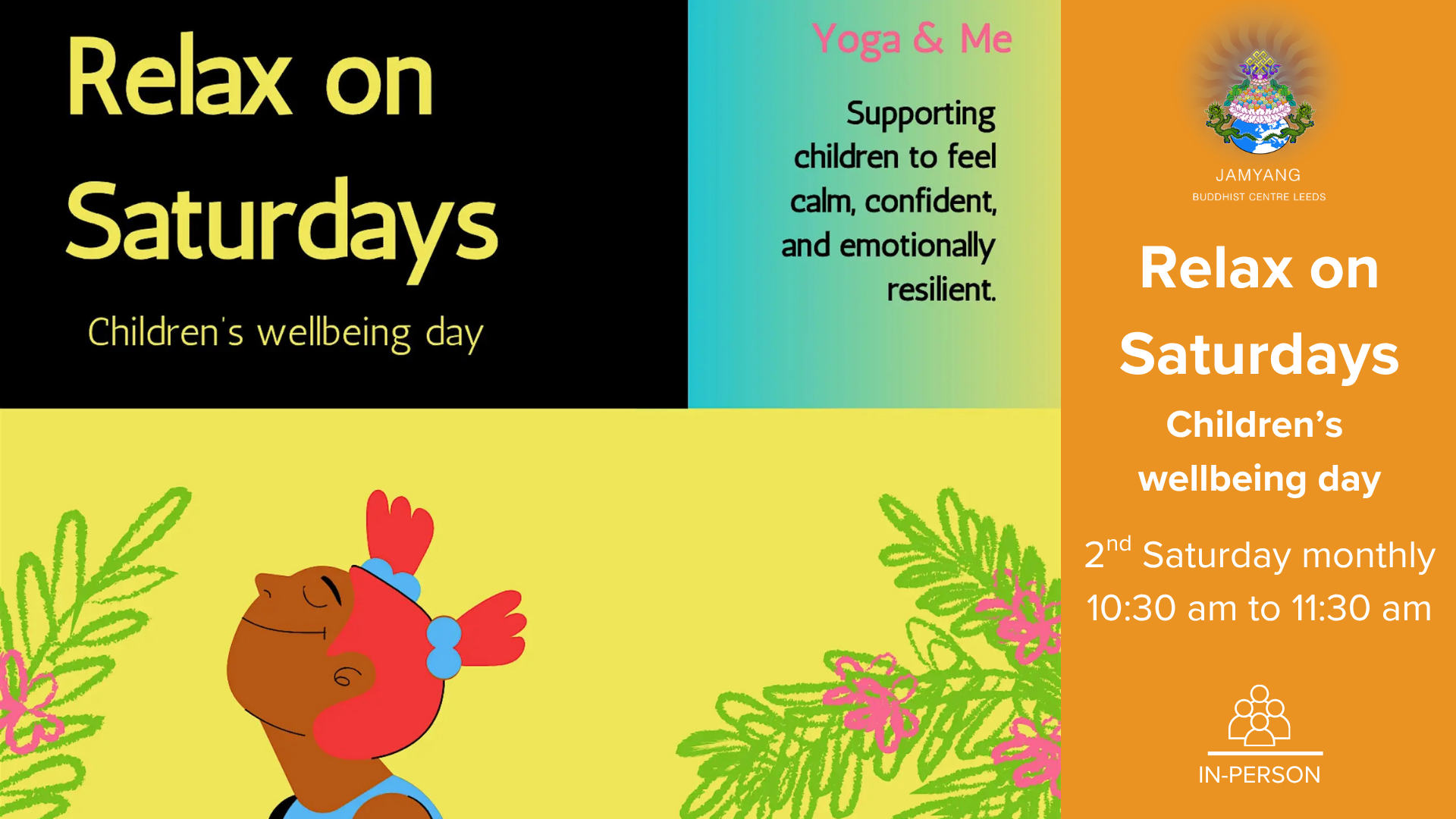
Relax on Saturdays - Children’s Wellbeing Day
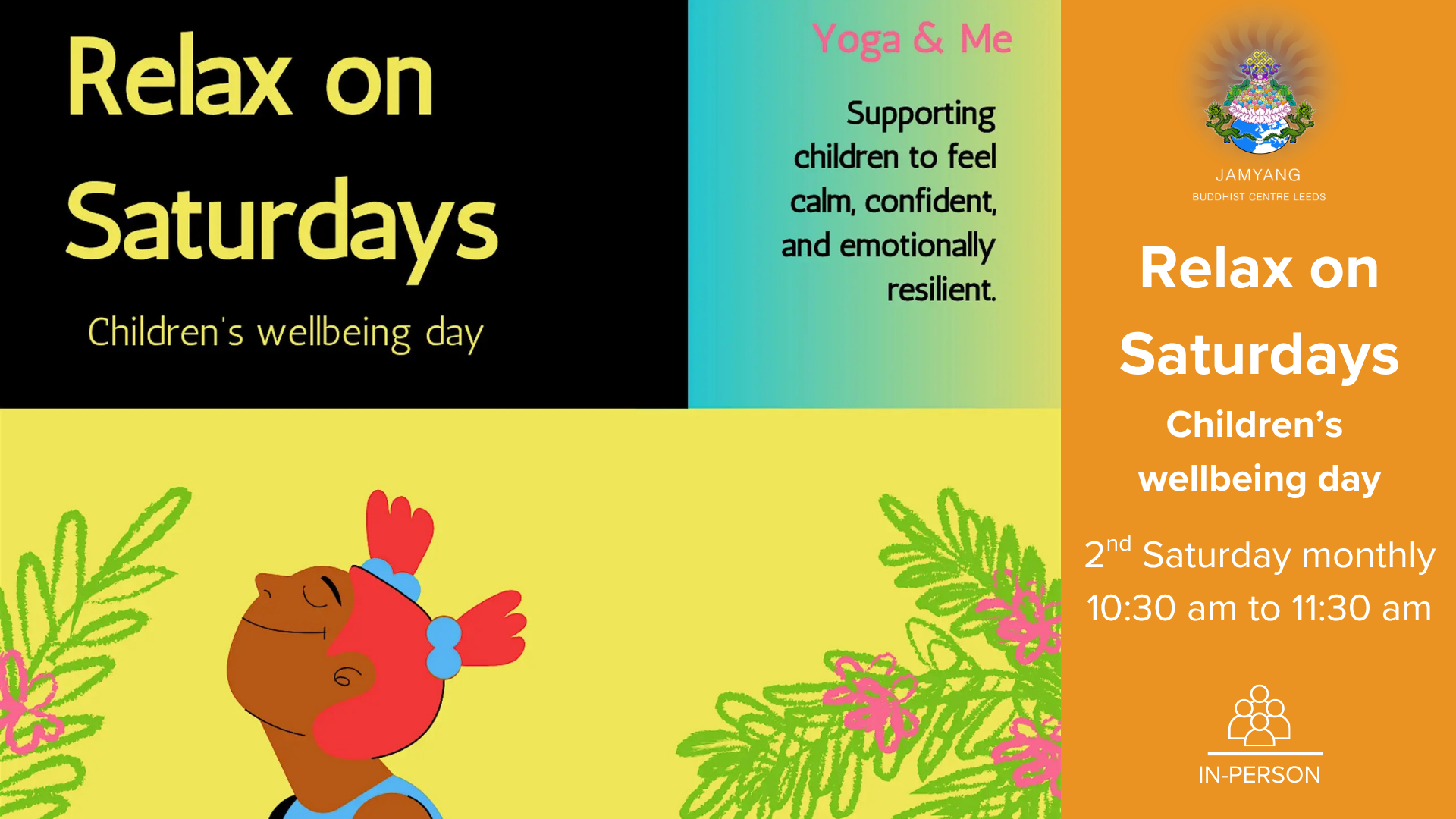
Overview of Session
DATE: 2nd Saturday monthly
TIME: 10:30 am to 11:30 am
LOCATION: In-person
LEVEL: Wellbeing – Children age 6 to 12
COST: £12 Booking essential
These monthly “Relax on Saturdays: Children’s Wellbeing Day” with Joana Gomes are a calm and supportive one-hour sessions where children can slow down and recharge.
Through gentle yoga, simple breathing exercises, mindfulness, and creative activities, children learn easy tools to relax their bodies and minds.
The sessions offer a safe and friendly space where children can build confidence, feel at ease, and learn how to manage their emotions in a positive way.
Designed for primary school-aged children, these sessions support mental health and welbeing in a safe, inclusive environment.
These monthly 1-hour session offer a structured, nurturing space where children can step away from busy routines and learn practical tools to support their welbeing.
Each session includes:
• Children’s Yoga (gentle movement & relaxation)
• Introduction to Mindfulness (simple, age-appropriate techniques)
• Mindful Arts & Crafts
• Breathing and calming exercises
Benefits for your child:
• Improved emotional regulation
• Reduced stress and anxiety
• Increased focus and self-awareness
• Development of kindness and self-compassion
About Joana:
Teaching yoga and mindfulness to children is something I care deeply about.
As both a practitioner and a mother of two young children, I see every day how much these practices can help.
This personal experience shapes the way I teach, helping me create sessions that are simple, engaging, and meaningful for children.
How to Book:
Limited spaces available – booking essential
go to Eventbrite to book or email Joanna directly at childrensyoga.yogime@gmail.com
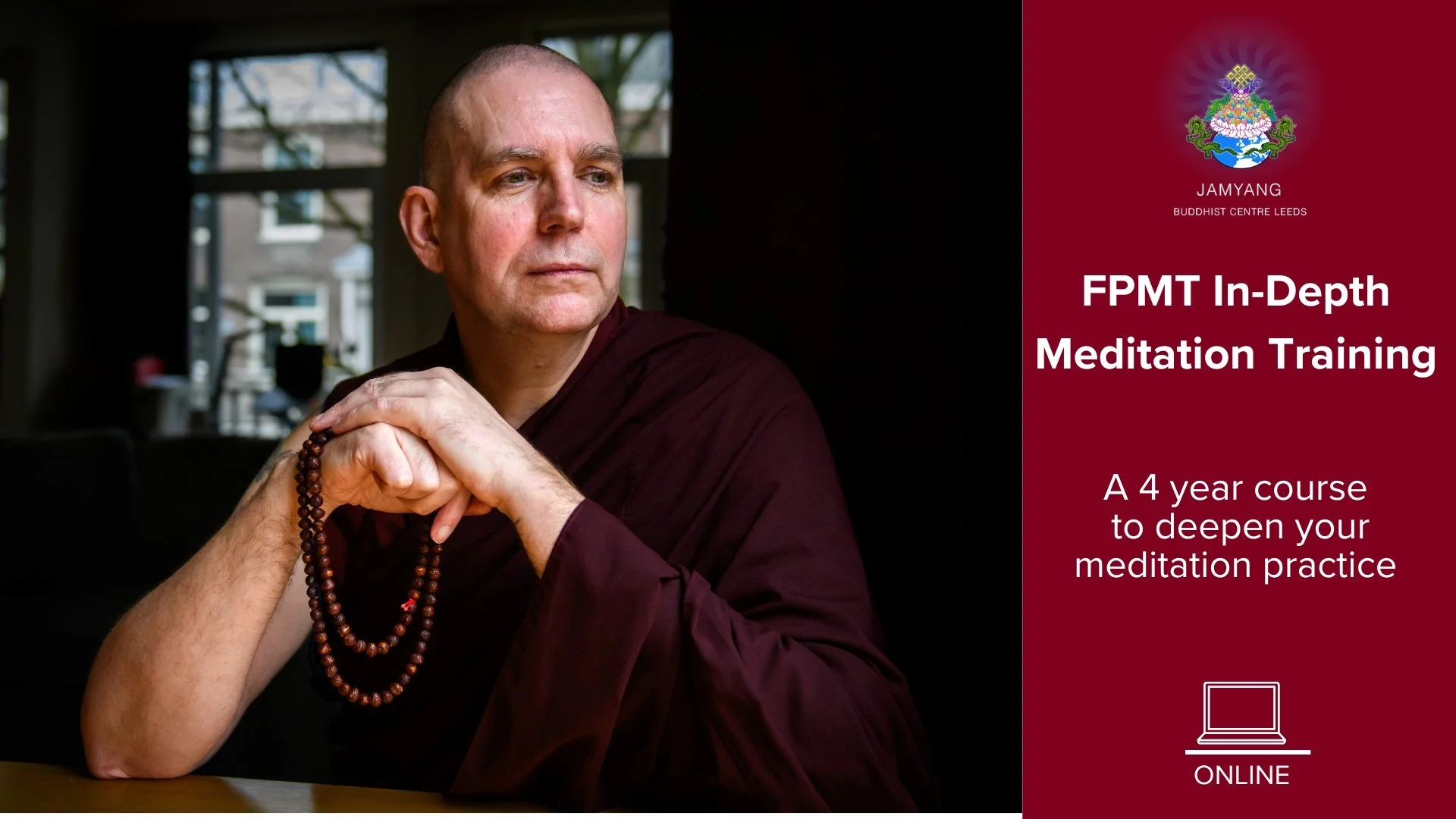
FPMT In-Depth Meditation Training
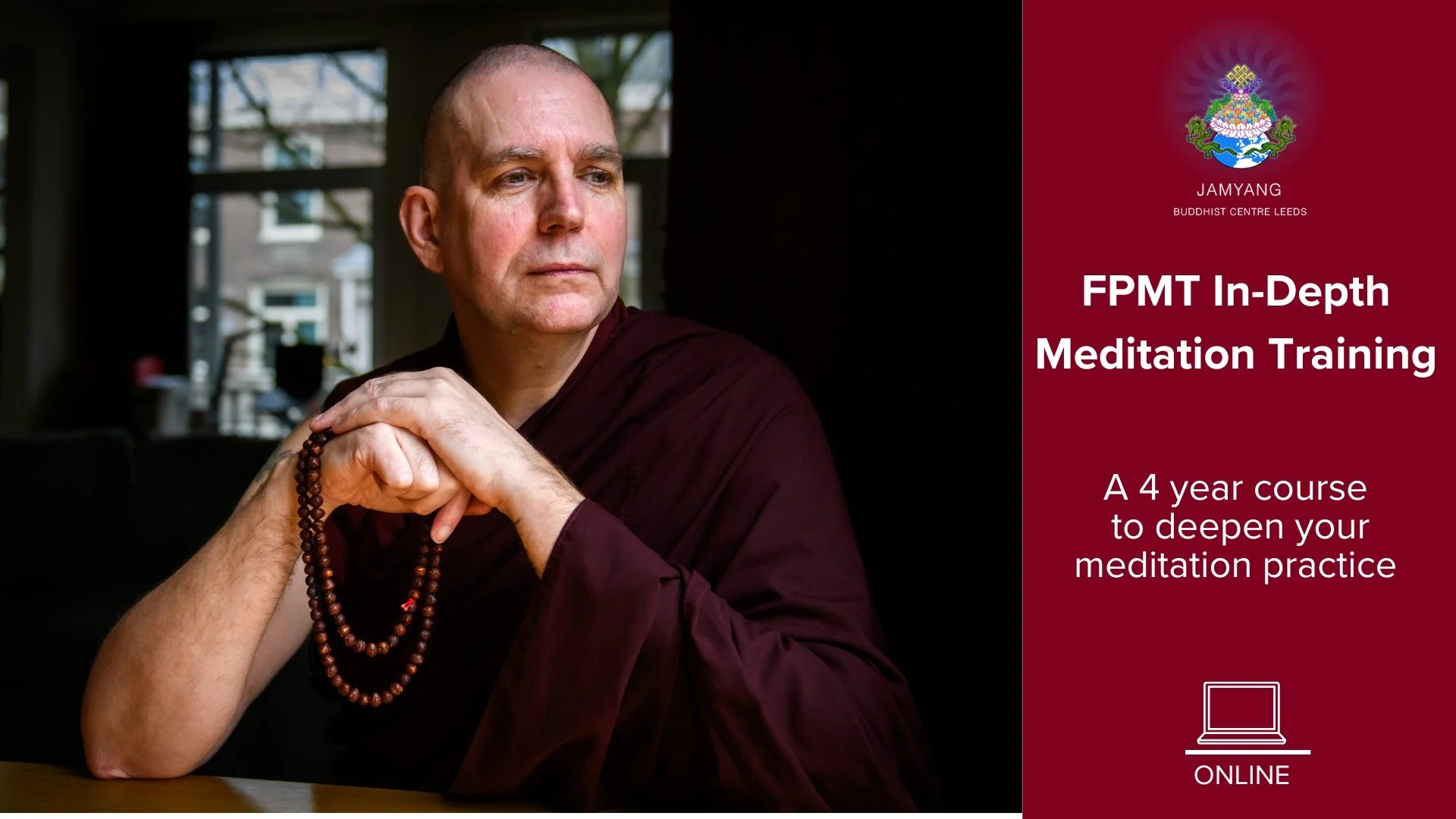
Overview of SESSION
DATE: 2026 / 2027: Year 4
Term 1: September 5th to November 28th 2026
If you are starting as a new student in year 4, don’t worry. You will get some preparatory advice on what previous recordings to have a listen to. Alternatively you may wish to join the new Ngondro Lamrim Meditation course for 2 years before starting In Depth Meditation Training. They are designed to be complementary.
TIME: Saturdays weekly 2:30pm – 5pm UK time
LOCATION: Zoom only
LEVEL: Buddhist Meditation – Intermediate to Advanced
IDMT Year Four, The Vajra Ground: Mahamudra and Kriya Tantra
In this culminating fourth year of our journey, our path turns inward to the mind itself—its empty, luminous nature—and outward to the transformative methods of tantra, where the naturally pure nature of our perception is recognized as the very ground of awakening.
As always, the year will start with generating the mind of awakening, using evocative instructions ranging from Langri Thangpa to Nāgārjuna and Lord Buddha in the famous Bodhisattvapiṭaka. This mind generation we'll cultivate through the four immeasurable thoughts and the support of calm abiding.
Illuminated by the life stories of the masters of the Gelug Mahāmudrā lineage and beyond, we'll explore its roots in the history of the early Indian Mahāsiddhas, such as Saraha and Tilopa, through the Kagyü master Gampopa's and Je Tsongkhapa's Mañjuśrī lineage up to Paṇchen Losang Chökyi Gyaltsen's Highway of the Conquerors and its perspective on this practice. In Sūtra Mahāmudrā we will practice resting attention in the empty nature of awareness, recognizing its clarity and openness as inseparable.
Kriyā Tantra offers a complementary method. Rather than suppress the ordinary, narrow self-narrative that we impose on ourselves and our world, it substitutes for it an extraordinary perspective of pure view. Occasionally, by way of introduction, we'll also taste practices from the higher tantras—glimpsing how afflictive emotions can be met as innate wisdom, and how the dissolution of the death process opens onto the innate mind of clear light. The structured practices of generation and recitation become a rehearsal for transformation, training perception to meet appearances as pure.
These methods rest on a relationship. We will therefore examine the practice of guru devotion candidly—both as the means by which the lineage's realization is transmitted and as a practice with real pitfalls, requiring discernment as much as trust. Through the Ganden Lha Gyāma, the Yoga of the inseparability of guru and Avalokiteśvara, and supporting sādhanas, devotion is approached not as deference but as the ethical road toward the state of Vajradhara: the full integration of wisdom and method.
This final year is an invitation to let realization ripen into a way of being. Grounded in bodhicitta and the four immeasurables, sustained by the preliminary practices, and held by the strength of community, we learn to meet the mind without grasping and to meet the world as pure appearance. Our aim is not to accumulate practices, but to bring the path to maturity—wisdom and compassion no longer cultivated separately, but lived as one.
This four-year online course provides students with long term, in-depth support in their meditative development.
The teacher and course developer is Venerable Losang Gendun. He has trained extensively in meditation in both Theravada and Mahayana Traditions
The In Depth Meditation Training course is also part of The Buddha Project led by Venerable Losang Gendun. You can find out more about Venerable Gendun, the course and who it is suitable for on our FPMT In-Depth Meditation Training webpage
If you have any questions you would like to ask before registering please email our In-Depth Meditation Coordinator Marie Odile on idmt@jamyangleeds.co.uk
The zoom link and all materials for the course are provided to registered students.
Donations:
Generosity is one of the cornerstones of the Buddhist path. With your donation we support The Buddha Project and we keep our centre going for the benefit of all sentient beings.
As the course is a collaboration with other FPMT centres it is not possible to offer this as part of our Jamyang Leeds membership programme.
The recommended donation per calendar month is £45.
If you are able to practice generosity and sponsor other students we recommend £58 per calendar month.
If you are on a reduced income it is £31 per calendar month.
There is also the option to donate annually.
If none of the above options are affordable please do still register, we never turn anyone away from the Dharma for financial reasons and we can agree a donation that is affordable for you right now. Please email Marie Odile our IDMT Coordinator idmt@jamyangleeds.co.uk if you would like to chat.
A Mindful Heart - Sunday Community Meditation
overview of sunday Community Meditation
DATE & TIME: Sunday 10:30-11:30
LOCATION: In-person at the centre
LEVEL: Meditation – All Welcome
SUGGESTED DONATION: Generosity model - please donate as you feel affordable and as generously as is manageable
Discover your best self every Sunday morning
Are you keen to work on your well-being and connect with others trying to make their life a little better for themselves and those around them? Join our uplifting Sunday Community Meditation Sessions.
Each hour-long gathering begins with a soothing meditation to calm your mind, followed by an inspiring discussion on a way of being such as interconnection, that enriches your everyday life. We then dive into a focused meditation designed to help you embrace that way of being fully.
Wrap up your morning with a cup of tea and friendly conversation in a welcoming, relaxed atmosphere. Absolutely everyone welcome.
Meet us every Sunday at 10:30 AM and start your week feeling refreshed, connected, and inspired. Your journey to a happier, more mindful life begins here!
Cost: Generosity Model: Pay as you feel.
From September 2026 to February 2027 we will focus on ‘A Mindful Heart’.
Inspired by the Creating Compassionate Cultures program (“CCC”) by Pam Cayton, and developed by the Foundation for Developing Compassion and Wisdom. Grounded in three core pathways of learning: Knowledge, Strength, and Compassion. These pathways guide you towards a happier, more meaningful life by fostering inner growth and a warmer connection with others.
Designed to help you develop a deeper understanding of how the mind works. The aim is to gradually let go of destructive patterns of thought and behaviour while cultivating a healthy sense of self-confidence and a deep, compassionate connection with others.
You are invited to reflect on your attitudes, perceptions, and emotional patterns. By exploring the workings of our own minds and the nature of our interdependence with others and the world around us, we begin to see how deeply connected our inner and outer realities truly are. We examine both logical and scientific perspectives on the nature of the self and our relationships with others.
To deepen the learning, you are encouraged to reflect between sessions, pausing to notice your inner experiences and reconnect with your deepest values. This supports the integration of insights and ways to act with greater mindfulness and wisdom.
Ultimately, the transformation we foster in ourselves contributes to building more compassionate cultures. How can one person influence a whole culture? The answer lies in understanding interdependence. Every action we take, every choice, interaction, and intention, affects others and the broader environment, this principle of cause and effect lies at the heart of all life, reminding us that our individual transformation ripples outward in meaningful ways.
The Creating Compassionate Cultures programme has 7 steps:
Mindful Intention
Interconnection
Change
Perception
Transforming harmful emotions
Empathy
Compassion
Session overview:
Welcome, Introduction and Motivation 5 mins
Settling Meditation 10 mins
Meditation topic introduced then participants briefly share their experience 15 mins
Guided meditation 15 mins
Feedback from participants 10 mins
Closing and Dedication 5 mins
September 2026
6th and 13th: The Pursuit of Happiness
20th and 27th: Understanding how things exist
October 2026:
4th and 11th: Developing Healthy Self Confidence
18th and 25th: Compassion - Opening the heart
November 2026:
1st and 8th: Mindfulness, reflection and critical thinking
15th and 22nd: Mindful intention - what do I really want
29th: Interconnection (week 1)
December 2026:
6th: Interconnection (week 2)
13th and 20th: Embracing Change
January 2027:
10th and 17th: Perception
24th and 31st Transforming harmful emotions
February 2027:
7th and 14th: Empathy
21st and 28th: Cultivating Compassion
Vipassana Meditation
Overview of Vipassana Meditation
Join us for a peaceful start to your week with a 30 minute Vipassana meditation session, designed to cultivate mindfulness, self-awareness, and equanimity. Led by Geshe Rinchen
DATE: Mondays weekly (March to May and July to November)
TIME: 7:00 am to 7:30 am
Vipassana (Special Insight Meditation), also called analytical meditation, is primarily a practice of wisdom. It is a form of concentration that focuses single-pointedly on the ultimate nature of phenomena through analytical reasoning. Analysing phenomena is a key aspect of Vipassana practice, as it helps develop a definitive understanding of the nature of reality—such as the self, mind, emotions, and thoughts.
As Je Tsongkhapa explains, shamatha (calm abiding) is like a lamp that remains clear and steady in a place without wind, whereas vipassana (special insight) is like seeing the nature of phenomena clearly through such a steady and clear lamp. Therefore, the usual order of these two meditations is: first, achieving calm abiding or mental stability as a foundation, then engaging in special insight meditation through analysis. However, Vipassana meditation can also be practised by analysing and observing sensations, thoughts, and emotions without first achieving shamatha. This practice should still begin with focusing on the breath or another object of meditation. In our case, we will focus on the breath to start analysing the nature of the mind in relation to our sense of self, emotions, and thoughts.
The session begins by focusing on the breath—either the rise and fall of the abdomen or the sensation of air entering and leaving the nostrils. This practice calms the mind and helps establish a deep sense of presence.
Next, we move into a guided body scan, bringing awareness to different parts of the body and observing subtle sensations without judgement. This helps develop a greater connection to your physical experience.
As we proceed, you will practise observing and analysing sensations, thoughts, and emotions as they arise, learning to witness them without attachment or aversion. This fosters a deeper understanding of the impermanence and interconnectedness of the mind and self. Finally, you will rest your mind either in the natural state of awareness or in the analytical clarity gained through observation and reasoning.
Through regular practice, Vipassana meditation cultivates wisdom, encouraging a balanced and objective view of internal experiences. This session is ideal for those seeking greater insight and calmness in their daily lives.
Morning Prayers
Overview
Start the day by joining us for Morning Prayers recommended by Lama Zopa Rinpoche and HH Dalai Lama, for the benefit of all sentient beings and the swift return of Lama Zopa Rinpoche. Everyone is welcome.
DATE: Monday – Friday all year around
TIME: 8:30am - 9:00am
LOCATION: Zoom
LEVEL: Buddhist Practices – All Welcome
FPMT Ngondro Lamrim Training
Overview of SESSION
DATE: 2026 / 2027: Year 1
Term 1: September 14th to November 28th 2026
Over a period of two years, the FPMT Ngöndro Lamrim Training (NLRT) offers 16 months of training in the common and uncommon preliminary practices. The training is designed to generate the motivation that supports the development of calm abiding, special insight, and tantra. By cultivating the inner qualities needed to ease unskillful patterns of mind that are the cause of hindrances on the path, it facilitates deep transformation.
An excellent preparation for the FPMT In-Depth Meditation Training (IDMT)
LOCATION: Recordings are released weekly
LEVEL: Buddhist Preliminary Practices
About the Course:
The Lamrim — "Stages of the Path" in Tibetan — is a systematic presentation of the entire Buddhist path to Awakening, written by the great Tibetan master Je Tsongkhapa in the 14th and early 15th century, based on writings of the Indian master Atisha. It arranges every essential teaching of the Buddha into a single, coherent, graduated sequence tailored to your mind, exactly as it is right now. Its true power lies not in study alone, but in practice. Each teaching is carefully arranged to meet the mind where it is and guide it—step by step—toward genuine change.
The uncommon preliminary practices (ngöndro) are powerful methods to purify the mind and prepare it for lasting transformation.
Over the first eleven months the common foundations, renunciation, bodhicitta, and the view of emptiness, are explored based on the Lamrim. For the remaining five months the focus is on the uncommon practices, Vajrasattva purification, mandala offerings, and guru yoga. Weekly sessions each introduce a new topic that examines different ways to meditate and why, in combination with a guided meditation.
The training helps establish a consistent daily meditative practice in supports of its overall aim: to engage in contemplative meditation in a way that genuinely transforms the mind's outlook on the world and gives one's life a new direction. Students gain a deep understanding of how to accumulate merit and purify unskillful karma while cultivating a healthy relationship with the Three Jewels and their teacher. The emphasis is on learning to meditate in a personally tailored way, in accordance with one’s psychological makeup and life conditions.
The Ngondro Lamrim Training teaching sessions are pre-recorded.
Each week, a 90-minute teaching together with two guided meditations are uploaded. On other days, advanced students contribute additional guided meditations. The teacher, Venerable Gendun, offers regular online Q&A sessions. For those who have already studied the Lamrim or the FPMT Basic Program, the training also offers specialized opportunities to learn how to guide others in meditation.
Year 1: Definite Emergence and Mind of Awakening
Prepare the mind for śamatha, vipaśyanā, and tantra
Explore renunciation and bodhicitta, the first two Principles of the Path
Develop genuine urgency through Lamrim contemplation
Cultivate the aspiration to Awakening for all beings
FPMT Ngondro Lamrim Taining is also part of The Buddha Project led by Venerable Losang Gendun. You can find out more about Venerable Gendun, the course and who it is suitable for on our FPMTNgondro Lamrim Training webpage
If you have any questions you would like to ask before registering please email our In-Depth Meditation Coordinator Marie Odile on idmt@jamyangleeds.co.uk
All materials for the course are provided to registered students.
Donations:
Generosity is one of the cornerstones of the Buddhist path. Donations help support both the centre and The Buddha Project as well as providing a donation for the teachings to Venerable Gendun. There are different levels depending on your income. There are three terms a year, each approximately 3 months long
As the course is a collaboration with other FPMT centres it is not possible to offer this as part of our Jamyang Leeds membership programme.
For those with a regular income the recommended donation is £95 per term
The sponsorhsip level is £115 per term
Ordained Sangha are free
If this isn’t affordable please do register, we never turn anyone away from the Dharma for financial reasons and we can agree a donation that is affordable for you at the current time. Please email Marie-Odile our IDMT Coordinator idmt@jamyangleeds.co.uk if you would like to chat.
Lunchtime Meditation
Overview
Make the most of your lunchtime with a guided meditation session to help calm your mind. These secular meditation sessions are a great way to relax and create some space for reflection in the middle of your day.
DATE: Monday- Friday
TIME: 12:30pm-1pm
LOCATION: Online all week and In person Tuesday and Friday
LEVEL: Wellbeing Programme – All levels
Yamantaka Practice Group
Overview of SESSION
This is a restricted practice, for those who have received the empowerment to practice Solitary Hero Vajrabhairava/Yamantaka.
If you have an interest in joining the group please email yamantakagroup@gmail.com to register.
The Yamantaka practice is held on Mondays weekly. Please note that some weeks it starts at 2:30pm and some at 6pm it doesn’t always alternate weekly.
Tonglen Loving Kindness meditation Practice
Overview of Tonglen Meditation
The Buddhist practice of Giving & Taking (Tonglen in Tibetan) is at its heart a selfless meditation of loving kindness and compassion.
DATE: Tuesdays
TIME: 7am-7:30am
LOCATION: Zoom
LEVEL: Buddhist Meditation – All Welcome
SUGGESTED DONATION: £4
A beautiful practice led by Chrissie and Di.
The Buddhist practice of Giving & Taking (Tonglen in Tibetan) is at its heart a selfless meditation of loving kindness and compassion. You imagine giving all your happiness to others, sometimes using visualisation with the breath, and then taking all the suffering and its causes from others. It’s a powerful practice for the brave-hearted!
Kshitigarbha Practice
Overview of Kshitigarbha practice
DATE: Tuesdays & Thursdays
TIME: 12pm-12:30pm
LOCATION: Zoom only
LEVEL: Buddhist Practices – All Welcome
SUGGESTED DONATION: £4
Lama Zopa Rinpoche (our organisation’s Spiritual Director) suggested Jamyang Leeds perform these practices to help with the financial obstacles we are currently having. From September 2022, we’ll be reciting this practice as much as we can. See the special newsletter explaining all about the practice here.
Buddhism for Intermediate Students
Overview of Programme
DATES: Weekly sessions 7th July to 24th November
TIME: Tuesday weekly 6:00 pm to 7:30 pm
LOCATION: Online
LEVEL: Intermediate students of Buddhism and those interested in Buddhist philosophy
Buddhism for Intermediate students:
This series of teachings aims to provide a comprehensive understanding of key Buddhist texts and practices, offering both theoretical knowledge and practical guidance for those interested in deepening their spiritual practice. Each monthly session is carefully designed to build a holistic understanding of Buddhist philosophy and meditative practices.
This series of sessions will focus upon the key text: Illuminating the Intent: An Exposition of Chandrakirti’s Entering the Middle Way.
Online drop in class – no need to register.
SUGGESTED DONATION FOR DROP IN CLASS:
Non-members – £12 per drop in class. This will contribute to the centre’s running costs and include a donation to the teacher.
Gift Aid: if you are a UK taxpayer we can claim back 25p for every £1 you donate. More information on Gift Aid can be found here.
Free to members of The Jamyang Buddhist Centre Leeds (your membership fees already contribute to our core costs in running the centre). You are invited to make a donation for the teacher, as is customary when receiving Buddhist teachings, in order to support their activity. For your reference we recommend a donation in the region of £4 per class. We will make the donation to the teacher on your behalf.
We never turn anyone away from the Dharma for financial reasons. If you cannot donate the suggested amount, please donate where possible within your means. It’s good to practice generosity where we can.
ABOUT YOUR Teacher: Geshe Rinchen Wangyal
Geshe Rinchen has dedicated his life to the study and practice of the Buddha’s teachings. He completed rigorous training in Buddhist philosophy, debate, and meditation, achieving the esteemed title of Geshe, the doctorate degree in the Tibetan Buddhist tradition.
His teachings are known for their clarity, warmth, and practical applicability, making profound topics accessible to students of all backgrounds.
Currently resident teacher at Jamyang Buddhist Centre Leeds, Geshe Rinchen combines his deep knowledge with genuine compassion, inspiring students to cultivate inner peace and wisdom in their own lives.
SESSION RESOURCES:
About this series:
The great Tsongkhapa wrote three profound texts on Madhyamika philosophy and practice:
The Essence of True Eloquence,
Ocean of Reasoning,
Illuminating the Intent.
Illuminating the Intent is one of these masterpieces, completed shortly before he passed into parinirvana. It is perhaps the most profound text ever written by a Tibetan scholar on Madhyamika philosophy and practice, guiding readers to both understand emptiness intellectually and apply its insights in daily life.
Nagarjuna composed the Fundamental Wisdom of the Middle Way, on which Chandrakirti later wrote his commentary, Entering the Middle Way. Since Chandrakirti’s work consists only of verses, Je Tsongkhapa composed a detailed commentary, making Illuminating the Intent an essential guide for understanding Nagarjuna’s root text. The primary theme of these texts is emptiness—what it is and how to practise it effectively.
Why This Text Matters:
Je Tsongkhapa’s text is invaluable for anyone seeking to understand reality, the self, the nature of the mind, life, the root causes of suffering, and consciousness. Studying it helps uncover practical methods to overcome suffering, find meaning in life, and apply these teachings in daily living.
About the Great Tsongkhapa:
The great Tsongkhapa (1357–1419) was a true genius in interpreting and practising Mahayana teachings as laid down by the ancient Indian Nalanda masters. He founded the Geluk tradition of Tibetan Buddhism, which emphasises both rigorous intellectual analysis and practical application of the Buddha’s teachings, following the approach of the Nalanda masters.
Who This Course Is For:
This course is suitable for both practitioners and academics, as well as anyone with a keen interest in Madhyamika philosophy and the practice of emptiness. In class, we will engage with the text through reading and giving explanation page by page following the Tibetan monastic educational tradition. At times, we will also participate in monastic-style debate to clarify the meaning and implications of the text. This approach allows participants to explore the material both intellectually and practically.
Vajrasattva Practice
Overview of The Vajrasattva Practice
DATE: Tuesdays
TIME: 8:00pm-8:30pm
LOCATION: Zoom
LEVEL: Buddhist Practices – All Welcome
SUGGESTED DONATION: £4
Purification here means looking at our past unskillful actions which have created seeds of negative karma in our minds, and using visualisation and mantra recitation to remove those seeds in a healthy and productive way. Vajrasattva is the embodiment of all the Buddha’s cleaning and purifying energy. We all make mistakes, and how we deal with them is key to making spiritual progress. We’ll be using a short text composed by Lama Zopa Rinpoche
the eight verses of thoughts transformation
Overview of the eight verses of thoughts transformation
Everflowing Nectar of Bodhichitta – Annihilating the Demon of the Self-Cherishing Mind
DATE: Wednesdays
TIME: 7am-7:30am
LOCATION: Zoom
LEVEL: Buddhist Practices- All Welcome
SUGGESTED DONATION: £4
Everflowing Nectar of Bodhichitta – Annihilating the Demon of the Self-Cherishing Mind
Led by Di or Sande
This practice is based on the short text” Eight Verses of Thought Transformation”, which contains the entire technique for transforming the mind into relative bodhichitta (i.e., the wish to achieve enlightenment for the benefit of all sentient beings) and absolute bodhichitta (i.e., the wisdom realizing emptiness).
Chanting the Verses of Noble manjushri
Overview of Session
DATE: Thursdays
TIME: 7:45am to 8:25 am
LOCATION: Zoom only
LEVEL: Buddhist Practices – suitable for Lama Zopa Rinpoche’s students
Join us to fulfill His Holiness the Dalai Lama’s wishes and chant the Names of Noble Manjushri for the swift return of Lama Zopa Rinpoche.
Please come along even if you havent done the practice before, its quite wonderful and very energising. Please download the text below, you can also listen and practice with the audio clip of Lama Zopa Rinpoche reciting the Chanting the Names of Noble Manjushri.
Kshitigarbha Practice
Overview of Kshitigarbha practice
DATE: Tuesdays & Thursdays
TIME: 12pm-12:30pm
LOCATION: Zoom only
LEVEL: Buddhist Practices – All Welcome
SUGGESTED DONATION: £4
Lama Zopa Rinpoche (our organisation’s Spiritual Director) suggested Jamyang Leeds perform these practices to help with the financial obstacles we are currently having. From September 2022, we’ll be reciting this practice as much as we can. See the special newsletter explaining all about the practice here.
Kalachakra Practice group
Overview of practice
This is a restricted group for those who have received the Kalachakra empowerment from a qualified Lama. To join the group you need to have either received the full Kalachakra empowerment or another High Yoga Tantra empowerment such as Heruka, as long as you have received a Kalachakra Jenang (permission).
This international group of Kalachakra practitioners meets weekly and alternates with commentary and practice.
Mind Mandala once a month and six session guru yoga for other sessions:
If you’re already part of this group, please use the details sent in the weekly email to join the practice
If you’d like to join us, please email spc@jamyangleeds.co.uk confirming that you have the appropriate empowerments. You will then be sent a registration form to complete.
Discovering Buddhism: how to meditate
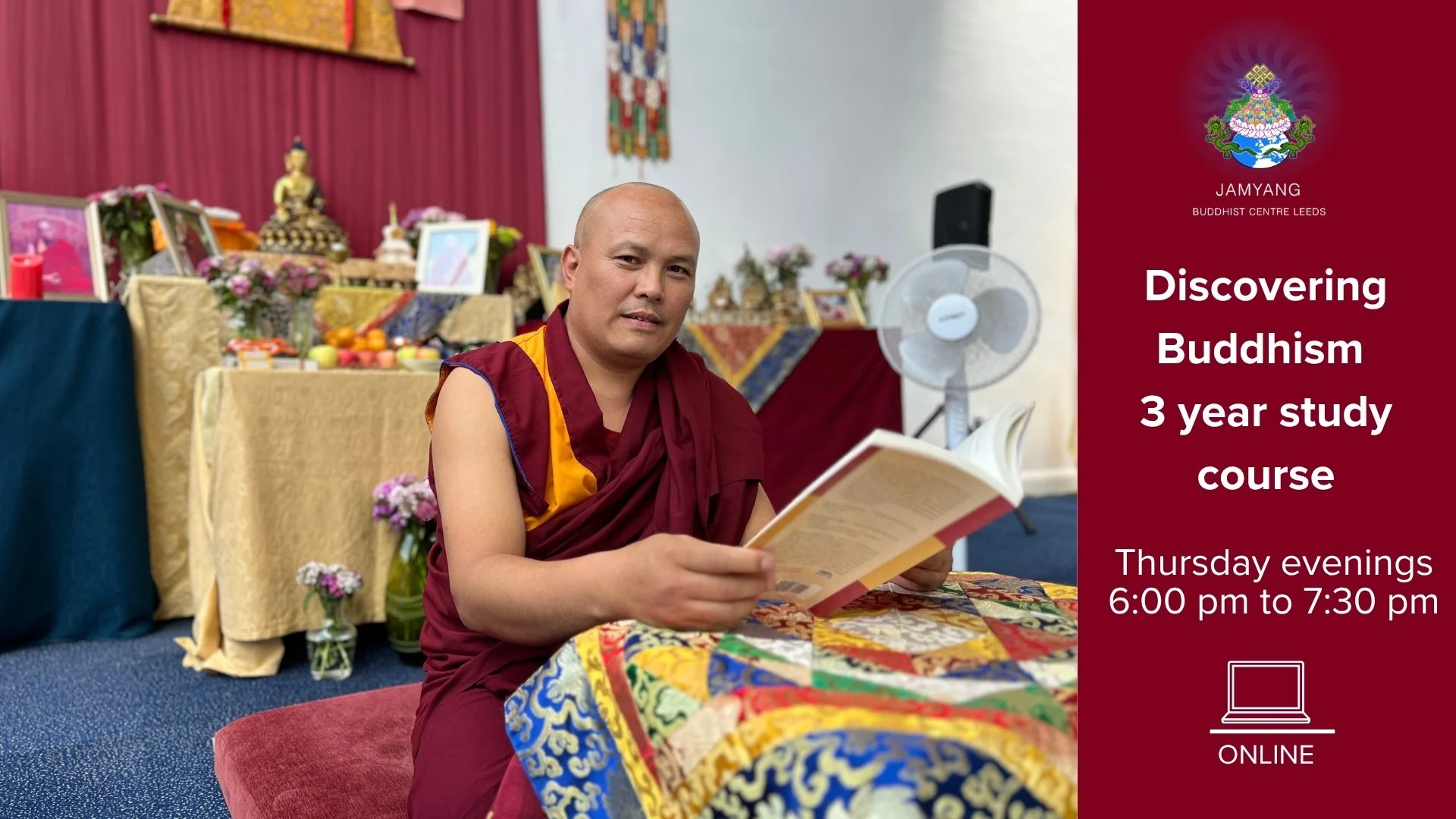
Overview of Programme
DATE: 2026: 15th October, 22nd October, 29th October, (no class on the 5th Nov) 12th November, 19th November, 26th November and Meditation day Sunday 29th November
TIME: Thursday’s weekly 6:30 pm to 8:30 pm
LOCATION: Online
LEVEL: The course is suitable for both beginners and intermediate students, providing a structured approach to Buddhist study.
What to Expect in This Module: How to meditate
Under the guidance of Geshe Rinchen you will learn the definition and purpose of meditation, how to sit, how to set up a meditation session, different meditation techniques, and how to deal with obstacles to meditation.
Through:
Introductory Meditations
Explanatory Teachings - Understand the Foundations and Special features of Meditation.
Reflection and Discussion - Consider how this practice relates to the rest of the path and your own practice.
Supportive Environment - Learn and share with like-minded practitioners, supported by the wisdom and guidance of Geshe Rinchen.
Integration Guidance - Learn ways to connect these Meditation methods with your lamrim meditation and daily spiritual growth.
This module concludes with a Day of Meditation on Sunday, 29th November, offering time for deeper reflection and integration of the teachings.
Suitable for both new and experienced students ready to delve into the inspiring methods that turn life’s challenges into opportunities for growth, compassion, and wisdom
Awakening the limitless potential of your mind, achieving all peace and happiness
Discovering Buddhism is a beginner to intermediate level, 2 year study programme that will give you a solid foundation in the teachings and practice of Tibetan Mahayana Buddhism. The Mind & its Potential is the 1st Module.
This course was designed by Lama Zopa Rinpoche for students to study, explore and put into practice the graduated path to enlightenment, the lamrim. Originally based on Buddha Shakyamuni’s teachings from 2500 years ago in India. The lamrim was systematically organised by the Indian master Atisha in the 11th Century and by several other great masters from Tibet including Lama Tsongkhapa in the 15th Century.
Our resident teacher Geshe Rinchen Wangyal (Geshe La) will be teaching this module. This is an excellent opportunity to receive these Lamrim teachings directly from Geshe La. We are indeed most fortunate to be able to do so.
This course commences August 2026 and runs for just over 2 years during term time on Thursday evenings online for 90 minutes and has 14 subjects, 13 of which are usually taught over 6 weeks. It is possible to join at any time during the course.
We warmly invite you to join us for this enriching journey with Geshe Rinchen. Together, let us explore how to bring the timeless wisdom of Buddhism into our everyday lives.
Please register for Discovering Buddhism here. For more information contact our course coordinator, Ruth: db@jamyangleeds.co.uk
ABOUT YOUR Teacher: Geshe Rinchen Wangyal
Geshe Rinchen studied at Drepung Losel Ling Monastery in India, then at the Institute of Buddhiust Dialectics. He gained his Geshe degree in 2015.
He then studied at the University of Winchester in the UK, gaining a BA (hons) Degree in Philosophy, Religion and Ethics in 2024
Geshe La has had articles published in The Scientific American in 2020 including 'Hygiene of the mind during the Pandemic’. He has also received awards for essay competitions at the Institute of Buddhist Dialectics.
Geshe La’s teachings are known for their clarity, warmth, and practical applicability, making profound topics accessible to students of all backgrounds. Geshe La combines his deep knowledge with genuine compassion, inspiring students to cultivate inner peace and wisdom in their own lives.
Geshe La teaches in English fluently.
You can read more about Geshe Rinchen here.
SUGGESTED DONATION:
Non-members – £72 per module for the Thursday classes (usually 6 weeks), and £32 for the meditation day at the end of each module. This will contribute to the centre’s running costs and includes a donation to the teacher.
Free to members - Members are invited to make a donation for the teacher, as is customary when receiving Buddhist teachings, in order to support their activity (for your reference we recommend a donation in the region of £20 per module and £10 per meditation day).
We never turn anyone away from the Dharma for financial reasons. If you cannot donate the suggested amount, please contact Ruth on: db@jamyangleeds.co.uk to discuss what would be affordable for you.
It’s good to practice generosity where we can.
How to Donate:
You can make a donation by card using our Donation Portal here. Please put Discovering Buddhism as a reference in the comments box
Alternatively you can donate by Bank Transfer using the details below, please reference Discovering Buddhism
Account Name: Jamyang Buddhist Centre Leeds
Bank Name: Cooperative Bank Plc
Account number: 65178087 Sort-Code: 08-92-99 SWIFT: CPBK GB22 IBAN: GB76 CPBK 0892 9965 1780 87
Gift Aid: if you are a UK taxpayer we can claim back 25p for every £1 you donate. Please indicate when registering if you would like us to claim gift aid on your donations.
Shamatha – Meditation on the Breath
Overview of Session
DATE: Fridays
TIME: 7am-7:30am
LOCATION: Zoom
LEVEL: All Welcome
SUGGESTED DONATION: £4
Led by Ruth
Mindfulness of Breathing is universally acknowledged to be of benefit to all living in the modern world. Many feel overloaded with all that is expected of us living this complex and exhausting existence. Developing our awareness in this way is a general prescription for soothing and healing the overworked body and mind.
Practicing focusing the attention on an object such as the breath is also a core practice in Tibetan Buddhism. Gradually over time we are able to hold the object of our attention over longer periods, which enables us to practice other meditations such as Vipassana more successfully.
White Umbrella Deity practice
Overview of practice
DATE: Fridays
TIME: 11:30 am to 12:00 pm
LOCATION: Please note this is online only
LEVEL: Buddhist Practices – see note below
SUGGESTED DONATION: £4
In September 2024, His Eminence Ling Rinpoche gave us this practice to overcome obstacles to the centre flourishing.
In addition to many benefits of engaging in these practices, Lama Zopa Rinpoche recommended that these two practices are beneficial to helping bring peace to situation between Israel and Palestine.
The Sanskrit name for the White Umbrella deity is Ushnisha Sitatapatra which can also be translated as “The Victorious White Parasol.” The White Umbrella Deity, [Skt. Sitatapatra, Tib. gdugs dkar] is a powerful female deity. She is relied upon for protection; healing illness; dispelling interferences, spirit possession, and harmful forces; quelling disasters; averting obstacles; and bringing auspiciousness.
Ushnisha Sitatapatra is a female form of Avalokiteshvara, the Bodhisattva of Compassion. Like this Bodhisattva in an elaborate form, she also has a thousand eyes that watch over living beings, and a thousand arms that protect and assist them. Thus she symbolizes the power of active compassion.
Practices of Arya Sitatapatra includes, “The Supreme Accomplishment of Sitatapatra,” and “Praises and Repelling Practices of Sitatapatra.”
Sound Bath with Charlotte
Overview of Session
DATE: Fridays 16th January; 20th February; 20th March; 17th April; 15th May; 19th June 2026, 10th July, 14th August, 18th September, 16th October, 20th November
TIME: 7pm-8pm
LOCATION: In-person
LEVEL: Wellbeing – All levels
COST: £17
Sound Baths offer a grounding space to slow down, breathe and let the body soften. Each session invites you to settle into stillness as the waves, frequencies and gentle vibrations move through you, supporting deep rest and release. No experience needed — simply arrive in comfortable clothing and get cosy!
Charlotte’s musical journey began at an early age, exploring and playing multiple instruments. This passion led her to the wonderful path of Sound Therapy, which began here at the Jamyang Buddhist Centre - a beautiful whole circle!
In Tibetan, Jamyang འཇམ་དབྱངས།་ means sweet sound, melody, gentle voice. so it has a very beautiful resonance with sound baths. Jamyang is also associated with the name of Manjushri the Buddha of Wisdom.
As a Sound Therapist, Charlotte holds space with care and intention, ensuring every session feels welcoming and deeply connected. Her love for nature naturally infuses her work, creating experiences that are grounding, restorative, and deeply relaxing. The energy, frequencies and vibrations of the earth come alive through the enchanting rumbles of the gong. Charlotte is honoured to support others’ wellbeing and share the transformative power of sound.
Registration essential. Please register using this link https://www.tickettailor.com/events/soundwaveswithcharlotte
£17 per session. Pay by card on registration or cash on the day.
Medicine Buddha Puja

Overview of Medicine Buddha Puja
Medicine Buddha is one of the practices recommended by the FPMT for students to do for the swift return of Kyabje Lama Zopa Rinpoche.
DATE: FRIDAYS
TIME: 7 pm to 8:15 pm
LOCATION: Zoom
LEVEL: Buddhist Practices – All Welcome
SUGGESTED DONATION: £6
This is a longer meditation on Medicine Buddha – to remove obstacles, esp. those relating to health and achieving a favourable rebirth, and activate a swift path to enlightenment.
As Lama Zopa Rinpoche said: “One of the best healing meditations is that on the Medicine Buddha, who is the manifestation of the healing energy of all enlightened beings.”
The puja involves chanting prayers to the Seven Medicine Buddhas and reciting the Medicine Buddha mantras.
It is kindly led by Sande
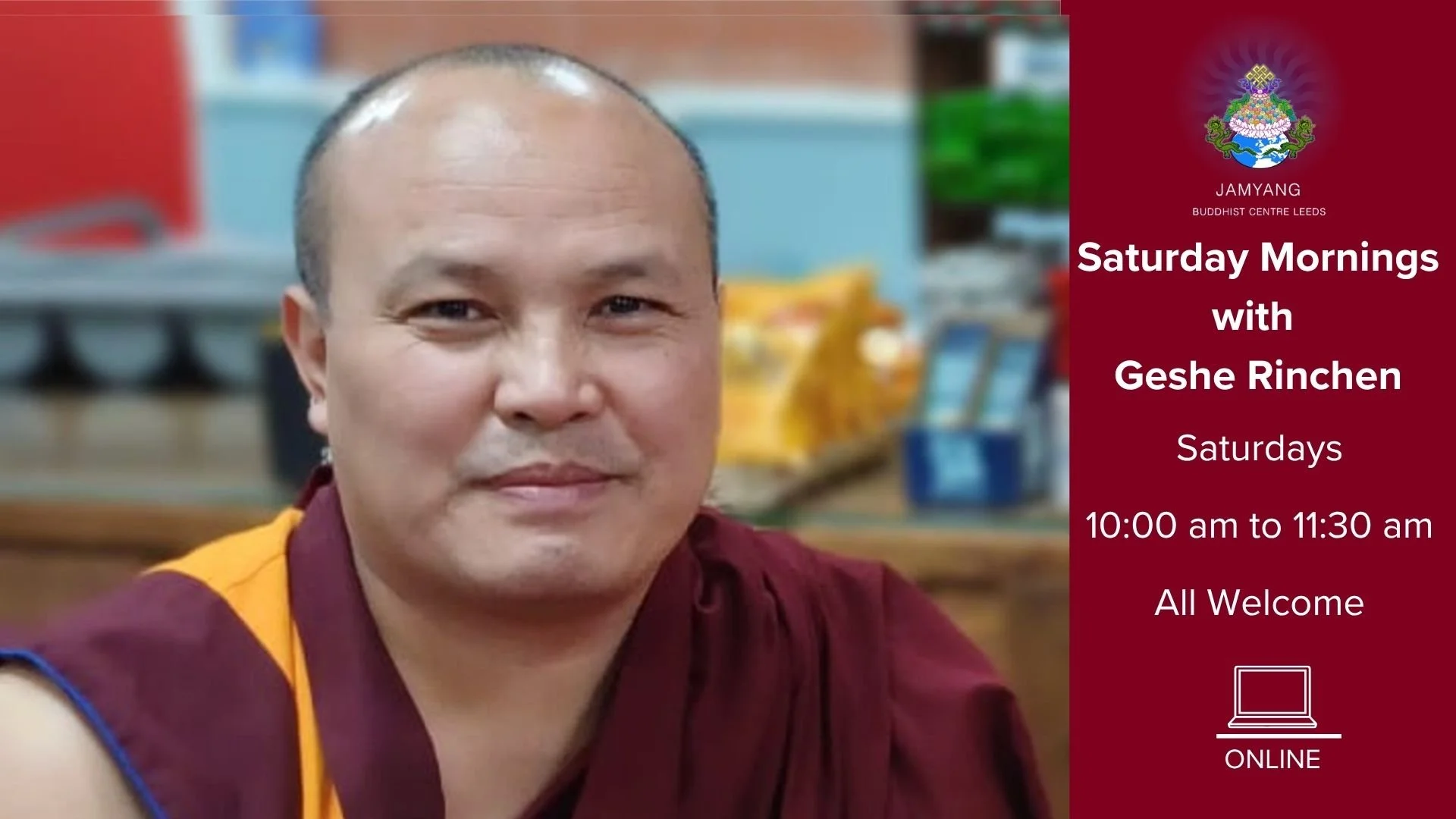
Saturday Mornings with Geshe Rinchen
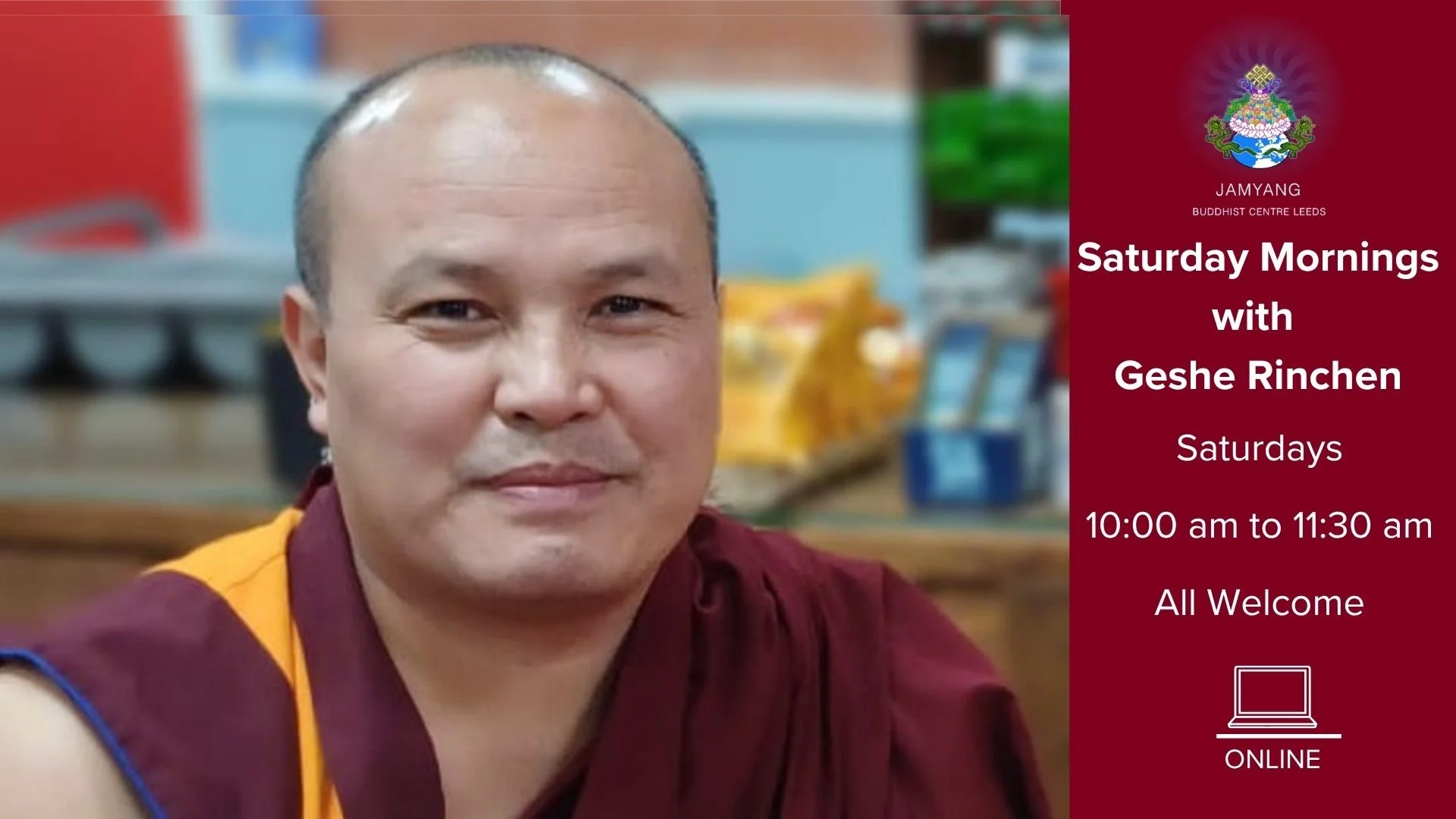
Overview of Programme
DATES: Saturdays weekly 4th July to 28th November
TIME: 10:00 am to 11:30 am
LOCATION: Online
LEVEL: Everyone interested in exploring Buddhism, from beginners to intermediate.
Saturday Mornings with Geshe Rinchen:
Are you curious about Buddhism and want to know more, or perhaps you already have some understanding but would like to expand on your knowledge. If so this Saturday morning class with Geshe Rinchen (Geshe La) is ideal for you. Designed as a drop in class with a different topic each week, covering key concepts in Buddhism and how they can make a real difference in our lives. Such as how we can deepen our connection with others, and how we can live our lives in the present moment. This is a great opportunity to spend time with Geshe La and ask questions.
Online drop in class – no need to register.
SUGGESTED DONATION FOR DROP IN CLASS:
Non-members – £12 per drop in class. This will contribute to the centre’s running costs and include a donation to the teacher.
Gift Aid: if you are a UK taxpayer we can claim back 25p for every £1 you donate. More information on Gift Aid can be found here.
Free to members of The Jamyang Buddhist Centre Leeds (your membership fees already contribute to our core costs in running the centre). You are invited to make a donation for the teacher, as is customary when receiving Buddhist teachings, in order to support their activity. For your reference we recommend a donation in the region of £4 per class. We will make the donation to the teacher on your behalf.
We never turn anyone away from the Dharma for financial reasons. If you cannot donate the suggested amount, please donate where possible within your means. It’s good to practice generosity where we can.
ABOUT YOUR Teacher: Geshe Rinchen Wangyal
Geshe Rinchen has dedicated his life to the study and practice of the Buddha’s teachings. He completed rigorous training in Buddhist philosophy, debate, and meditation, achieving the esteemed title of Geshe, the doctorate degree in the Tibetan Buddhist tradition.
His teachings are known for their clarity, warmth, and practical applicability, making profound topics accessible to students of all backgrounds.
Currently resident teacher at Jamyang Buddhist Centre Leeds, Geshe Rinchen combines his deep knowledge with genuine compassion, inspiring students to cultivate inner peace and wisdom in their own lives.
SESSION RESOURCES:
About this series:
July 2026
4 July – What did the Buddha Discover?
11 July – Buddha Nature – the Seed of Enlightenment
18 July – Understanding the Mind and Mental Factors
25 July – The Story of Milarepa: Transformation and Enlightenment
August 2026
1 August – The Four Noble Truths: An overview
8 August – Understanding Suffering
15 August – The Causes: Karma and Afflictive Emotions
22 August – The End of Suffering: What is Possible?
29 August – The Path: A Practical Way Forward
September 2026
5 September - Calm Abiding (Samatha)
12 September - Insightful Meditation (Vipassana)
19 September - the Mind of Awakening (Bodhicitta)
26 September – The Wisdom of Emptiness
October 2026
3 October – The Two Accumulations: Merit and Wisdom
10 October – Offering to the Three Jewels
17 October – Circumambulation Practice
24 October – Prostration Practice
31 October – Reciting Mantras and Their Benefits
November 2026
7 November – Introduction to Visualisation Practice
14 November – Medicine Buddha Practice
21 November – Tara Practice
28 November – Establishing Daily Practices
Who This Course Is For:
This is a wonderful opportunity to hear Geshe La teach each weekend online and to ask him questions.
These topics have been carefully selected for beginners,
They are also very suitable for all students of Buddhism to refresh and expand on their understanding.
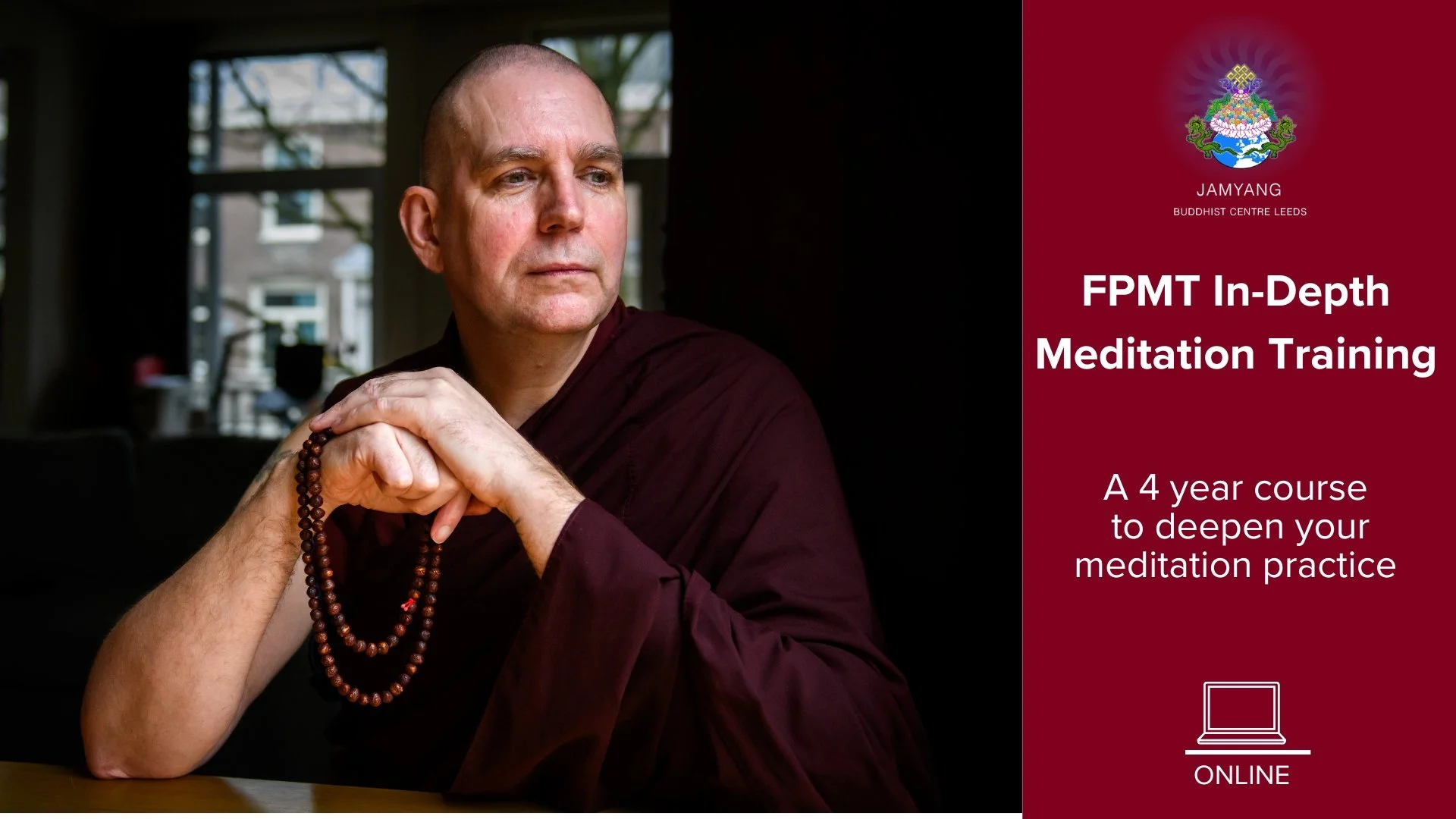
FPMT In-Depth Meditation Training
Overview of SESSION
DATE: 2026 / 2027: Year 4
Term 1: September 5th to November 28th 2026
If you are starting as a new student in year 4, don’t worry. You will get some preparatory advice on what previous recordings to have a listen to. Alternatively you may wish to join the new Ngondro Lamrim Meditation course for 2 years before starting In Depth Meditation Training. They are designed to be complementary.
TIME: Saturdays weekly 2:30pm – 5pm UK time
LOCATION: Zoom only
LEVEL: Buddhist Meditation – Intermediate to Advanced
IDMT Year Four, The Vajra Ground: Mahamudra and Kriya Tantra
In this culminating fourth year of our journey, our path turns inward to the mind itself—its empty, luminous nature—and outward to the transformative methods of tantra, where the naturally pure nature of our perception is recognized as the very ground of awakening.
As always, the year will start with generating the mind of awakening, using evocative instructions ranging from Langri Thangpa to Nāgārjuna and Lord Buddha in the famous Bodhisattvapiṭaka. This mind generation we'll cultivate through the four immeasurable thoughts and the support of calm abiding.
Illuminated by the life stories of the masters of the Gelug Mahāmudrā lineage and beyond, we'll explore its roots in the history of the early Indian Mahāsiddhas, such as Saraha and Tilopa, through the Kagyü master Gampopa's and Je Tsongkhapa's Mañjuśrī lineage up to Paṇchen Losang Chökyi Gyaltsen's Highway of the Conquerors and its perspective on this practice. In Sūtra Mahāmudrā we will practice resting attention in the empty nature of awareness, recognizing its clarity and openness as inseparable.
Kriyā Tantra offers a complementary method. Rather than suppress the ordinary, narrow self-narrative that we impose on ourselves and our world, it substitutes for it an extraordinary perspective of pure view. Occasionally, by way of introduction, we'll also taste practices from the higher tantras—glimpsing how afflictive emotions can be met as innate wisdom, and how the dissolution of the death process opens onto the innate mind of clear light. The structured practices of generation and recitation become a rehearsal for transformation, training perception to meet appearances as pure.
These methods rest on a relationship. We will therefore examine the practice of guru devotion candidly—both as the means by which the lineage's realization is transmitted and as a practice with real pitfalls, requiring discernment as much as trust. Through the Ganden Lha Gyāma, the Yoga of the inseparability of guru and Avalokiteśvara, and supporting sādhanas, devotion is approached not as deference but as the ethical road toward the state of Vajradhara: the full integration of wisdom and method.
This final year is an invitation to let realization ripen into a way of being. Grounded in bodhicitta and the four immeasurables, sustained by the preliminary practices, and held by the strength of community, we learn to meet the mind without grasping and to meet the world as pure appearance. Our aim is not to accumulate practices, but to bring the path to maturity—wisdom and compassion no longer cultivated separately, but lived as one.
This four-year online course provides students with long term, in-depth support in their meditative development.
The teacher and course developer is Venerable Losang Gendun. He has trained extensively in meditation in both Theravada and Mahayana Traditions
The In Depth Meditation Training course is also part of The Buddha Project led by Venerable Losang Gendun. You can find out more about Venerable Gendun, the course and who it is suitable for on our FPMT In-Depth Meditation Training webpage
If you have any questions you would like to ask before registering please email our In-Depth Meditation Coordinator Marie Odile on idmt@jamyangleeds.co.uk
The zoom link and all materials for the course are provided to registered students.
Donations:
Generosity is one of the cornerstones of the Buddhist path. With your donation we support The Buddha Project and we keep our centre going for the benefit of all sentient beings.
As the course is a collaboration with other FPMT centres it is not possible to offer this as part of our Jamyang Leeds membership programme.
The recommended donation per calendar month is £45.
If you are able to practice generosity and sponsor other students we recommend £58 per calendar month.
If you are on a reduced income it is £31 per calendar month.
There is also the option to donate annually.
If none of the above options are affordable please do still register, we never turn anyone away from the Dharma for financial reasons and we can agree a donation that is affordable for you right now. Please email Marie Odile our IDMT Coordinator idmt@jamyangleeds.co.uk if you would like to chat.
A Mindful Heart - Sunday Community Meditation
overview of sunday Community Meditation
DATE & TIME: Sunday 10:30-11:30
LOCATION: In-person at the centre
LEVEL: Meditation – All Welcome
SUGGESTED DONATION: Generosity model - please donate as you feel affordable and as generously as is manageable
Discover your best self every Sunday morning
Are you keen to work on your well-being and connect with others trying to make their life a little better for themselves and those around them? Join our uplifting Sunday Community Meditation Sessions.
Each hour-long gathering begins with a soothing meditation to calm your mind, followed by an inspiring discussion on a way of being such as interconnection, that enriches your everyday life. We then dive into a focused meditation designed to help you embrace that way of being fully.
Wrap up your morning with a cup of tea and friendly conversation in a welcoming, relaxed atmosphere. Absolutely everyone welcome.
Meet us every Sunday at 10:30 AM and start your week feeling refreshed, connected, and inspired. Your journey to a happier, more mindful life begins here!
Cost: Generosity Model: Pay as you feel.
From September 2026 to February 2027 we will focus on ‘A Mindful Heart’.
Inspired by the Creating Compassionate Cultures program (“CCC”) by Pam Cayton, and developed by the Foundation for Developing Compassion and Wisdom. Grounded in three core pathways of learning: Knowledge, Strength, and Compassion. These pathways guide you towards a happier, more meaningful life by fostering inner growth and a warmer connection with others.
Designed to help you develop a deeper understanding of how the mind works. The aim is to gradually let go of destructive patterns of thought and behaviour while cultivating a healthy sense of self-confidence and a deep, compassionate connection with others.
You are invited to reflect on your attitudes, perceptions, and emotional patterns. By exploring the workings of our own minds and the nature of our interdependence with others and the world around us, we begin to see how deeply connected our inner and outer realities truly are. We examine both logical and scientific perspectives on the nature of the self and our relationships with others.
To deepen the learning, you are encouraged to reflect between sessions, pausing to notice your inner experiences and reconnect with your deepest values. This supports the integration of insights and ways to act with greater mindfulness and wisdom.
Ultimately, the transformation we foster in ourselves contributes to building more compassionate cultures. How can one person influence a whole culture? The answer lies in understanding interdependence. Every action we take, every choice, interaction, and intention, affects others and the broader environment, this principle of cause and effect lies at the heart of all life, reminding us that our individual transformation ripples outward in meaningful ways.
The Creating Compassionate Cultures programme has 7 steps:
Mindful Intention
Interconnection
Change
Perception
Transforming harmful emotions
Empathy
Compassion
Session overview:
Welcome, Introduction and Motivation 5 mins
Settling Meditation 10 mins
Meditation topic introduced then participants briefly share their experience 15 mins
Guided meditation 15 mins
Feedback from participants 10 mins
Closing and Dedication 5 mins
September 2026
6th and 13th: The Pursuit of Happiness
20th and 27th: Understanding how things exist
October 2026:
4th and 11th: Developing Healthy Self Confidence
18th and 25th: Compassion - Opening the heart
November 2026:
1st and 8th: Mindfulness, reflection and critical thinking
15th and 22nd: Mindful intention - what do I really want
29th: Interconnection (week 1)
December 2026:
6th: Interconnection (week 2)
13th and 20th: Embracing Change
January 2027:
10th and 17th: Perception
24th and 31st Transforming harmful emotions
February 2027:
7th and 14th: Empathy
21st and 28th: Cultivating Compassion
Vipassana Meditation
Overview of Vipassana Meditation
Join us for a peaceful start to your week with a 30 minute Vipassana meditation session, designed to cultivate mindfulness, self-awareness, and equanimity. Led by Geshe Rinchen
DATE: Mondays weekly (March to May and July to November)
TIME: 7:00 am to 7:30 am
Vipassana (Special Insight Meditation), also called analytical meditation, is primarily a practice of wisdom. It is a form of concentration that focuses single-pointedly on the ultimate nature of phenomena through analytical reasoning. Analysing phenomena is a key aspect of Vipassana practice, as it helps develop a definitive understanding of the nature of reality—such as the self, mind, emotions, and thoughts.
As Je Tsongkhapa explains, shamatha (calm abiding) is like a lamp that remains clear and steady in a place without wind, whereas vipassana (special insight) is like seeing the nature of phenomena clearly through such a steady and clear lamp. Therefore, the usual order of these two meditations is: first, achieving calm abiding or mental stability as a foundation, then engaging in special insight meditation through analysis. However, Vipassana meditation can also be practised by analysing and observing sensations, thoughts, and emotions without first achieving shamatha. This practice should still begin with focusing on the breath or another object of meditation. In our case, we will focus on the breath to start analysing the nature of the mind in relation to our sense of self, emotions, and thoughts.
The session begins by focusing on the breath—either the rise and fall of the abdomen or the sensation of air entering and leaving the nostrils. This practice calms the mind and helps establish a deep sense of presence.
Next, we move into a guided body scan, bringing awareness to different parts of the body and observing subtle sensations without judgement. This helps develop a greater connection to your physical experience.
As we proceed, you will practise observing and analysing sensations, thoughts, and emotions as they arise, learning to witness them without attachment or aversion. This fosters a deeper understanding of the impermanence and interconnectedness of the mind and self. Finally, you will rest your mind either in the natural state of awareness or in the analytical clarity gained through observation and reasoning.
Through regular practice, Vipassana meditation cultivates wisdom, encouraging a balanced and objective view of internal experiences. This session is ideal for those seeking greater insight and calmness in their daily lives.
Morning Prayers
Overview
Start the day by joining us for Morning Prayers recommended by Lama Zopa Rinpoche and HH Dalai Lama, for the benefit of all sentient beings and the swift return of Lama Zopa Rinpoche. Everyone is welcome.
DATE: Monday – Friday all year around
TIME: 8:30am - 9:00am
LOCATION: Zoom
LEVEL: Buddhist Practices – All Welcome
FPMT Ngondro Lamrim Training
Overview of SESSION
DATE: 2026 / 2027: Year 1
Term 1: September 14th to November 28th 2026
Over a period of two years, the FPMT Ngöndro Lamrim Training (NLRT) offers 16 months of training in the common and uncommon preliminary practices. The training is designed to generate the motivation that supports the development of calm abiding, special insight, and tantra. By cultivating the inner qualities needed to ease unskillful patterns of mind that are the cause of hindrances on the path, it facilitates deep transformation.
An excellent preparation for the FPMT In-Depth Meditation Training (IDMT)
LOCATION: Recordings are released weekly
LEVEL: Buddhist Preliminary Practices
About the Course:
The Lamrim — "Stages of the Path" in Tibetan — is a systematic presentation of the entire Buddhist path to Awakening, written by the great Tibetan master Je Tsongkhapa in the 14th and early 15th century, based on writings of the Indian master Atisha. It arranges every essential teaching of the Buddha into a single, coherent, graduated sequence tailored to your mind, exactly as it is right now. Its true power lies not in study alone, but in practice. Each teaching is carefully arranged to meet the mind where it is and guide it—step by step—toward genuine change.
The uncommon preliminary practices (ngöndro) are powerful methods to purify the mind and prepare it for lasting transformation.
Over the first eleven months the common foundations, renunciation, bodhicitta, and the view of emptiness, are explored based on the Lamrim. For the remaining five months the focus is on the uncommon practices, Vajrasattva purification, mandala offerings, and guru yoga. Weekly sessions each introduce a new topic that examines different ways to meditate and why, in combination with a guided meditation.
The training helps establish a consistent daily meditative practice in supports of its overall aim: to engage in contemplative meditation in a way that genuinely transforms the mind's outlook on the world and gives one's life a new direction. Students gain a deep understanding of how to accumulate merit and purify unskillful karma while cultivating a healthy relationship with the Three Jewels and their teacher. The emphasis is on learning to meditate in a personally tailored way, in accordance with one’s psychological makeup and life conditions.
The Ngondro Lamrim Training teaching sessions are pre-recorded.
Each week, a 90-minute teaching together with two guided meditations are uploaded. On other days, advanced students contribute additional guided meditations. The teacher, Venerable Gendun, offers regular online Q&A sessions. For those who have already studied the Lamrim or the FPMT Basic Program, the training also offers specialized opportunities to learn how to guide others in meditation.
Year 1: Definite Emergence and Mind of Awakening
Prepare the mind for śamatha, vipaśyanā, and tantra
Explore renunciation and bodhicitta, the first two Principles of the Path
Develop genuine urgency through Lamrim contemplation
Cultivate the aspiration to Awakening for all beings
FPMT Ngondro Lamrim Taining is also part of The Buddha Project led by Venerable Losang Gendun. You can find out more about Venerable Gendun, the course and who it is suitable for on our FPMT Ngondro Lamrim Training webpage
If you have any questions you would like to ask before registering please email our In-Depth Meditation Coordinator Marie Odile on idmt@jamyangleeds.co.uk
All materials for the course are provided to registered students.
Donations:
Generosity is one of the cornerstones of the Buddhist path. Donations help support both the centre and The Buddha Project as well as providing a donation for the teachings to Venerable Gendun. There are different levels depending on your income. There are three terms a year, each approximately 3 months long
As the course is a collaboration with other FPMT centres it is not possible to offer this as part of our Jamyang Leeds membership programme.
For those with a regular income the recommended donation is £95 per term
The sponsorhsip level is £115 per term
Ordained Sangha are free
If this isn’t affordable please do register, we never turn anyone away from the Dharma for financial reasons and we can agree a donation that is affordable for you at the current time. Please email Marie-Odile our IDMT Coordinator idmt@jamyangleeds.co.uk if you would like to chat.
Lunchtime Meditation
Overview
Make the most of your lunchtime with a guided meditation session to help calm your mind. These secular meditation sessions are a great way to relax and create some space for reflection in the middle of your day.
DATE: Monday- Friday
TIME: 12:30pm-1pm
LOCATION: Online all week and In person Tuesday and Friday
LEVEL: Wellbeing Programme – All levels
Yamantaka Practice Group
Overview of SESSION
This is a restricted practice, for those who have received the empowerment to practice Solitary Hero Vajrabhairava/Yamantaka.
If you have an interest in joining the group please email yamantakagroup@gmail.com to register.
The Yamantaka practice is held on the Mondays weekly. Please note that some weeks it starts at 2:30pm and some at 6pm it doesn’t always alternate weekly.
Tonglen Loving Kindness meditation Practice
Overview of Tonglen Meditation
The Buddhist practice of Giving & Taking (Tonglen in Tibetan) is at its heart a selfless meditation of loving kindness and compassion.
DATE: Tuesdays
TIME: 7am-7:30am
LOCATION: Zoom
LEVEL: Buddhist Meditation – All Welcome
SUGGESTED DONATION: £4
A beautiful practice led by Chrissie and Di.
The Buddhist practice of Giving & Taking (Tonglen in Tibetan) is at its heart a selfless meditation of loving kindness and compassion. You imagine giving all your happiness to others, sometimes using visualisation with the breath, and then taking all the suffering and its causes from others. It’s a powerful practice for the brave-hearted!
Kshitigarbha Practice
Overview of Kshitigarbha practice
DATE: Tuesdays & Thursdays
TIME: 12pm-12:30pm
LOCATION: Zoom only
LEVEL: Buddhist Practices – All Welcome
SUGGESTED DONATION: £4
Lama Zopa Rinpoche (our organisation’s Spiritual Director) suggested Jamyang Leeds perform these practices to help with the financial obstacles we are currently having. From September 2022, we’ll be reciting this practice as much as we can. See the special newsletter explaining all about the practice here.
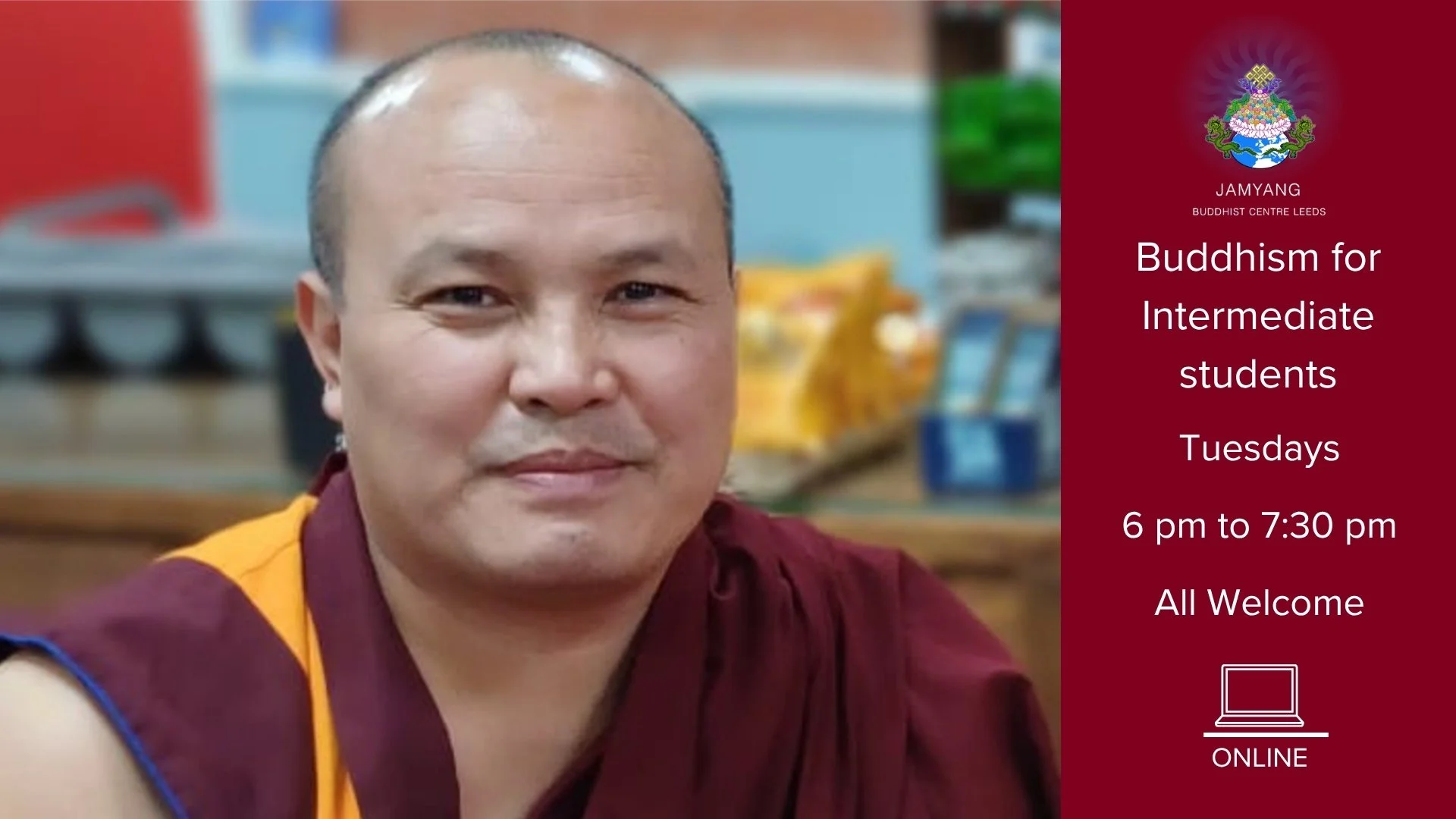
Buddhism for Intermediate Students
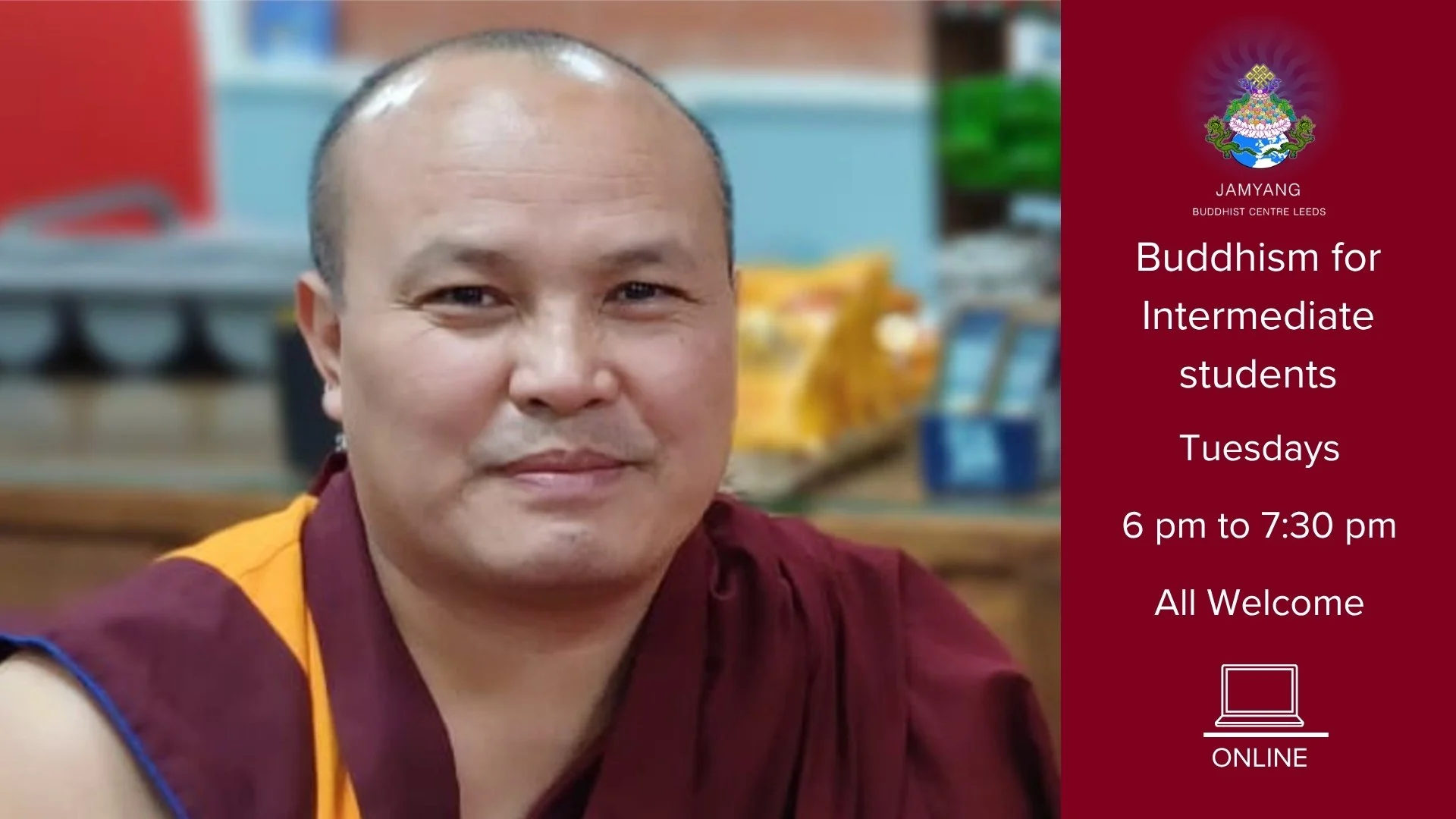
Overview of Programme
DATES: Weekly sessions 7th July to 24th November
TIME: Tuesday weekly 6:00 pm to 7:30 pm
LOCATION: Online
LEVEL: Intermediate students of Buddhism and those interested in Buddhist philosophy
Buddhism for Intermediate students:
This series of teachings aims to provide a comprehensive understanding of key Buddhist texts and practices, offering both theoretical knowledge and practical guidance for those interested in deepening their spiritual practice. Each monthly session is carefully designed to build a holistic understanding of Buddhist philosophy and meditative practices.
This series of sessions will focus upon the key text: Illuminating the Intent: An Exposition of Chandrakirti’s Entering the Middle Way.
Online drop in class – no need to register.
SUGGESTED DONATION FOR DROP IN CLASS:
Non-members – £12 per drop in class. This will contribute to the centre’s running costs and include a donation to the teacher.
Gift Aid: if you are a UK taxpayer we can claim back 25p for every £1 you donate. More information on Gift Aid can be found here.
Free to members of The Jamyang Buddhist Centre Leeds (your membership fees already contribute to our core costs in running the centre). You are invited to make a donation for the teacher, as is customary when receiving Buddhist teachings, in order to support their activity. For your reference we recommend a donation in the region of £4 per class. We will make the donation to the teacher on your behalf.
We never turn anyone away from the Dharma for financial reasons. If you cannot donate the suggested amount, please donate where possible within your means. It’s good to practice generosity where we can.
ABOUT YOUR Teacher: Geshe Rinchen Wangyal
Geshe Rinchen has dedicated his life to the study and practice of the Buddha’s teachings. He completed rigorous training in Buddhist philosophy, debate, and meditation, achieving the esteemed title of Geshe, the doctorate degree in the Tibetan Buddhist tradition.
His teachings are known for their clarity, warmth, and practical applicability, making profound topics accessible to students of all backgrounds.
Currently resident teacher at Jamyang Buddhist Centre Leeds, Geshe Rinchen combines his deep knowledge with genuine compassion, inspiring students to cultivate inner peace and wisdom in their own lives.
SESSION RESOURCES:
About this series:
The great Tsongkhapa wrote three profound texts on Madhyamika philosophy and practice:
The Essence of True Eloquence,
Ocean of Reasoning,
Illuminating the Intent.
Illuminating the Intent is one of these masterpieces, completed shortly before he passed into parinirvana. It is perhaps the most profound text ever written by a Tibetan scholar on Madhyamika philosophy and practice, guiding readers to both understand emptiness intellectually and apply its insights in daily life.
Nagarjuna composed the Fundamental Wisdom of the Middle Way, on which Chandrakirti later wrote his commentary, Entering the Middle Way. Since Chandrakirti’s work consists only of verses, Je Tsongkhapa composed a detailed commentary, making Illuminating the Intent an essential guide for understanding Nagarjuna’s root text. The primary theme of these texts is emptiness—what it is and how to practise it effectively.
Why This Text Matters:
Je Tsongkhapa’s text is invaluable for anyone seeking to understand reality, the self, the nature of the mind, life, the root causes of suffering, and consciousness. Studying it helps uncover practical methods to overcome suffering, find meaning in life, and apply these teachings in daily living.
About the Great Tsongkhapa:
The great Tsongkhapa (1357–1419) was a true genius in interpreting and practising Mahayana teachings as laid down by the ancient Indian Nalanda masters. He founded the Geluk tradition of Tibetan Buddhism, which emphasises both rigorous intellectual analysis and practical application of the Buddha’s teachings, following the approach of the Nalanda masters.
Who This Course Is For:
This course is suitable for both practitioners and academics, as well as anyone with a keen interest in Madhyamika philosophy and the practice of emptiness. In class, we will engage with the text through reading and giving explanation page by page following the Tibetan monastic educational tradition. At times, we will also participate in monastic-style debate to clarify the meaning and implications of the text. This approach allows participants to explore the material both intellectually and practically.
Vajrasattva Practice
Overview of The Vajrasattva Practice
DATE: Tuesdays
TIME: 8:00pm-8:30pm
LOCATION: Zoom
LEVEL: Buddhist Practices – All Welcome
SUGGESTED DONATION: £4
Purification here means looking at our past unskillful actions which have created seeds of negative karma in our minds, and using visualisation and mantra recitation to remove those seeds in a healthy and productive way. Vajrasattva is the embodiment of all the Buddha’s cleaning and purifying energy. We all make mistakes, and how we deal with them is key to making spiritual progress. We’ll be using a short text composed by Lama Zopa Rinpoche
the eight verses of thoughts transformation
Overview of the eight verses of thoughts transformation
Everflowing Nectar of Bodhichitta – Annihilating the Demon of the Self-Cherishing Mind
DATE: Wednesdays
TIME: 7am-7:30am
LOCATION: Zoom
LEVEL: Buddhist Practices- All Welcome
SUGGESTED DONATION: £4
Everflowing Nectar of Bodhichitta – Annihilating the Demon of the Self-Cherishing Mind
Led by Di or Sande
This practice is based on the short text” Eight Verses of Thought Transformation”, which contains the entire technique for transforming the mind into relative bodhichitta (i.e., the wish to achieve enlightenment for the benefit of all sentient beings) and absolute bodhichitta (i.e., the wisdom realizing emptiness).
Chanting the Verses of Noble manjushri
Overview of Session
DATE: Thursdays
TIME: 7:45am to 8:25 am
LOCATION: Zoom only
LEVEL: Buddhist Practices – suitable for Lama Zopa Rinpoche’s students
Join us to fulfill His Holiness the Dalai Lama’s wishes and chant the Names of Noble Manjushri for the swift return of Lama Zopa Rinpoche.
Please come along even if you havent done the practice before, its quite wonderful and very energising. Please download the text below, you can also listen and practice with the audio clip of Lama Zopa Rinpoche reciting the Chanting the Names of Noble Manjushri.
Kshitigarbha Practice
Overview of Kshitigarbha practice
DATE: Tuesdays & Thursdays
TIME: 12pm-12:30pm
LOCATION: Zoom only
LEVEL: Buddhist Practices – All Welcome
SUGGESTED DONATION: £4
Lama Zopa Rinpoche (our organisation’s Spiritual Director) suggested Jamyang Leeds perform these practices to help with the financial obstacles we are currently having. From September 2022, we’ll be reciting this practice as much as we can. See the special newsletter explaining all about the practice here.
Kalachakra Practice group
Overview of practice
This is a restricted group for those who have received the Kalachakra empowerment from a qualified Lama. To join the group you need to have either received the full Kalachakra empowerment or another High Yoga Tantra empowerment such as Heruka, as long as you have received a Kalachakra Jenang (permission).
This international group of Kalachakra practitioners meets weekly and alternates with commentary and practice.
Mind Mandala once a month and six session guru yoga for other sessions:
If you’re already part of this group, please use the details sent in the weekly email to join the practice
If you’d like to join us, please email spc@jamyangleeds.co.uk confirming that you have the appropriate empowerments. You will then be sent a registration form to complete.
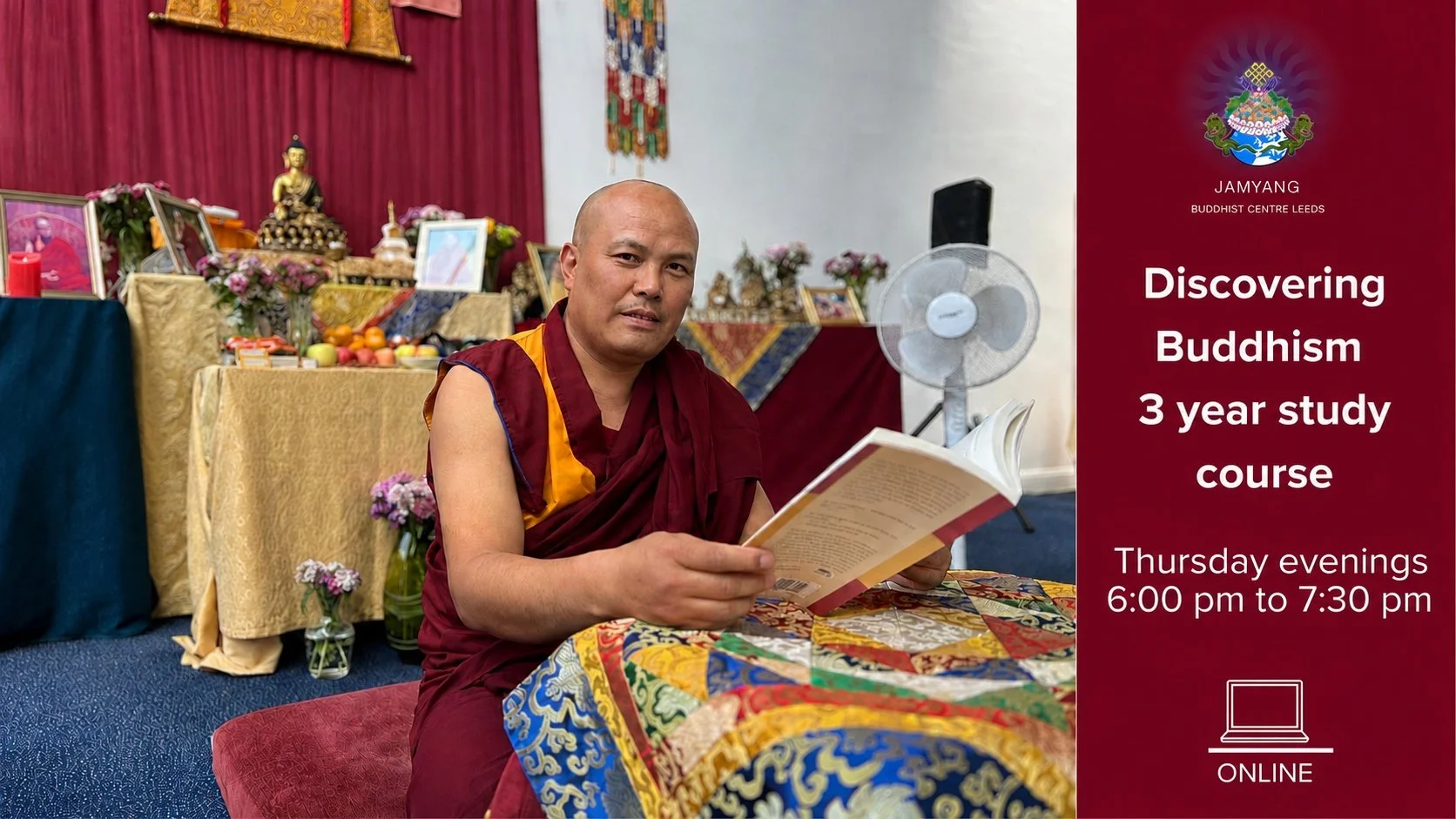
Discovering Buddhism: how to meditate
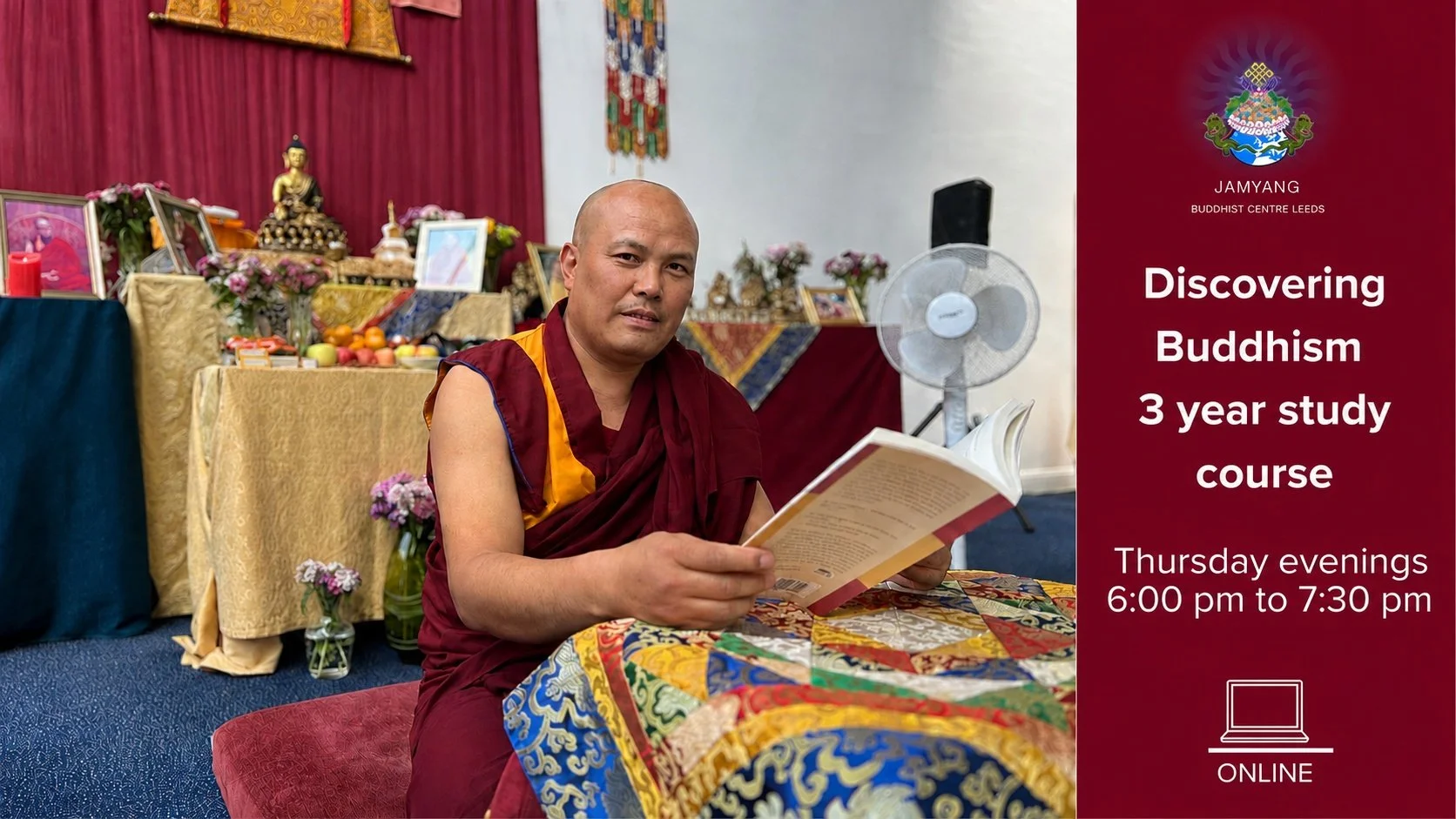
Overview of Programme
DATE: 2026: 15th October, 22nd October, 29th October, (no class on the 5th Nov) 12th November, 19th November, 26th November and Meditation day Sunday 29th November
TIME: Thursday’s weekly 6:00 pm to 7:30 pm
LOCATION: Online
LEVEL: The course is suitable for both beginners and intermediate students, providing a structured approach to Buddhist study.
What to Expect in This Module: How to meditate
Under the guidance of Geshe Rinchen you will learn the definition and purpose of meditation, how to sit, how to set up a meditation session, different meditation techniques, and how to deal with obstacles to meditation.
Through:
Introductory Meditations
Explanatory Teachings - Understand the Foundations and Special features of Meditation.
Reflection and Discussion - Consider how this practice relates to the rest of the path and your own practice.
Supportive Environment - Learn and share with like-minded practitioners, supported by the wisdom and guidance of Geshe Rinchen.
Integration Guidance - Learn ways to connect these Meditation methods with your lamrim meditation and daily spiritual growth.
This module concludes with an online Day of Meditation on Sunday, 29th November, offering time for deeper reflection and integration of the teachings.
Suitable for both new and experienced students ready to delve into the inspiring methods that turn life’s challenges into opportunities for growth, compassion, and wisdom
Awakening the limitless potential of your mind, achieving all peace and happiness
Discovering Buddhism is a beginner to intermediate level, 2 year study programme that will give you a solid foundation in the teachings and practice of Tibetan Mahayana Buddhism. The Mind & its Potential is the 1st Module.
This course was designed by Lama Zopa Rinpoche for students to study, explore and put into practice the graduated path to enlightenment, the lamrim. Originally based on Buddha Shakyamuni’s teachings from 2500 years ago in India. The lamrim was systematically organised by the Indian master Atisha in the 11th Century and by several other great masters from Tibet including Lama Tsongkhapa in the 15th Century.
Our resident teacher Geshe Rinchen Wangyal (Geshe La) will be teaching this module. This is an excellent opportunity to receive these Lamrim teachings directly from Geshe La. We are indeed most fortunate to be able to do so.
This course commences August 2026 and runs for just over 2 years during term time on Thursday evenings online for 90 minutes and has 14 subjects, 13 of which are usually taught over 6 weeks. It is possible to join at any time during the course.
We warmly invite you to join us for this enriching journey with Geshe Rinchen. Together, let us explore how to bring the timeless wisdom of Buddhism into our everyday lives.
Please register for Discovering Buddhism here. For more information contact our course coordinator, Ruth: db@jamyangleeds.co.uk
ABOUT YOUR Teacher: Geshe Rinchen Wangyal
Geshe Rinchen studied at Drepung Losel Ling Monastery in India, then at the Institute of Buddhiust Dialectics. He gained his Geshe degree in 2015.
He then studied at the University of Winchester in the UK, gaining a BA (hons) Degree in Philosophy, Religion and Ethics in 2024
Geshe La has had articles published in The Scientific American in 2020 including 'Hygiene of the mind during the Pandemic’. He has also received awards for essay competitions at the Institute of Buddhist Dialectics.
Geshe La’s teachings are known for their clarity, warmth, and practical applicability, making profound topics accessible to students of all backgrounds. Geshe La combines his deep knowledge with genuine compassion, inspiring students to cultivate inner peace and wisdom in their own lives.
Geshe La teaches in English fluently.
You can read more about Geshe Rinchen here.
SUGGESTED DONATION:
Non-members – £72 per module for the Thursday classes (usually 6 weeks), and £32 for the meditation day at the end of each module. This will contribute to the centre’s running costs and includes a donation to the teacher.
Free to members - Members are invited to make a donation for the teacher, as is customary when receiving Buddhist teachings, in order to support their activity (for your reference we recommend a donation in the region of £20 per module and £10 per meditation day).
We never turn anyone away from the Dharma for financial reasons. If you cannot donate the suggested amount, please contact Ruth on: db@jamyangleeds.co.uk to discuss what would be affordable for you.
It’s good to practice generosity where we can.
How to Donate:
You can make a donation by card using our Donation Portal here. Please put Discovering Buddhism as a reference in the comments box
Alternatively you can donate by Bank Transfer using the details below, please reference Discovering Buddhism
Account Name: Jamyang Buddhist Centre Leeds
Bank Name: Cooperative Bank Plc
Account number: 65178087 Sort-Code: 08-92-99 SWIFT: CPBK GB22 IBAN: GB76 CPBK 0892 9965 1780 87
Gift Aid: if you are a UK taxpayer we can claim back 25p for every £1 you donate. Please indicate when registering if you would like us to claim gift aid on your donations.
Shamatha – Meditation on the Breath
Overview of Session
DATE: Fridays
TIME: 7am-7:30am
LOCATION: Zoom
LEVEL: All Welcome
SUGGESTED DONATION: £4
Led by Ruth
Mindfulness of Breathing is universally acknowledged to be of benefit to all living in the modern world. Many feel overloaded with all that is expected of us living this complex and exhausting existence. Developing our awareness in this way is a general prescription for soothing and healing the overworked body and mind.
Practicing focusing the attention on an object such as the breath is also a core practice in Tibetan Buddhism. Gradually over time we are able to hold the object of our attention over longer periods, which enables us to practice other meditations such as Vipassana more successfully.
White Umbrella Deity practice
Overview of practice
DATE: Fridays
TIME: 11:30 am to 12:00 pm
LOCATION: Please note this is online only
LEVEL: Buddhist Practices – see note below
SUGGESTED DONATION: £4
In September 2024, His Eminence Ling Rinpoche gave us this practice to overcome obstacles to the centre flourishing.
In addition to many benefits of engaging in these practices, Lama Zopa Rinpoche recommended that these two practices are beneficial to helping bring peace to situation between Israel and Palestine.
The Sanskrit name for the White Umbrella deity is Ushnisha Sitatapatra which can also be translated as “The Victorious White Parasol.” The White Umbrella Deity, [Skt. Sitatapatra, Tib. gdugs dkar] is a powerful female deity. She is relied upon for protection; healing illness; dispelling interferences, spirit possession, and harmful forces; quelling disasters; averting obstacles; and bringing auspiciousness.
Ushnisha Sitatapatra is a female form of Avalokiteshvara, the Bodhisattva of Compassion. Like this Bodhisattva in an elaborate form, she also has a thousand eyes that watch over living beings, and a thousand arms that protect and assist them. Thus she symbolizes the power of active compassion.
Practices of Arya Sitatapatra includes, “The Supreme Accomplishment of Sitatapatra,” and “Praises and Repelling Practices of Sitatapatra.”
Medicine Buddha Puja
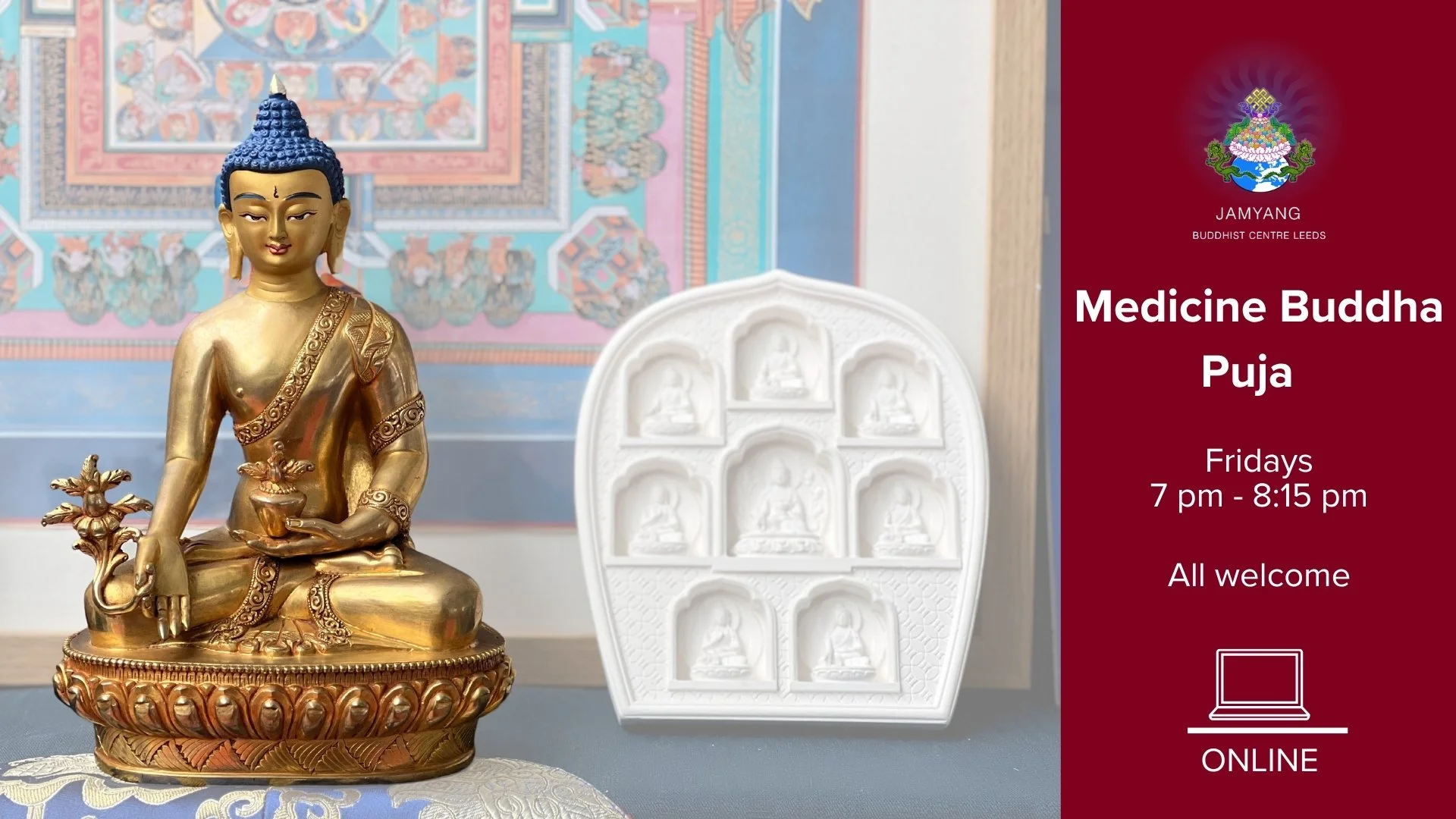
Overview of Medicine Buddha Puja
Medicine Buddha is one of the practices recommended by the FPMT for students to do for the swift return of Kyabje Lama Zopa Rinpoche.
DATE: FRIDAYS
TIME: 7 pm to 8:15 pm
LOCATION: Zoom
LEVEL: Buddhist Practices – All Welcome
SUGGESTED DONATION: £6
This is a longer meditation on Medicine Buddha – to remove obstacles, esp. those relating to health and achieving a favourable rebirth, and activate a swift path to enlightenment.
As Lama Zopa Rinpoche said: “One of the best healing meditations is that on the Medicine Buddha, who is the manifestation of the healing energy of all enlightened beings.”
The puja involves chanting prayers to the Seven Medicine Buddhas and reciting the Medicine Buddha mantras.
It is kindly led by Sande

HOLBECK JUMBLE SALE
JUMBLE TIMINGS:
DATE: Saturday 28th November
TIME: 10:00am to 12:30pm
LOCATION: In the Hall
FREE ENTRY
Holbeck Jumble Sale – Fundraising Event at Jamyang Buddhist Centre Leeds
FREE ENTRY | EVERYTHING £1 OR LESS!
Join us for our next fundraising jumble sale—a lively community event filled with bargains, good vibes, and a great cause!
Whether you're hunting for books, clothes, homewares, toys, or a surprise treasure, there’s something for everyone—and every item is priced at just £1 or less. You’ll be supporting the ongoing activities of Jamyang Buddhist Centre, helping us continue to offer teachings, meditation sessions, and community support in Holbeck and beyond.
Why come along?
Fantastic finds at unbeatable prices
Friendly community atmosphere
Support a meaningful cause
A great way to reduce, reuse, and recycle
Donations are very welcome!
If you have good-quality items you’d like to contribute to our shop or jumble sale, please drop them off at the centre during opening hours in the lead-up to the sale—or contact us to arrange a time. Your generosity goes a long way.
Don’t miss this much-loved event—it’s always a busy one!
Spread the word, bring a friend, and we’ll see you there!
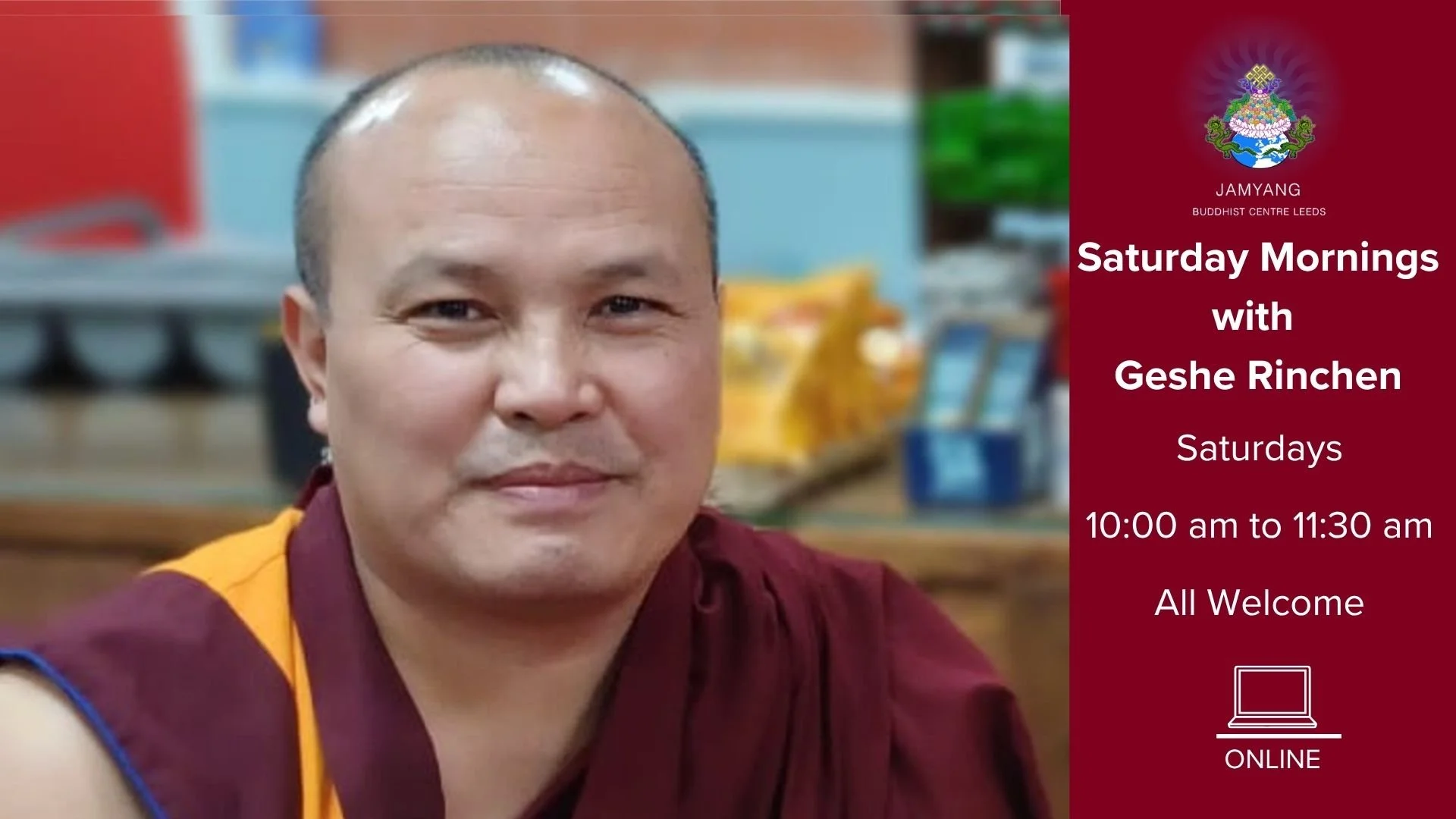
Saturday Mornings with Geshe Rinchen
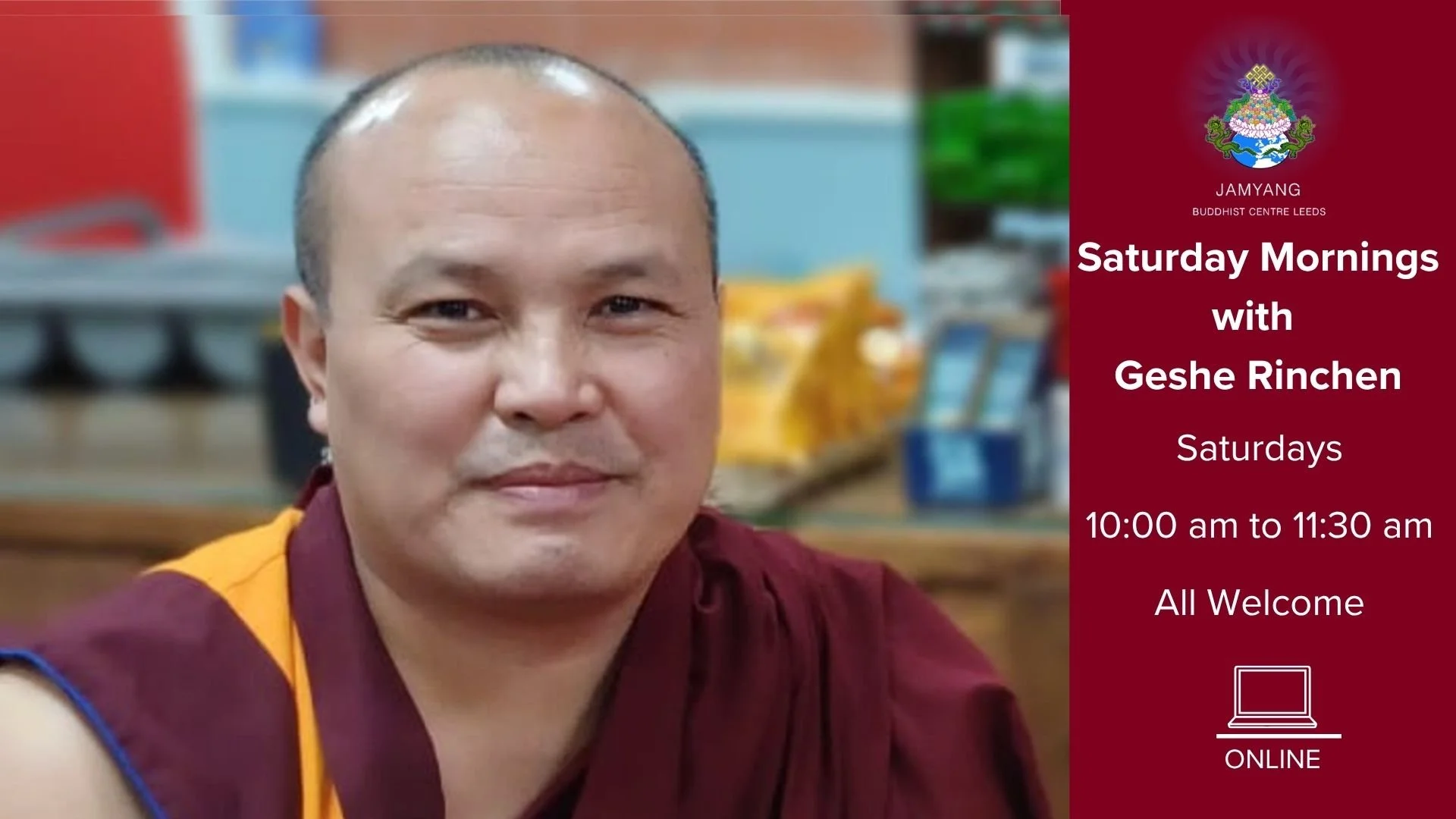
Overview of Programme
DATES: Saturdays weekly 4th July to 28th November
TIME: 10:00 am to 11:30 am
LOCATION: Online
LEVEL: Everyone interested in exploring Buddhism, from beginners to intermediate.
Saturday Mornings with Geshe Rinchen:
Are you curious about Buddhism and want to know more, or perhaps you already have some understanding but would like to expand on your knowledge. If so this Saturday morning class with Geshe Rinchen (Geshe La) is ideal for you. Designed as a drop in class with a different topic each week, covering key concepts in Buddhism and how they can make a real difference in our lives. Such as how we can deepen our connection with others, and how we can live our lives in the present moment. This is a great opportunity to spend time with Geshe La and ask questions.
Online drop in class – no need to register.
SUGGESTED DONATION FOR DROP IN CLASS:
Non-members – £12 per drop in class. This will contribute to the centre’s running costs and include a donation to the teacher.
Gift Aid: if you are a UK taxpayer we can claim back 25p for every £1 you donate. More information on Gift Aid can be found here.
Free to members of The Jamyang Buddhist Centre Leeds (your membership fees already contribute to our core costs in running the centre). You are invited to make a donation for the teacher, as is customary when receiving Buddhist teachings, in order to support their activity. For your reference we recommend a donation in the region of £4 per class. We will make the donation to the teacher on your behalf.
We never turn anyone away from the Dharma for financial reasons. If you cannot donate the suggested amount, please donate where possible within your means. It’s good to practice generosity where we can.
ABOUT YOUR Teacher: Geshe Rinchen Wangyal
Geshe Rinchen has dedicated his life to the study and practice of the Buddha’s teachings. He completed rigorous training in Buddhist philosophy, debate, and meditation, achieving the esteemed title of Geshe, the doctorate degree in the Tibetan Buddhist tradition.
His teachings are known for their clarity, warmth, and practical applicability, making profound topics accessible to students of all backgrounds.
Currently resident teacher at Jamyang Buddhist Centre Leeds, Geshe Rinchen combines his deep knowledge with genuine compassion, inspiring students to cultivate inner peace and wisdom in their own lives.
SESSION RESOURCES:
About this series:
July 2026
4 July – What did the Buddha Discover?
11 July – Buddha Nature – the Seed of Enlightenment
18 July – Understanding the Mind and Mental Factors
25 July – The Story of Milarepa: Transformation and Enlightenment
August 2026
1 August – The Four Noble Truths: An overview
8 August – Understanding Suffering
15 August – The Causes: Karma and Afflictive Emotions
22 August – The End of Suffering: What is Possible?
29 August – The Path: A Practical Way Forward
September 2026
5 September - Calm Abiding (Samatha)
12 September - Insightful Meditation (Vipassana)
19 September - the Mind of Awakening (Bodhicitta)
26 September – The Wisdom of Emptiness
October 2026
3 October – The Two Accumulations: Merit and Wisdom
10 October – Offering to the Three Jewels
17 October – Circumambulation Practice
24 October – Prostration Practice
31 October – Reciting Mantras and Their Benefits
November 2026
7 November – Introduction to Visualisation Practice
14 November – Medicine Buddha Practice
21 November – Tara Practice
28 November – Establishing Daily Practices
Who This Course Is For:
This is a wonderful opportunity to hear Geshe La teach each weekend online and to ask him questions.
These topics have been carefully selected for beginners,
They are also very suitable for all students of Buddhism to refresh and expand on their understanding.
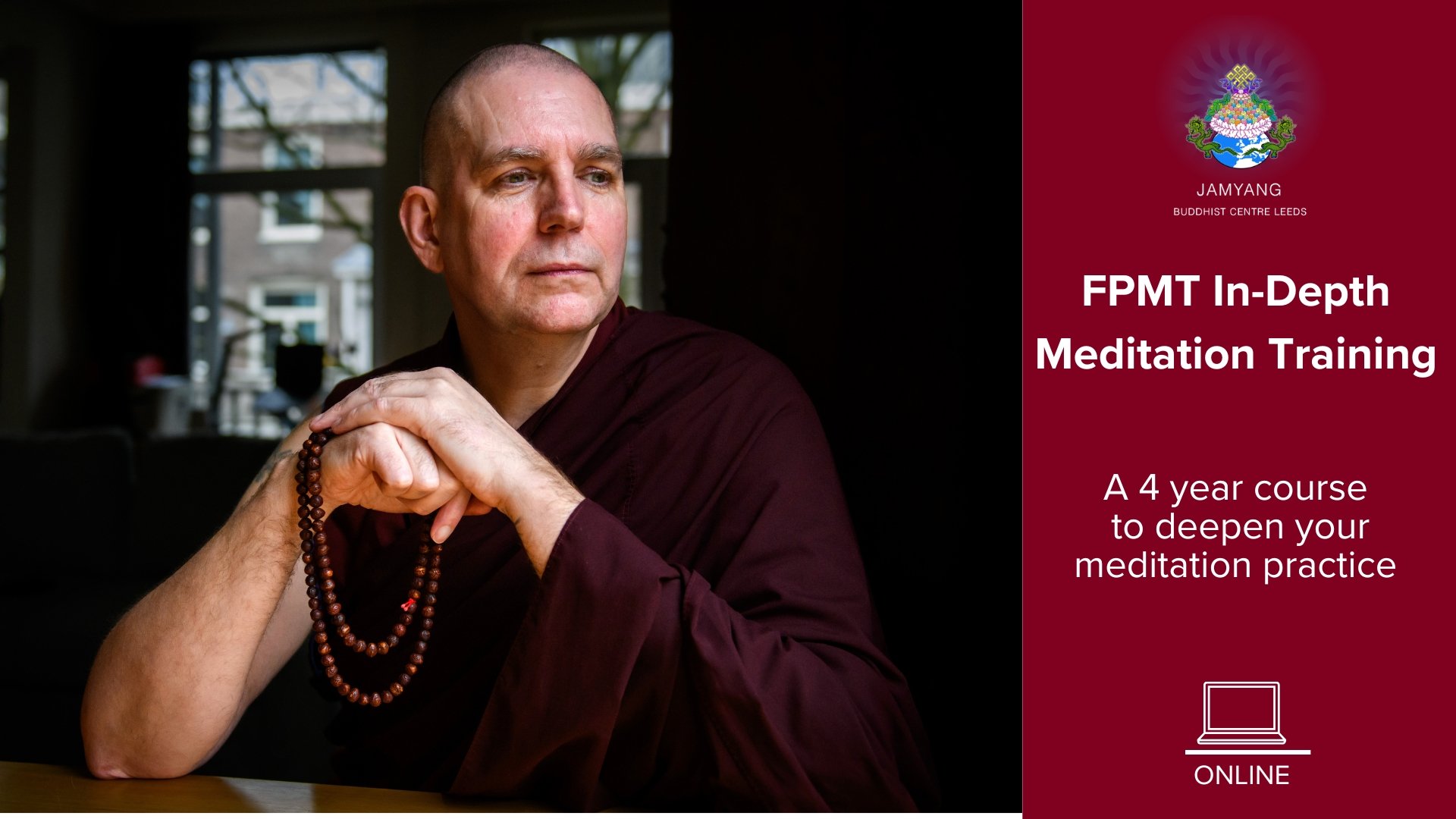
FPMT In-Depth Meditation Training
Overview of SESSION
DATE: 2026 / 2027: Year 4
Term 1: September 5th to November 28th 2026
If you are starting as a new student in year 4, don’t worry. You will get some preparatory advice on what previous recordings to have a listen to. Alternatively you may wish to join the new Ngondro Lamrim Meditation course for 2 years before starting In Depth Meditation Training. They are designed to be complementary.
TIME: Saturdays weekly 2:30pm – 5pm UK time
LOCATION: Zoom only
LEVEL: Buddhist Meditation – Intermediate to Advanced
IDMT Year Four, The Vajra Ground: Mahamudra and Kriya Tantra
In this culminating fourth year of our journey, our path turns inward to the mind itself—its empty, luminous nature—and outward to the transformative methods of tantra, where the naturally pure nature of our perception is recognized as the very ground of awakening.
As always, the year will start with generating the mind of awakening, using evocative instructions ranging from Langri Thangpa to Nāgārjuna and Lord Buddha in the famous Bodhisattvapiṭaka. This mind generation we'll cultivate through the four immeasurable thoughts and the support of calm abiding.
Illuminated by the life stories of the masters of the Gelug Mahāmudrā lineage and beyond, we'll explore its roots in the history of the early Indian Mahāsiddhas, such as Saraha and Tilopa, through the Kagyü master Gampopa's and Je Tsongkhapa's Mañjuśrī lineage up to Paṇchen Losang Chökyi Gyaltsen's Highway of the Conquerors and its perspective on this practice. In Sūtra Mahāmudrā we will practice resting attention in the empty nature of awareness, recognizing its clarity and openness as inseparable.
Kriyā Tantra offers a complementary method. Rather than suppress the ordinary, narrow self-narrative that we impose on ourselves and our world, it substitutes for it an extraordinary perspective of pure view. Occasionally, by way of introduction, we'll also taste practices from the higher tantras—glimpsing how afflictive emotions can be met as innate wisdom, and how the dissolution of the death process opens onto the innate mind of clear light. The structured practices of generation and recitation become a rehearsal for transformation, training perception to meet appearances as pure.
These methods rest on a relationship. We will therefore examine the practice of guru devotion candidly—both as the means by which the lineage's realization is transmitted and as a practice with real pitfalls, requiring discernment as much as trust. Through the Ganden Lha Gyāma, the Yoga of the inseparability of guru and Avalokiteśvara, and supporting sādhanas, devotion is approached not as deference but as the ethical road toward the state of Vajradhara: the full integration of wisdom and method.
This final year is an invitation to let realization ripen into a way of being. Grounded in bodhicitta and the four immeasurables, sustained by the preliminary practices, and held by the strength of community, we learn to meet the mind without grasping and to meet the world as pure appearance. Our aim is not to accumulate practices, but to bring the path to maturity—wisdom and compassion no longer cultivated separately, but lived as one.
This four-year online course provides students with long term, in-depth support in their meditative development.
The teacher and course developer is Venerable Losang Gendun. He has trained extensively in meditation in both Theravada and Mahayana Traditions
The In Depth Meditation Training course is also part of The Buddha Project led by Venerable Losang Gendun. You can find out more about Venerable Gendun, the course and who it is suitable for on our FPMT In-Depth Meditation Training webpage
If you have any questions you would like to ask before registering please email our In-Depth Meditation Coordinator Marie Odile on idmt@jamyangleeds.co.uk
The zoom link and all materials for the course are provided to registered students.
Donations:
Generosity is one of the cornerstones of the Buddhist path. With your donation we support The Buddha Project and we keep our centre going for the benefit of all sentient beings.
As the course is a collaboration with other FPMT centres it is not possible to offer this as part of our Jamyang Leeds membership programme.
The recommended donation per calendar month is £45.
If you are able to practice generosity and sponsor other students we recommend £58 per calendar month.
If you are on a reduced income it is £31 per calendar month.
There is also the option to donate annually.
If none of the above options are affordable please do still register, we never turn anyone away from the Dharma for financial reasons and we can agree a donation that is affordable for you right now. Please email Marie Odile our IDMT Coordinator idmt@jamyangleeds.co.uk if you would like to chat.
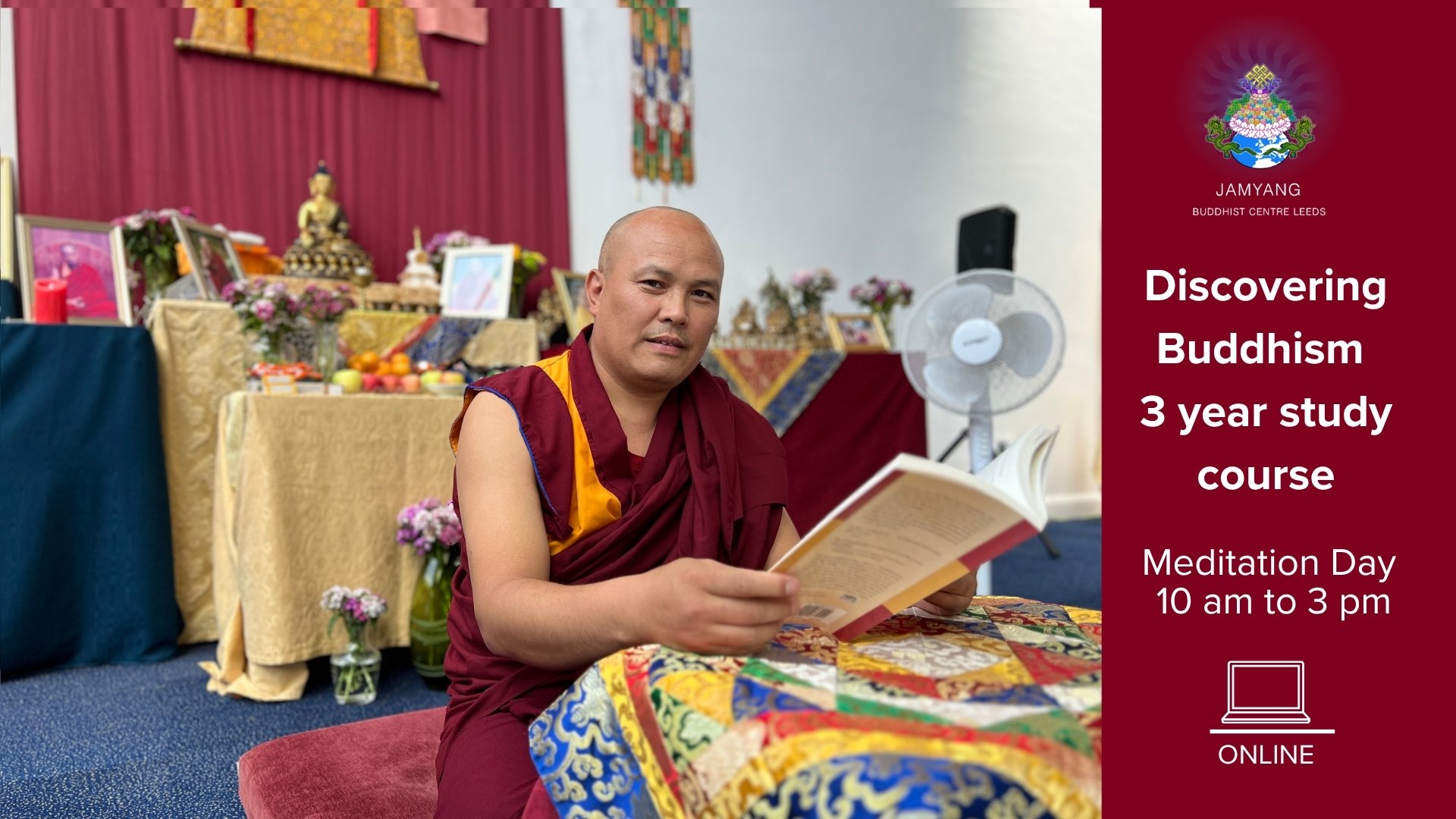
Discovering Buddhism: Meditation Day
Overview of Programme
DATE: 2026: Sunday 29th November 2026
TIME: 10 am to 3 pm
LOCATION: Meditation Day is online only
LEVEL: This FPMT study course is suitable for both beginners and intermediate students, providing a structured approach to Buddhist study.
What to Expect in This Module : how to meditate
This module concludes with an online Day of Meditation on Sunday, 29th November, offering time for deeper reflection and integration of the teachings.
Under the guidance of Geshe Rinchen you will learn the definition and purpose of meditation, how to sit, how to set up a meditation session, different meditation techniques, and how to deal with obstacles to meditation.
Through:
Introductory Meditations
Explanatory Teachings - Understand the Foundations and Special features of Meditation.
Reflection and Discussion - Consider how this practice relates to the rest of the path and your own practice.
Supportive Environment - Learn and share with like-minded practitioners, supported by the wisdom and guidance of Geshe Rinchen.
Integration Guidance - Learn ways to connect these Meditation methods with your lamrim meditation and daily spiritual growth.
Suitable for both new and experienced students ready to delve into the inspiring methods that turn life’s challenges into opportunities for growth, compassion, and wisdom
Discovering Buddhism is a beginner to intermediate level, 3 year FPMT study course that will give you a solid foundation in the teachings and practice of Tibetan Mahayana Buddhism.
This course was designed by Lama Zopa Rinpoche for students to study, explore and put into practice the graduated path to enlightenment, the lamrim. Originally based on Buddha Shakyamuni’s teachings from 2500 years ago in India. The lamrim was systematically organised by the Indian master Atisha in the 11th Century and by several other great masters from Tibet including Lama Tsongkhapa in the 15th Century.
Our resident teacher Geshe Rinchen Wangyal (Geshe La) will be teaching this module. This is an excellent opportunity to receive these Lamrim teachings directly from Geshe La. We are indeed most fortunate to be able to do so.
This course commences August 2026 and runs for 3 years on Thursday evenings online for 90 minutes and has 14 subjects, 13 of which are usually taught over 6 weeks. The course runs during March, April, May, July, August, September, October and November. There are no classes in January, February, June and December.
It is possible to join at any time during the course.
We warmly invite you to join us for this enriching journey with Geshe Rinchen. Together, let us explore how to bring the timeless wisdom of Buddhism into our everyday lives.
Registration Form . For more information contact our Discovering Buddhsim Coordinator, Ruth: db@jamyangleeds.co.uk
ABOUT YOUR Teacher: Geshe Rinchen Wangyal
Geshe Rinchen studied at Drepung Losel Ling Monastery in India, then at the Institute of Buddhiust Dialectics. He gained his Geshe degree in 2015.
He then studied at the University of Winchester in the UK, gaining a BA (hons) Degree in Philosophy, Religion and Ethics in 2024
Geshe La has had articles published in The Scientific American in 2020 including 'Hygiene of the mind during the Pandemic’. He has also received awards for essay competitions at the Institute of Buddhist Dialectics.
Geshe La’s teachings are known for their clarity, warmth, and practical applicability, making profound topics accessible to students of all backgrounds. Geshe La combines his deep knowledge with genuine compassion, inspiring students to cultivate inner peace and wisdom in their own lives.
Geshe La teaches in English fluently.
You can read more about Geshe Rinchen here.
SUGGESTED DONATION:
Non-members – £72 per module for the Thursday classes (usually 6 weeks), and £32 for the meditation day at the end of each module. This will contribute to the centre’s running costs and include a donation to the teacher.
Free to members - Members are invited to make a donation for the teacher, as is customary when receiving Buddhist teachings, in order to support their activity (for your reference we recommend a donation in the region of £20 per module and £10 per meditation day).
We never turn anyone away from the Dharma for financial reasons. If you cannot donate the suggested amount, please contact Ruth on db@jamyang.co.uk to discuss what would be affordable for you.
It’s good to practice generosity where we can.
How to Donate:
You can make a donation by card using our Donation Portal here. Please put Discovering Buddhism as a reference in the comments box
Alternatively you can donate by Bank Transfer using the details below, please reference Discovering Buddhism
Account Name: Jamyang Buddhist Centre Leeds
Bank Name: Cooperative Bank Plc
Account number: 65178087 Sort-Code: 08-92-99 SWIFT: CPBK GB22 IBAN: GB76 CPBK 0892 9965 1780 87
Gift Aid: if you are a UK taxpayer we can claim back 25p for every £1 you donate. Please indicate when registering if you would like us to claim giftaid on your donations.
A Mindful Heart - Sunday Community Meditation
overview of sunday Community Meditation
DATE & TIME: Sunday 10:30-11:30
LOCATION: In-person at the centre
LEVEL: Meditation – All Welcome
SUGGESTED DONATION: Generosity model - please donate as you feel affordable and as generously as is manageable
Discover your best self every Sunday morning
Are you keen to work on your well-being and connect with others trying to make their life a little better for themselves and those around them? Join our uplifting Sunday Community Meditation Sessions.
Each hour-long gathering begins with a soothing meditation to calm your mind, followed by an inspiring discussion on a way of being such as interconnection, that enriches your everyday life. We then dive into a focused meditation designed to help you embrace that way of being fully.
Wrap up your morning with a cup of tea and friendly conversation in a welcoming, relaxed atmosphere. Absolutely everyone welcome.
Meet us every Sunday at 10:30 AM and start your week feeling refreshed, connected, and inspired. Your journey to a happier, more mindful life begins here!
Cost: Generosity Model: Pay as you feel.
From September 2026 to February 2027 we will focus on ‘A Mindful Heart’.
Inspired by the Creating Compassionate Cultures program (“CCC”) by Pam Cayton, and developed by the Foundation for Developing Compassion and Wisdom. Grounded in three core pathways of learning: Knowledge, Strength, and Compassion. These pathways guide you towards a happier, more meaningful life by fostering inner growth and a warmer connection with others.
Designed to help you develop a deeper understanding of how the mind works. The aim is to gradually let go of destructive patterns of thought and behaviour while cultivating a healthy sense of self-confidence and a deep, compassionate connection with others.
You are invited to reflect on your attitudes, perceptions, and emotional patterns. By exploring the workings of our own minds and the nature of our interdependence with others and the world around us, we begin to see how deeply connected our inner and outer realities truly are. We examine both logical and scientific perspectives on the nature of the self and our relationships with others.
To deepen the learning, you are encouraged to reflect between sessions, pausing to notice your inner experiences and reconnect with your deepest values. This supports the integration of insights and ways to act with greater mindfulness and wisdom.
Ultimately, the transformation we foster in ourselves contributes to building more compassionate cultures. How can one person influence a whole culture? The answer lies in understanding interdependence. Every action we take, every choice, interaction, and intention, affects others and the broader environment, this principle of cause and effect lies at the heart of all life, reminding us that our individual transformation ripples outward in meaningful ways.
The Creating Compassionate Cultures programme has 7 steps:
Mindful Intention
Interconnection
Change
Perception
Transforming harmful emotions
Empathy
Compassion
Session overview:
Welcome, Introduction and Motivation 5 mins
Settling Meditation 10 mins
Meditation topic introduced then participants briefly share their experience 15 mins
Guided meditation 15 mins
Feedback from participants 10 mins
Closing and Dedication 5 mins
September 2026
6th and 13th: The Pursuit of Happiness
20th and 27th: Understanding how things exist
October 2026:
4th and 11th: Developing Healthy Self Confidence
18th and 25th: Compassion - Opening the heart
November 2026:
1st and 8th: Mindfulness, reflection and critical thinking
15th and 22nd: Mindful intention - what do I really want
29th: Interconnection (week 1)
December 2026:
6th: Interconnection (week 2)
13th and 20th: Embracing Change
January 2027:
10th and 17th: Perception
24th and 31st Transforming harmful emotions
February 2027:
7th and 14th: Empathy
21st and 28th: Cultivating Compassion
Vipassana Meditation
Overview of Vipassana Meditation
Join us for a peaceful start to your week with a 30 minute Vipassana meditation session, designed to cultivate mindfulness, self-awareness, and equanimity. Led by Geshe Rinchen
DATE: Mondays weekly (March to May and July to November)
TIME: 7:00 am to 7:30 am
Vipassana (Special Insight Meditation), also called analytical meditation, is primarily a practice of wisdom. It is a form of concentration that focuses single-pointedly on the ultimate nature of phenomena through analytical reasoning. Analysing phenomena is a key aspect of Vipassana practice, as it helps develop a definitive understanding of the nature of reality—such as the self, mind, emotions, and thoughts.
As Je Tsongkhapa explains, shamatha (calm abiding) is like a lamp that remains clear and steady in a place without wind, whereas vipassana (special insight) is like seeing the nature of phenomena clearly through such a steady and clear lamp. Therefore, the usual order of these two meditations is: first, achieving calm abiding or mental stability as a foundation, then engaging in special insight meditation through analysis. However, Vipassana meditation can also be practised by analysing and observing sensations, thoughts, and emotions without first achieving shamatha. This practice should still begin with focusing on the breath or another object of meditation. In our case, we will focus on the breath to start analysing the nature of the mind in relation to our sense of self, emotions, and thoughts.
The session begins by focusing on the breath—either the rise and fall of the abdomen or the sensation of air entering and leaving the nostrils. This practice calms the mind and helps establish a deep sense of presence.
Next, we move into a guided body scan, bringing awareness to different parts of the body and observing subtle sensations without judgement. This helps develop a greater connection to your physical experience.
As we proceed, you will practise observing and analysing sensations, thoughts, and emotions as they arise, learning to witness them without attachment or aversion. This fosters a deeper understanding of the impermanence and interconnectedness of the mind and self. Finally, you will rest your mind either in the natural state of awareness or in the analytical clarity gained through observation and reasoning.
Through regular practice, Vipassana meditation cultivates wisdom, encouraging a balanced and objective view of internal experiences. This session is ideal for those seeking greater insight and calmness in their daily lives.
Morning Prayers
Overview
Start the day by joining us for Morning Prayers recommended by Lama Zopa Rinpoche and HH Dalai Lama, for the benefit of all sentient beings and the swift return of Lama Zopa Rinpoche. Everyone is welcome.
DATE: Monday – Friday all year around
TIME: 8:30am - 9:00am
LOCATION: Zoom
LEVEL: Buddhist Practices – All Welcome
Lunchtime Meditation
Overview
Make the most of your lunchtime with a guided meditation session to help calm your mind. These secular meditation sessions are a great way to relax and create some space for reflection in the middle of your day.
DATE: Monday- Friday
TIME: 12:30pm-1pm
LOCATION: Online all week and In person Tuesday and Friday
LEVEL: Wellbeing Programme – All levels
Yamantaka Practice Group
Overview of SESSION
This is a restricted practice, for those who have received the empowerment to practice Solitary Hero Vajrabhairava/Yamantaka.
If you have an interest in joining the group please email yamantakagroup@gmail.com to register.
The Yamantaka practice is held on the Mondays weekly. Please note that some weeks it starts at 2:30pm and some at 6pm it doesn’t always alternate weekly.
Tara Puja for World Peace
Overview of Session
DATE: 2026: Last Monday monthly (break in August)
TIME: 5:45pm-6:30pm
LOCATION: Zoom
LEVEL: Buddhist Practices – All welcome
SUGGESTED DONATION: £6
Tara Puja dedicated to world peace is held on a monthly basis.
Led by Ondy Willson and translated by Venerable Tenzin into Russian for Russian and Ukrainian students
Please join us, occasionally or regularly, at 17.45 UK time to show our support for the courageous spiritual communities both in Ukraine & Russia and also in Israel and Gaza. May we all nurture compassion & peace in the face of destruction & violence.
By coming together like this we send a powerful message that comes from the depths of our being. We value peace, harmony and the enlightened qualities we aspire to embody, as generated in the 21 Taras Sadhana.
By the power of our merit may there be a non-violent and bloodless revolution of consciousness so that enlightened democracies based on social wellbeing flourish everywhere.
Please forward this invitation to anyone who you think may be interested in this free and beneficial session.
The puja will last approximately 45 minutes to include some guidance on harnessing the positive power of the prayers in generating the particular qualities of compassion and fearlessness.
Ondy Willson, a touring FPMT teacher since 2007, has students in Russia & Ukraine, so felt particularly moved to offer these pujas both to connect with & support those who are suffering on the front line. So these pujas have provided, not just an opportunity to deal with fear and pray for peace, but to meet directly together as a global community and interact with our Ukrainian and Russian dharma friends. At the end of one week’s puja, participants in Ukraine & Russia shared their stories & experiences, which was very moving for us all to hear.
Tonglen Loving Kindness meditation Practice
Overview of Tonglen Meditation
The Buddhist practice of Giving & Taking (Tonglen in Tibetan) is at its heart a selfless meditation of loving kindness and compassion.
DATE: Tuesdays
TIME: 7am-7:30am
LOCATION: Zoom
LEVEL: Buddhist Meditation – All Welcome
SUGGESTED DONATION: £4
A beautiful practice led by Chrissie and Di.
The Buddhist practice of Giving & Taking (Tonglen in Tibetan) is at its heart a selfless meditation of loving kindness and compassion. You imagine giving all your happiness to others, sometimes using visualisation with the breath, and then taking all the suffering and its causes from others. It’s a powerful practice for the brave-hearted!
Kshitigarbha Practice
Overview of Kshitigarbha practice
DATE: Tuesdays & Thursdays
TIME: 12pm-12:30pm
LOCATION: Zoom only
LEVEL: Buddhist Practices – All Welcome
SUGGESTED DONATION: £4
Lama Zopa Rinpoche (our organisation’s Spiritual Director) suggested Jamyang Leeds perform these practices to help with the financial obstacles we are currently having. From September 2022, we’ll be reciting this practice as much as we can. See the special newsletter explaining all about the practice here.
Vajrasattva Practice
Overview of The Vajrasattva Practice
DATE: Tuesdays
TIME: 8:00pm-8:30pm
LOCATION: Zoom
LEVEL: Buddhist Practices – All Welcome
SUGGESTED DONATION: £4
Purification here means looking at our past unskillful actions which have created seeds of negative karma in our minds, and using visualisation and mantra recitation to remove those seeds in a healthy and productive way. Vajrasattva is the embodiment of all the Buddha’s cleaning and purifying energy. We all make mistakes, and how we deal with them is key to making spiritual progress. We’ll be using a short text composed by Lama Zopa Rinpoche
the eight verses of thoughts transformation
Overview of the eight verses of thoughts transformation
Everflowing Nectar of Bodhichitta – Annihilating the Demon of the Self-Cherishing Mind
DATE: Wednesdays
TIME: 7am-7:30am
LOCATION: Zoom
LEVEL: Buddhist Practices- All Welcome
SUGGESTED DONATION: £4
Everflowing Nectar of Bodhichitta – Annihilating the Demon of the Self-Cherishing Mind
Led by Di or Sande
This practice is based on the short text” Eight Verses of Thought Transformation”, which contains the entire technique for transforming the mind into relative bodhichitta (i.e., the wish to achieve enlightenment for the benefit of all sentient beings) and absolute bodhichitta (i.e., the wisdom realizing emptiness).
Chanting the Verses of Noble manjushri
Overview of Session
DATE: Thursdays
TIME: 7:45am to 8:25 am
LOCATION: Zoom only
LEVEL: Buddhist Practices – suitable for Lama Zopa Rinpoche’s students
Join us to fulfill His Holiness the Dalai Lama’s wishes and chant the Names of Noble Manjushri for the swift return of Lama Zopa Rinpoche.
Please come along even if you havent done the practice before, its quite wonderful and very energising. Please download the text below, you can also listen and practice with the audio clip of Lama Zopa Rinpoche reciting the Chanting the Names of Noble Manjushri.
Lama Choepa (Guru Puja) and Tsog
Overview of Session
DATES: 2026: 13th January; 11th February; 13th March; 26th April; 12th May; 10th June; 24th July; 8th August; 21st September; 5th October; 4th November; 3rd December
TIME: 60 - 90 minute sessions, start time varies
LOCATION: In Person and Online
LEVEL: Buddhist Ceremonies – All Welcome
Dedicated to the Swift return of Lama Zopa Rinpoche as a bright, unmistaken child.
During the practice of Lama Choepa, we invoke all the lamas of the graduated path lineage, beginning with Shakyamuni Buddha himself, extending to our present direct teachers who have shown us the path. We pay homage to them, make offerings, and request each of them to please bless our minds with the same realizations that they themselves have generated. By offering sincere, heartfelt requests, we make our minds ripe to receive the full blessings of this precious lineage and quickly actualize the realizations we need to attain enlightenment. If we wish to experience realisations quickly, the practice of Lama Choepa is indispensable.
“If you are able to do the practice of Guru Puja in your daily life, it contains all the important points of sutra and tantra. It is a complete practice, and it shows the heart of the instruction of Lama Tsongkhapa’s tradition. Even if one can’t do much else in daily life, Guru Puja is the essential practice.”
Open to all Buddhists, no empowerments needed.
Please arrive early and bring flowers, incense, vegetarian food and drink as offerings for the altar.
More information can also be found on this FPMT page.
Kshitigarbha Practice
Overview of Kshitigarbha practice
DATE: Tuesdays & Thursdays
TIME: 12pm-12:30pm
LOCATION: Zoom only
LEVEL: Buddhist Practices – All Welcome
SUGGESTED DONATION: £4
Lama Zopa Rinpoche (our organisation’s Spiritual Director) suggested Jamyang Leeds perform these practices to help with the financial obstacles we are currently having. From September 2022, we’ll be reciting this practice as much as we can. See the special newsletter explaining all about the practice here.
Kalachakra Practice group
Overview of practice
This is a restricted group for those who have received the Kalachakra empowerment from a qualified Lama. To join the group you need to have either received the full Kalachakra empowerment or another High Yoga Tantra empowerment such as Heruka, as long as you have received a Kalachakra Jenang (permission).
This international group of Kalachakra practitioners meets weekly and alternates with commentary and practice.
Mind Mandala once a month and six session guru yoga for other sessions:
If you’re already part of this group, please use the details sent in the weekly email to join the practice
If you’d like to join us, please email spc@jamyangleeds.co.uk confirming that you have the appropriate empowerments. You will then be sent a registration form to complete.
Shamatha – Meditation on the Breath
Overview of Session
DATE: Fridays
TIME: 7am-7:30am
LOCATION: Zoom
LEVEL: All Welcome
SUGGESTED DONATION: £4
Led by Ruth
Mindfulness of Breathing is universally acknowledged to be of benefit to all living in the modern world. Many feel overloaded with all that is expected of us living this complex and exhausting existence. Developing our awareness in this way is a general prescription for soothing and healing the overworked body and mind.
Practicing focusing the attention on an object such as the breath is also a core practice in Tibetan Buddhism. Gradually over time we are able to hold the object of our attention over longer periods, which enables us to practice other meditations such as Vipassana more successfully.
White Umbrella Deity practice
Overview of practice
DATE: Fridays
TIME: 11:30 am to 12:00 pm
LOCATION: Please note this is online only
LEVEL: Buddhist Practices – see note below
SUGGESTED DONATION: £4
In September 2024, His Eminence Ling Rinpoche gave us this practice to overcome obstacles to the centre flourishing.
In addition to many benefits of engaging in these practices, Lama Zopa Rinpoche recommended that these two practices are beneficial to helping bring peace to situation between Israel and Palestine.
The Sanskrit name for the White Umbrella deity is Ushnisha Sitatapatra which can also be translated as “The Victorious White Parasol.” The White Umbrella Deity, [Skt. Sitatapatra, Tib. gdugs dkar] is a powerful female deity. She is relied upon for protection; healing illness; dispelling interferences, spirit possession, and harmful forces; quelling disasters; averting obstacles; and bringing auspiciousness.
Ushnisha Sitatapatra is a female form of Avalokiteshvara, the Bodhisattva of Compassion. Like this Bodhisattva in an elaborate form, she also has a thousand eyes that watch over living beings, and a thousand arms that protect and assist them. Thus she symbolizes the power of active compassion.
Practices of Arya Sitatapatra includes, “The Supreme Accomplishment of Sitatapatra,” and “Praises and Repelling Practices of Sitatapatra.”
Medicine Buddha Puja
Overview of Medicine Buddha Puja
Medicine Buddha is one of the practices recommended by the FPMT for students to do for the swift return of Kyabje Lama Zopa Rinpoche.
DATE: FRIDAYS
TIME: 7 pm to 8:15 pm
LOCATION: Zoom
LEVEL: Buddhist Practices – All Welcome
SUGGESTED DONATION: £6
This is a longer meditation on Medicine Buddha – to remove obstacles, esp. those relating to health and achieving a favourable rebirth, and activate a swift path to enlightenment.
As Lama Zopa Rinpoche said: “One of the best healing meditations is that on the Medicine Buddha, who is the manifestation of the healing energy of all enlightened beings.”
The puja involves chanting prayers to the Seven Medicine Buddhas and reciting the Medicine Buddha mantras.
It is kindly led by Sande
A Mindful Heart - Sunday Community Meditation
overview of sunday Community Meditation
DATE & TIME: Sunday 10:30-11:30
LOCATION: In-person at the centre
LEVEL: Meditation – All Welcome
SUGGESTED DONATION: Generosity model - please donate as you feel affordable and as generously as is manageable
Discover your best self every Sunday morning
Are you keen to work on your well-being and connect with others trying to make their life a little better for themselves and those around them? Join our uplifting Sunday Community Meditation Sessions.
Each hour-long gathering begins with a soothing meditation to calm your mind, followed by an inspiring discussion on a way of being such as interconnection, that enriches your everyday life. We then dive into a focused meditation designed to help you embrace that way of being fully.
Wrap up your morning with a cup of tea and friendly conversation in a welcoming, relaxed atmosphere. Absolutely everyone welcome.
Meet us every Sunday at 10:30 AM and start your week feeling refreshed, connected, and inspired. Your journey to a happier, more mindful life begins here!
Cost: Generosity Model: Pay as you feel.
From September 2026 to February 2027 we will focus on ‘A Mindful Heart’.
Inspired by the Creating Compassionate Cultures program (“CCC”) by Pam Cayton, and developed by the Foundation for Developing Compassion and Wisdom. Grounded in three core pathways of learning: Knowledge, Strength, and Compassion. These pathways guide you towards a happier, more meaningful life by fostering inner growth and a warmer connection with others.
Designed to help you develop a deeper understanding of how the mind works. The aim is to gradually let go of destructive patterns of thought and behaviour while cultivating a healthy sense of self-confidence and a deep, compassionate connection with others.
You are invited to reflect on your attitudes, perceptions, and emotional patterns. By exploring the workings of our own minds and the nature of our interdependence with others and the world around us, we begin to see how deeply connected our inner and outer realities truly are. We examine both logical and scientific perspectives on the nature of the self and our relationships with others.
To deepen the learning, you are encouraged to reflect between sessions, pausing to notice your inner experiences and reconnect with your deepest values. This supports the integration of insights and ways to act with greater mindfulness and wisdom.
Ultimately, the transformation we foster in ourselves contributes to building more compassionate cultures. How can one person influence a whole culture? The answer lies in understanding interdependence. Every action we take, every choice, interaction, and intention, affects others and the broader environment, this principle of cause and effect lies at the heart of all life, reminding us that our individual transformation ripples outward in meaningful ways.
The Creating Compassionate Cultures programme has 7 steps:
Mindful Intention
Interconnection
Change
Perception
Transforming harmful emotions
Empathy
Compassion
Session overview:
Welcome, Introduction and Motivation 5 mins
Settling Meditation 10 mins
Meditation topic introduced then participants briefly share their experience 15 mins
Guided meditation 15 mins
Feedback from participants 10 mins
Closing and Dedication 5 mins
September 2026
6th and 13th: The Pursuit of Happiness
20th and 27th: Understanding how things exist
October 2026:
4th and 11th: Developing Healthy Self Confidence
18th and 25th: Compassion - Opening the heart
November 2026:
1st and 8th: Mindfulness, reflection and critical thinking
15th and 22nd: Mindful intention - what do I really want
29th: Interconnection (week 1)
December 2026:
6th: Interconnection (week 2)
13th and 20th: Embracing Change
January 2027:
10th and 17th: Perception
24th and 31st Transforming harmful emotions
February 2027:
7th and 14th: Empathy
21st and 28th: Cultivating Compassion
Morning Prayers
Overview
Start the day by joining us for Morning Prayers recommended by Lama Zopa Rinpoche and HH Dalai Lama, for the benefit of all sentient beings and the swift return of Lama Zopa Rinpoche. Everyone is welcome.
DATE: Monday – Friday all year around
TIME: 8:30am - 9:00am
LOCATION: Zoom
LEVEL: Buddhist Practices – All Welcome
Lunchtime Meditation
Overview
Make the most of your lunchtime with a guided meditation session to help calm your mind. These secular meditation sessions are a great way to relax and create some space for reflection in the middle of your day.
DATE: Monday- Friday
TIME: 12:30pm-1pm
LOCATION: Online all week and In person Tuesday and Friday
LEVEL: Wellbeing Programme – All levels
Yamantaka Practice Group
Overview of SESSION
This is a restricted practice, for those who have received the empowerment to practice Solitary Hero Vajrabhairava/Yamantaka.
If you have an interest in joining the group please email yamantakagroup@gmail.com to register.
The Yamantaka practice is held on the Mondays weekly. Please note that some weeks it starts at 2:30pm and some at 6pm it doesn’t always alternate weekly.
Yamantaka Study Group
Overview of SESSION
This study group is for those who have received the empowerment to practice Solitary Hero Vajrabhairava/Yamantaka.
If you have an interest in joining the study group please email yamantakagroup@gmail.com to register.
The Yamantaka study group is held on the first or second Monday monthly at 6pm.
Tonglen Loving Kindness meditation Practice
Overview of Tonglen Meditation
The Buddhist practice of Giving & Taking (Tonglen in Tibetan) is at its heart a selfless meditation of loving kindness and compassion.
DATE: Tuesdays
TIME: 7am-7:30am
LOCATION: Zoom
LEVEL: Buddhist Meditation – All Welcome
SUGGESTED DONATION: £4
A beautiful practice led by Chrissie and Di.
The Buddhist practice of Giving & Taking (Tonglen in Tibetan) is at its heart a selfless meditation of loving kindness and compassion. You imagine giving all your happiness to others, sometimes using visualisation with the breath, and then taking all the suffering and its causes from others. It’s a powerful practice for the brave-hearted!
Tech Tuesday with Steve
Overview of Session
DATE: 1st Tuesday monthly
TIME: 10 am to 2pm
LOCATION: In-person ( online appointments can be arranged)
LEVEL: Everyone
COST: Donation for Sangha
Are you struggling with your computer?
Are there things you would like to know more about e.g. email or browsing the internet?
Have you got questions about how it works?
We will be running a monthly workshop on the first Tuesday of every month starting in January, bring your computer plus the charger to the session and we can go through any questions or issues you have.
The workshop is being run by Steve Holton who has 30 years experience in the IT industry, is Microsoft qualified and is keen to help you. He can also look at Apple devices.
Kshitigarbha Practice
Overview of Kshitigarbha practice
DATE: Tuesdays & Thursdays
TIME: 12pm-12:30pm
LOCATION: Zoom only
LEVEL: Buddhist Practices – All Welcome
SUGGESTED DONATION: £4
Lama Zopa Rinpoche (our organisation’s Spiritual Director) suggested Jamyang Leeds perform these practices to help with the financial obstacles we are currently having. From September 2022, we’ll be reciting this practice as much as we can. See the special newsletter explaining all about the practice here.
Vajrasattva Practice
Overview of The Vajrasattva Practice
DATE: Tuesdays
TIME: 8:00pm-8:30pm
LOCATION: Zoom
LEVEL: Buddhist Practices – All Welcome
SUGGESTED DONATION: £4
Purification here means looking at our past unskillful actions which have created seeds of negative karma in our minds, and using visualisation and mantra recitation to remove those seeds in a healthy and productive way. Vajrasattva is the embodiment of all the Buddha’s cleaning and purifying energy. We all make mistakes, and how we deal with them is key to making spiritual progress. We’ll be using a short text composed by Lama Zopa Rinpoche
the eight verses of thoughts transformation
Overview of the eight verses of thoughts transformation
Everflowing Nectar of Bodhichitta – Annihilating the Demon of the Self-Cherishing Mind
DATE: Wednesdays
TIME: 7am-7:30am
LOCATION: Zoom
LEVEL: Buddhist Practices- All Welcome
SUGGESTED DONATION: £4
Everflowing Nectar of Bodhichitta – Annihilating the Demon of the Self-Cherishing Mind
Led by Di or Sande
This practice is based on the short text” Eight Verses of Thought Transformation”, which contains the entire technique for transforming the mind into relative bodhichitta (i.e., the wish to achieve enlightenment for the benefit of all sentient beings) and absolute bodhichitta (i.e., the wisdom realizing emptiness).
Chanting the Verses of Noble manjushri
Overview of Session
DATE: Thursdays
TIME: 7:45am to 8:25 am
LOCATION: Zoom only
LEVEL: Buddhist Practices – suitable for Lama Zopa Rinpoche’s students
Join us to fulfill His Holiness the Dalai Lama’s wishes and chant the Names of Noble Manjushri for the swift return of Lama Zopa Rinpoche.
Please come along even if you havent done the practice before, its quite wonderful and very energising. Please download the text below, you can also listen and practice with the audio clip of Lama Zopa Rinpoche reciting the Chanting the Names of Noble Manjushri.
Kshitigarbha Practice
Overview of Kshitigarbha practice
DATE: Tuesdays & Thursdays
TIME: 12pm-12:30pm
LOCATION: Zoom only
LEVEL: Buddhist Practices – All Welcome
SUGGESTED DONATION: £4
Lama Zopa Rinpoche (our organisation’s Spiritual Director) suggested Jamyang Leeds perform these practices to help with the financial obstacles we are currently having. From September 2022, we’ll be reciting this practice as much as we can. See the special newsletter explaining all about the practice here.
Kalachakra Practice group
Overview of practice
This is a restricted group for those who have received the Kalachakra empowerment from a qualified Lama. To join the group you need to have either received the full Kalachakra empowerment or another High Yoga Tantra empowerment such as Heruka, as long as you have received a Kalachakra Jenang (permission).
This international group of Kalachakra practitioners meets weekly and alternates with commentary and practice.
Mind Mandala once a month and six session guru yoga for other sessions:
If you’re already part of this group, please use the details sent in the weekly email to join the practice
If you’d like to join us, please email spc@jamyangleeds.co.uk confirming that you have the appropriate empowerments. You will then be sent a registration form to complete.
Shamatha – Meditation on the Breath
Overview of Session
DATE: Fridays
TIME: 7am-7:30am
LOCATION: Zoom
LEVEL: All Welcome
SUGGESTED DONATION: £4
Led by Ruth
Mindfulness of Breathing is universally acknowledged to be of benefit to all living in the modern world. Many feel overloaded with all that is expected of us living this complex and exhausting existence. Developing our awareness in this way is a general prescription for soothing and healing the overworked body and mind.
Practicing focusing the attention on an object such as the breath is also a core practice in Tibetan Buddhism. Gradually over time we are able to hold the object of our attention over longer periods, which enables us to practice other meditations such as Vipassana more successfully.
White Dzambhala practice
Overview of practice
DATE: Fridays
TIME: 11 am to 11:30 am
LOCATION: Please note this is online only
LEVEL: Buddhist Practices – see note below
SUGGESTED DONATION: £4
Dzambhala practice is said to bring wealth, prosperity, success, good fortune and luck, long life and wisdom.
Please come and join in with this monthly practice to help the centre, the FPMT and Buddha Dharma to flourish and be free from obstacles.
To do this practice in full, it is best to have a Kriya tantra empowerment of Chenrezig. However, one may still do this practice without such an empowerment by simply skipping the
self-generation on page 3. The Torma Offering on page 15 requires empowerment
Dzambhala is an emanation of Ratnasambhava, one of the five buddha families, whose enlightened activity is increasing and whose essence is generosity. Some people practice Dzambhala to
achieve spiritual prosperity, although this deity is also associated with wealth and prosperity in the material world. Dzambhala practice is said to bring wealth, prosperity, success, good fortune
and luck, long life and wisdom. He is depicted holding a mongoose spouting jewels.
There are five different wealth Dzambhala, each has their own practice and mantra to help eliminate poverty and create financial stability.
Through the power of compassionate intention, visualization, and mantra recitation, as well as a wealth-stimulating ritual, this practice ripens and enhances our karma for an abundance of
resources. When done with single-pointed concentration and faith, this ritual easily increases one’s financial prosperity.
White Umbrella Deity practice
Overview of practice
DATE: Fridays
TIME: 11:30 am to 12:00 pm
LOCATION: Please note this is online only
LEVEL: Buddhist Practices – see note below
SUGGESTED DONATION: £4
In September 2024, His Eminence Ling Rinpoche gave us this practice to overcome obstacles to the centre flourishing.
In addition to many benefits of engaging in these practices, Lama Zopa Rinpoche recommended that these two practices are beneficial to helping bring peace to situation between Israel and Palestine.
The Sanskrit name for the White Umbrella deity is Ushnisha Sitatapatra which can also be translated as “The Victorious White Parasol.” The White Umbrella Deity, [Skt. Sitatapatra, Tib. gdugs dkar] is a powerful female deity. She is relied upon for protection; healing illness; dispelling interferences, spirit possession, and harmful forces; quelling disasters; averting obstacles; and bringing auspiciousness.
Ushnisha Sitatapatra is a female form of Avalokiteshvara, the Bodhisattva of Compassion. Like this Bodhisattva in an elaborate form, she also has a thousand eyes that watch over living beings, and a thousand arms that protect and assist them. Thus she symbolizes the power of active compassion.
Practices of Arya Sitatapatra includes, “The Supreme Accomplishment of Sitatapatra,” and “Praises and Repelling Practices of Sitatapatra.”
Medicine Buddha Puja
Overview of Medicine Buddha Puja
Medicine Buddha is one of the practices recommended by the FPMT for students to do for the swift return of Kyabje Lama Zopa Rinpoche.
DATE: FRIDAYS
TIME: 7 pm to 8:15 pm
LOCATION: Zoom
LEVEL: Buddhist Practices – All Welcome
SUGGESTED DONATION: £6
This is a longer meditation on Medicine Buddha – to remove obstacles, esp. those relating to health and achieving a favourable rebirth, and activate a swift path to enlightenment.
As Lama Zopa Rinpoche said: “One of the best healing meditations is that on the Medicine Buddha, who is the manifestation of the healing energy of all enlightened beings.”
The puja involves chanting prayers to the Seven Medicine Buddhas and reciting the Medicine Buddha mantras.
It is kindly led by Sande
A Mindful Heart - Sunday Community Meditation
overview of sunday Community Meditation
DATE & TIME: Sunday 10:30-11:30
LOCATION: In-person at the centre
LEVEL: Meditation – All Welcome
SUGGESTED DONATION: Generosity model - please donate as you feel affordable and as generously as is manageable
Discover your best self every Sunday morning
Are you keen to work on your well-being and connect with others trying to make their life a little better for themselves and those around them? Join our uplifting Sunday Community Meditation Sessions.
Each hour-long gathering begins with a soothing meditation to calm your mind, followed by an inspiring discussion on a way of being such as interconnection, that enriches your everyday life. We then dive into a focused meditation designed to help you embrace that way of being fully.
Wrap up your morning with a cup of tea and friendly conversation in a welcoming, relaxed atmosphere. Absolutely everyone welcome.
Meet us every Sunday at 10:30 AM and start your week feeling refreshed, connected, and inspired. Your journey to a happier, more mindful life begins here!
Cost: Generosity Model: Pay as you feel.
From September 2026 to February 2027 we will focus on ‘A Mindful Heart’.
Inspired by the Creating Compassionate Cultures program (“CCC”) by Pam Cayton, and developed by the Foundation for Developing Compassion and Wisdom. Grounded in three core pathways of learning: Knowledge, Strength, and Compassion. These pathways guide you towards a happier, more meaningful life by fostering inner growth and a warmer connection with others.
Designed to help you develop a deeper understanding of how the mind works. The aim is to gradually let go of destructive patterns of thought and behaviour while cultivating a healthy sense of self-confidence and a deep, compassionate connection with others.
You are invited to reflect on your attitudes, perceptions, and emotional patterns. By exploring the workings of our own minds and the nature of our interdependence with others and the world around us, we begin to see how deeply connected our inner and outer realities truly are. We examine both logical and scientific perspectives on the nature of the self and our relationships with others.
To deepen the learning, you are encouraged to reflect between sessions, pausing to notice your inner experiences and reconnect with your deepest values. This supports the integration of insights and ways to act with greater mindfulness and wisdom.
Ultimately, the transformation we foster in ourselves contributes to building more compassionate cultures. How can one person influence a whole culture? The answer lies in understanding interdependence. Every action we take, every choice, interaction, and intention, affects others and the broader environment, this principle of cause and effect lies at the heart of all life, reminding us that our individual transformation ripples outward in meaningful ways.
The Creating Compassionate Cultures programme has 7 steps:
Mindful Intention
Interconnection
Change
Perception
Transforming harmful emotions
Empathy
Compassion
Session overview:
Welcome, Introduction and Motivation 5 mins
Settling Meditation 10 mins
Meditation topic introduced then participants briefly share their experience 15 mins
Guided meditation 15 mins
Feedback from participants 10 mins
Closing and Dedication 5 mins
September 2026
6th and 13th: The Pursuit of Happiness
20th and 27th: Understanding how things exist
October 2026:
4th and 11th: Developing Healthy Self Confidence
18th and 25th: Compassion - Opening the heart
November 2026:
1st and 8th: Mindfulness, reflection and critical thinking
15th and 22nd: Mindful intention - what do I really want
29th: Interconnection (week 1)
December 2026:
6th: Interconnection (week 2)
13th and 20th: Embracing Change
January 2027:
10th and 17th: Perception
24th and 31st Transforming harmful emotions
February 2027:
7th and 14th: Empathy
21st and 28th: Cultivating Compassion
Morning Prayers
Overview
Start the day by joining us for Morning Prayers recommended by Lama Zopa Rinpoche and HH Dalai Lama, for the benefit of all sentient beings and the swift return of Lama Zopa Rinpoche. Everyone is welcome.
DATE: Monday – Friday all year around
TIME: 8:30am - 9:00am
LOCATION: Zoom
LEVEL: Buddhist Practices – All Welcome
Lunchtime Meditation
Overview
Make the most of your lunchtime with a guided meditation session to help calm your mind. These secular meditation sessions are a great way to relax and create some space for reflection in the middle of your day.
DATE: Monday- Friday
TIME: 12:30pm-1pm
LOCATION: Online all week and In person Tuesday and Friday
LEVEL: Wellbeing Programme – All levels
Yamantaka Practice Group
Overview of SESSION
This is a restricted practice, for those who have received the empowerment to practice Solitary Hero Vajrabhairava/Yamantaka.
If you have an interest in joining the group please email yamantakagroup@gmail.com to register.
The Yamantaka practice is held on Mondays weekly. Please note that some weeks it starts at 2:30pm and some at 6pm it doesn’t always alternate weekly.
Tonglen Loving Kindness meditation Practice
Overview of Tonglen Meditation
The Buddhist practice of Giving & Taking (Tonglen in Tibetan) is at its heart a selfless meditation of loving kindness and compassion.
DATE: Tuesdays
TIME: 7am-7:30am
LOCATION: Zoom
LEVEL: Buddhist Meditation – All Welcome
SUGGESTED DONATION: £4
A beautiful practice led by Chrissie and Di.
The Buddhist practice of Giving & Taking (Tonglen in Tibetan) is at its heart a selfless meditation of loving kindness and compassion. You imagine giving all your happiness to others, sometimes using visualisation with the breath, and then taking all the suffering and its causes from others. It’s a powerful practice for the brave-hearted!
Kshitigarbha Practice
Overview of Kshitigarbha practice
DATE: Tuesdays & Thursdays
TIME: 12pm-12:30pm
LOCATION: Zoom only
LEVEL: Buddhist Practices – All Welcome
SUGGESTED DONATION: £4
Lama Zopa Rinpoche (our organisation’s Spiritual Director) suggested Jamyang Leeds perform these practices to help with the financial obstacles we are currently having. From September 2022, we’ll be reciting this practice as much as we can. See the special newsletter explaining all about the practice here.
Vajrasattva Practice
Overview of The Vajrasattva Practice
DATE: Tuesdays
TIME: 8:00pm-8:30pm
LOCATION: Zoom
LEVEL: Buddhist Practices – All Welcome
SUGGESTED DONATION: £4
Purification here means looking at our past unskillful actions which have created seeds of negative karma in our minds, and using visualisation and mantra recitation to remove those seeds in a healthy and productive way. Vajrasattva is the embodiment of all the Buddha’s cleaning and purifying energy. We all make mistakes, and how we deal with them is key to making spiritual progress. We’ll be using a short text composed by Lama Zopa Rinpoche
the eight verses of thoughts transformation
Overview of the eight verses of thoughts transformation
Everflowing Nectar of Bodhichitta – Annihilating the Demon of the Self-Cherishing Mind
DATE: Wednesdays
TIME: 7am-7:30am
LOCATION: Zoom
LEVEL: Buddhist Practices- All Welcome
SUGGESTED DONATION: £4
Everflowing Nectar of Bodhichitta – Annihilating the Demon of the Self-Cherishing Mind
Led by Di or Sande
This practice is based on the short text” Eight Verses of Thought Transformation”, which contains the entire technique for transforming the mind into relative bodhichitta (i.e., the wish to achieve enlightenment for the benefit of all sentient beings) and absolute bodhichitta (i.e., the wisdom realizing emptiness).
Chanting the Verses of Noble manjushri
Overview of Session
DATE: Thursdays
TIME: 7:45am to 8:25 am
LOCATION: Zoom only
LEVEL: Buddhist Practices – suitable for Lama Zopa Rinpoche’s students
Join us to fulfill His Holiness the Dalai Lama’s wishes and chant the Names of Noble Manjushri for the swift return of Lama Zopa Rinpoche.
Please come along even if you havent done the practice before, its quite wonderful and very energising. Please download the text below, you can also listen and practice with the audio clip of Lama Zopa Rinpoche reciting the Chanting the Names of Noble Manjushri.
Kshitigarbha Practice
Overview of Kshitigarbha practice
DATE: Tuesdays & Thursdays
TIME: 12pm-12:30pm
LOCATION: Zoom only
LEVEL: Buddhist Practices – All Welcome
SUGGESTED DONATION: £4
Lama Zopa Rinpoche (our organisation’s Spiritual Director) suggested Jamyang Leeds perform these practices to help with the financial obstacles we are currently having. From September 2022, we’ll be reciting this practice as much as we can. See the special newsletter explaining all about the practice here.
Kalachakra Practice group
Overview of practice
This is a restricted group for those who have received the Kalachakra empowerment from a qualified Lama. To join the group you need to have either received the full Kalachakra empowerment or another High Yoga Tantra empowerment such as Heruka, as long as you have received a Kalachakra Jenang (permission).
This international group of Kalachakra practitioners meets weekly and alternates with commentary and practice.
Mind Mandala once a month and six session guru yoga for other sessions:
If you’re already part of this group, please use the details sent in the weekly email to join the practice
If you’d like to join us, please email spc@jamyangleeds.co.uk confirming that you have the appropriate empowerments. You will then be sent a registration form to complete.
Shamatha – Meditation on the Breath
Overview of Session
DATE: Fridays
TIME: 7am-7:30am
LOCATION: Zoom
LEVEL: All Welcome
SUGGESTED DONATION: £4
Led by Ruth
Mindfulness of Breathing is universally acknowledged to be of benefit to all living in the modern world. Many feel overloaded with all that is expected of us living this complex and exhausting existence. Developing our awareness in this way is a general prescription for soothing and healing the overworked body and mind.
Practicing focusing the attention on an object such as the breath is also a core practice in Tibetan Buddhism. Gradually over time we are able to hold the object of our attention over longer periods, which enables us to practice other meditations such as Vipassana more successfully.
White Umbrella Deity practice
Overview of practice
DATE: Fridays
TIME: 11:30 am to 12:00 pm
LOCATION: Please note this is online only
LEVEL: Buddhist Practices – see note below
SUGGESTED DONATION: £4
In September 2024, His Eminence Ling Rinpoche gave us this practice to overcome obstacles to the centre flourishing.
In addition to many benefits of engaging in these practices, Lama Zopa Rinpoche recommended that these two practices are beneficial to helping bring peace to situation between Israel and Palestine.
The Sanskrit name for the White Umbrella deity is Ushnisha Sitatapatra which can also be translated as “The Victorious White Parasol.” The White Umbrella Deity, [Skt. Sitatapatra, Tib. gdugs dkar] is a powerful female deity. She is relied upon for protection; healing illness; dispelling interferences, spirit possession, and harmful forces; quelling disasters; averting obstacles; and bringing auspiciousness.
Ushnisha Sitatapatra is a female form of Avalokiteshvara, the Bodhisattva of Compassion. Like this Bodhisattva in an elaborate form, she also has a thousand eyes that watch over living beings, and a thousand arms that protect and assist them. Thus she symbolizes the power of active compassion.
Practices of Arya Sitatapatra includes, “The Supreme Accomplishment of Sitatapatra,” and “Praises and Repelling Practices of Sitatapatra.”
Medicine Buddha Puja
Overview of Medicine Buddha Puja
Medicine Buddha is one of the practices recommended by the FPMT for students to do for the swift return of Kyabje Lama Zopa Rinpoche.
DATE: FRIDAYS
TIME: 7 pm to 8:15 pm
LOCATION: Zoom
LEVEL: Buddhist Practices – All Welcome
SUGGESTED DONATION: £6
This is a longer meditation on Medicine Buddha – to remove obstacles, esp. those relating to health and achieving a favourable rebirth, and activate a swift path to enlightenment.
As Lama Zopa Rinpoche said: “One of the best healing meditations is that on the Medicine Buddha, who is the manifestation of the healing energy of all enlightened beings.”
The puja involves chanting prayers to the Seven Medicine Buddhas and reciting the Medicine Buddha mantras.
It is kindly led by Sande
A Mindful Heart - Sunday Community Meditation
overview of sunday Community Meditation
DATE & TIME: Sunday 10:30-11:30
LOCATION: In-person at the centre
LEVEL: Meditation – All Welcome
SUGGESTED DONATION: Generosity model - please donate as you feel affordable and as generously as is manageable
Discover your best self every Sunday morning
Are you keen to work on your well-being and connect with others trying to make their life a little better for themselves and those around them? Join our uplifting Sunday Community Meditation Sessions.
Each hour-long gathering begins with a soothing meditation to calm your mind, followed by an inspiring discussion on a way of being such as interconnection, that enriches your everyday life. We then dive into a focused meditation designed to help you embrace that way of being fully.
Wrap up your morning with a cup of tea and friendly conversation in a welcoming, relaxed atmosphere. Absolutely everyone welcome.
Meet us every Sunday at 10:30 AM and start your week feeling refreshed, connected, and inspired. Your journey to a happier, more mindful life begins here!
Cost: Generosity Model: Pay as you feel.
From September 2026 to February 2027 we will focus on ‘A Mindful Heart’.
Inspired by the Creating Compassionate Cultures program (“CCC”) by Pam Cayton, and developed by the Foundation for Developing Compassion and Wisdom. Grounded in three core pathways of learning: Knowledge, Strength, and Compassion. These pathways guide you towards a happier, more meaningful life by fostering inner growth and a warmer connection with others.
Designed to help you develop a deeper understanding of how the mind works. The aim is to gradually let go of destructive patterns of thought and behaviour while cultivating a healthy sense of self-confidence and a deep, compassionate connection with others.
You are invited to reflect on your attitudes, perceptions, and emotional patterns. By exploring the workings of our own minds and the nature of our interdependence with others and the world around us, we begin to see how deeply connected our inner and outer realities truly are. We examine both logical and scientific perspectives on the nature of the self and our relationships with others.
To deepen the learning, you are encouraged to reflect between sessions, pausing to notice your inner experiences and reconnect with your deepest values. This supports the integration of insights and ways to act with greater mindfulness and wisdom.
Ultimately, the transformation we foster in ourselves contributes to building more compassionate cultures. How can one person influence a whole culture? The answer lies in understanding interdependence. Every action we take, every choice, interaction, and intention, affects others and the broader environment, this principle of cause and effect lies at the heart of all life, reminding us that our individual transformation ripples outward in meaningful ways.
The Creating Compassionate Cultures programme has 7 steps:
Mindful Intention
Interconnection
Change
Perception
Transforming harmful emotions
Empathy
Compassion
Session overview:
Welcome, Introduction and Motivation 5 mins
Settling Meditation 10 mins
Meditation topic introduced then participants briefly share their experience 15 mins
Guided meditation 15 mins
Feedback from participants 10 mins
Closing and Dedication 5 mins
September 2026
6th and 13th: The Pursuit of Happiness
20th and 27th: Understanding how things exist
October 2026:
4th and 11th: Developing Healthy Self Confidence
18th and 25th: Compassion - Opening the heart
November 2026:
1st and 8th: Mindfulness, reflection and critical thinking
15th and 22nd: Mindful intention - what do I really want
29th: Interconnection (week 1)
December 2026:
6th: Interconnection (week 2)
13th and 20th: Embracing Change
January 2027:
10th and 17th: Perception
24th and 31st Transforming harmful emotions
February 2027:
7th and 14th: Empathy
21st and 28th: Cultivating Compassion
Morning Prayers
Overview
Start the day by joining us for Morning Prayers recommended by Lama Zopa Rinpoche and HH Dalai Lama, for the benefit of all sentient beings and the swift return of Lama Zopa Rinpoche. Everyone is welcome.
DATE: Monday – Friday all year around
TIME: 8:30am - 9:00am
LOCATION: Zoom
LEVEL: Buddhist Practices – All Welcome
Lunchtime Meditation
Overview
Make the most of your lunchtime with a guided meditation session to help calm your mind. These secular meditation sessions are a great way to relax and create some space for reflection in the middle of your day.
DATE: Christmas week: Monday to Wednesday
TIME: 12:30pm-1pm
LOCATION: Online Monday to Wednesday and In person Tuesday
LEVEL: Wellbeing Programme – All levels
Yamantaka Practice Group
Overview of SESSION
This is a restricted practice, for those who have received the empowerment to practice Solitary Hero Vajrabhairava/Yamantaka.
If you have an interest in joining the group please email yamantakagroup@gmail.com to register.
The Yamantaka practice is held on the Mondays weekly. Please note that some weeks it starts at 2:30pm and some at 6pm it doesn’t always alternate weekly.
Tara Puja for World Peace
Overview of Session
DATE: 2026: Last Monday monthly - December on 21st
TIME: 5:45pm-6:30pm
LOCATION: Zoom
LEVEL: Buddhist Practices – All welcome
SUGGESTED DONATION: £6
Tara Puja dedicated to world peace is held on a monthly basis.
Led by Ondy Willson and translated by Venerable Tenzin into Russian for Russian and Ukrainian students
Please join us, occasionally or regularly, at 17.45 UK time to show our support for the courageous spiritual communities both in Ukraine & Russia and also in Israel and Gaza. May we all nurture compassion & peace in the face of destruction & violence.
By coming together like this we send a powerful message that comes from the depths of our being. We value peace, harmony and the enlightened qualities we aspire to embody, as generated in the 21 Taras Sadhana.
By the power of our merit may there be a non-violent and bloodless revolution of consciousness so that enlightened democracies based on social wellbeing flourish everywhere.
Please forward this invitation to anyone who you think may be interested in this free and beneficial session.
The puja will last approximately 45 minutes to include some guidance on harnessing the positive power of the prayers in generating the particular qualities of compassion and fearlessness.
Ondy Willson, a touring FPMT teacher since 2007, has students in Russia & Ukraine, so felt particularly moved to offer these pujas both to connect with & support those who are suffering on the front line. So these pujas have provided, not just an opportunity to deal with fear and pray for peace, but to meet directly together as a global community and interact with our Ukrainian and Russian dharma friends. At the end of one week’s puja, participants in Ukraine & Russia shared their stories & experiences, which was very moving for us all to hear.
Chanting the Verses of Noble manjushri
Overview of Session
DATE: Thursdays
TIME: 7:45am to 8:25 am
LOCATION: Zoom only
LEVEL: Buddhist Practices – suitable for Lama Zopa Rinpoche’s students
Join us to fulfill His Holiness the Dalai Lama’s wishes and chant the Names of Noble Manjushri for the swift return of Lama Zopa Rinpoche.
Please come along even if you havent done the practice before, its quite wonderful and very energising. Please download the text below, you can also listen and practice with the audio clip of Lama Zopa Rinpoche reciting the Chanting the Names of Noble Manjushri.
Medicine Buddha Puja
Overview of Medicine Buddha Puja
Medicine Buddha is one of the practices recommended by the FPMT for students to do for the swift return of Kyabje Lama Zopa Rinpoche.
DATE: FRIDAYS
TIME: 7 pm to 8:15 pm
LOCATION: Zoom
LEVEL: Buddhist Practices – All Welcome
SUGGESTED DONATION: £6
This is a longer meditation on Medicine Buddha – to remove obstacles, esp. those relating to health and achieving a favourable rebirth, and activate a swift path to enlightenment.
As Lama Zopa Rinpoche said: “One of the best healing meditations is that on the Medicine Buddha, who is the manifestation of the healing energy of all enlightened beings.”
The puja involves chanting prayers to the Seven Medicine Buddhas and reciting the Medicine Buddha mantras.
It is kindly led by Sande
Morning Prayers
Overview
Start the day by joining us for Morning Prayers recommended by Lama Zopa Rinpoche and HH Dalai Lama, for the benefit of all sentient beings and the swift return of Lama Zopa Rinpoche. Everyone is welcome.
DATE: Monday – Friday all year around
TIME: 8:30am - 9:00am
LOCATION: Zoom
LEVEL: Buddhist Practices – All Welcome
Chanting the Verses of Noble manjushri
Overview of Session
DATE: Thursdays
TIME: 7:45am to 8:25 am
LOCATION: Zoom only
LEVEL: Buddhist Practices – suitable for Lama Zopa Rinpoche’s students
Join us to fulfill His Holiness the Dalai Lama’s wishes and chant the Names of Noble Manjushri for the swift return of Lama Zopa Rinpoche.
Please come along even if you havent done the practice before, its quite wonderful and very energising. Please download the text below, you can also listen and practice with the audio clip of Lama Zopa Rinpoche reciting the Chanting the Names of Noble Manjushri.
Medicine Buddha Puja
Overview of Medicine Buddha Puja
Medicine Buddha is one of the practices recommended by the FPMT for students to do for the swift return of Kyabje Lama Zopa Rinpoche.
DATE: FRIDAYS
TIME: 7 pm to 8:15 pm
LOCATION: Zoom
LEVEL: Buddhist Practices – All Welcome
SUGGESTED DONATION: £6
This is a longer meditation on Medicine Buddha – to remove obstacles, esp. those relating to health and achieving a favourable rebirth, and activate a swift path to enlightenment.
As Lama Zopa Rinpoche said: “One of the best healing meditations is that on the Medicine Buddha, who is the manifestation of the healing energy of all enlightened beings.”
The puja involves chanting prayers to the Seven Medicine Buddhas and reciting the Medicine Buddha mantras.
It is kindly led by Sande
A Mindful Heart - Sunday Community Meditation
overview of sunday Community Meditation
DATE & TIME: Sunday 10:30-11:30
LOCATION: In-person at the centre
LEVEL: Meditation – All Welcome
SUGGESTED DONATION: Generosity model - please donate as you feel affordable and as generously as is manageable
Discover your best self every Sunday morning
Are you keen to work on your well-being and connect with others trying to make their life a little better for themselves and those around them? Join our uplifting Sunday Community Meditation Sessions.
Each hour-long gathering begins with a soothing meditation to calm your mind, followed by an inspiring discussion on a way of being such as interconnection, that enriches your everyday life. We then dive into a focused meditation designed to help you embrace that way of being fully.
Wrap up your morning with a cup of tea and friendly conversation in a welcoming, relaxed atmosphere. Absolutely everyone welcome.
Meet us every Sunday at 10:30 AM and start your week feeling refreshed, connected, and inspired. Your journey to a happier, more mindful life begins here!
Cost: Generosity Model: Pay as you feel.
From September 2026 to February 2027 we will focus on ‘A Mindful Heart’.
Inspired by the Creating Compassionate Cultures program (“CCC”) by Pam Cayton, and developed by the Foundation for Developing Compassion and Wisdom. Grounded in three core pathways of learning: Knowledge, Strength, and Compassion. These pathways guide you towards a happier, more meaningful life by fostering inner growth and a warmer connection with others.
Designed to help you develop a deeper understanding of how the mind works. The aim is to gradually let go of destructive patterns of thought and behaviour while cultivating a healthy sense of self-confidence and a deep, compassionate connection with others.
You are invited to reflect on your attitudes, perceptions, and emotional patterns. By exploring the workings of our own minds and the nature of our interdependence with others and the world around us, we begin to see how deeply connected our inner and outer realities truly are. We examine both logical and scientific perspectives on the nature of the self and our relationships with others.
To deepen the learning, you are encouraged to reflect between sessions, pausing to notice your inner experiences and reconnect with your deepest values. This supports the integration of insights and ways to act with greater mindfulness and wisdom.
Ultimately, the transformation we foster in ourselves contributes to building more compassionate cultures. How can one person influence a whole culture? The answer lies in understanding interdependence. Every action we take, every choice, interaction, and intention, affects others and the broader environment, this principle of cause and effect lies at the heart of all life, reminding us that our individual transformation ripples outward in meaningful ways.
The Creating Compassionate Cultures programme has 7 steps:
Mindful Intention
Interconnection
Change
Perception
Transforming harmful emotions
Empathy
Compassion
Session overview:
Welcome, Introduction and Motivation 5 mins
Settling Meditation 10 mins
Meditation topic introduced then participants briefly share their experience 15 mins
Guided meditation 15 mins
Feedback from participants 10 mins
Closing and Dedication 5 mins
September 2026
6th and 13th: The Pursuit of Happiness
20th and 27th: Understanding how things exist
October 2026:
4th and 11th: Developing Healthy Self Confidence
18th and 25th: Compassion - Opening the heart
November 2026:
1st and 8th: Mindfulness, reflection and critical thinking
15th and 22nd: Mindful intention - what do I really want
29th: Interconnection (week 1)
December 2026:
6th: Interconnection (week 2)
13th and 20th: Embracing Change
January 2027:
10th and 17th: Perception
24th and 31st Transforming harmful emotions
February 2027:
7th and 14th: Empathy
21st and 28th: Cultivating Compassion
A Mindful Heart - Sunday Community Meditation
overview of sunday Community Meditation
DATE & TIME: Sunday 10:30-11:30
LOCATION: In-person at the centre
LEVEL: Meditation – All Welcome
SUGGESTED DONATION: Generosity model - please donate as you feel affordable and as generously as is manageable
Discover your best self every Sunday morning
Are you keen to work on your well-being and connect with others trying to make their life a little better for themselves and those around them? Join our uplifting Sunday Community Meditation Sessions.
Each hour-long gathering begins with a soothing meditation to calm your mind, followed by an inspiring discussion on a way of being such as interconnection, that enriches your everyday life. We then dive into a focused meditation designed to help you embrace that way of being fully.
Wrap up your morning with a cup of tea and friendly conversation in a welcoming, relaxed atmosphere. Absolutely everyone welcome.
Meet us every Sunday at 10:30 AM and start your week feeling refreshed, connected, and inspired. Your journey to a happier, more mindful life begins here!
Cost: Generosity Model: Pay as you feel.
From September 2026 to February 2027 we will focus on ‘A Mindful Heart’.
Inspired by the Creating Compassionate Cultures program (“CCC”) by Pam Cayton, and developed by the Foundation for Developing Compassion and Wisdom. Grounded in three core pathways of learning: Knowledge, Strength, and Compassion. These pathways guide you towards a happier, more meaningful life by fostering inner growth and a warmer connection with others.
Designed to help you develop a deeper understanding of how the mind works. The aim is to gradually let go of destructive patterns of thought and behaviour while cultivating a healthy sense of self-confidence and a deep, compassionate connection with others.
You are invited to reflect on your attitudes, perceptions, and emotional patterns. By exploring the workings of our own minds and the nature of our interdependence with others and the world around us, we begin to see how deeply connected our inner and outer realities truly are. We examine both logical and scientific perspectives on the nature of the self and our relationships with others.
To deepen the learning, you are encouraged to reflect between sessions, pausing to notice your inner experiences and reconnect with your deepest values. This supports the integration of insights and ways to act with greater mindfulness and wisdom.
Ultimately, the transformation we foster in ourselves contributes to building more compassionate cultures. How can one person influence a whole culture? The answer lies in understanding interdependence. Every action we take, every choice, interaction, and intention, affects others and the broader environment, this principle of cause and effect lies at the heart of all life, reminding us that our individual transformation ripples outward in meaningful ways.
The Creating Compassionate Cultures programme has 7 steps:
Mindful Intention
Interconnection
Change
Perception
Transforming harmful emotions
Empathy
Compassion
Session overview:
Welcome, Introduction and Motivation 5 mins
Settling Meditation 10 mins
Meditation topic introduced then participants briefly share their experience 15 mins
Guided meditation 15 mins
Feedback from participants 10 mins
Closing and Dedication 5 mins
September 2026
6th and 13th: The Pursuit of Happiness
20th and 27th: Understanding how things exist
October 2026:
4th and 11th: Developing Healthy Self Confidence
18th and 25th: Compassion - Opening the heart
November 2026:
1st and 8th: Mindfulness, reflection and critical thinking
15th and 22nd: Mindful intention - what do I really want
29th: Interconnection (week 1)
December 2026:
6th: Interconnection (week 2)
13th and 20th: Embracing Change
January 2027:
10th and 17th: Perception
24th and 31st Transforming harmful emotions
February 2027:
7th and 14th: Empathy
21st and 28th: Cultivating Compassion
A Mindful Heart - Sunday Community Meditation
overview of sunday Community Meditation
DATE & TIME: Sunday 10:30-11:30
LOCATION: In-person at the centre
LEVEL: Meditation – All Welcome
SUGGESTED DONATION: Generosity model - please donate as you feel affordable and as generously as is manageable
Discover your best self every Sunday morning
Are you keen to work on your well-being and connect with others trying to make their life a little better for themselves and those around them? Join our uplifting Sunday Community Meditation Sessions.
Each hour-long gathering begins with a soothing meditation to calm your mind, followed by an inspiring discussion on a way of being such as interconnection, that enriches your everyday life. We then dive into a focused meditation designed to help you embrace that way of being fully.
Wrap up your morning with a cup of tea and friendly conversation in a welcoming, relaxed atmosphere. Absolutely everyone welcome.
Meet us every Sunday at 10:30 AM and start your week feeling refreshed, connected, and inspired. Your journey to a happier, more mindful life begins here!
Cost: Generosity Model: Pay as you feel.
From September 2026 to February 2027 we will focus on ‘A Mindful Heart’.
Inspired by the Creating Compassionate Cultures program (“CCC”) by Pam Cayton, and developed by the Foundation for Developing Compassion and Wisdom. Grounded in three core pathways of learning: Knowledge, Strength, and Compassion. These pathways guide you towards a happier, more meaningful life by fostering inner growth and a warmer connection with others.
Designed to help you develop a deeper understanding of how the mind works. The aim is to gradually let go of destructive patterns of thought and behaviour while cultivating a healthy sense of self-confidence and a deep, compassionate connection with others.
You are invited to reflect on your attitudes, perceptions, and emotional patterns. By exploring the workings of our own minds and the nature of our interdependence with others and the world around us, we begin to see how deeply connected our inner and outer realities truly are. We examine both logical and scientific perspectives on the nature of the self and our relationships with others.
To deepen the learning, you are encouraged to reflect between sessions, pausing to notice your inner experiences and reconnect with your deepest values. This supports the integration of insights and ways to act with greater mindfulness and wisdom.
Ultimately, the transformation we foster in ourselves contributes to building more compassionate cultures. How can one person influence a whole culture? The answer lies in understanding interdependence. Every action we take, every choice, interaction, and intention, affects others and the broader environment, this principle of cause and effect lies at the heart of all life, reminding us that our individual transformation ripples outward in meaningful ways.
The Creating Compassionate Cultures programme has 7 steps:
Mindful Intention
Interconnection
Change
Perception
Transforming harmful emotions
Empathy
Compassion
Session overview:
Welcome, Introduction and Motivation 5 mins
Settling Meditation 10 mins
Meditation topic introduced then participants briefly share their experience 15 mins
Guided meditation 15 mins
Feedback from participants 10 mins
Closing and Dedication 5 mins
September 2026
6th and 13th: The Pursuit of Happiness
20th and 27th: Understanding how things exist
October 2026:
4th and 11th: Developing Healthy Self Confidence
18th and 25th: Compassion - Opening the heart
November 2026:
1st and 8th: Mindfulness, reflection and critical thinking
15th and 22nd: Mindful intention - what do I really want
29th: Interconnection (week 1)
December 2026:
6th: Interconnection (week 2)
13th and 20th: Embracing Change
January 2027:
10th and 17th: Perception
24th and 31st Transforming harmful emotions
February 2027:
7th and 14th: Empathy
21st and 28th: Cultivating Compassion
A Mindful Heart - Sunday Community Meditation
overview of sunday Community Meditation
DATE & TIME: Sunday 10:30-11:30
LOCATION: In-person at the centre
LEVEL: Meditation – All Welcome
SUGGESTED DONATION: Generosity model - please donate as you feel affordable and as generously as is manageable
Discover your best self every Sunday morning
Are you keen to work on your well-being and connect with others trying to make their life a little better for themselves and those around them? Join our uplifting Sunday Community Meditation Sessions.
Each hour-long gathering begins with a soothing meditation to calm your mind, followed by an inspiring discussion on a way of being such as interconnection, that enriches your everyday life. We then dive into a focused meditation designed to help you embrace that way of being fully.
Wrap up your morning with a cup of tea and friendly conversation in a welcoming, relaxed atmosphere. Absolutely everyone welcome.
Meet us every Sunday at 10:30 AM and start your week feeling refreshed, connected, and inspired. Your journey to a happier, more mindful life begins here!
Cost: Generosity Model: Pay as you feel.
From September 2026 to February 2027 we will focus on ‘A Mindful Heart’.
Inspired by the Creating Compassionate Cultures program (“CCC”) by Pam Cayton, and developed by the Foundation for Developing Compassion and Wisdom. Grounded in three core pathways of learning: Knowledge, Strength, and Compassion. These pathways guide you towards a happier, more meaningful life by fostering inner growth and a warmer connection with others.
Designed to help you develop a deeper understanding of how the mind works. The aim is to gradually let go of destructive patterns of thought and behaviour while cultivating a healthy sense of self-confidence and a deep, compassionate connection with others.
You are invited to reflect on your attitudes, perceptions, and emotional patterns. By exploring the workings of our own minds and the nature of our interdependence with others and the world around us, we begin to see how deeply connected our inner and outer realities truly are. We examine both logical and scientific perspectives on the nature of the self and our relationships with others.
To deepen the learning, you are encouraged to reflect between sessions, pausing to notice your inner experiences and reconnect with your deepest values. This supports the integration of insights and ways to act with greater mindfulness and wisdom.
Ultimately, the transformation we foster in ourselves contributes to building more compassionate cultures. How can one person influence a whole culture? The answer lies in understanding interdependence. Every action we take, every choice, interaction, and intention, affects others and the broader environment, this principle of cause and effect lies at the heart of all life, reminding us that our individual transformation ripples outward in meaningful ways.
The Creating Compassionate Cultures programme has 7 steps:
Mindful Intention
Interconnection
Change
Perception
Transforming harmful emotions
Empathy
Compassion
Session overview:
Welcome, Introduction and Motivation 5 mins
Settling Meditation 10 mins
Meditation topic introduced then participants briefly share their experience 15 mins
Guided meditation 15 mins
Feedback from participants 10 mins
Closing and Dedication 5 mins
September 2026
6th and 13th: The Pursuit of Happiness
20th and 27th: Understanding how things exist
October 2026:
4th and 11th: Developing Healthy Self Confidence
18th and 25th: Compassion - Opening the heart
November 2026:
1st and 8th: Mindfulness, reflection and critical thinking
15th and 22nd: Mindful intention - what do I really want
29th: Interconnection (week 1)
December 2026:
6th: Interconnection (week 2)
13th and 20th: Embracing Change
January 2027:
10th and 17th: Perception
24th and 31st Transforming harmful emotions
February 2027:
7th and 14th: Empathy
21st and 28th: Cultivating Compassion
A Mindful Heart - Sunday Community Meditation
overview of sunday Community Meditation
DATE & TIME: Sunday 10:30-11:30
LOCATION: In-person at the centre
LEVEL: Meditation – All Welcome
SUGGESTED DONATION: Generosity model - please donate as you feel affordable and as generously as is manageable
Discover your best self every Sunday morning
Are you keen to work on your well-being and connect with others trying to make their life a little better for themselves and those around them? Join our uplifting Sunday Community Meditation Sessions.
Each hour-long gathering begins with a soothing meditation to calm your mind, followed by an inspiring discussion on a way of being such as interconnection, that enriches your everyday life. We then dive into a focused meditation designed to help you embrace that way of being fully.
Wrap up your morning with a cup of tea and friendly conversation in a welcoming, relaxed atmosphere. Absolutely everyone welcome.
Meet us every Sunday at 10:30 AM and start your week feeling refreshed, connected, and inspired. Your journey to a happier, more mindful life begins here!
Cost: Generosity Model: Pay as you feel.
From September 2026 to February 2027 we will focus on ‘A Mindful Heart’.
Inspired by the Creating Compassionate Cultures program (“CCC”) by Pam Cayton, and developed by the Foundation for Developing Compassion and Wisdom. Grounded in three core pathways of learning: Knowledge, Strength, and Compassion. These pathways guide you towards a happier, more meaningful life by fostering inner growth and a warmer connection with others.
Designed to help you develop a deeper understanding of how the mind works. The aim is to gradually let go of destructive patterns of thought and behaviour while cultivating a healthy sense of self-confidence and a deep, compassionate connection with others.
You are invited to reflect on your attitudes, perceptions, and emotional patterns. By exploring the workings of our own minds and the nature of our interdependence with others and the world around us, we begin to see how deeply connected our inner and outer realities truly are. We examine both logical and scientific perspectives on the nature of the self and our relationships with others.
To deepen the learning, you are encouraged to reflect between sessions, pausing to notice your inner experiences and reconnect with your deepest values. This supports the integration of insights and ways to act with greater mindfulness and wisdom.
Ultimately, the transformation we foster in ourselves contributes to building more compassionate cultures. How can one person influence a whole culture? The answer lies in understanding interdependence. Every action we take, every choice, interaction, and intention, affects others and the broader environment, this principle of cause and effect lies at the heart of all life, reminding us that our individual transformation ripples outward in meaningful ways.
The Creating Compassionate Cultures programme has 7 steps:
Mindful Intention
Interconnection
Change
Perception
Transforming harmful emotions
Empathy
Compassion
Session overview:
Welcome, Introduction and Motivation 5 mins
Settling Meditation 10 mins
Meditation topic introduced then participants briefly share their experience 15 mins
Guided meditation 15 mins
Feedback from participants 10 mins
Closing and Dedication 5 mins
September 2026
6th and 13th: The Pursuit of Happiness
20th and 27th: Understanding how things exist
October 2026:
4th and 11th: Developing Healthy Self Confidence
18th and 25th: Compassion - Opening the heart
November 2026:
1st and 8th: Mindfulness, reflection and critical thinking
15th and 22nd: Mindful intention - what do I really want
29th: Interconnection (week 1)
December 2026:
6th: Interconnection (week 2)
13th and 20th: Embracing Change
January 2027:
10th and 17th: Perception
24th and 31st Transforming harmful emotions
February 2027:
7th and 14th: Empathy
21st and 28th: Cultivating Compassion
A Mindful Heart - Sunday Community Meditation
overview of sunday Community Meditation
DATE & TIME: Sunday 10:30-11:30
LOCATION: In-person at the centre
LEVEL: Meditation – All Welcome
SUGGESTED DONATION: Generosity model - please donate as you feel affordable and as generously as is manageable
Discover your best self every Sunday morning
Are you keen to work on your well-being and connect with others trying to make their life a little better for themselves and those around them? Join our uplifting Sunday Community Meditation Sessions.
Each hour-long gathering begins with a soothing meditation to calm your mind, followed by an inspiring discussion on a way of being such as interconnection, that enriches your everyday life. We then dive into a focused meditation designed to help you embrace that way of being fully.
Wrap up your morning with a cup of tea and friendly conversation in a welcoming, relaxed atmosphere. Absolutely everyone welcome.
Meet us every Sunday at 10:30 AM and start your week feeling refreshed, connected, and inspired. Your journey to a happier, more mindful life begins here!
Cost: Generosity Model: Pay as you feel.
From September 2026 to February 2027 we will focus on ‘A Mindful Heart’.
Inspired by the Creating Compassionate Cultures program (“CCC”) by Pam Cayton, and developed by the Foundation for Developing Compassion and Wisdom. Grounded in three core pathways of learning: Knowledge, Strength, and Compassion. These pathways guide you towards a happier, more meaningful life by fostering inner growth and a warmer connection with others.
Designed to help you develop a deeper understanding of how the mind works. The aim is to gradually let go of destructive patterns of thought and behaviour while cultivating a healthy sense of self-confidence and a deep, compassionate connection with others.
You are invited to reflect on your attitudes, perceptions, and emotional patterns. By exploring the workings of our own minds and the nature of our interdependence with others and the world around us, we begin to see how deeply connected our inner and outer realities truly are. We examine both logical and scientific perspectives on the nature of the self and our relationships with others.
To deepen the learning, you are encouraged to reflect between sessions, pausing to notice your inner experiences and reconnect with your deepest values. This supports the integration of insights and ways to act with greater mindfulness and wisdom.
Ultimately, the transformation we foster in ourselves contributes to building more compassionate cultures. How can one person influence a whole culture? The answer lies in understanding interdependence. Every action we take, every choice, interaction, and intention, affects others and the broader environment, this principle of cause and effect lies at the heart of all life, reminding us that our individual transformation ripples outward in meaningful ways.
The Creating Compassionate Cultures programme has 7 steps:
Mindful Intention
Interconnection
Change
Perception
Transforming harmful emotions
Empathy
Compassion
Session overview:
Welcome, Introduction and Motivation 5 mins
Settling Meditation 10 mins
Meditation topic introduced then participants briefly share their experience 15 mins
Guided meditation 15 mins
Feedback from participants 10 mins
Closing and Dedication 5 mins
September 2026
6th and 13th: The Pursuit of Happiness
20th and 27th: Understanding how things exist
October 2026:
4th and 11th: Developing Healthy Self Confidence
18th and 25th: Compassion - Opening the heart
November 2026:
1st and 8th: Mindfulness, reflection and critical thinking
15th and 22nd: Mindful intention - what do I really want
29th: Interconnection (week 1)
December 2026:
6th: Interconnection (week 2)
13th and 20th: Embracing Change
January 2027:
10th and 17th: Perception
24th and 31st Transforming harmful emotions
February 2027:
7th and 14th: Empathy
21st and 28th: Cultivating Compassion
A Mindful Heart - Sunday Community Meditation
overview of sunday Community Meditation
DATE & TIME: Sunday 10:30-11:30
LOCATION: In-person at the centre
LEVEL: Meditation – All Welcome
SUGGESTED DONATION: Generosity model - please donate as you feel affordable and as generously as is manageable
Discover your best self every Sunday morning
Are you keen to work on your well-being and connect with others trying to make their life a little better for themselves and those around them? Join our uplifting Sunday Community Meditation Sessions.
Each hour-long gathering begins with a soothing meditation to calm your mind, followed by an inspiring discussion on a way of being such as interconnection, that enriches your everyday life. We then dive into a focused meditation designed to help you embrace that way of being fully.
Wrap up your morning with a cup of tea and friendly conversation in a welcoming, relaxed atmosphere. Absolutely everyone welcome.
Meet us every Sunday at 10:30 AM and start your week feeling refreshed, connected, and inspired. Your journey to a happier, more mindful life begins here!
Cost: Generosity Model: Pay as you feel.
From September 2026 to February 2027 we will focus on ‘A Mindful Heart’.
Inspired by the Creating Compassionate Cultures program (“CCC”) by Pam Cayton, and developed by the Foundation for Developing Compassion and Wisdom. Grounded in three core pathways of learning: Knowledge, Strength, and Compassion. These pathways guide you towards a happier, more meaningful life by fostering inner growth and a warmer connection with others.
Designed to help you develop a deeper understanding of how the mind works. The aim is to gradually let go of destructive patterns of thought and behaviour while cultivating a healthy sense of self-confidence and a deep, compassionate connection with others.
You are invited to reflect on your attitudes, perceptions, and emotional patterns. By exploring the workings of our own minds and the nature of our interdependence with others and the world around us, we begin to see how deeply connected our inner and outer realities truly are. We examine both logical and scientific perspectives on the nature of the self and our relationships with others.
To deepen the learning, you are encouraged to reflect between sessions, pausing to notice your inner experiences and reconnect with your deepest values. This supports the integration of insights and ways to act with greater mindfulness and wisdom.
Ultimately, the transformation we foster in ourselves contributes to building more compassionate cultures. How can one person influence a whole culture? The answer lies in understanding interdependence. Every action we take, every choice, interaction, and intention, affects others and the broader environment, this principle of cause and effect lies at the heart of all life, reminding us that our individual transformation ripples outward in meaningful ways.
The Creating Compassionate Cultures programme has 7 steps:
Mindful Intention
Interconnection
Change
Perception
Transforming harmful emotions
Empathy
Compassion
Session overview:
Welcome, Introduction and Motivation 5 mins
Settling Meditation 10 mins
Meditation topic introduced then participants briefly share their experience 15 mins
Guided meditation 15 mins
Feedback from participants 10 mins
Closing and Dedication 5 mins
September 2026
6th and 13th: The Pursuit of Happiness
20th and 27th: Understanding how things exist
October 2026:
4th and 11th: Developing Healthy Self Confidence
18th and 25th: Compassion - Opening the heart
November 2026:
1st and 8th: Mindfulness, reflection and critical thinking
15th and 22nd: Mindful intention - what do I really want
29th: Interconnection (week 1)
December 2026:
6th: Interconnection (week 2)
13th and 20th: Embracing Change
January 2027:
10th and 17th: Perception
24th and 31st Transforming harmful emotions
February 2027:
7th and 14th: Empathy
21st and 28th: Cultivating Compassion
A Mindful Heart - Sunday Community Meditation
overview of sunday Community Meditation
DATE & TIME: Sunday 10:30-11:30
LOCATION: In-person at the centre
LEVEL: Meditation – All Welcome
SUGGESTED DONATION: Generosity model - please donate as you feel affordable and as generously as is manageable
Discover your best self every Sunday morning
Are you keen to work on your well-being and connect with others trying to make their life a little better for themselves and those around them? Join our uplifting Sunday Community Meditation Sessions.
Each hour-long gathering begins with a soothing meditation to calm your mind, followed by an inspiring discussion on a way of being such as interconnection, that enriches your everyday life. We then dive into a focused meditation designed to help you embrace that way of being fully.
Wrap up your morning with a cup of tea and friendly conversation in a welcoming, relaxed atmosphere. Absolutely everyone welcome.
Meet us every Sunday at 10:30 AM and start your week feeling refreshed, connected, and inspired. Your journey to a happier, more mindful life begins here!
Cost: Generosity Model: Pay as you feel.
From September 2026 to February 2027 we will focus on ‘A Mindful Heart’.
Inspired by the Creating Compassionate Cultures program (“CCC”) by Pam Cayton, and developed by the Foundation for Developing Compassion and Wisdom. Grounded in three core pathways of learning: Knowledge, Strength, and Compassion. These pathways guide you towards a happier, more meaningful life by fostering inner growth and a warmer connection with others.
Designed to help you develop a deeper understanding of how the mind works. The aim is to gradually let go of destructive patterns of thought and behaviour while cultivating a healthy sense of self-confidence and a deep, compassionate connection with others.
You are invited to reflect on your attitudes, perceptions, and emotional patterns. By exploring the workings of our own minds and the nature of our interdependence with others and the world around us, we begin to see how deeply connected our inner and outer realities truly are. We examine both logical and scientific perspectives on the nature of the self and our relationships with others.
To deepen the learning, you are encouraged to reflect between sessions, pausing to notice your inner experiences and reconnect with your deepest values. This supports the integration of insights and ways to act with greater mindfulness and wisdom.
Ultimately, the transformation we foster in ourselves contributes to building more compassionate cultures. How can one person influence a whole culture? The answer lies in understanding interdependence. Every action we take, every choice, interaction, and intention, affects others and the broader environment, this principle of cause and effect lies at the heart of all life, reminding us that our individual transformation ripples outward in meaningful ways.
The Creating Compassionate Cultures programme has 7 steps:
Mindful Intention
Interconnection
Change
Perception
Transforming harmful emotions
Empathy
Compassion
Session overview:
Welcome, Introduction and Motivation 5 mins
Settling Meditation 10 mins
Meditation topic introduced then participants briefly share their experience 15 mins
Guided meditation 15 mins
Feedback from participants 10 mins
Closing and Dedication 5 mins
September 2026
6th and 13th: The Pursuit of Happiness
20th and 27th: Understanding how things exist
October 2026:
4th and 11th: Developing Healthy Self Confidence
18th and 25th: Compassion - Opening the heart
November 2026:
1st and 8th: Mindfulness, reflection and critical thinking
15th and 22nd: Mindful intention - what do I really want
29th: Interconnection (week 1)
December 2026:
6th: Interconnection (week 2)
13th and 20th: Embracing Change
January 2027:
10th and 17th: Perception
24th and 31st Transforming harmful emotions
February 2027:
7th and 14th: Empathy
21st and 28th: Cultivating Compassion
Discovering Buddhism: Establishing a daily practice
Overview of Programme
DATE: 2027: 4th March, 11th March, 18th March, 25th March,1st April, 8th April and Meditation day Sunday 11th April
TIME: Thursday’s weekly 6:00 pm to 7:30 pm
LOCATION: Online
LEVEL: This FPMT study course is suitable for both beginners and intermediate students, providing a structured approach to Buddhist study.
What to Expect in This Module: establishing a daily practice
In this module you will assemble the tools you need to develop a successful daily practice. Using Lama Zopa Rinpoche’s A Daily Meditation on Shakyamuni Buddha (also known as A Daily Meditation Practice) as a guide, become familiar with the elements necessary to generate realizations in the mind. Also, receive some tips for making every action of the day meaningful.
Awakening the limitless potential of your mind, achieving all peace and happiness.
Through:
Introductory Meditations - Meditation on Space like Clarity, Guided meditations help you explore the nature of the mind, develop mindfulness, and cultivate inner clarity and peace.
Explanatory Teachings - Explore how to establish a meaningful and sustainable daily Dharma practice. Learn the purpose and structure of a personal practice, including meditation, refuge, bodhicitta, purification, and dedication, while developing the confidence to integrate these into everyday life.
Reflection and Discussion - Consider how this practice relates to the rest of the path and your own practice. Opportunities to reflect on the teachings and share insights through supportive group discussion
Supportive Environment - Learn and share with like-minded practitioners, supported by the wisdom and guidance of Geshe Rinchen.
This module concludes with a Day of Meditation on Sunday, 11th April, offering time for deeper reflection and integration of the teachings.
Suitable for both new and experienced students ready to delve into the inspiring methods that turn life’s challenges into opportunities for growth, compassion, and wisdom
Awakening the limitless potential of your mind, achieving all peace and happiness
Discovering Buddhism is a beginner to intermediate level, 3 year FPMT study course that will give you a solid foundation in the teachings and practice of Tibetan Mahayana Buddhism.
This course was designed by Lama Zopa Rinpoche for students to study, explore and put into practice the graduated path to enlightenment, the lamrim. Originally based on Buddha Shakyamuni’s teachings from 2500 years ago in India. The lamrim was systematically organised by the Indian master Atisha in the 11th Century and by several other great masters from Tibet including Lama Tsongkhapa in the 15th Century.
Our resident teacher Geshe Rinchen Wangyal (Geshe La) will be teaching this module. This is an excellent opportunity to receive these Lamrim teachings directly from Geshe La. We are indeed most fortunate to be able to do so.
This course commences August 2026 and runs for 3 years on Thursday evenings online for 90 minutes and has 14 subjects, 13 of which are usually taught over 6 weeks. The course runs during March, April, May, July, August, September, October and November. There are no classes in January, February, June and December.
It is possible to join at any time during the course.
We warmly invite you to join us for this enriching journey with Geshe Rinchen. Together, let us explore how to bring the timeless wisdom of Buddhism into our everyday lives.
Registration Form . For more information contact our Discovering Buddhsim Coordinator, Ruth: db@jamyangleeds.co.uk
ABOUT YOUR Teacher: Geshe Rinchen Wangyal
Geshe Rinchen studied at Drepung Losel Ling Monastery in India, then at the Institute of Buddhiust Dialectics. He gained his Geshe degree in 2015.
He then studied at the University of Winchester in the UK, gaining a BA (hons) Degree in Philosophy, Religion and Ethics in 2024
Geshe La has had articles published in The Scientific American in 2020 including 'Hygiene of the mind during the Pandemic’. He has also received awards for essay competitions at the Institute of Buddhist Dialectics.
Geshe La’s teachings are known for their clarity, warmth, and practical applicability, making profound topics accessible to students of all backgrounds. Geshe La combines his deep knowledge with genuine compassion, inspiring students to cultivate inner peace and wisdom in their own lives.
Geshe La teaches in English fluently.
You can read more about Geshe Rinchen here.
SUGGESTED DONATION:
Non-members – £72 per module for the Thursday classes (usually 6 weeks), and £32 for the meditation day at the end of each module. This will contribute to the centre’s running costs and include a donation to the teacher.
Free to members - Members are invited to make a donation for the teacher, as is customary when receiving Buddhist teachings, in order to support their activity (for your reference we recommend a donation in the region of £20 per module and £10 per meditation day).
We never turn anyone away from the Dharma for financial reasons. If you cannot donate the suggested amount, please contact Ruth on db@jamyang.co.uk to discuss what would be affordable for you.
It’s good to practice generosity where we can.
How to Donate:
You can make a donation by card using our Donation Portal here. Please put Discovering Buddhism as a reference in the comments box
Alternatively you can donate by Bank Transfer using the details below, please reference Discovering Buddhism
Account Name: Jamyang Buddhist Centre Leeds
Bank Name: Cooperative Bank Plc
Account number: 65178087 Sort-Code: 08-92-99 SWIFT: CPBK GB22 IBAN: GB76 CPBK 0892 9965 1780 87
Gift Aid: if you are a UK taxpayer we can claim back 25p for every £1 you donate. Please indicate when registering if you would like us to claim giftaid on your donations.
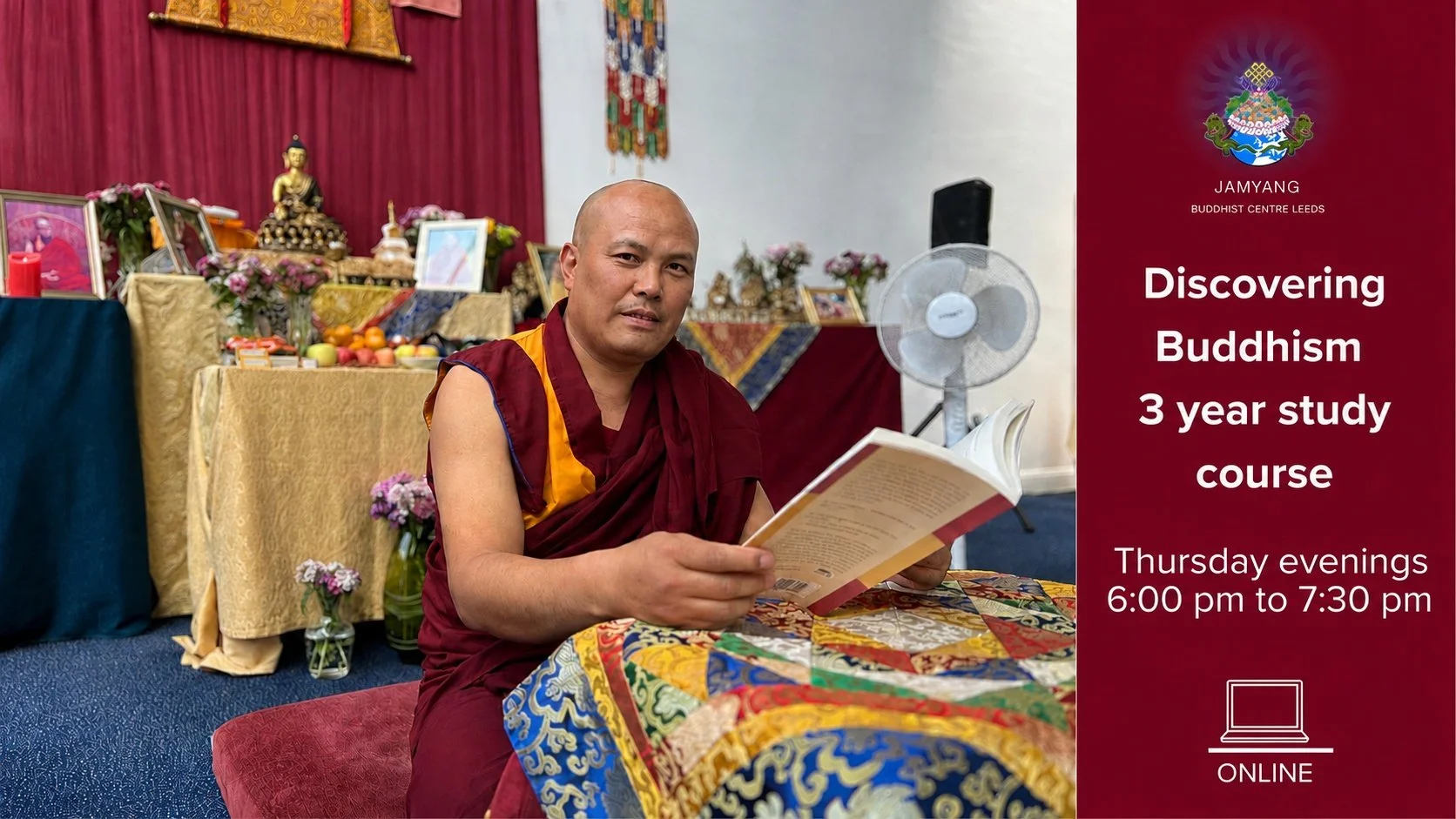
Discovering Buddhism: Establishing a daily practice
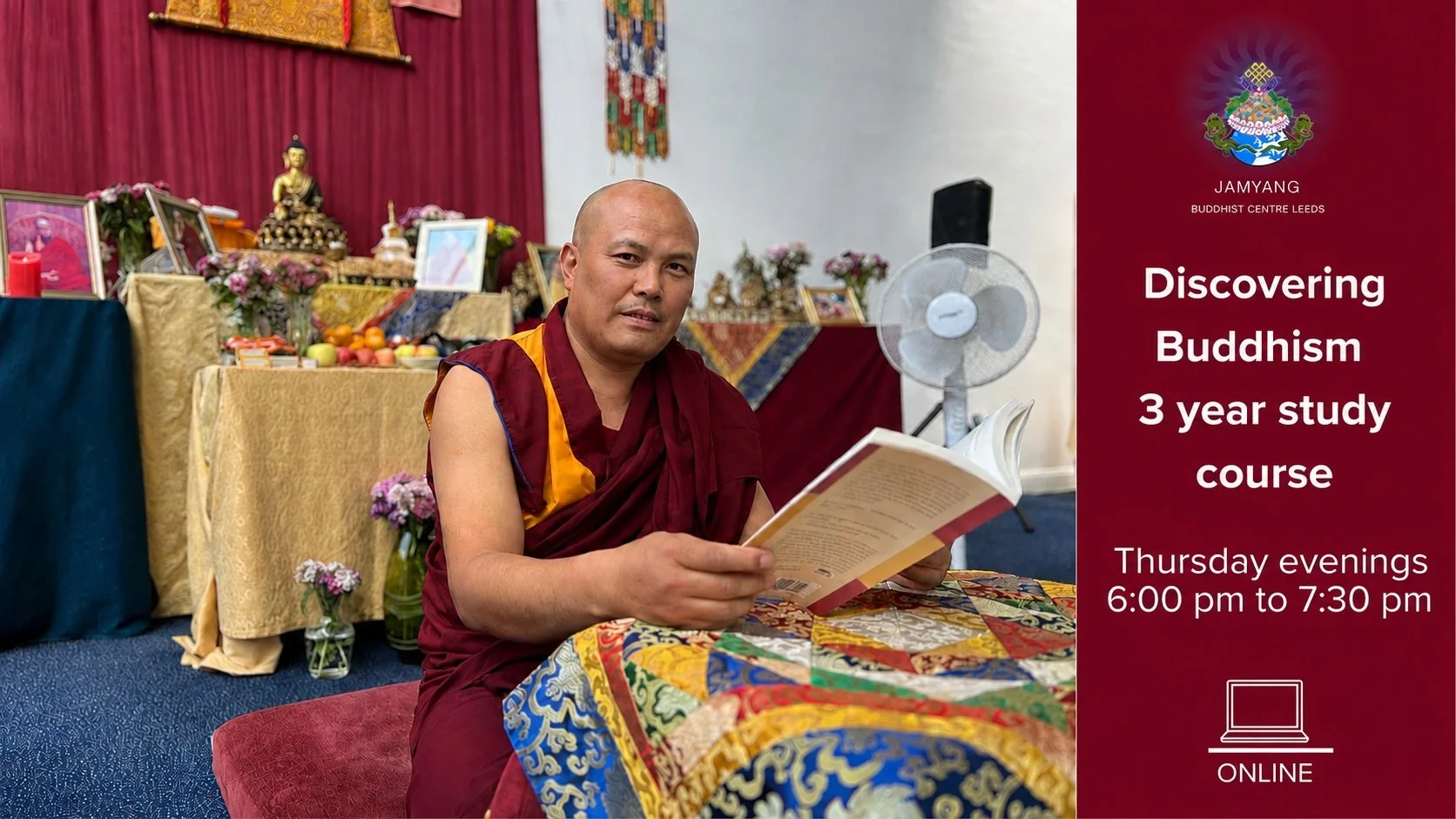
Overview of Programme
DATE: 2027: 4th March, 11th March, 18th March, 25th March,1st April, 8th April and Meditation day Sunday 11th April
TIME: Thursday’s weekly 6:00 pm to 7:30 pm
LOCATION: Online
LEVEL: This FPMT study course is suitable for both beginners and intermediate students, providing a structured approach to Buddhist study.
What to Expect in This Module: establishing a daily practice
In this module you will assemble the tools you need to develop a successful daily practice. Using Lama Zopa Rinpoche’s A Daily Meditation on Shakyamuni Buddha (also known as A Daily Meditation Practice) as a guide, become familiar with the elements necessary to generate realizations in the mind. Also, receive some tips for making every action of the day meaningful.
Awakening the limitless potential of your mind, achieving all peace and happiness.
Through:
Introductory Meditations - Meditation on Space like Clarity, Guided meditations help you explore the nature of the mind, develop mindfulness, and cultivate inner clarity and peace.
Explanatory Teachings - Explore how to establish a meaningful and sustainable daily Dharma practice. Learn the purpose and structure of a personal practice, including meditation, refuge, bodhicitta, purification, and dedication, while developing the confidence to integrate these into everyday life.
Reflection and Discussion - Consider how this practice relates to the rest of the path and your own practice. Opportunities to reflect on the teachings and share insights through supportive group discussion
Supportive Environment - Learn and share with like-minded practitioners, supported by the wisdom and guidance of Geshe Rinchen.
This module concludes with a Day of Meditation on Sunday, 11th April, offering time for deeper reflection and integration of the teachings.
Suitable for both new and experienced students ready to delve into the inspiring methods that turn life’s challenges into opportunities for growth, compassion, and wisdom
Awakening the limitless potential of your mind, achieving all peace and happiness
Discovering Buddhism is a beginner to intermediate level, 3 year FPMT study course that will give you a solid foundation in the teachings and practice of Tibetan Mahayana Buddhism.
This course was designed by Lama Zopa Rinpoche for students to study, explore and put into practice the graduated path to enlightenment, the lamrim. Originally based on Buddha Shakyamuni’s teachings from 2500 years ago in India. The lamrim was systematically organised by the Indian master Atisha in the 11th Century and by several other great masters from Tibet including Lama Tsongkhapa in the 15th Century.
Our resident teacher Geshe Rinchen Wangyal (Geshe La) will be teaching this module. This is an excellent opportunity to receive these Lamrim teachings directly from Geshe La. We are indeed most fortunate to be able to do so.
This course commences August 2026 and runs for 3 years on Thursday evenings online for 90 minutes and has 14 subjects, 13 of which are usually taught over 6 weeks. The course runs during March, April, May, July, August, September, October and November. There are no classes in January, February, June and December.
It is possible to join at any time during the course.
We warmly invite you to join us for this enriching journey with Geshe Rinchen. Together, let us explore how to bring the timeless wisdom of Buddhism into our everyday lives.
Registration Form . For more information contact our Discovering Buddhsim Coordinator, Ruth: db@jamyangleeds.co.uk
ABOUT YOUR Teacher: Geshe Rinchen Wangyal
Geshe Rinchen studied at Drepung Losel Ling Monastery in India, then at the Institute of Buddhiust Dialectics. He gained his Geshe degree in 2015.
He then studied at the University of Winchester in the UK, gaining a BA (hons) Degree in Philosophy, Religion and Ethics in 2024
Geshe La has had articles published in The Scientific American in 2020 including 'Hygiene of the mind during the Pandemic’. He has also received awards for essay competitions at the Institute of Buddhist Dialectics.
Geshe La’s teachings are known for their clarity, warmth, and practical applicability, making profound topics accessible to students of all backgrounds. Geshe La combines his deep knowledge with genuine compassion, inspiring students to cultivate inner peace and wisdom in their own lives.
Geshe La teaches in English fluently.
You can read more about Geshe Rinchen here.
SUGGESTED DONATION:
Non-members – £72 per module for the Thursday classes (usually 6 weeks), and £32 for the meditation day at the end of each module. This will contribute to the centre’s running costs and include a donation to the teacher.
Free to members - Members are invited to make a donation for the teacher, as is customary when receiving Buddhist teachings, in order to support their activity (for your reference we recommend a donation in the region of £20 per module and £10 per meditation day).
We never turn anyone away from the Dharma for financial reasons. If you cannot donate the suggested amount, please contact Ruth on db@jamyang.co.uk to discuss what would be affordable for you.
It’s good to practice generosity where we can.
How to Donate:
You can make a donation by card using our Donation Portal here. Please put Discovering Buddhism as a reference in the comments box
Alternatively you can donate by Bank Transfer using the details below, please reference Discovering Buddhism
Account Name: Jamyang Buddhist Centre Leeds
Bank Name: Cooperative Bank Plc
Account number: 65178087 Sort-Code: 08-92-99 SWIFT: CPBK GB22 IBAN: GB76 CPBK 0892 9965 1780 87
Gift Aid: if you are a UK taxpayer we can claim back 25p for every £1 you donate. Please indicate when registering if you would like us to claim giftaid on your donations.
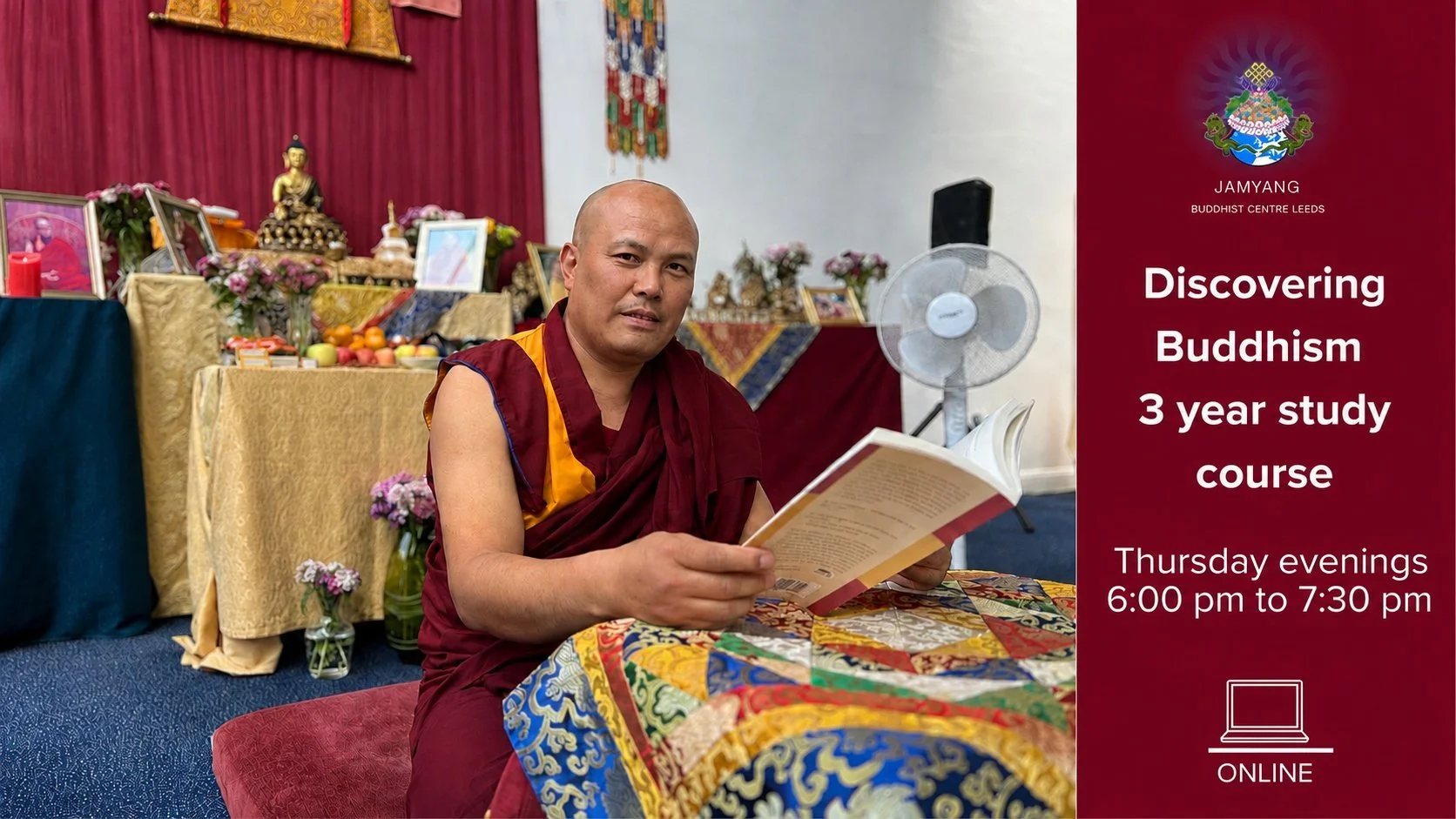
Discovering Buddhism: Establishing a daily practice
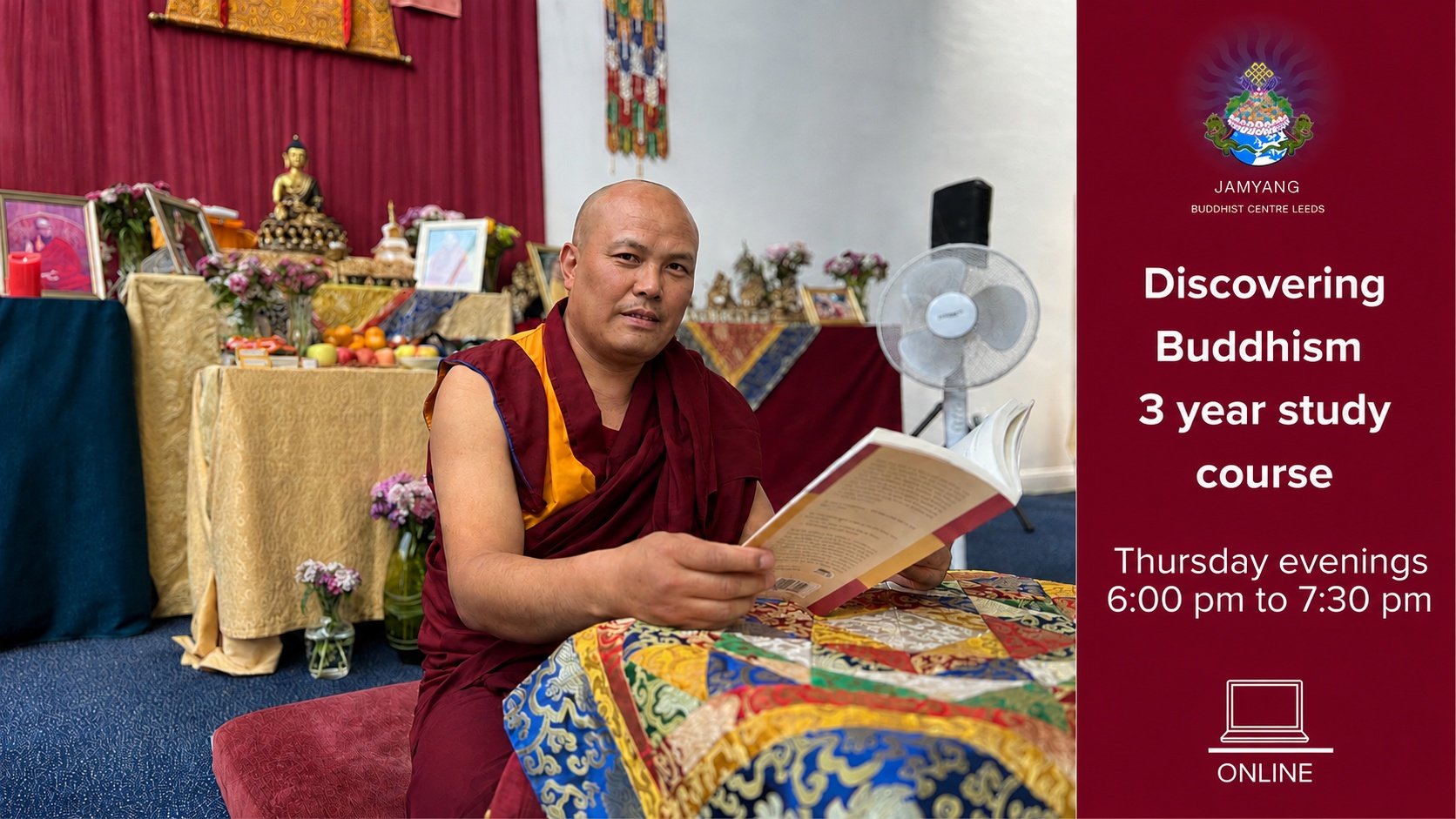
Overview of Programme
DATE: 2027: 4th March, 11th March, 18th March, 25th March,1st April, 8th April and Meditation day Sunday 11th April
TIME: Thursday’s weekly 6:00 pm to 7:30 pm
LOCATION: Online
LEVEL: This FPMT study course is suitable for both beginners and intermediate students, providing a structured approach to Buddhist study.
What to Expect in This Module: establishing a daily practice
In this module you will assemble the tools you need to develop a successful daily practice. Using Lama Zopa Rinpoche’s A Daily Meditation on Shakyamuni Buddha (also known as A Daily Meditation Practice) as a guide, become familiar with the elements necessary to generate realizations in the mind. Also, receive some tips for making every action of the day meaningful.
Awakening the limitless potential of your mind, achieving all peace and happiness.
Through:
Introductory Meditations - Meditation on Space like Clarity, Guided meditations help you explore the nature of the mind, develop mindfulness, and cultivate inner clarity and peace.
Explanatory Teachings - Explore how to establish a meaningful and sustainable daily Dharma practice. Learn the purpose and structure of a personal practice, including meditation, refuge, bodhicitta, purification, and dedication, while developing the confidence to integrate these into everyday life.
Reflection and Discussion - Consider how this practice relates to the rest of the path and your own practice. Opportunities to reflect on the teachings and share insights through supportive group discussion
Supportive Environment - Learn and share with like-minded practitioners, supported by the wisdom and guidance of Geshe Rinchen.
This module concludes with a Day of Meditation on Sunday, 11th April, offering time for deeper reflection and integration of the teachings.
Suitable for both new and experienced students ready to delve into the inspiring methods that turn life’s challenges into opportunities for growth, compassion, and wisdom
Awakening the limitless potential of your mind, achieving all peace and happiness
Discovering Buddhism is a beginner to intermediate level, 3 year FPMT study course that will give you a solid foundation in the teachings and practice of Tibetan Mahayana Buddhism.
This course was designed by Lama Zopa Rinpoche for students to study, explore and put into practice the graduated path to enlightenment, the lamrim. Originally based on Buddha Shakyamuni’s teachings from 2500 years ago in India. The lamrim was systematically organised by the Indian master Atisha in the 11th Century and by several other great masters from Tibet including Lama Tsongkhapa in the 15th Century.
Our resident teacher Geshe Rinchen Wangyal (Geshe La) will be teaching this module. This is an excellent opportunity to receive these Lamrim teachings directly from Geshe La. We are indeed most fortunate to be able to do so.
This course commences August 2026 and runs for 3 years on Thursday evenings online for 90 minutes and has 14 subjects, 13 of which are usually taught over 6 weeks. The course runs during March, April, May, July, August, September, October and November. There are no classes in January, February, June and December.
It is possible to join at any time during the course.
We warmly invite you to join us for this enriching journey with Geshe Rinchen. Together, let us explore how to bring the timeless wisdom of Buddhism into our everyday lives.
Registration Form . For more information contact our Discovering Buddhsim Coordinator, Ruth: db@jamyangleeds.co.uk
ABOUT YOUR Teacher: Geshe Rinchen Wangyal
Geshe Rinchen studied at Drepung Losel Ling Monastery in India, then at the Institute of Buddhiust Dialectics. He gained his Geshe degree in 2015.
He then studied at the University of Winchester in the UK, gaining a BA (hons) Degree in Philosophy, Religion and Ethics in 2024
Geshe La has had articles published in The Scientific American in 2020 including 'Hygiene of the mind during the Pandemic’. He has also received awards for essay competitions at the Institute of Buddhist Dialectics.
Geshe La’s teachings are known for their clarity, warmth, and practical applicability, making profound topics accessible to students of all backgrounds. Geshe La combines his deep knowledge with genuine compassion, inspiring students to cultivate inner peace and wisdom in their own lives.
Geshe La teaches in English fluently.
You can read more about Geshe Rinchen here.
SUGGESTED DONATION:
Non-members – £72 per module for the Thursday classes (usually 6 weeks), and £32 for the meditation day at the end of each module. This will contribute to the centre’s running costs and include a donation to the teacher.
Free to members - Members are invited to make a donation for the teacher, as is customary when receiving Buddhist teachings, in order to support their activity (for your reference we recommend a donation in the region of £20 per module and £10 per meditation day).
We never turn anyone away from the Dharma for financial reasons. If you cannot donate the suggested amount, please contact Ruth on db@jamyang.co.uk to discuss what would be affordable for you.
It’s good to practice generosity where we can.
How to Donate:
You can make a donation by card using our Donation Portal here. Please put Discovering Buddhism as a reference in the comments box
Alternatively you can donate by Bank Transfer using the details below, please reference Discovering Buddhism
Account Name: Jamyang Buddhist Centre Leeds
Bank Name: Cooperative Bank Plc
Account number: 65178087 Sort-Code: 08-92-99 SWIFT: CPBK GB22 IBAN: GB76 CPBK 0892 9965 1780 87
Gift Aid: if you are a UK taxpayer we can claim back 25p for every £1 you donate. Please indicate when registering if you would like us to claim giftaid on your donations.
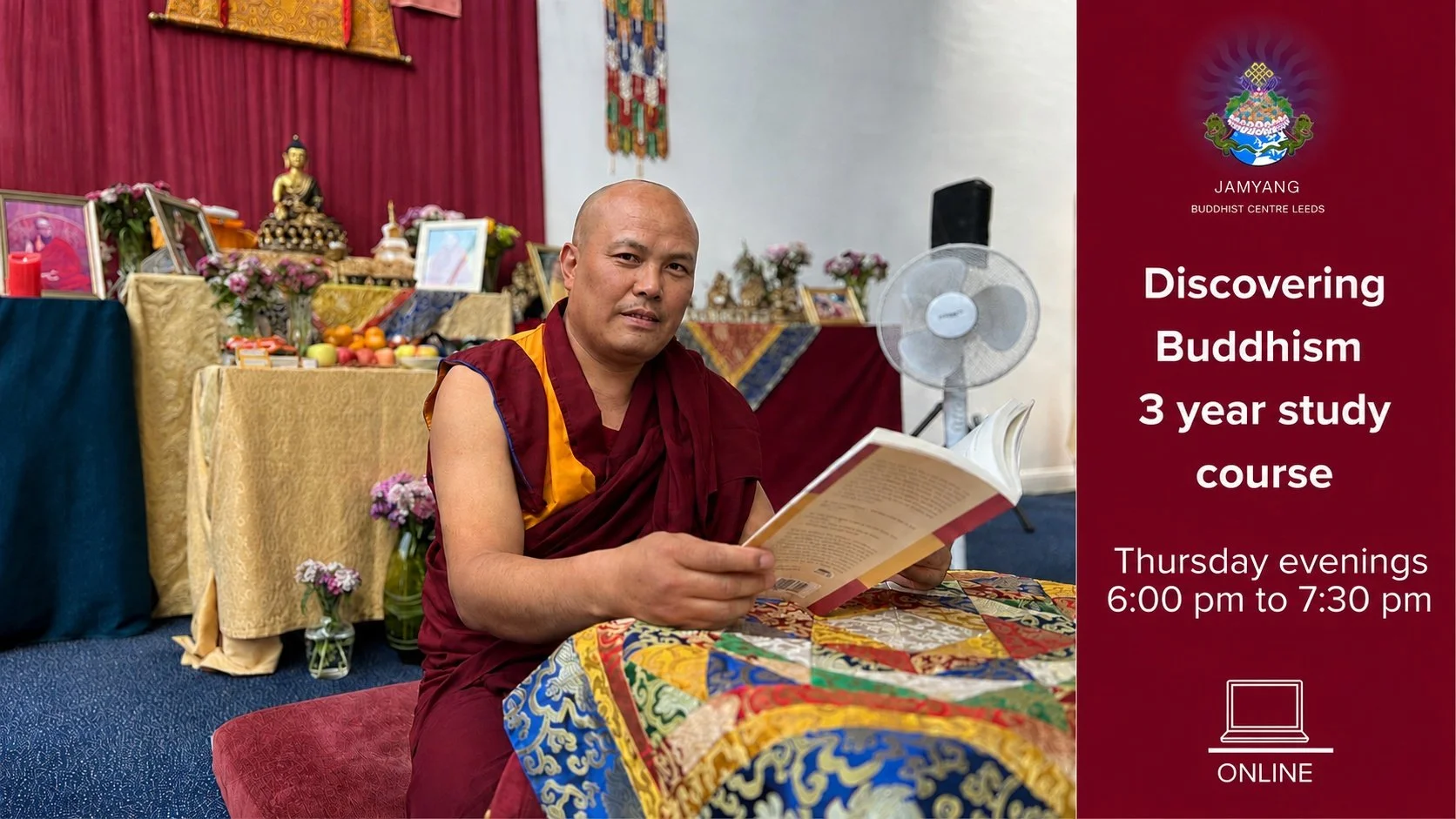
Discovering Buddhism: Establishing a daily practice
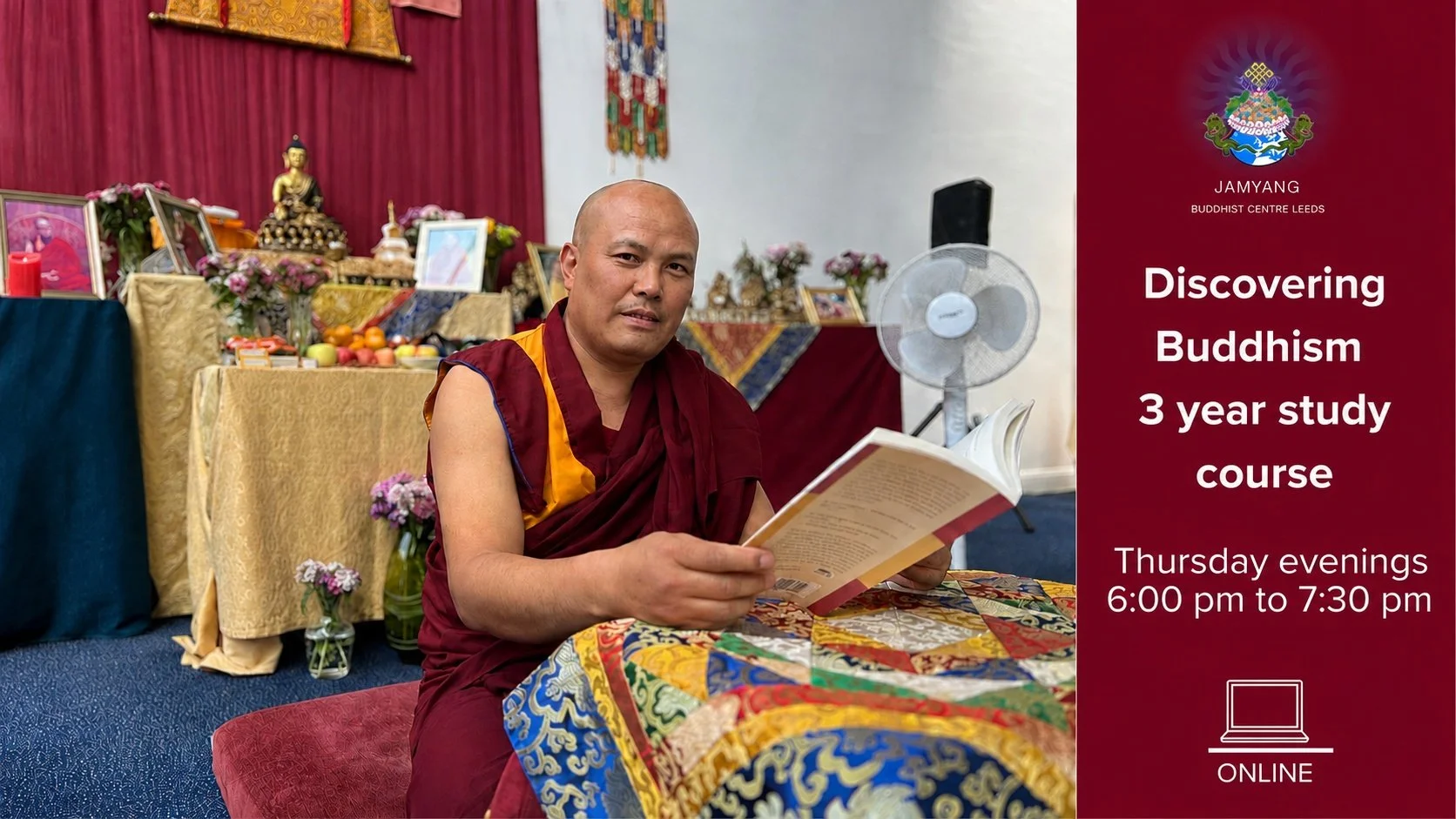
Overview of Programme
DATE: 2027: 4th March, 11th March, 18th March, 25th March,1st April, 8th April and Meditation day Sunday 11th April
TIME: Thursday’s weekly 6:00 pm to 7:30 pm
LOCATION: Online
LEVEL: This FPMT study course is suitable for both beginners and intermediate students, providing a structured approach to Buddhist study.
What to Expect in This Module: establishing a daily practice
In this module you will assemble the tools you need to develop a successful daily practice. Using Lama Zopa Rinpoche’s A Daily Meditation on Shakyamuni Buddha (also known as A Daily Meditation Practice) as a guide, become familiar with the elements necessary to generate realizations in the mind. Also, receive some tips for making every action of the day meaningful.
Awakening the limitless potential of your mind, achieving all peace and happiness.
Through:
Introductory Meditations - Meditation on Space like Clarity, Guided meditations help you explore the nature of the mind, develop mindfulness, and cultivate inner clarity and peace.
Explanatory Teachings - Explore how to establish a meaningful and sustainable daily Dharma practice. Learn the purpose and structure of a personal practice, including meditation, refuge, bodhicitta, purification, and dedication, while developing the confidence to integrate these into everyday life.
Reflection and Discussion - Consider how this practice relates to the rest of the path and your own practice. Opportunities to reflect on the teachings and share insights through supportive group discussion
Supportive Environment - Learn and share with like-minded practitioners, supported by the wisdom and guidance of Geshe Rinchen.
This module concludes with a Day of Meditation on Sunday, 11th April, offering time for deeper reflection and integration of the teachings.
Suitable for both new and experienced students ready to delve into the inspiring methods that turn life’s challenges into opportunities for growth, compassion, and wisdom
Awakening the limitless potential of your mind, achieving all peace and happiness
Discovering Buddhism is a beginner to intermediate level, 3 year FPMT study course that will give you a solid foundation in the teachings and practice of Tibetan Mahayana Buddhism.
This course was designed by Lama Zopa Rinpoche for students to study, explore and put into practice the graduated path to enlightenment, the lamrim. Originally based on Buddha Shakyamuni’s teachings from 2500 years ago in India. The lamrim was systematically organised by the Indian master Atisha in the 11th Century and by several other great masters from Tibet including Lama Tsongkhapa in the 15th Century.
Our resident teacher Geshe Rinchen Wangyal (Geshe La) will be teaching this module. This is an excellent opportunity to receive these Lamrim teachings directly from Geshe La. We are indeed most fortunate to be able to do so.
This course commences August 2026 and runs for 3 years on Thursday evenings online for 90 minutes and has 14 subjects, 13 of which are usually taught over 6 weeks. The course runs during March, April, May, July, August, September, October and November. There are no classes in January, February, June and December.
It is possible to join at any time during the course.
We warmly invite you to join us for this enriching journey with Geshe Rinchen. Together, let us explore how to bring the timeless wisdom of Buddhism into our everyday lives.
Registration Form . For more information contact our Discovering Buddhsim Coordinator, Ruth: db@jamyangleeds.co.uk
ABOUT YOUR Teacher: Geshe Rinchen Wangyal
Geshe Rinchen studied at Drepung Losel Ling Monastery in India, then at the Institute of Buddhiust Dialectics. He gained his Geshe degree in 2015.
He then studied at the University of Winchester in the UK, gaining a BA (hons) Degree in Philosophy, Religion and Ethics in 2024
Geshe La has had articles published in The Scientific American in 2020 including 'Hygiene of the mind during the Pandemic’. He has also received awards for essay competitions at the Institute of Buddhist Dialectics.
Geshe La’s teachings are known for their clarity, warmth, and practical applicability, making profound topics accessible to students of all backgrounds. Geshe La combines his deep knowledge with genuine compassion, inspiring students to cultivate inner peace and wisdom in their own lives.
Geshe La teaches in English fluently.
You can read more about Geshe Rinchen here.
SUGGESTED DONATION:
Non-members – £72 per module for the Thursday classes (usually 6 weeks), and £32 for the meditation day at the end of each module. This will contribute to the centre’s running costs and include a donation to the teacher.
Free to members - Members are invited to make a donation for the teacher, as is customary when receiving Buddhist teachings, in order to support their activity (for your reference we recommend a donation in the region of £20 per module and £10 per meditation day).
We never turn anyone away from the Dharma for financial reasons. If you cannot donate the suggested amount, please contact Ruth on db@jamyang.co.uk to discuss what would be affordable for you.
It’s good to practice generosity where we can.
How to Donate:
You can make a donation by card using our Donation Portal here. Please put Discovering Buddhism as a reference in the comments box
Alternatively you can donate by Bank Transfer using the details below, please reference Discovering Buddhism
Account Name: Jamyang Buddhist Centre Leeds
Bank Name: Cooperative Bank Plc
Account number: 65178087 Sort-Code: 08-92-99 SWIFT: CPBK GB22 IBAN: GB76 CPBK 0892 9965 1780 87
Gift Aid: if you are a UK taxpayer we can claim back 25p for every £1 you donate. Please indicate when registering if you would like us to claim giftaid on your donations.
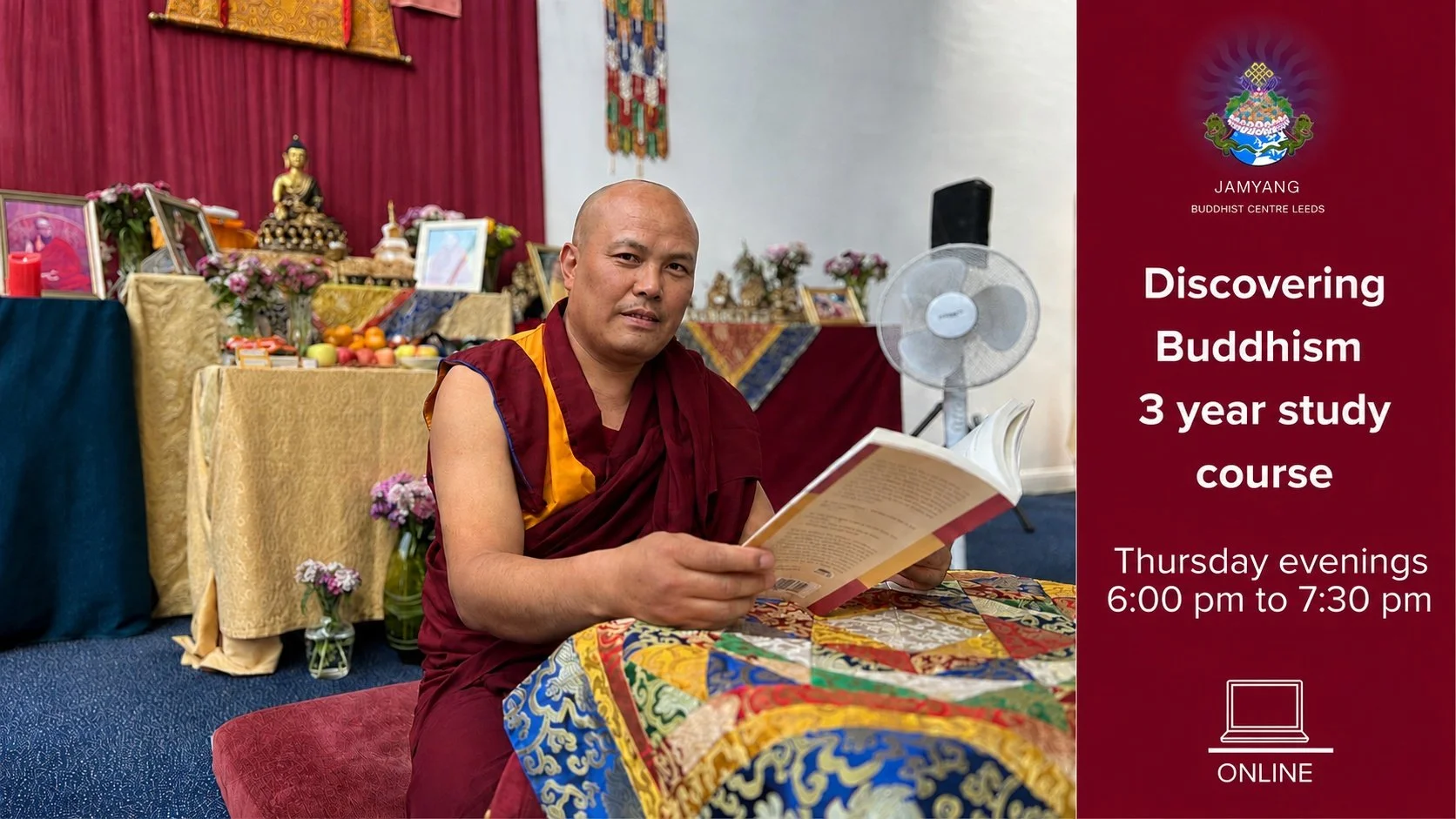
Discovering Buddhism: Establishing a daily practice
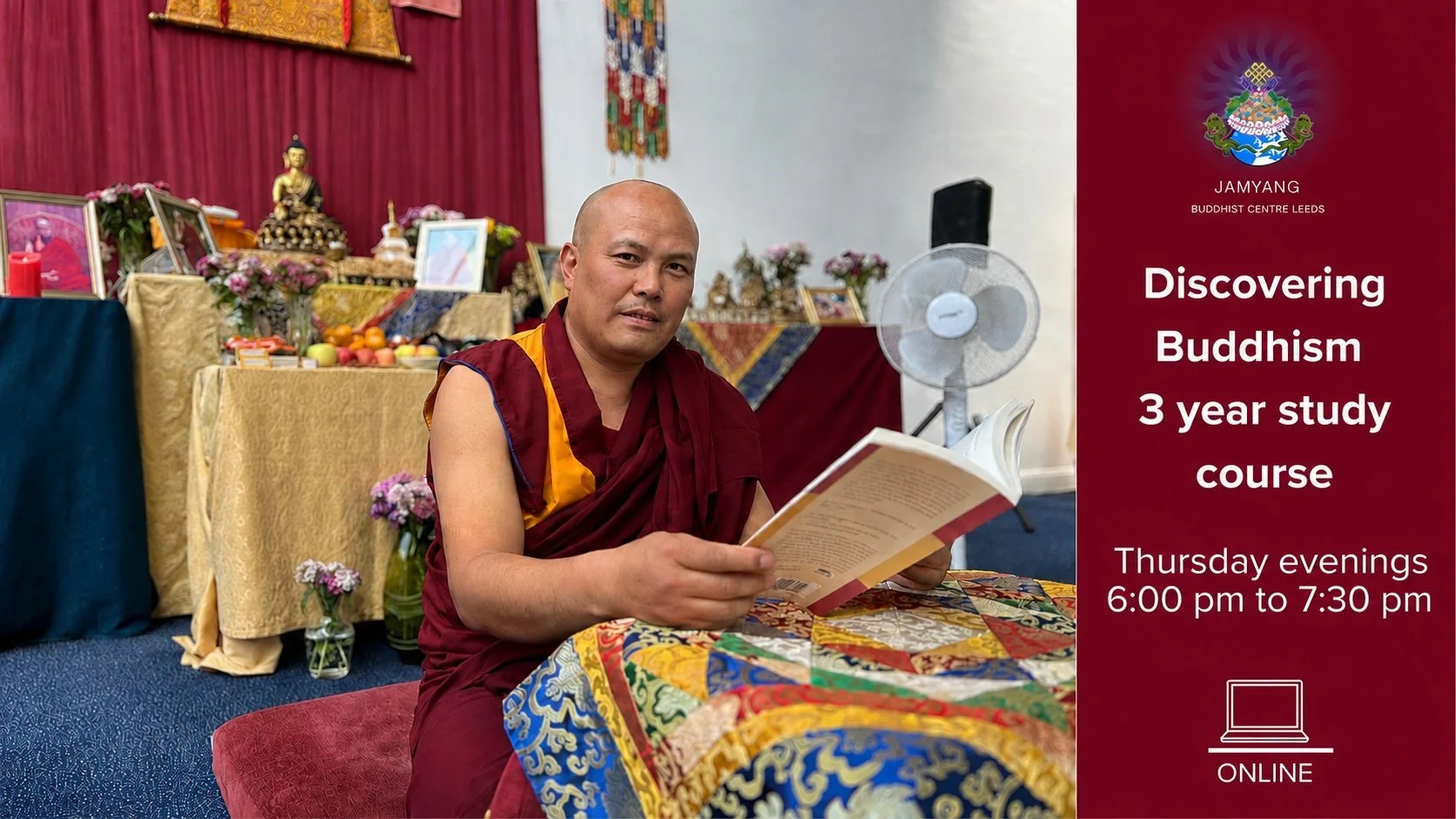
Overview of Programme
DATE: 2027: 4th March, 11th March, 18th March, 25th March,1st April, 8th April and Meditation day Sunday 11th April
TIME: Thursday’s weekly 6:00 pm to 7:30 pm
LOCATION: Online
LEVEL: This FPMT study course is suitable for both beginners and intermediate students, providing a structured approach to Buddhist study.
What to Expect in This Module: establishing a daily practice
In this module you will assemble the tools you need to develop a successful daily practice. Using Lama Zopa Rinpoche’s A Daily Meditation on Shakyamuni Buddha (also known as A Daily Meditation Practice) as a guide, become familiar with the elements necessary to generate realizations in the mind. Also, receive some tips for making every action of the day meaningful.
Awakening the limitless potential of your mind, achieving all peace and happiness.
Through:
Introductory Meditations - Meditation on Space like Clarity, Guided meditations help you explore the nature of the mind, develop mindfulness, and cultivate inner clarity and peace.
Explanatory Teachings - Explore how to establish a meaningful and sustainable daily Dharma practice. Learn the purpose and structure of a personal practice, including meditation, refuge, bodhicitta, purification, and dedication, while developing the confidence to integrate these into everyday life.
Reflection and Discussion - Consider how this practice relates to the rest of the path and your own practice. Opportunities to reflect on the teachings and share insights through supportive group discussion
Supportive Environment - Learn and share with like-minded practitioners, supported by the wisdom and guidance of Geshe Rinchen.
This module concludes with a Day of Meditation on Sunday, 11th April, offering time for deeper reflection and integration of the teachings.
Suitable for both new and experienced students ready to delve into the inspiring methods that turn life’s challenges into opportunities for growth, compassion, and wisdom
Awakening the limitless potential of your mind, achieving all peace and happiness
Discovering Buddhism is a beginner to intermediate level, 3 year FPMT study course that will give you a solid foundation in the teachings and practice of Tibetan Mahayana Buddhism.
This course was designed by Lama Zopa Rinpoche for students to study, explore and put into practice the graduated path to enlightenment, the lamrim. Originally based on Buddha Shakyamuni’s teachings from 2500 years ago in India. The lamrim was systematically organised by the Indian master Atisha in the 11th Century and by several other great masters from Tibet including Lama Tsongkhapa in the 15th Century.
Our resident teacher Geshe Rinchen Wangyal (Geshe La) will be teaching this module. This is an excellent opportunity to receive these Lamrim teachings directly from Geshe La. We are indeed most fortunate to be able to do so.
This course commences August 2026 and runs for 3 years on Thursday evenings online for 90 minutes and has 14 subjects, 13 of which are usually taught over 6 weeks. The course runs during March, April, May, July, August, September, October and November. There are no classes in January, February, June and December.
It is possible to join at any time during the course.
We warmly invite you to join us for this enriching journey with Geshe Rinchen. Together, let us explore how to bring the timeless wisdom of Buddhism into our everyday lives.
Registration Form . For more information contact our Discovering Buddhsim Coordinator, Ruth: db@jamyangleeds.co.uk
ABOUT YOUR Teacher: Geshe Rinchen Wangyal
Geshe Rinchen studied at Drepung Losel Ling Monastery in India, then at the Institute of Buddhiust Dialectics. He gained his Geshe degree in 2015.
He then studied at the University of Winchester in the UK, gaining a BA (hons) Degree in Philosophy, Religion and Ethics in 2024
Geshe La has had articles published in The Scientific American in 2020 including 'Hygiene of the mind during the Pandemic’. He has also received awards for essay competitions at the Institute of Buddhist Dialectics.
Geshe La’s teachings are known for their clarity, warmth, and practical applicability, making profound topics accessible to students of all backgrounds. Geshe La combines his deep knowledge with genuine compassion, inspiring students to cultivate inner peace and wisdom in their own lives.
Geshe La teaches in English fluently.
You can read more about Geshe Rinchen here.
SUGGESTED DONATION:
Non-members – £72 per module for the Thursday classes (usually 6 weeks), and £32 for the meditation day at the end of each module. This will contribute to the centre’s running costs and include a donation to the teacher.
Free to members - Members are invited to make a donation for the teacher, as is customary when receiving Buddhist teachings, in order to support their activity (for your reference we recommend a donation in the region of £20 per module and £10 per meditation day).
We never turn anyone away from the Dharma for financial reasons. If you cannot donate the suggested amount, please contact Ruth on db@jamyang.co.uk to discuss what would be affordable for you.
It’s good to practice generosity where we can.
How to Donate:
You can make a donation by card using our Donation Portal here. Please put Discovering Buddhism as a reference in the comments box
Alternatively you can donate by Bank Transfer using the details below, please reference Discovering Buddhism
Account Name: Jamyang Buddhist Centre Leeds
Bank Name: Cooperative Bank Plc
Account number: 65178087 Sort-Code: 08-92-99 SWIFT: CPBK GB22 IBAN: GB76 CPBK 0892 9965 1780 87
Gift Aid: if you are a UK taxpayer we can claim back 25p for every £1 you donate. Please indicate when registering if you would like us to claim giftaid on your donations.
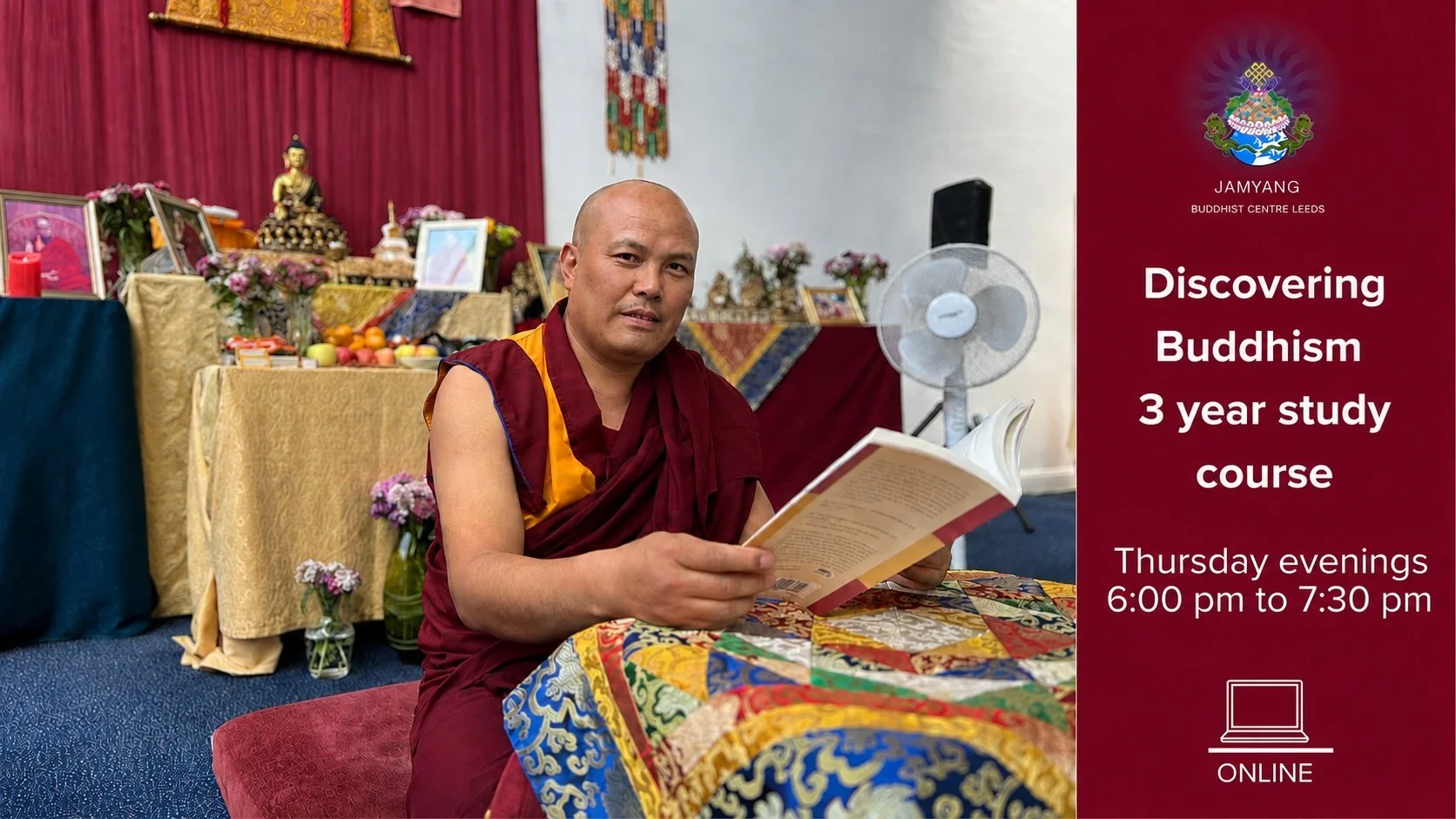
Discovering Buddhism: Establishing a daily practice
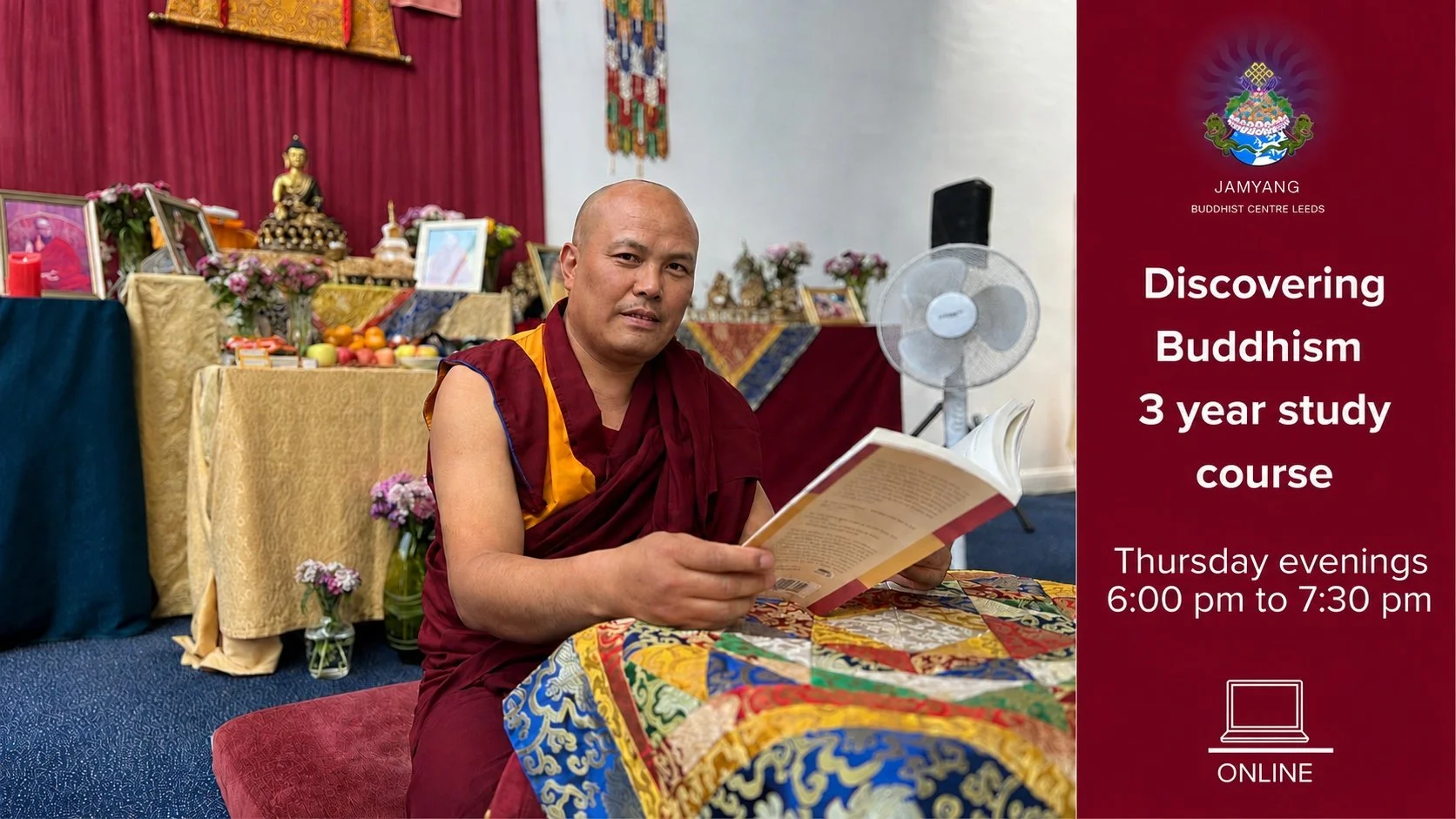
Overview of Programme
DATE: 2027: 4th March, 11th March, 18th March, 25th March,1st April, 8th April and Meditation day Sunday 11th April
TIME: Thursday’s weekly 6:00 pm to 7:30 pm
LOCATION: Online
LEVEL: This FPMT study course is suitable for both beginners and intermediate students, providing a structured approach to Buddhist study.
What to Expect in This Module: establishing a daily practice
In this module you will assemble the tools you need to develop a successful daily practice. Using Lama Zopa Rinpoche’s A Daily Meditation on Shakyamuni Buddha (also known as A Daily Meditation Practice) as a guide, become familiar with the elements necessary to generate realizations in the mind. Also, receive some tips for making every action of the day meaningful.
Awakening the limitless potential of your mind, achieving all peace and happiness.
Through:
Introductory Meditations - Meditation on Space like Clarity, Guided meditations help you explore the nature of the mind, develop mindfulness, and cultivate inner clarity and peace.
Explanatory Teachings - Explore how to establish a meaningful and sustainable daily Dharma practice. Learn the purpose and structure of a personal practice, including meditation, refuge, bodhicitta, purification, and dedication, while developing the confidence to integrate these into everyday life.
Reflection and Discussion - Consider how this practice relates to the rest of the path and your own practice. Opportunities to reflect on the teachings and share insights through supportive group discussion
Supportive Environment - Learn and share with like-minded practitioners, supported by the wisdom and guidance of Geshe Rinchen.
This module concludes with a Day of Meditation on Sunday, 11th April, offering time for deeper reflection and integration of the teachings.
Suitable for both new and experienced students ready to delve into the inspiring methods that turn life’s challenges into opportunities for growth, compassion, and wisdom
Awakening the limitless potential of your mind, achieving all peace and happiness
Discovering Buddhism is a beginner to intermediate level, 3 year FPMT study course that will give you a solid foundation in the teachings and practice of Tibetan Mahayana Buddhism.
This course was designed by Lama Zopa Rinpoche for students to study, explore and put into practice the graduated path to enlightenment, the lamrim. Originally based on Buddha Shakyamuni’s teachings from 2500 years ago in India. The lamrim was systematically organised by the Indian master Atisha in the 11th Century and by several other great masters from Tibet including Lama Tsongkhapa in the 15th Century.
Our resident teacher Geshe Rinchen Wangyal (Geshe La) will be teaching this module. This is an excellent opportunity to receive these Lamrim teachings directly from Geshe La. We are indeed most fortunate to be able to do so.
This course commences August 2026 and runs for 3 years on Thursday evenings online for 90 minutes and has 14 subjects, 13 of which are usually taught over 6 weeks. The course runs during March, April, May, July, August, September, October and November. There are no classes in January, February, June and December.
It is possible to join at any time during the course.
We warmly invite you to join us for this enriching journey with Geshe Rinchen. Together, let us explore how to bring the timeless wisdom of Buddhism into our everyday lives.
Registration Form . For more information contact our Discovering Buddhsim Coordinator, Ruth: db@jamyangleeds.co.uk
ABOUT YOUR Teacher: Geshe Rinchen Wangyal
Geshe Rinchen studied at Drepung Losel Ling Monastery in India, then at the Institute of Buddhiust Dialectics. He gained his Geshe degree in 2015.
He then studied at the University of Winchester in the UK, gaining a BA (hons) Degree in Philosophy, Religion and Ethics in 2024
Geshe La has had articles published in The Scientific American in 2020 including 'Hygiene of the mind during the Pandemic’. He has also received awards for essay competitions at the Institute of Buddhist Dialectics.
Geshe La’s teachings are known for their clarity, warmth, and practical applicability, making profound topics accessible to students of all backgrounds. Geshe La combines his deep knowledge with genuine compassion, inspiring students to cultivate inner peace and wisdom in their own lives.
Geshe La teaches in English fluently.
You can read more about Geshe Rinchen here.
SUGGESTED DONATION:
Non-members – £72 per module for the Thursday classes (usually 6 weeks), and £32 for the meditation day at the end of each module. This will contribute to the centre’s running costs and include a donation to the teacher.
Free to members - Members are invited to make a donation for the teacher, as is customary when receiving Buddhist teachings, in order to support their activity (for your reference we recommend a donation in the region of £20 per module and £10 per meditation day).
We never turn anyone away from the Dharma for financial reasons. If you cannot donate the suggested amount, please contact Ruth on db@jamyang.co.uk to discuss what would be affordable for you.
It’s good to practice generosity where we can.
How to Donate:
You can make a donation by card using our Donation Portal here. Please put Discovering Buddhism as a reference in the comments box
Alternatively you can donate by Bank Transfer using the details below, please reference Discovering Buddhism
Account Name: Jamyang Buddhist Centre Leeds
Bank Name: Cooperative Bank Plc
Account number: 65178087 Sort-Code: 08-92-99 SWIFT: CPBK GB22 IBAN: GB76 CPBK 0892 9965 1780 87
Gift Aid: if you are a UK taxpayer we can claim back 25p for every £1 you donate. Please indicate when registering if you would like us to claim giftaid on your donations.
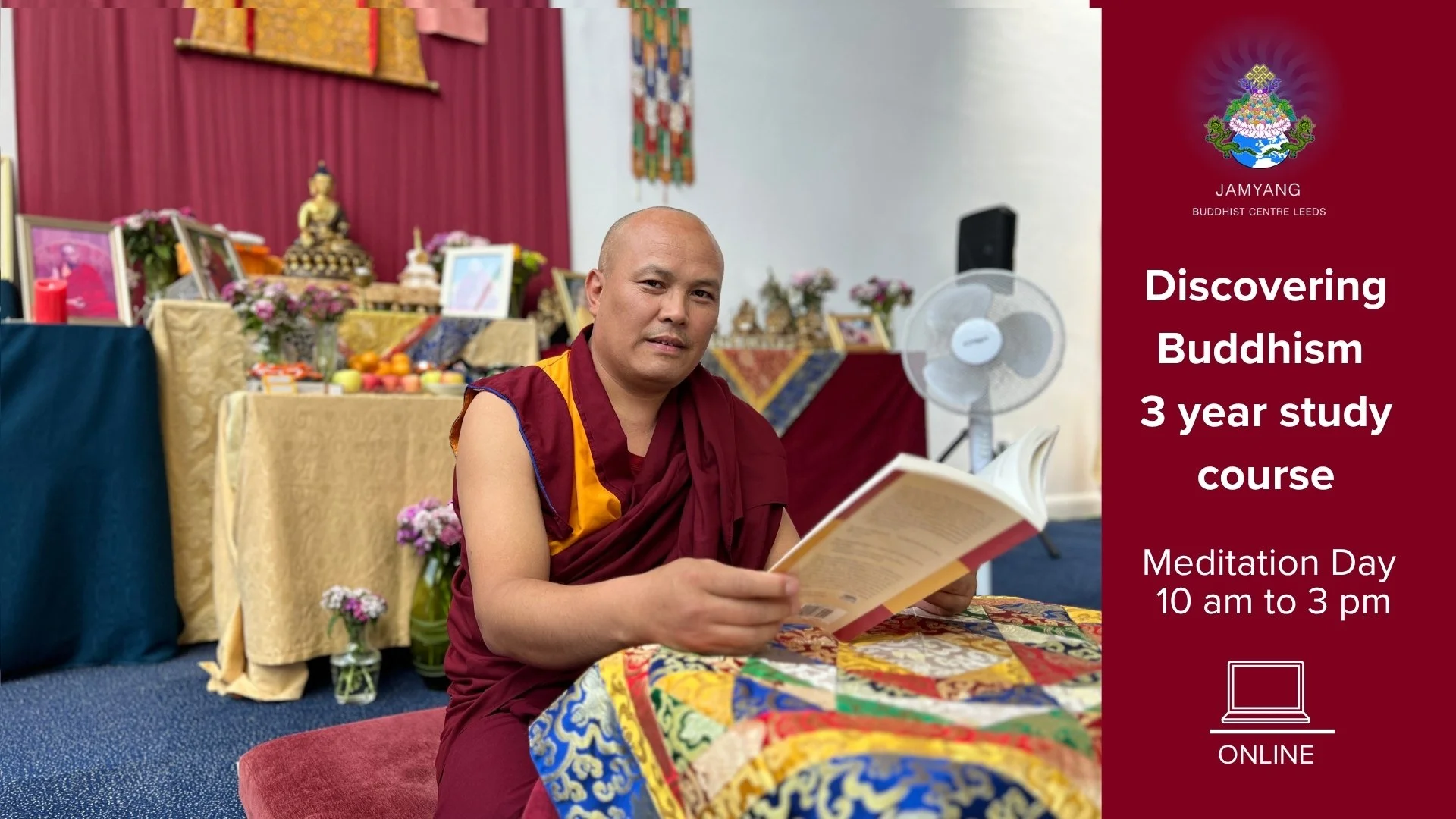
Discovering Buddhism: Meditation Day
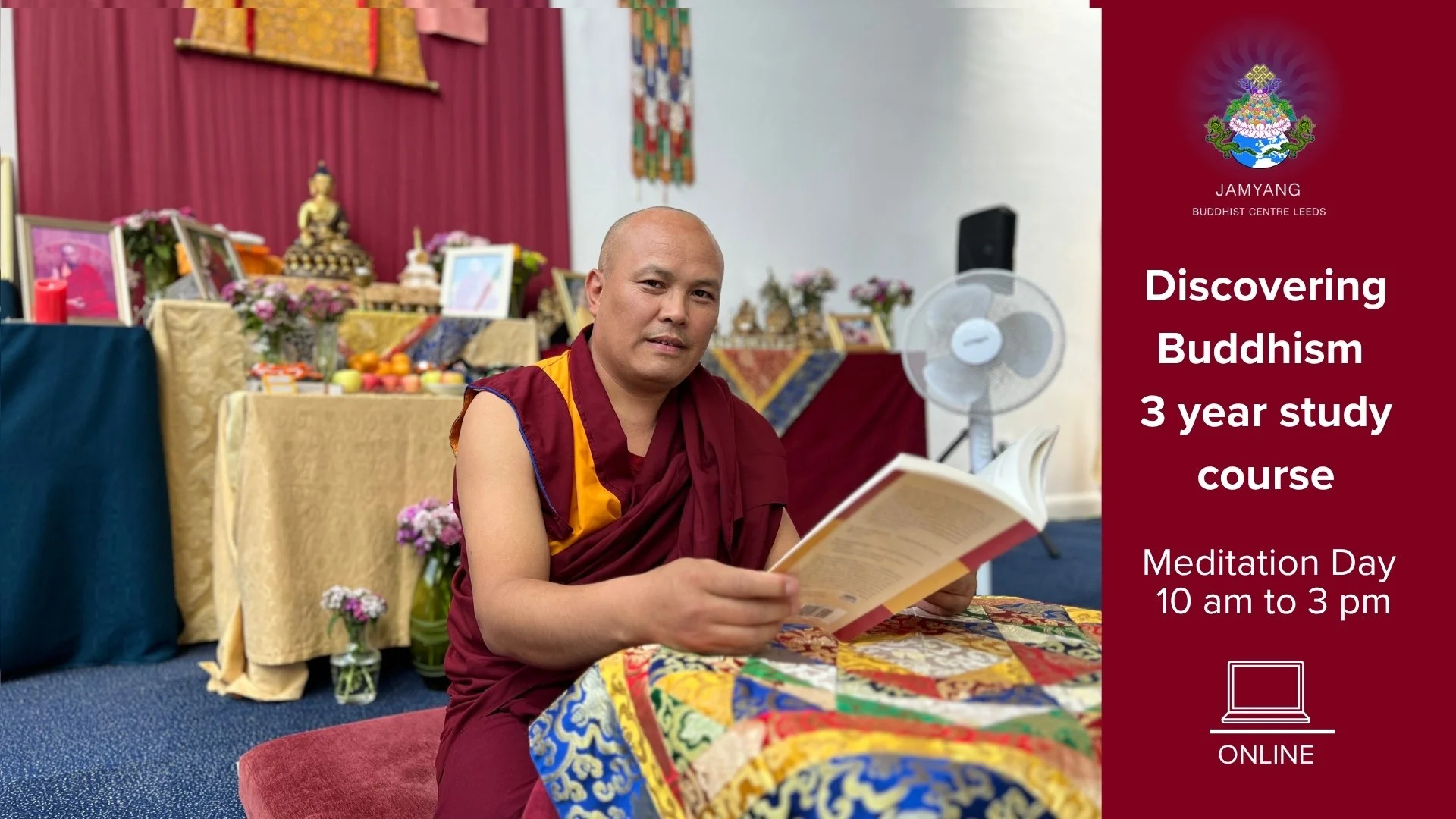
Overview of Programme
DATE: 2027: Sunday 11th April
TIME: 10 am to 3 pm
LOCATION: Online
LEVEL: This FPMT study course is suitable for both beginners and intermediate students, providing a structured approach to Buddhist study.
What to Expect in This Module: establishing a daily practice
In this module you will assemble the tools you need to develop a successful daily practice. Using Lama Zopa Rinpoche’s A Daily Meditation on Shakyamuni Buddha (also known as A Daily Meditation Practice) as a guide, become familiar with the elements necessary to generate realizations in the mind. Also, receive some tips for making every action of the day meaningful.
Awakening the limitless potential of your mind, achieving all peace and happiness.
Through:
Introductory Meditations - Meditation on Space like Clarity, Guided meditations help you explore the nature of the mind, develop mindfulness, and cultivate inner clarity and peace.
Explanatory Teachings - Explore how to establish a meaningful and sustainable daily Dharma practice. Learn the purpose and structure of a personal practice, including meditation, refuge, bodhicitta, purification, and dedication, while developing the confidence to integrate these into everyday life.
Reflection and Discussion - Consider how this practice relates to the rest of the path and your own practice. Opportunities to reflect on the teachings and share insights through supportive group discussion
Supportive Environment - Learn and share with like-minded practitioners, supported by the wisdom and guidance of Geshe Rinchen.
This module concludes with a Day of Meditation on Sunday, 11th April, offering time for deeper reflection and integration of the teachings.
Suitable for both new and experienced students ready to delve into the inspiring methods that turn life’s challenges into opportunities for growth, compassion, and wisdom
Awakening the limitless potential of your mind, achieving all peace and happiness
Discovering Buddhism is a beginner to intermediate level, 3 year FPMT study course that will give you a solid foundation in the teachings and practice of Tibetan Mahayana Buddhism.
This course was designed by Lama Zopa Rinpoche for students to study, explore and put into practice the graduated path to enlightenment, the lamrim. Originally based on Buddha Shakyamuni’s teachings from 2500 years ago in India. The lamrim was systematically organised by the Indian master Atisha in the 11th Century and by several other great masters from Tibet including Lama Tsongkhapa in the 15th Century.
Our resident teacher Geshe Rinchen Wangyal (Geshe La) will be teaching this module. This is an excellent opportunity to receive these Lamrim teachings directly from Geshe La. We are indeed most fortunate to be able to do so.
This course commences August 2026 and runs for 3 years on Thursday evenings online for 90 minutes and has 14 subjects, 13 of which are usually taught over 6 weeks. The course runs during March, April, May, July, August, September, October and November. There are no classes in January, February, June and December.
It is possible to join at any time during the course.
We warmly invite you to join us for this enriching journey with Geshe Rinchen. Together, let us explore how to bring the timeless wisdom of Buddhism into our everyday lives.
Registration Form . For more information contact our Discovering Buddhsim Coordinator, Ruth: db@jamyangleeds.co.uk
ABOUT YOUR Teacher: Geshe Rinchen Wangyal
Geshe Rinchen studied at Drepung Losel Ling Monastery in India, then at the Institute of Buddhiust Dialectics. He gained his Geshe degree in 2015.
He then studied at the University of Winchester in the UK, gaining a BA (hons) Degree in Philosophy, Religion and Ethics in 2024
Geshe La has had articles published in The Scientific American in 2020 including 'Hygiene of the mind during the Pandemic’. He has also received awards for essay competitions at the Institute of Buddhist Dialectics.
Geshe La’s teachings are known for their clarity, warmth, and practical applicability, making profound topics accessible to students of all backgrounds. Geshe La combines his deep knowledge with genuine compassion, inspiring students to cultivate inner peace and wisdom in their own lives.
Geshe La teaches in English fluently.
You can read more about Geshe Rinchen here.
SUGGESTED DONATION:
Non-members – £72 per module for the Thursday classes (usually 6 weeks), and £32 for the meditation day at the end of each module. This will contribute to the centre’s running costs and include a donation to the teacher.
Free to members - Members are invited to make a donation for the teacher, as is customary when receiving Buddhist teachings, in order to support their activity (for your reference we recommend a donation in the region of £20 per module and £10 per meditation day).
We never turn anyone away from the Dharma for financial reasons. If you cannot donate the suggested amount, please contact Ruth on db@jamyang.co.uk to discuss what would be affordable for you.
It’s good to practice generosity where we can.
How to Donate:
You can make a donation by card using our Donation Portal here. Please put Discovering Buddhism as a reference in the comments box
Alternatively you can donate by Bank Transfer using the details below, please reference Discovering Buddhism
Account Name: Jamyang Buddhist Centre Leeds
Bank Name: Cooperative Bank Plc
Account number: 65178087 Sort-Code: 08-92-99 SWIFT: CPBK GB22 IBAN: GB76 CPBK 0892 9965 1780 87
Gift Aid: if you are a UK taxpayer we can claim back 25p for every £1 you donate. Please indicate when registering if you would like us to claim giftaid on your donations.
Hatha Yoga with Sally Brown
Overview of Session
DATE: Sunday Monthly 20th September; 11th October; 8th November
TIME: 11:45 am to 12:45 pm
LOCATION: In-person
LEVEL: Everyone welcome - Drop In class
COST: Free or Donate as you feel, Sally will make donations to Jamyang from each class to raise funds for the centre.
About the Class:
This friendly and accessible community Hatha Yoga class is suitable for all bodies and abilities.
Everyone is welcome – beginners, chair-users, seniors and people starting or returning to exercise.
It’s all about moving steadily, getting more flexible and feeling more relaxed.
About the Teacher - Sally Brown:
Sally is an Accessible and Community yoga teacher living and working in north-east Leeds.
She teaches and runs inclusive, affordable yoga classes for under-represented groups and challenged local communities.
A 200-hour qualified yoga teacher, Sally is registered with the British Wheel of Yoga, an ambassador for Accessible Yoga and has been teaching for nine years.
She teaches the slower, more accessible and mindful styles including Hatha, Yin, Restorative, Nidra, Gentle and Chair, as well as Steady yoga and yoga-inspired Flex and Move sessions.
Contact:
Dr Sally SJ Brown.
A Mindful Heart - Sunday Community Meditation
overview of sunday Community Meditation
DATE & TIME: Sunday 10:30-11:30
LOCATION: In-person at the centre
LEVEL: Meditation – All Welcome
SUGGESTED DONATION: Generosity model - please donate as you feel affordable and as generously as is manageable
Discover your best self every Sunday morning
Are you keen to work on your well-being and connect with others trying to make their life a little better for themselves and those around them? Join our uplifting Sunday Community Meditation Sessions.
Each hour-long gathering begins with a soothing meditation to calm your mind, followed by an inspiring discussion on a way of being such as interconnection, that enriches your everyday life. We then dive into a focused meditation designed to help you embrace that way of being fully.
Wrap up your morning with a cup of tea and friendly conversation in a welcoming, relaxed atmosphere. Absolutely everyone welcome.
Meet us every Sunday at 10:30 AM and start your week feeling refreshed, connected, and inspired. Your journey to a happier, more mindful life begins here!
Cost: Generosity Model: Pay as you feel.
From September 2026 to February 2027 we will focus on ‘A Mindful Heart’.
Inspired by the Creating Compassionate Cultures program (“CCC”) by Pam Cayton, and developed by the Foundation for Developing Compassion and Wisdom. Grounded in three core pathways of learning: Knowledge, Strength, and Compassion. These pathways guide you towards a happier, more meaningful life by fostering inner growth and a warmer connection with others.
Designed to help you develop a deeper understanding of how the mind works. The aim is to gradually let go of destructive patterns of thought and behaviour while cultivating a healthy sense of self-confidence and a deep, compassionate connection with others.
You are invited to reflect on your attitudes, perceptions, and emotional patterns. By exploring the workings of our own minds and the nature of our interdependence with others and the world around us, we begin to see how deeply connected our inner and outer realities truly are. We examine both logical and scientific perspectives on the nature of the self and our relationships with others.
To deepen the learning, you are encouraged to reflect between sessions, pausing to notice your inner experiences and reconnect with your deepest values. This supports the integration of insights and ways to act with greater mindfulness and wisdom.
Ultimately, the transformation we foster in ourselves contributes to building more compassionate cultures. How can one person influence a whole culture? The answer lies in understanding interdependence. Every action we take, every choice, interaction, and intention, affects others and the broader environment, this principle of cause and effect lies at the heart of all life, reminding us that our individual transformation ripples outward in meaningful ways.
The Creating Compassionate Cultures programme has 7 steps:
Mindful Intention
Interconnection
Change
Perception
Transforming harmful emotions
Empathy
Compassion
Session overview:
Welcome, Introduction and Motivation 5 mins
Settling Meditation 10 mins
Meditation topic introduced then participants briefly share their experience 15 mins
Guided meditation 15 mins
Feedback from participants 10 mins
Closing and Dedication 5 mins
September 2026
6th and 13th: The Pursuit of Happiness
20th and 27th: Understanding how things exist
October 2026:
4th and 11th: Developing Healthy Self Confidence
18th and 25th: Compassion - Opening the heart
November 2026:
1st and 8th: Mindfulness, reflection and critical thinking
15th and 22nd: Mindful intention - what do I really want
29th: Interconnection (week 1)
December 2026:
6th: Interconnection (week 2)
13th and 20th: Embracing Change
January 2027:
10th and 17th: Perception
24th and 31st Transforming harmful emotions
February 2027:
7th and 14th: Empathy
21st and 28th: Cultivating Compassion
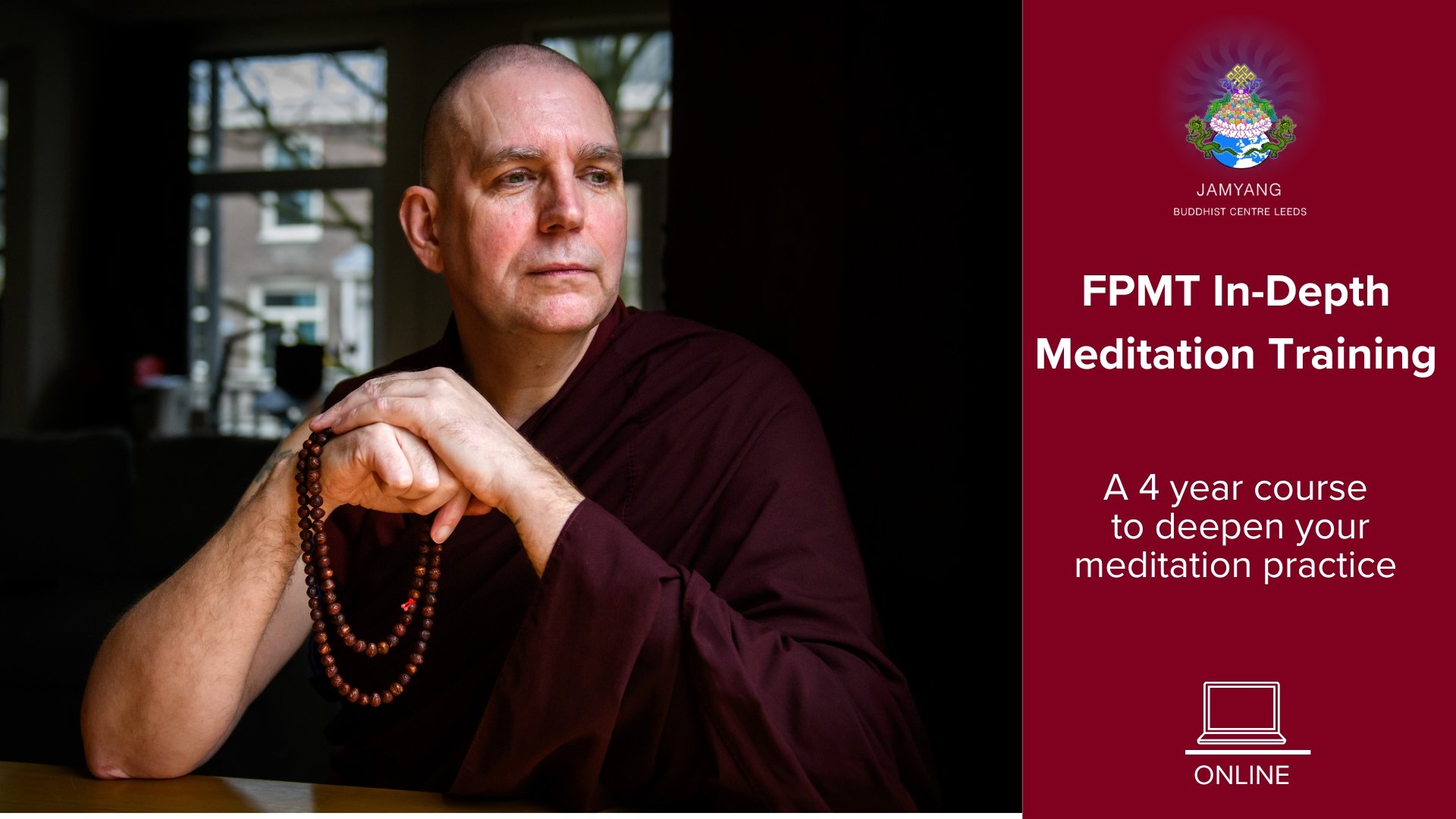
FPMT In-Depth Meditation Training
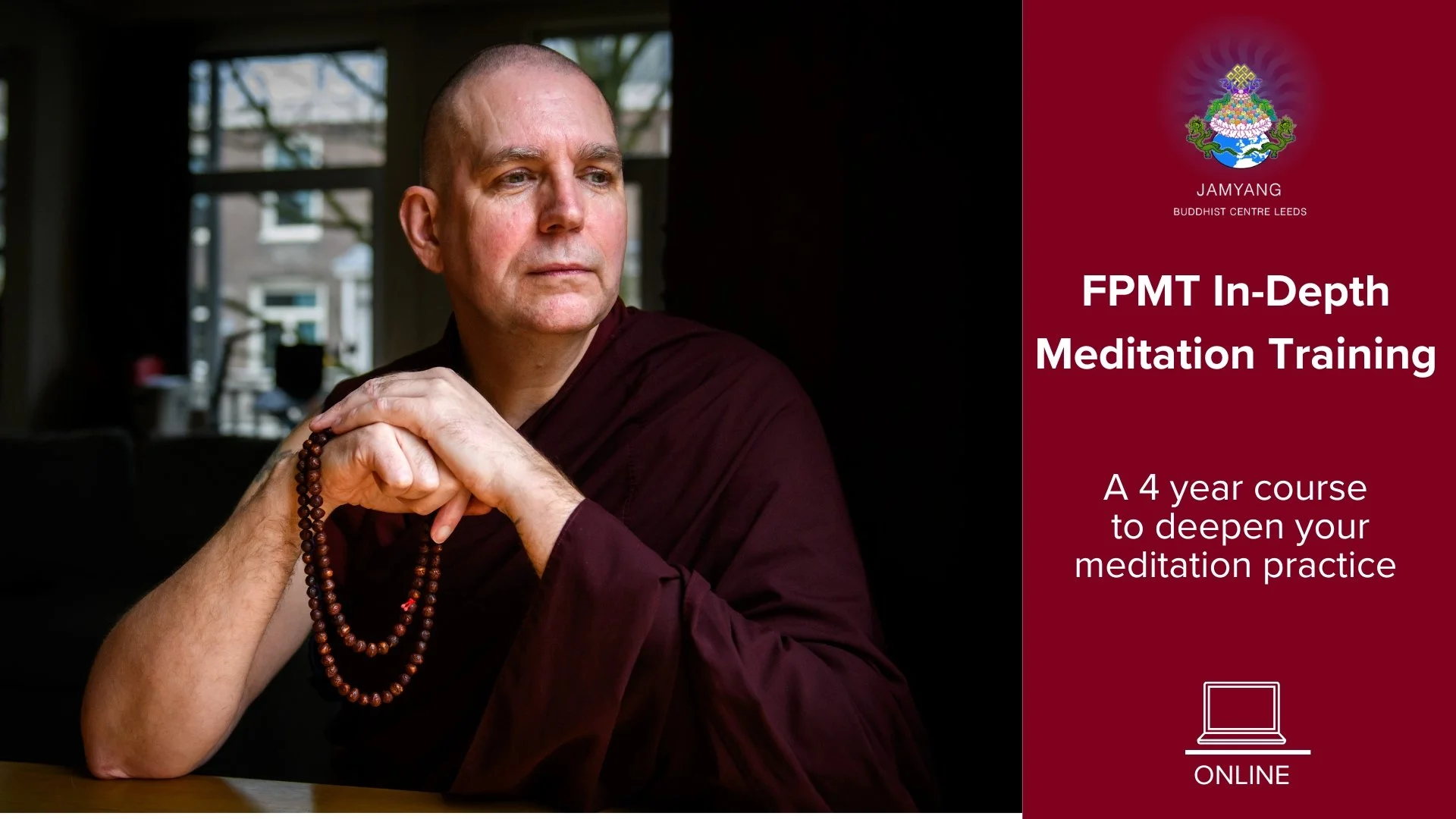
Overview of SESSION
DATE: 2026 / 2027: Year 4
Term 1: September 5th to November 28th 2026
If you are starting as a new student in year 4, don’t worry. You will get some preparatory advice on what previous recordings to have a listen to. Alternatively you may wish to join the new Ngondro Lamrim Meditation course for 2 years before starting In Depth Meditation Training. They are designed to be complementary.
TIME: Saturdays weekly 2:30pm – 5pm UK time
LOCATION: Zoom only
LEVEL: Buddhist Meditation – Intermediate to Advanced
IDMT Year Four, The Vajra Ground: Mahamudra and Kriya Tantra
In this culminating fourth year of our journey, our path turns inward to the mind itself—its empty, luminous nature—and outward to the transformative methods of tantra, where the naturally pure nature of our perception is recognized as the very ground of awakening.
As always, the year will start with generating the mind of awakening, using evocative instructions ranging from Langri Thangpa to Nāgārjuna and Lord Buddha in the famous Bodhisattvapiṭaka. This mind generation we'll cultivate through the four immeasurable thoughts and the support of calm abiding.
Illuminated by the life stories of the masters of the Gelug Mahāmudrā lineage and beyond, we'll explore its roots in the history of the early Indian Mahāsiddhas, such as Saraha and Tilopa, through the Kagyü master Gampopa's and Je Tsongkhapa's Mañjuśrī lineage up to Paṇchen Losang Chökyi Gyaltsen's Highway of the Conquerors and its perspective on this practice. In Sūtra Mahāmudrā we will practice resting attention in the empty nature of awareness, recognizing its clarity and openness as inseparable.
Kriyā Tantra offers a complementary method. Rather than suppress the ordinary, narrow self-narrative that we impose on ourselves and our world, it substitutes for it an extraordinary perspective of pure view. Occasionally, by way of introduction, we'll also taste practices from the higher tantras—glimpsing how afflictive emotions can be met as innate wisdom, and how the dissolution of the death process opens onto the innate mind of clear light. The structured practices of generation and recitation become a rehearsal for transformation, training perception to meet appearances as pure.
These methods rest on a relationship. We will therefore examine the practice of guru devotion candidly—both as the means by which the lineage's realization is transmitted and as a practice with real pitfalls, requiring discernment as much as trust. Through the Ganden Lha Gyāma, the Yoga of the inseparability of guru and Avalokiteśvara, and supporting sādhanas, devotion is approached not as deference but as the ethical road toward the state of Vajradhara: the full integration of wisdom and method.
This final year is an invitation to let realization ripen into a way of being. Grounded in bodhicitta and the four immeasurables, sustained by the preliminary practices, and held by the strength of community, we learn to meet the mind without grasping and to meet the world as pure appearance. Our aim is not to accumulate practices, but to bring the path to maturity—wisdom and compassion no longer cultivated separately, but lived as one.
This four-year online course provides students with long term, in-depth support in their meditative development.
The teacher and course developer is Venerable Losang Gendun. He has trained extensively in meditation in both Theravada and Mahayana Traditions
The In Depth Meditation Training course is also part of The Buddha Project led by Venerable Losang Gendun. You can find out more about Venerable Gendun, the course and who it is suitable for on our FPMT In-Depth Meditation Training webpage
If you have any questions you would like to ask before registering please email our In-Depth Meditation Coordinator Marie Odile on idmt@jamyangleeds.co.uk
The zoom link and all materials for the course are provided to registered students.
Donations:
Generosity is one of the cornerstones of the Buddhist path. With your donation we support The Buddha Project and we keep our centre going for the benefit of all sentient beings.
As the course is a collaboration with other FPMT centres it is not possible to offer this as part of our Jamyang Leeds membership programme.
The recommended donation per calendar month is £45.
If you are able to practice generosity and sponsor other students we recommend £58 per calendar month.
If you are on a reduced income it is £31 per calendar month.
There is also the option to donate annually.
If none of the above options are affordable please do still register, we never turn anyone away from the Dharma for financial reasons and we can agree a donation that is affordable for you right now. Please email Marie Odile our IDMT Coordinator idmt@jamyangleeds.co.uk if you would like to chat.
Relax on Saturdays - Children’s Wellbeing Day
Overview of Session
DATE: 2nd Saturday monthly
TIME: 10:30 am to 11:30 am
LOCATION: In-person
LEVEL: Wellbeing – Children age 6 to 12
COST: £12 Booking essential
These monthly “Relax on Saturdays: Children’s Wellbeing Day” with Joana Gomes are a calm and supportive one-hour sessions where children can slow down and recharge.
Through gentle yoga, simple breathing exercises, mindfulness, and creative activities, children learn easy tools to relax their bodies and minds.
The sessions offer a safe and friendly space where children can build confidence, feel at ease, and learn how to manage their emotions in a positive way.
Designed for primary school-aged children, these sessions support mental health and welbeing in a safe, inclusive environment.
These monthly 1-hour session offer a structured, nurturing space where children can step away from busy routines and learn practical tools to support their welbeing.
Each session includes:
• Children’s Yoga (gentle movement & relaxation)
• Introduction to Mindfulness (simple, age-appropriate techniques)
• Mindful Arts & Crafts
• Breathing and calming exercises
Benefits for your child:
• Improved emotional regulation
• Reduced stress and anxiety
• Increased focus and self-awareness
• Development of kindness and self-compassion
About Joana:
Teaching yoga and mindfulness to children is something I care deeply about.
As both a practitioner and a mother of two young children, I see every day how much these practices can help.
This personal experience shapes the way I teach, helping me create sessions that are simple, engaging, and meaningful for children.
How to Book:
Limited spaces available – booking essential
go to Eventbrite to book or email Joanna directly at childrensyoga.yogime@gmail.com
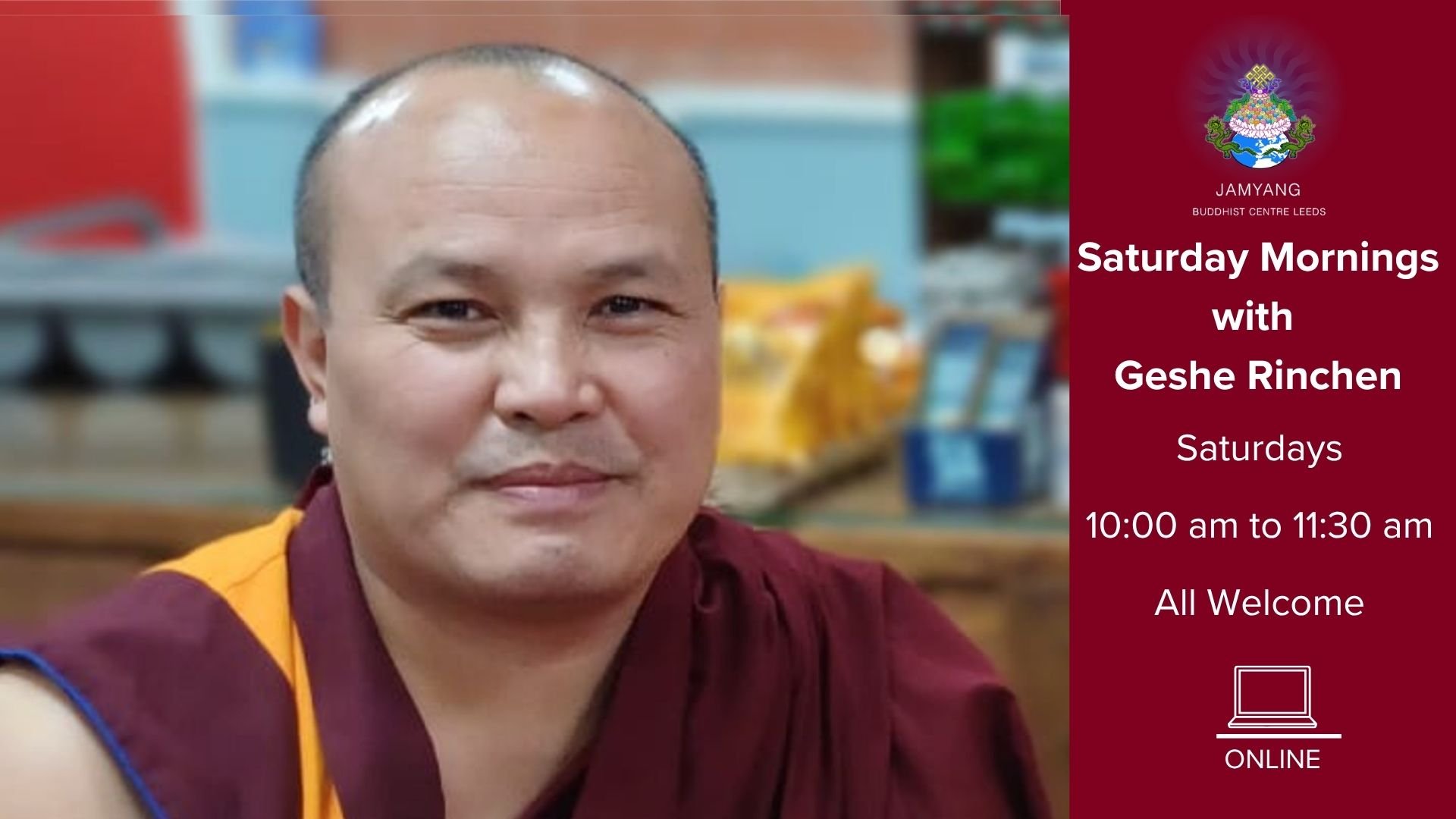
Saturday Mornings with Geshe Rinchen
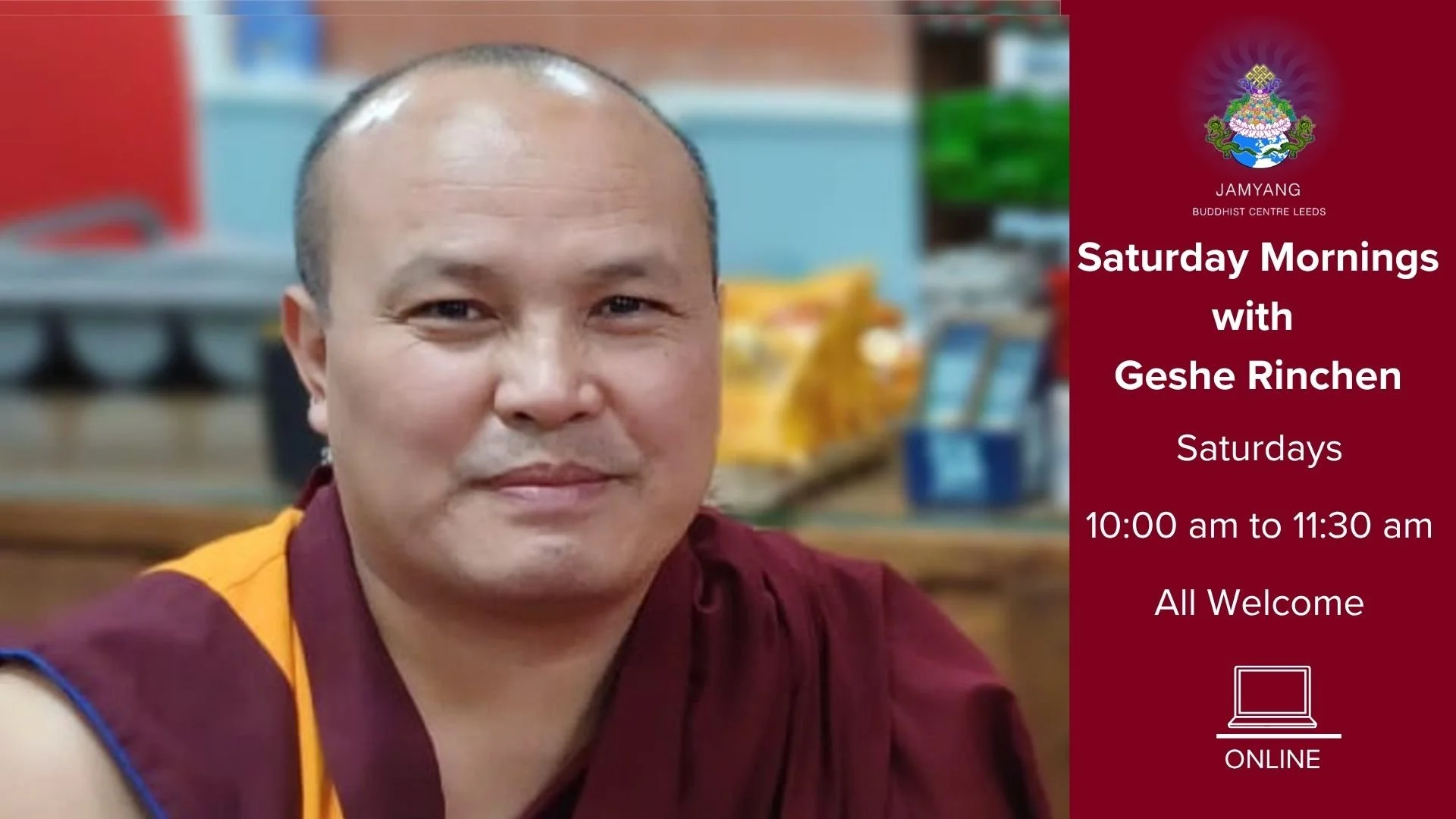
Overview of Programme
DATES: Saturdays weekly 4th July to 28th November
TIME: 10:00 am to 11:30 am
LOCATION: Online
LEVEL: Everyone interested in exploring Buddhism, from beginners to intermediate.
Saturday Mornings with Geshe Rinchen:
Are you curious about Buddhism and want to know more, or perhaps you already have some understanding but would like to expand on your knowledge. If so this Saturday morning class with Geshe Rinchen (Geshe La) is ideal for you. Designed as a drop in class with a different topic each week, covering key concepts in Buddhism and how they can make a real difference in our lives. Such as how we can deepen our connection with others, and how we can live our lives in the present moment. This is a great opportunity to spend time with Geshe La and ask questions.
Online drop in class – no need to register.
SUGGESTED DONATION FOR DROP IN CLASS:
Non-members – £12 per drop in class. This will contribute to the centre’s running costs and include a donation to the teacher.
Gift Aid: if you are a UK taxpayer we can claim back 25p for every £1 you donate. More information on Gift Aid can be found here.
Free to members of The Jamyang Buddhist Centre Leeds (your membership fees already contribute to our core costs in running the centre). You are invited to make a donation for the teacher, as is customary when receiving Buddhist teachings, in order to support their activity. For your reference we recommend a donation in the region of £4 per class. We will make the donation to the teacher on your behalf.
We never turn anyone away from the Dharma for financial reasons. If you cannot donate the suggested amount, please donate where possible within your means. It’s good to practice generosity where we can.
ABOUT YOUR Teacher: Geshe Rinchen Wangyal
Geshe Rinchen has dedicated his life to the study and practice of the Buddha’s teachings. He completed rigorous training in Buddhist philosophy, debate, and meditation, achieving the esteemed title of Geshe, the doctorate degree in the Tibetan Buddhist tradition.
His teachings are known for their clarity, warmth, and practical applicability, making profound topics accessible to students of all backgrounds.
Currently resident teacher at Jamyang Buddhist Centre Leeds, Geshe Rinchen combines his deep knowledge with genuine compassion, inspiring students to cultivate inner peace and wisdom in their own lives.
SESSION RESOURCES:
About this series:
July 2026
4 July – What did the Buddha Discover?
11 July – Buddha Nature – the Seed of Enlightenment
18 July – Understanding the Mind and Mental Factors
25 July – The Story of Milarepa: Transformation and Enlightenment
August 2026
1 August – The Four Noble Truths: An overview
8 August – Understanding Suffering
15 August – The Causes: Karma and Afflictive Emotions
22 August – The End of Suffering: What is Possible?
29 August – The Path: A Practical Way Forward
September 2026
5 September - Calm Abiding (Samatha)
12 September - Insightful Meditation (Vipassana)
19 September - the Mind of Awakening (Bodhicitta)
26 September – The Wisdom of Emptiness
October 2026
3 October – The Two Accumulations: Merit and Wisdom
10 October – Offering to the Three Jewels
17 October – Circumambulation Practice
24 October – Prostration Practice
31 October – Reciting Mantras and Their Benefits
November 2026
7 November – Introduction to Visualisation Practice
14 November – Medicine Buddha Practice
21 November – Tara Practice
28 November – Establishing Daily Practices
Who This Course Is For:
This is a wonderful opportunity to hear Geshe La teach each weekend online and to ask him questions.
These topics have been carefully selected for beginners,
They are also very suitable for all students of Buddhism to refresh and expand on their understanding.
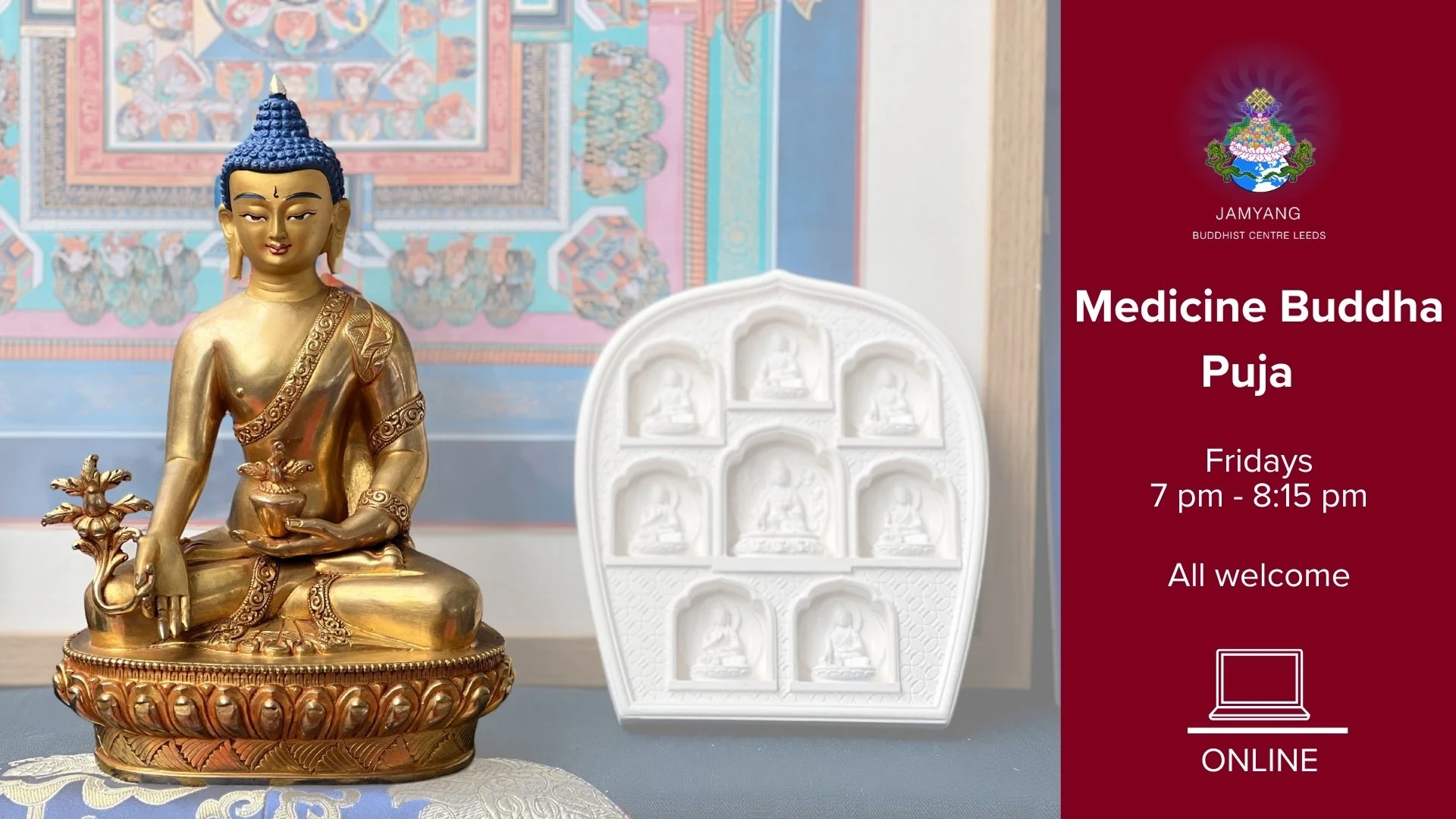
Medicine Buddha Puja
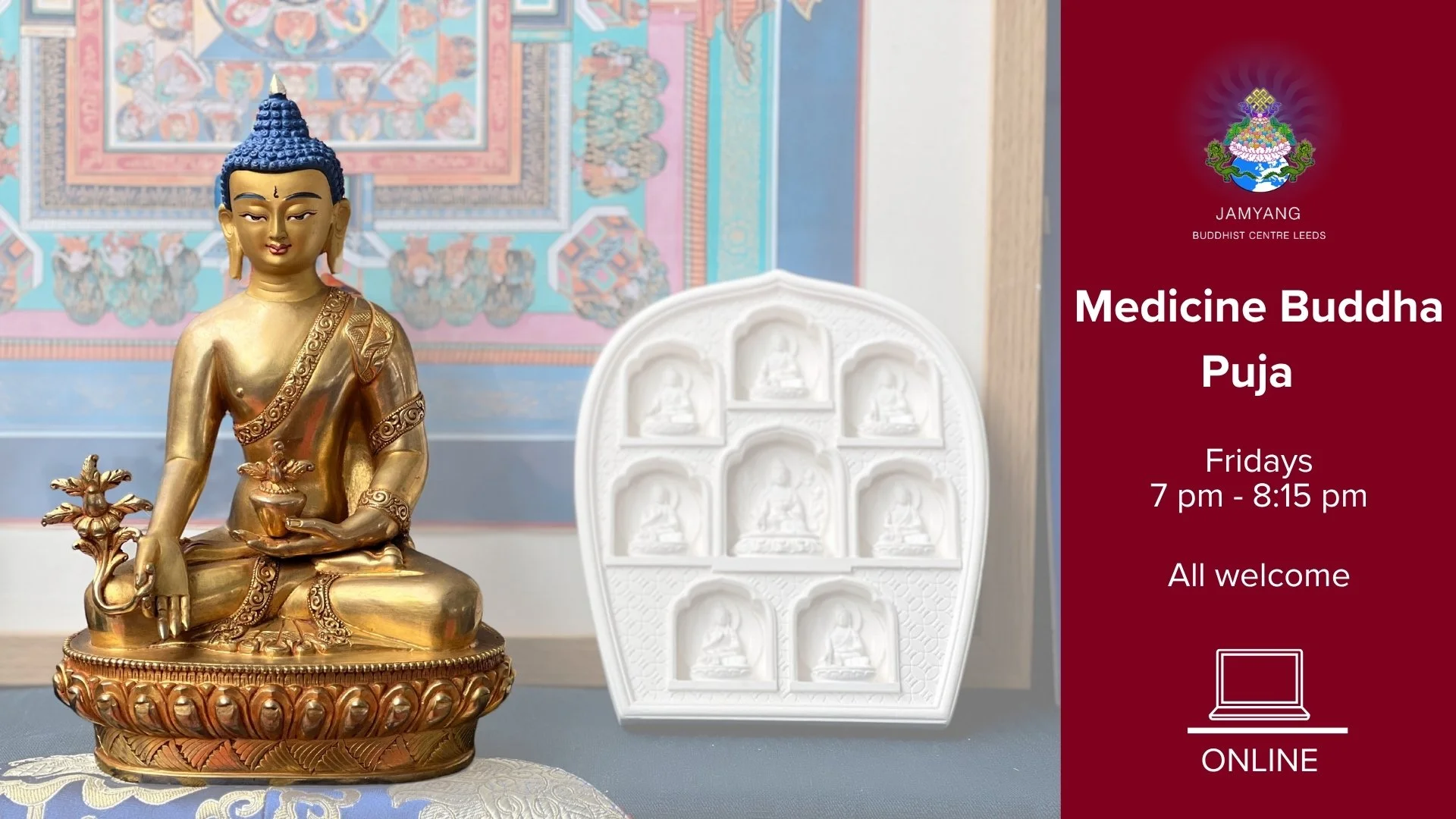
Overview of Medicine Buddha Puja
Medicine Buddha is one of the practices recommended by the FPMT for students to do for the swift return of Kyabje Lama Zopa Rinpoche.
DATE: FRIDAYS
TIME: 7 pm to 8:15 pm
LOCATION: Zoom
LEVEL: Buddhist Practices – All Welcome
SUGGESTED DONATION: £6
This is a longer meditation on Medicine Buddha – to remove obstacles, esp. those relating to health and achieving a favourable rebirth, and activate a swift path to enlightenment.
As Lama Zopa Rinpoche said: “One of the best healing meditations is that on the Medicine Buddha, who is the manifestation of the healing energy of all enlightened beings.”
The puja involves chanting prayers to the Seven Medicine Buddhas and reciting the Medicine Buddha mantras.
It is kindly led by Sande
Annual General Meeting
Annual General Meeting
The meeting is open to our whole community and members of the public, and we welcome anyone interested in the Centre to attend, hear about our work and share their questions.
DATE: Friday 9th October
TIME: 1 pm to 3 pm
LOCATION: In person and Zoom
Dear friends,
You are warmly invited to the Annual General Meeting (AGM) of Jamyang Buddhist Centre Leeds. Our AGM is an opportunity to come together, reflect on the past year, hear reports on the Centre’s activities and finances, and look ahead to our plans for the future. The meeting is open to our whole community and members of the public, and we welcome anyone interested in the Centre to attend, hear about our work and share their questions.
AGENDA
Motivation
Welcome and apologies for absence
Minutes of last AGM and Matters Arising
Annual Report for the Centre, including:
Chair’s Report
Treasurer’s Report
Director’s Report
SPC’s Report
Other reports
Strategic Plan - update on progress
Successes & Challenges
Resignation and Appointment of Trustees
Any Other Business
Dedication
We look forward to seeing you and celebrating another year of our community together.
With warm wishes,
The Jamyang Leeds team
White Umbrella Deity practice
Overview of practice
DATE: Fridays
TIME: 11:30 am to 12:00 pm
LOCATION: Please note this is online only
LEVEL: Buddhist Practices – see note below
SUGGESTED DONATION: £4
In September 2024, His Eminence Ling Rinpoche gave us this practice to overcome obstacles to the centre flourishing.
In addition to many benefits of engaging in these practices, Lama Zopa Rinpoche recommended that these two practices are beneficial to helping bring peace to situation between Israel and Palestine.
The Sanskrit name for the White Umbrella deity is Ushnisha Sitatapatra which can also be translated as “The Victorious White Parasol.” The White Umbrella Deity, [Skt. Sitatapatra, Tib. gdugs dkar] is a powerful female deity. She is relied upon for protection; healing illness; dispelling interferences, spirit possession, and harmful forces; quelling disasters; averting obstacles; and bringing auspiciousness.
Ushnisha Sitatapatra is a female form of Avalokiteshvara, the Bodhisattva of Compassion. Like this Bodhisattva in an elaborate form, she also has a thousand eyes that watch over living beings, and a thousand arms that protect and assist them. Thus she symbolizes the power of active compassion.
Practices of Arya Sitatapatra includes, “The Supreme Accomplishment of Sitatapatra,” and “Praises and Repelling Practices of Sitatapatra.”
Vinyassa Flow Yoga with Giulia
Overview of Session
DATE: Friday weekly
TIME: 10:00 am to 11:00 am
LOCATION: In-person
LEVEL: Everyone welcome - Drop In class
COST: Pay as you feel, everything will be donated to support Jamyang Buddhist Center
About the Class:
These Vinyassa Flow Yoga classes are designed to build strength, stability and balance, both physically and mentally, through creative sequencing and a grounding focus on breath.
This drop in class is suitable for everyone
About the Teacher - Giulia Ferrari:
Giulia is a yoga teacher with a passion for empowering people through dynamic, energising movement and mindful breathing. She strives to create a supportive, inclusive space where students feel safe to express themselves, open their hearts and release what no longer serves them.
With a background in ballet and a passion for rock climbing, Giulia’s approach blends grace, strength, and playful energy. She first came to yoga 20 years ago during a time of difficulty and anxiety, and it became a source of healing and resilience. That transformative experience made Giulia want to give back by sharing the acceptance and encouragement she received through the practice.
In 2025, Giulia completed 200-hour Yoga Flow teacher training at Yoga Hero in Leeds. Outside of the studio, she works as a veterinary surgeon. Giulia’s other passions are the mountains and the great outdoors, and you'll often find her ice or rock climbing when she is not on the mat.
Whether through movement, breath, or stillness, Giulia’s goal is to help you reconnect with yourself, feel empowered, and move through life with greater ease.
Contact:
All enquiries to Giulia on mountainsyoga@gmail.com
Shamatha – Meditation on the Breath
Overview of Session
DATE: Fridays
TIME: 7am-7:30am
LOCATION: Zoom
LEVEL: All Welcome
SUGGESTED DONATION: £4
Led by Ruth
Mindfulness of Breathing is universally acknowledged to be of benefit to all living in the modern world. Many feel overloaded with all that is expected of us living this complex and exhausting existence. Developing our awareness in this way is a general prescription for soothing and healing the overworked body and mind.
Practicing focusing the attention on an object such as the breath is also a core practice in Tibetan Buddhism. Gradually over time we are able to hold the object of our attention over longer periods, which enables us to practice other meditations such as Vipassana more successfully.
Kalachakra Practice group
Overview of practice
This is a restricted group for those who have received the Kalachakra empowerment from a qualified Lama. To join the group you need to have either received the full Kalachakra empowerment or another High Yoga Tantra empowerment such as Heruka, as long as you have received a Kalachakra Jenang (permission).
This international group of Kalachakra practitioners meets weekly and alternates with commentary and practice.
Mind Mandala once a month and six session guru yoga for other sessions:
If you’re already part of this group, please use the details sent in the weekly email to join the practice
If you’d like to join us, please email spc@jamyangleeds.co.uk confirming that you have the appropriate empowerments. You will then be sent a registration form to complete.
Kshitigarbha Practice
Overview of Kshitigarbha practice
DATE: Tuesdays & Thursdays
TIME: 12pm-12:30pm
LOCATION: Zoom only
LEVEL: Buddhist Practices – All Welcome
SUGGESTED DONATION: £4
Lama Zopa Rinpoche (our organisation’s Spiritual Director) suggested Jamyang Leeds perform these practices to help with the financial obstacles we are currently having. From September 2022, we’ll be reciting this practice as much as we can. See the special newsletter explaining all about the practice here.
Chanting the Verses of Noble manjushri
Overview of Session
DATE: Thursdays
TIME: 7:45am to 8:25 am
LOCATION: Zoom only
LEVEL: Buddhist Practices – suitable for Lama Zopa Rinpoche’s students
Join us to fulfill His Holiness the Dalai Lama’s wishes and chant the Names of Noble Manjushri for the swift return of Lama Zopa Rinpoche.
Please come along even if you havent done the practice before, its quite wonderful and very energising. Please download the text below, you can also listen and practice with the audio clip of Lama Zopa Rinpoche reciting the Chanting the Names of Noble Manjushri.
the eight verses of thoughts transformation
Overview of the eight verses of thoughts transformation
Everflowing Nectar of Bodhichitta – Annihilating the Demon of the Self-Cherishing Mind
DATE: Wednesdays
TIME: 7am-7:30am
LOCATION: Zoom
LEVEL: Buddhist Practices- All Welcome
SUGGESTED DONATION: £4
Everflowing Nectar of Bodhichitta – Annihilating the Demon of the Self-Cherishing Mind
Led by Di or Sande
This practice is based on the short text” Eight Verses of Thought Transformation”, which contains the entire technique for transforming the mind into relative bodhichitta (i.e., the wish to achieve enlightenment for the benefit of all sentient beings) and absolute bodhichitta (i.e., the wisdom realizing emptiness).
Vajrasattva Practice
Overview of The Vajrasattva Practice
DATE: Tuesdays
TIME: 8:00pm-8:30pm
LOCATION: Zoom
LEVEL: Buddhist Practices – All Welcome
SUGGESTED DONATION: £4
Purification here means looking at our past unskillful actions which have created seeds of negative karma in our minds, and using visualisation and mantra recitation to remove those seeds in a healthy and productive way. Vajrasattva is the embodiment of all the Buddha’s cleaning and purifying energy. We all make mistakes, and how we deal with them is key to making spiritual progress. We’ll be using a short text composed by Lama Zopa Rinpoche
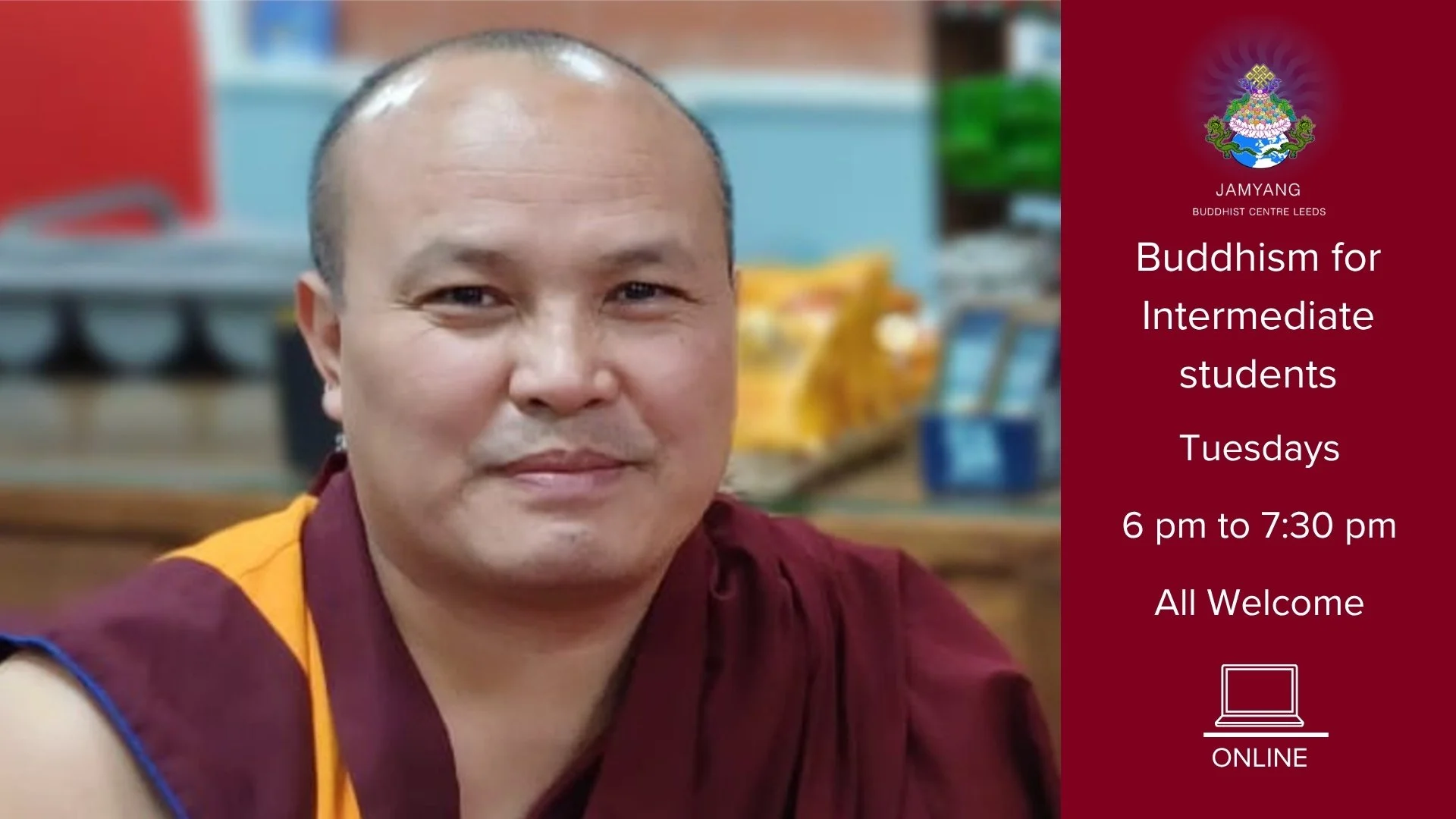
Buddhism for Intermediate Students
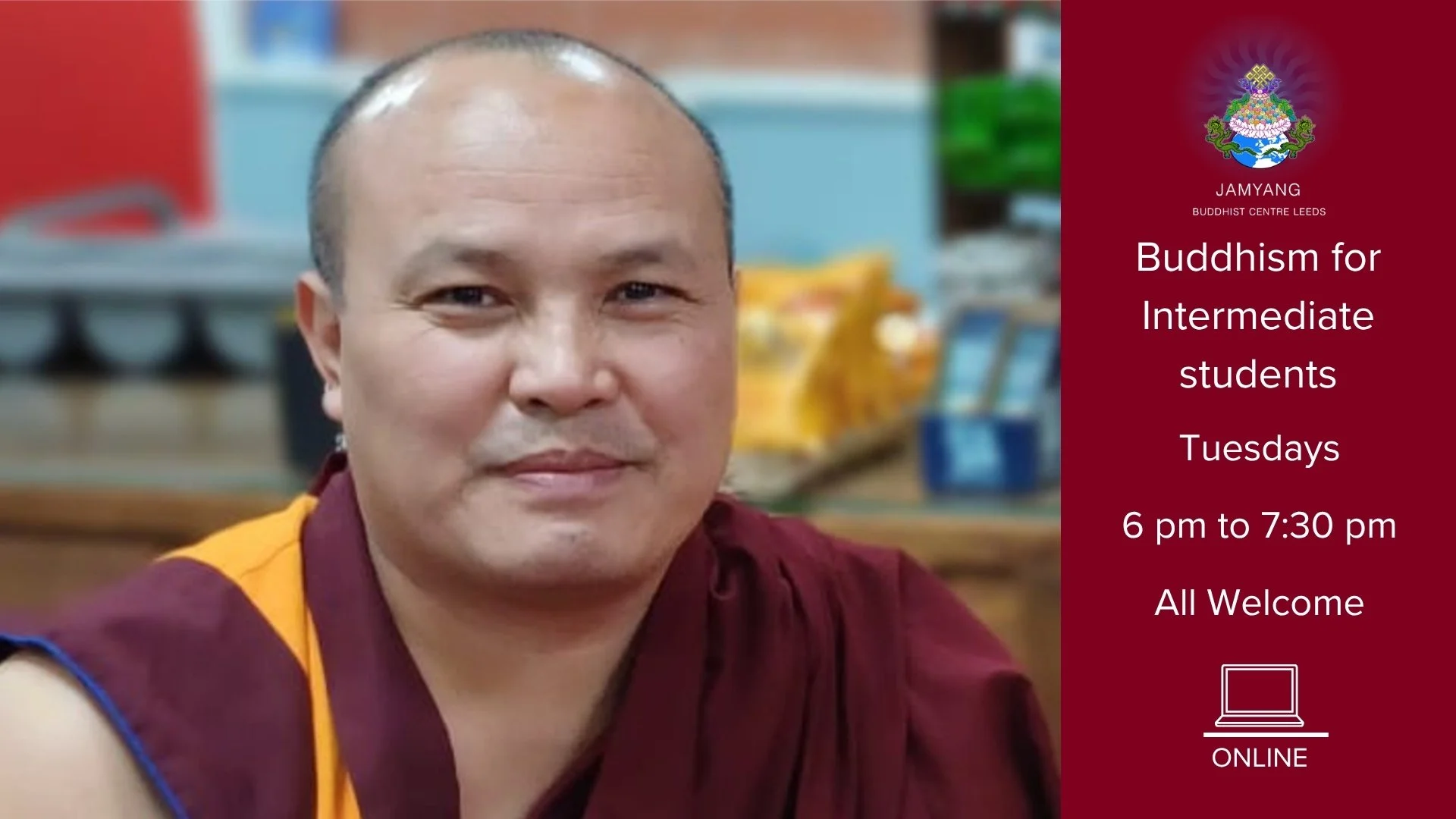
Overview of Programme
DATES: Weekly sessions 7th July to 24th November
TIME: Tuesday weekly 6:00 pm to 7:30 pm
LOCATION: Online
LEVEL: Intermediate students of Buddhism and those interested in Buddhist philosophy
Buddhism for Intermediate students:
This series of teachings aims to provide a comprehensive understanding of key Buddhist texts and practices, offering both theoretical knowledge and practical guidance for those interested in deepening their spiritual practice. Each monthly session is carefully designed to build a holistic understanding of Buddhist philosophy and meditative practices.
This series of sessions will focus upon the key text: Illuminating the Intent: An Exposition of Chandrakirti’s Entering the Middle Way.
Online drop in class – no need to register.
SUGGESTED DONATION FOR DROP IN CLASS:
Non-members – £12 per drop in class. This will contribute to the centre’s running costs and include a donation to the teacher.
Gift Aid: if you are a UK taxpayer we can claim back 25p for every £1 you donate. More information on Gift Aid can be found here.
Free to members of The Jamyang Buddhist Centre Leeds (your membership fees already contribute to our core costs in running the centre). You are invited to make a donation for the teacher, as is customary when receiving Buddhist teachings, in order to support their activity. For your reference we recommend a donation in the region of £4 per class. We will make the donation to the teacher on your behalf.
We never turn anyone away from the Dharma for financial reasons. If you cannot donate the suggested amount, please donate where possible within your means. It’s good to practice generosity where we can.
ABOUT YOUR Teacher: Geshe Rinchen Wangyal
Geshe Rinchen has dedicated his life to the study and practice of the Buddha’s teachings. He completed rigorous training in Buddhist philosophy, debate, and meditation, achieving the esteemed title of Geshe, the doctorate degree in the Tibetan Buddhist tradition.
His teachings are known for their clarity, warmth, and practical applicability, making profound topics accessible to students of all backgrounds.
Currently resident teacher at Jamyang Buddhist Centre Leeds, Geshe Rinchen combines his deep knowledge with genuine compassion, inspiring students to cultivate inner peace and wisdom in their own lives.
SESSION RESOURCES:
About this series:
The great Tsongkhapa wrote three profound texts on Madhyamika philosophy and practice:
The Essence of True Eloquence,
Ocean of Reasoning,
Illuminating the Intent.
Illuminating the Intent is one of these masterpieces, completed shortly before he passed into parinirvana. It is perhaps the most profound text ever written by a Tibetan scholar on Madhyamika philosophy and practice, guiding readers to both understand emptiness intellectually and apply its insights in daily life.
Nagarjuna composed the Fundamental Wisdom of the Middle Way, on which Chandrakirti later wrote his commentary, Entering the Middle Way. Since Chandrakirti’s work consists only of verses, Je Tsongkhapa composed a detailed commentary, making Illuminating the Intent an essential guide for understanding Nagarjuna’s root text. The primary theme of these texts is emptiness—what it is and how to practise it effectively.
Why This Text Matters:
Je Tsongkhapa’s text is invaluable for anyone seeking to understand reality, the self, the nature of the mind, life, the root causes of suffering, and consciousness. Studying it helps uncover practical methods to overcome suffering, find meaning in life, and apply these teachings in daily living.
About the Great Tsongkhapa:
The great Tsongkhapa (1357–1419) was a true genius in interpreting and practising Mahayana teachings as laid down by the ancient Indian Nalanda masters. He founded the Geluk tradition of Tibetan Buddhism, which emphasises both rigorous intellectual analysis and practical application of the Buddha’s teachings, following the approach of the Nalanda masters.
Who This Course Is For:
This course is suitable for both practitioners and academics, as well as anyone with a keen interest in Madhyamika philosophy and the practice of emptiness. In class, we will engage with the text through reading and giving explanation page by page following the Tibetan monastic educational tradition. At times, we will also participate in monastic-style debate to clarify the meaning and implications of the text. This approach allows participants to explore the material both intellectually and practically.
Kshitigarbha Practice
Overview of Kshitigarbha practice
DATE: Tuesdays & Thursdays
TIME: 12pm-12:30pm
LOCATION: Zoom only
LEVEL: Buddhist Practices – All Welcome
SUGGESTED DONATION: £4
Lama Zopa Rinpoche (our organisation’s Spiritual Director) suggested Jamyang Leeds perform these practices to help with the financial obstacles we are currently having. From September 2022, we’ll be reciting this practice as much as we can. See the special newsletter explaining all about the practice here.
Cancelled: Tech Tuesday with Steve
Overview of Session
DATE: 1st Tuesday monthly
TIME: 10 am to 2pm
LOCATION: In-person ( online appointments can be arranged)
LEVEL: Everyone
COST: Donation for Sangha
Are you struggling with your computer?
Are there things you would like to know more about e.g. email or browsing the internet?
Have you got questions about how it works?
We will be running a monthly workshop on the first Tuesday of every month starting in January, bring your computer plus the charger to the session and we can go through any questions or issues you have.
The workshop is being run by Steve Holton who has 30 years experience in the IT industry, is Microsoft qualified and is keen to help you. He can also look at Apple devices.
Tonglen Loving Kindness meditation Practice
Overview of Tonglen Meditation
The Buddhist practice of Giving & Taking (Tonglen in Tibetan) is at its heart a selfless meditation of loving kindness and compassion.
DATE: Tuesdays
TIME: 7am-7:30am
LOCATION: Zoom
LEVEL: Buddhist Meditation – All Welcome
SUGGESTED DONATION: £4
A beautiful practice led by Chrissie and Di.
The Buddhist practice of Giving & Taking (Tonglen in Tibetan) is at its heart a selfless meditation of loving kindness and compassion. You imagine giving all your happiness to others, sometimes using visualisation with the breath, and then taking all the suffering and its causes from others. It’s a powerful practice for the brave-hearted!
Yamantaka Study Group
Overview of SESSION
This study group is for those who have received the empowerment to practice Solitary Hero Vajrabhairava/Yamantaka.
If you have an interest in joining the study group please email yamantakagroup@gmail.com to register.
The Yamantaka study group is held on the first or second Monday monthly at 6pm.
Yamantaka Practice Group
Overview of SESSION
This is a restricted practice, for those who have received the empowerment to practice Solitary Hero Vajrabhairava/Yamantaka.
If you have an interest in joining the group please email yamantakagroup@gmail.com to register.
The Yamantaka practice is held on the Mondays weekly. Please note that some weeks it starts at 2:30pm and some at 6pm it doesn’t always alternate weekly.
Lunchtime Meditation
Overview
Make the most of your lunchtime with a guided meditation session to help calm your mind. These secular meditation sessions are a great way to relax and create some space for reflection in the middle of your day.
DATE: Monday- Friday
TIME: 12:30pm-1pm
LOCATION: Online all week and In person Tuesday and Friday
LEVEL: Wellbeing Programme – All levels
Pause, take a breath, and give yourself the midday reset you deserve.
Our lunchtime meditation sessions offer a gentle sanctuary right in the middle of your busy day—a dedicated space to slow down, drop your shoulders, and reconnect with yourself. Guided by a variety of our experienced, friendly meditators, these sessions focus on simple, relaxing breathwork designed to clear your mind, soothe your nervous system, and restore your inner energy.
Whether you are completely new to meditation or have been practicing for years, you are warmly invited to join us just as you are.
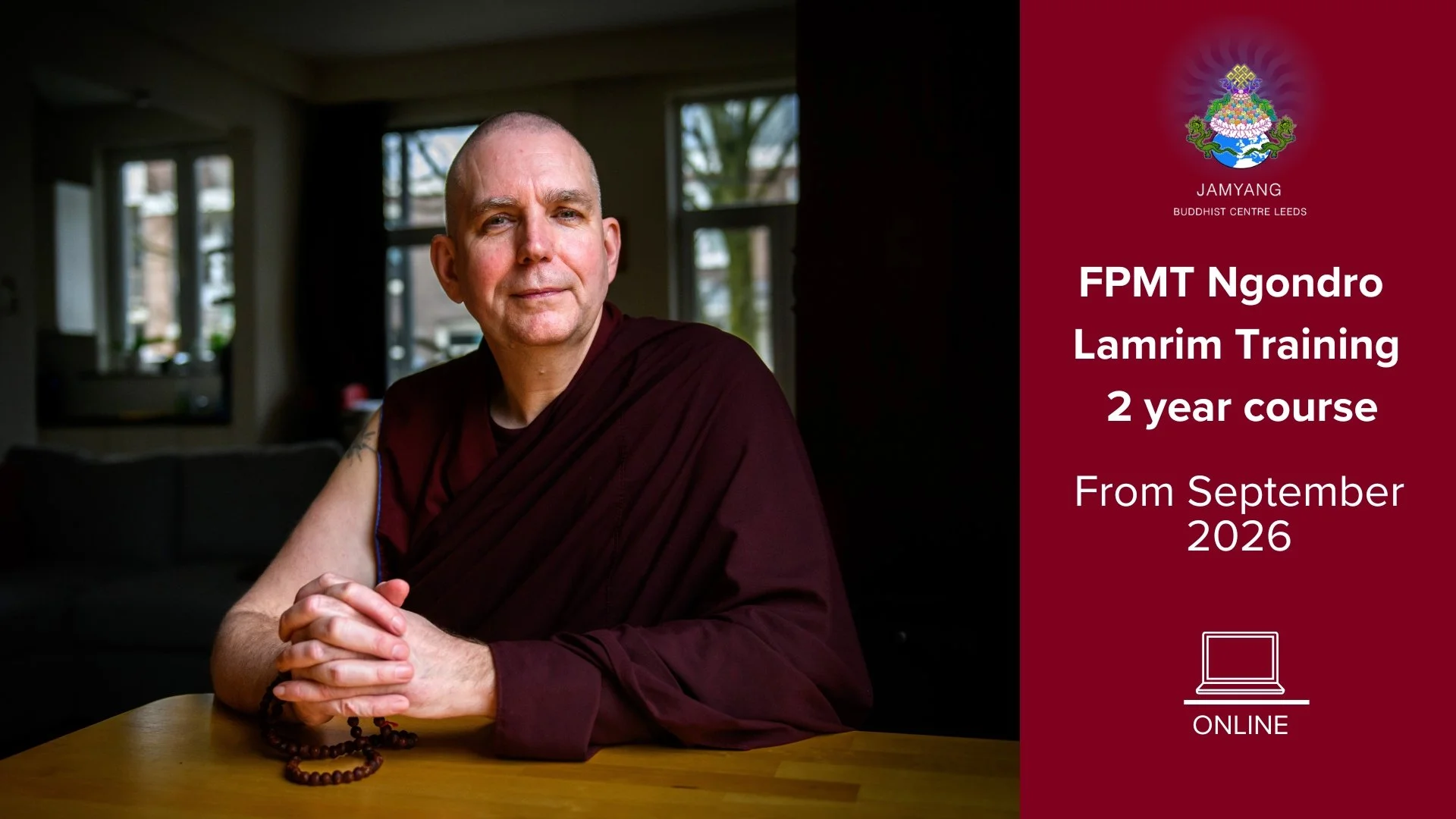
FPMT Ngondro Lamrim Training
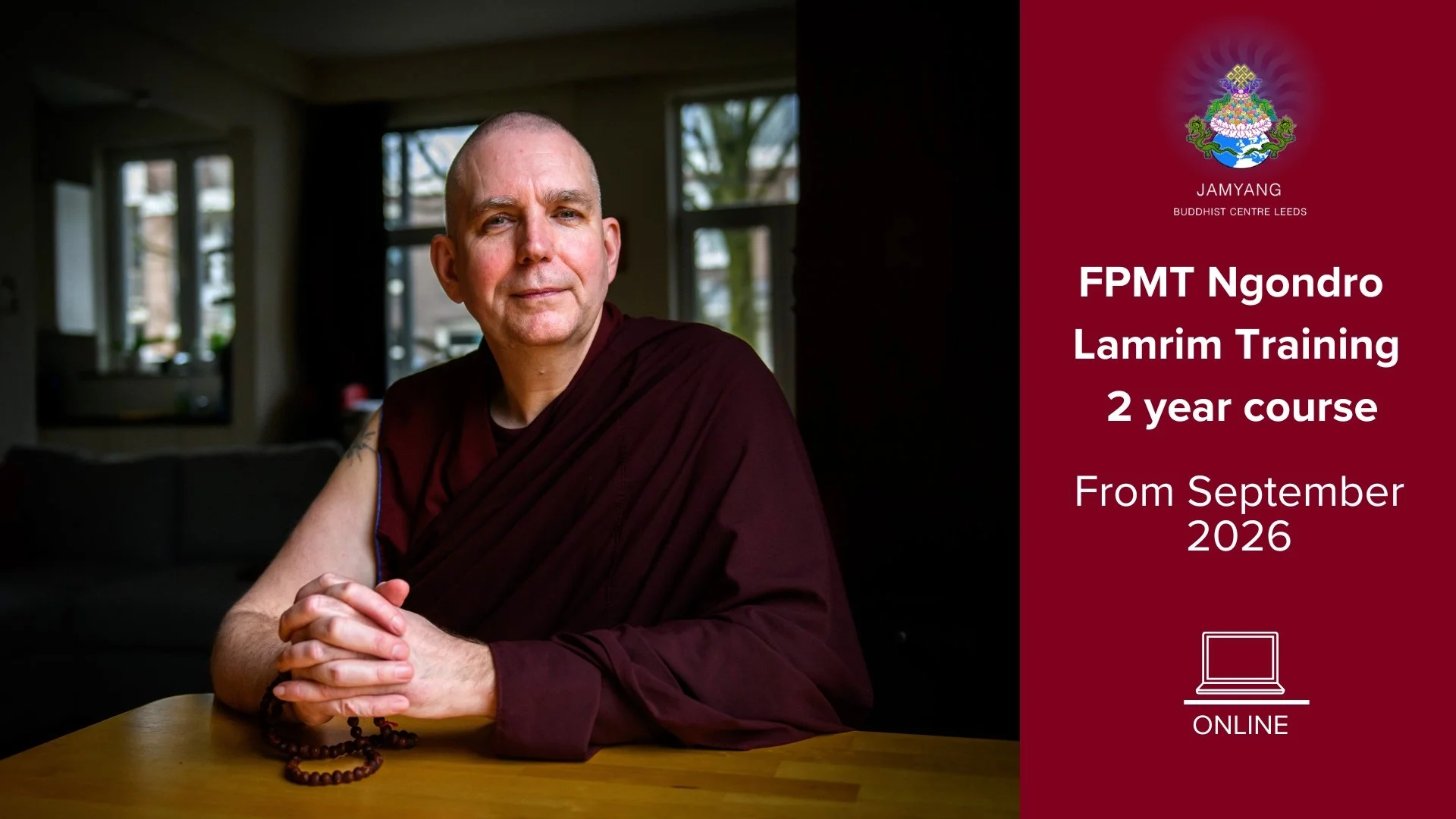
Overview of SESSION
DATE: 2026 / 2027: Year 1
Term 1: September 14th to November 28th 2026
Over a period of two years, the FPMT Ngöndro Lamrim Training (NLRT) offers 16 months of training in the common and uncommon preliminary practices. The training is designed to generate the motivation that supports the development of calm abiding, special insight, and tantra. By cultivating the inner qualities needed to ease unskillful patterns of mind that are the cause of hindrances on the path, it facilitates deep transformation.
An excellent preparation for the FPMT In-Depth Meditation Training (IDMT)
LOCATION: Recordings are released weekly
LEVEL: Buddhist Preliminary Practices
About the Course:
The Lamrim — "Stages of the Path" in Tibetan — is a systematic presentation of the entire Buddhist path to Awakening, written by the great Tibetan master Je Tsongkhapa in the 14th and early 15th century, based on writings of the Indian master Atisha. It arranges every essential teaching of the Buddha into a single, coherent, graduated sequence tailored to your mind, exactly as it is right now. Its true power lies not in study alone, but in practice. Each teaching is carefully arranged to meet the mind where it is and guide it—step by step—toward genuine change.
The uncommon preliminary practices (ngöndro) are powerful methods to purify the mind and prepare it for lasting transformation.
Over the first eleven months the common foundations, renunciation, bodhicitta, and the view of emptiness, are explored based on the Lamrim. For the remaining five months the focus is on the uncommon practices, Vajrasattva purification, mandala offerings, and guru yoga. Weekly sessions each introduce a new topic that examines different ways to meditate and why, in combination with a guided meditation.
The training helps establish a consistent daily meditative practice in supports of its overall aim: to engage in contemplative meditation in a way that genuinely transforms the mind's outlook on the world and gives one's life a new direction. Students gain a deep understanding of how to accumulate merit and purify unskillful karma while cultivating a healthy relationship with the Three Jewels and their teacher. The emphasis is on learning to meditate in a personally tailored way, in accordance with one’s psychological makeup and life conditions.
The Ngondro Lamrim Training teaching sessions are pre-recorded.
Each week, a 90-minute teaching together with two guided meditations are uploaded. On other days, advanced students contribute additional guided meditations. The teacher, Venerable Gendun, offers regular online Q&A sessions. For those who have already studied the Lamrim or the FPMT Basic Program, the training also offers specialized opportunities to learn how to guide others in meditation.
Year 1: Definite Emergence and Mind of Awakening
Prepare the mind for śamatha, vipaśyanā, and tantra
Explore renunciation and bodhicitta, the first two Principles of the Path
Develop genuine urgency through Lamrim contemplation
Cultivate the aspiration to Awakening for all beings
FPMT Ngondro Lamrim Taining is also part of The Buddha Project led by Venerable Losang Gendun. You can find out more about Venerable Gendun, the course and who it is suitable for on our FPMT Ngondro Lamrim Training webpage
If you have any questions you would like to ask before registering please email our In-Depth Meditation Coordinator Marie Odile on idmt@jamyangleeds.co.uk
All materials for the course are provided to registered students.
Donations:
Generosity is one of the cornerstones of the Buddhist path. Donations help support both the centre and The Buddha Project as well as providing a donation for the teachings to Venerable Gendun. There are different levels depending on your income. There are three terms a year, each approximately 3 months long
As the course is a collaboration with other FPMT centres it is not possible to offer this as part of our Jamyang Leeds membership programme.
For those with a regular income the recommended donation is £95 per term
The sponsorhsip level is £115 per term
Ordained Sangha are free
If this isn’t affordable please do register, we never turn anyone away from the Dharma for financial reasons and we can agree a donation that is affordable for you at the current time. Please email Marie-Odile our IDMT Coordinator idmt@jamyangleeds.co.uk if you would like to chat.
Lama Choepa (Guru Puja) and Tsog
Overview of Session
DATES: 2026: 13th January; 11th February; 13th March; 26th April; 12th May; 10th June; 24th July; 8th August; 21st September; 5th October; 4th November; 3rd December
TIME: 60 - 90 minute sessions, start time varies
LOCATION: In Person and Online
LEVEL: Buddhist Ceremonies – All Welcome
Dedicated to the Swift return of Lama Zopa Rinpoche as a bright, unmistaken child.
During the practice of Lama Choepa, we invoke all the lamas of the graduated path lineage, beginning with Shakyamuni Buddha himself, extending to our present direct teachers who have shown us the path. We pay homage to them, make offerings, and request each of them to please bless our minds with the same realizations that they themselves have generated. By offering sincere, heartfelt requests, we make our minds ripe to receive the full blessings of this precious lineage and quickly actualize the realizations we need to attain enlightenment. If we wish to experience realisations quickly, the practice of Lama Choepa is indispensable.
“If you are able to do the practice of Guru Puja in your daily life, it contains all the important points of sutra and tantra. It is a complete practice, and it shows the heart of the instruction of Lama Tsongkhapa’s tradition. Even if one can’t do much else in daily life, Guru Puja is the essential practice.”
Open to all Buddhists, no empowerments needed.
Please arrive early and bring flowers, incense, vegetarian food and drink as offerings for the altar.
More information can also be found on this FPMT page.
Morning Prayers
Overview
Start the day by joining us for Morning Prayers recommended by Lama Zopa Rinpoche and HH Dalai Lama, for the benefit of all sentient beings and the swift return of Lama Zopa Rinpoche. Everyone is welcome.
DATE: Monday – Friday all year around
TIME: 8:30am - 9:00am
LOCATION: Zoom
LEVEL: Buddhist Practices – All Welcome
Vipassana Meditation
Overview of Vipassana Meditation
Join us for a peaceful start to your week with a 30 minute Vipassana meditation session, designed to cultivate mindfulness, self-awareness, and equanimity. Led by Geshe Rinchen
DATE: Mondays weekly (March to May and July to November)
TIME: 7:00 am to 7:30 am
Vipassana (Special Insight Meditation), also called analytical meditation, is primarily a practice of wisdom. It is a form of concentration that focuses single-pointedly on the ultimate nature of phenomena through analytical reasoning. Analysing phenomena is a key aspect of Vipassana practice, as it helps develop a definitive understanding of the nature of reality—such as the self, mind, emotions, and thoughts.
As Je Tsongkhapa explains, shamatha (calm abiding) is like a lamp that remains clear and steady in a place without wind, whereas vipassana (special insight) is like seeing the nature of phenomena clearly through such a steady and clear lamp. Therefore, the usual order of these two meditations is: first, achieving calm abiding or mental stability as a foundation, then engaging in special insight meditation through analysis. However, Vipassana meditation can also be practised by analysing and observing sensations, thoughts, and emotions without first achieving shamatha. This practice should still begin with focusing on the breath or another object of meditation. In our case, we will focus on the breath to start analysing the nature of the mind in relation to our sense of self, emotions, and thoughts.
The session begins by focusing on the breath—either the rise and fall of the abdomen or the sensation of air entering and leaving the nostrils. This practice calms the mind and helps establish a deep sense of presence.
Next, we move into a guided body scan, bringing awareness to different parts of the body and observing subtle sensations without judgement. This helps develop a greater connection to your physical experience.
As we proceed, you will practise observing and analysing sensations, thoughts, and emotions as they arise, learning to witness them without attachment or aversion. This fosters a deeper understanding of the impermanence and interconnectedness of the mind and self. Finally, you will rest your mind either in the natural state of awareness or in the analytical clarity gained through observation and reasoning.
Through regular practice, Vipassana meditation cultivates wisdom, encouraging a balanced and objective view of internal experiences. This session is ideal for those seeking greater insight and calmness in their daily lives.
A Mindful Heart - Sunday Community Meditation
overview of sunday Community Meditation
DATE & TIME: Sunday 10:30-11:30
LOCATION: In-person at the centre
LEVEL: Meditation – All Welcome
SUGGESTED DONATION: Generosity model - please donate as you feel affordable and as generously as is manageable
Discover your best self every Sunday morning
Are you keen to work on your well-being and connect with others trying to make their life a little better for themselves and those around them? Join our uplifting Sunday Community Meditation Sessions.
Each hour-long gathering begins with a soothing meditation to calm your mind, followed by an inspiring discussion on a way of being such as interconnection, that enriches your everyday life. We then dive into a focused meditation designed to help you embrace that way of being fully.
Wrap up your morning with a cup of tea and friendly conversation in a welcoming, relaxed atmosphere. Absolutely everyone welcome.
Meet us every Sunday at 10:30 AM and start your week feeling refreshed, connected, and inspired. Your journey to a happier, more mindful life begins here!
Cost: Generosity Model: Pay as you feel.
From September 2026 to February 2027 we will focus on ‘A Mindful Heart’.
Inspired by the Creating Compassionate Cultures program (“CCC”) by Pam Cayton, and developed by the Foundation for Developing Compassion and Wisdom. Grounded in three core pathways of learning: Knowledge, Strength, and Compassion. These pathways guide you towards a happier, more meaningful life by fostering inner growth and a warmer connection with others.
Designed to help you develop a deeper understanding of how the mind works. The aim is to gradually let go of destructive patterns of thought and behaviour while cultivating a healthy sense of self-confidence and a deep, compassionate connection with others.
You are invited to reflect on your attitudes, perceptions, and emotional patterns. By exploring the workings of our own minds and the nature of our interdependence with others and the world around us, we begin to see how deeply connected our inner and outer realities truly are. We examine both logical and scientific perspectives on the nature of the self and our relationships with others.
To deepen the learning, you are encouraged to reflect between sessions, pausing to notice your inner experiences and reconnect with your deepest values. This supports the integration of insights and ways to act with greater mindfulness and wisdom.
Ultimately, the transformation we foster in ourselves contributes to building more compassionate cultures. How can one person influence a whole culture? The answer lies in understanding interdependence. Every action we take, every choice, interaction, and intention, affects others and the broader environment, this principle of cause and effect lies at the heart of all life, reminding us that our individual transformation ripples outward in meaningful ways.
The Creating Compassionate Cultures programme has 7 steps:
Mindful Intention
Interconnection
Change
Perception
Transforming harmful emotions
Empathy
Compassion
Session overview:
Welcome, Introduction and Motivation 5 mins
Settling Meditation 10 mins
Meditation topic introduced then participants briefly share their experience 15 mins
Guided meditation 15 mins
Feedback from participants 10 mins
Closing and Dedication 5 mins
September 2026
6th and 13th: The Pursuit of Happiness
20th and 27th: Understanding how things exist
October 2026:
4th and 11th: Developing Healthy Self Confidence
18th and 25th: Compassion - Opening the heart
November 2026:
1st and 8th: Mindfulness, reflection and critical thinking
15th and 22nd: Mindful intention - what do I really want
29th: Interconnection (week 1)
December 2026:
6th: Interconnection (week 2)
13th and 20th: Embracing Change
January 2027:
10th and 17th: Perception
24th and 31st Transforming harmful emotions
February 2027:
7th and 14th: Empathy
21st and 28th: Cultivating Compassion
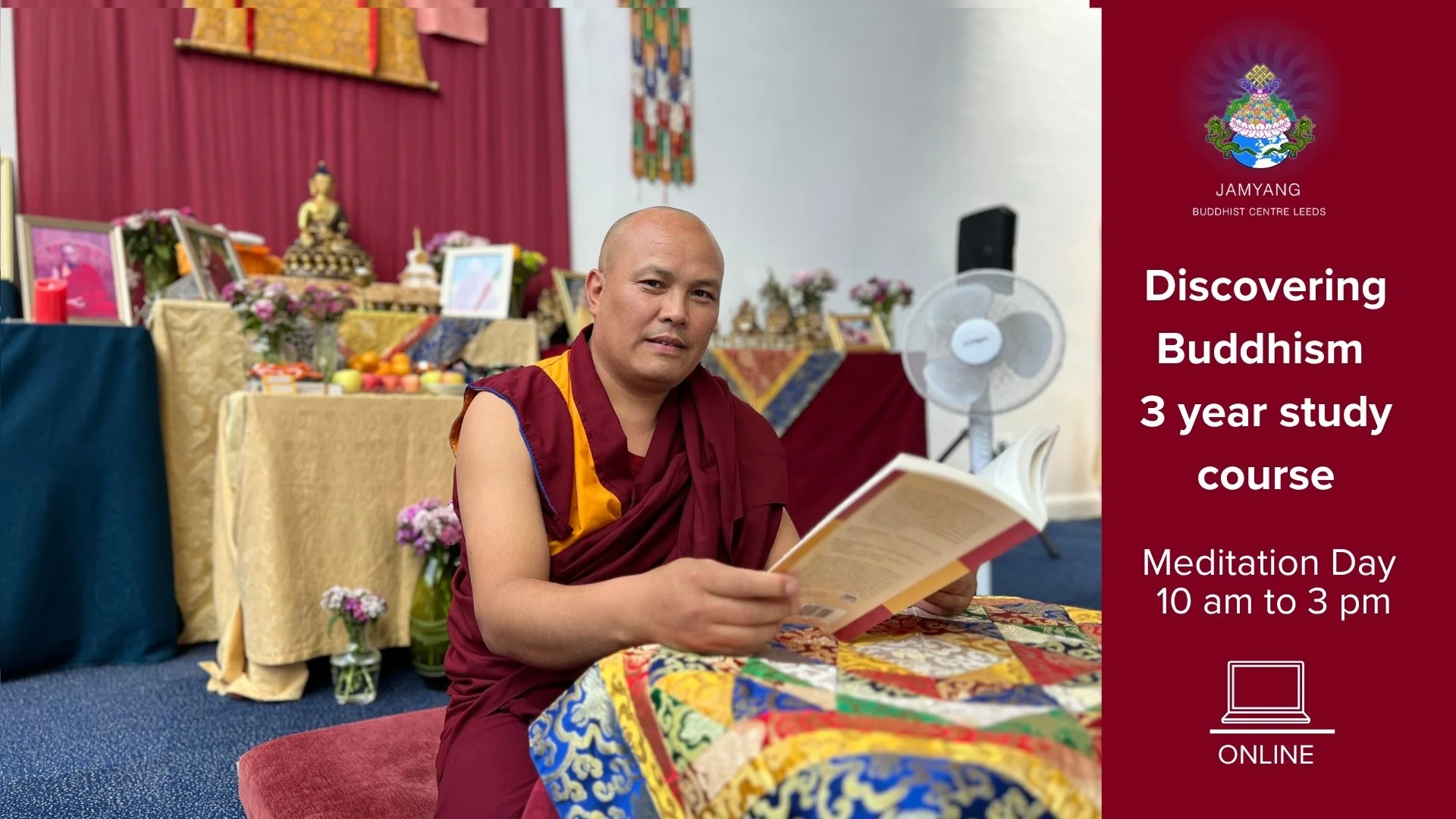
Discovering Buddhism: Meditation Day

Overview of Programme
DATE: 2026: Sunday 4th October
TIME: 10 am to 3 pm
LOCATION: Meditation Day Online only
LEVEL: This FPMT study course is suitable for both beginners and intermediate students, providing a structured approach to Buddhist study.
What to Expect in This Module : Mind and its Potential
This module concludes with an online Day of Meditation on Sunday, 4th October, offering time for deeper reflection and integration of the teachings.
In this module you will explore the differentiation between mind and brain, mind as the creator of our experiences, and the implications of possessing a mind that has no beginning and no end. Under the guidance, wisdom, compassion & kindness of Geshe Rinchen, you will learn methods to transform destructive thoughts and attitudes and create a positive and joyous mind.
Through:
Introductory Meditations - Meditation on Space like Clarity, Guided meditations help you explore the nature of the mind, develop mindfulness, and cultivate inner clarity and peace.
Explanatory Teachings - Understand the Foundations and Special features of The Mind & its Potential. Clear teachings that explore the nature of the mind and provide practical tools for personal growth and well-being.
Reflection and Discussion - Consider how this module relates to the rest of the path and your own practice. Opportunities to reflect on the teachings and share insights through supportive group discussion.
Supportive Environment - Learn and share with like-minded practitioners, supported by the wisdom and guidance of Geshe Rinchen.
Integration Guidance - Learn ways to connect these teaching methods related to the Mind & its Potential with your lamrim meditation and daily spiritual growth. Ongoing guidance to help sustain and deepen your practice beyond the course.
Suitable for both new and experienced students ready to delve into the inspiring methods that turn life’s challenges into opportunities for growth, compassion, and wisdom
Awakening the limitless potential of your mind, achieving all peace and happiness
Discovering Buddhism is a beginner to intermediate level, 3 year FPMT study course that will give you a solid foundation in the teachings and practice of Tibetan Mahayana Buddhism.
This course was designed by Lama Zopa Rinpoche for students to study, explore and put into practice the graduated path to enlightenment, the lamrim. Originally based on Buddha Shakyamuni’s teachings from 2500 years ago in India. The lamrim was systematically organised by the Indian master Atisha in the 11th Century and by several other great masters from Tibet including Lama Tsongkhapa in the 15th Century.
Our resident teacher Geshe Rinchen Wangyal (Geshe La) will be teaching this module. This is an excellent opportunity to receive these Lamrim teachings directly from Geshe La. We are indeed most fortunate to be able to do so.
This course commences August 2026 and runs for 3 years on Thursday evenings online for 90 minutes and has 14 subjects, 13 of which are usually taught over 6 weeks. The course runs during March, April, May, July, August, September, October and November. There are no classes in January, February, June and December.
It is possible to join at any time during the course.
We warmly invite you to join us for this enriching journey with Geshe Rinchen. Together, let us explore how to bring the timeless wisdom of Buddhism into our everyday lives.
Registration Form . For more information contact our Discovering Buddhsim Coordinator, Ruth: db@jamyangleeds.co.uk
ABOUT YOUR Teacher: Geshe Rinchen Wangyal
Geshe Rinchen studied at Drepung Losel Ling Monastery in India, then at the Institute of Buddhiust Dialectics. He gained his Geshe degree in 2015.
He then studied at the University of Winchester in the UK, gaining a BA (hons) Degree in Philosophy, Religion and Ethics in 2024
Geshe La has had articles published in The Scientific American in 2020 including 'Hygiene of the mind during the Pandemic’. He has also received awards for essay competitions at the Institute of Buddhist Dialectics.
Geshe La’s teachings are known for their clarity, warmth, and practical applicability, making profound topics accessible to students of all backgrounds. Geshe La combines his deep knowledge with genuine compassion, inspiring students to cultivate inner peace and wisdom in their own lives.
Geshe La teaches in English fluently.
You can read more about Geshe Rinchen here.
SUGGESTED DONATION:
Non-members – £72 per module for the Thursday classes (usually 6 weeks), and £32 for the meditation day at the end of each module. This will contribute to the centre’s running costs and include a donation to the teacher.
Free to members - Members are invited to make a donation for the teacher, as is customary when receiving Buddhist teachings, in order to support their activity (for your reference we recommend a donation in the region of £20 per module and £10 per meditation day).
We never turn anyone away from the Dharma for financial reasons. If you cannot donate the suggested amount, please contact Ruth on db@jamyang.co.uk to discuss what would be affordable for you.
It’s good to practice generosity where we can.
How to Donate:
You can make a donation by card using our Donation Portal here. Please put Discovering Buddhism as a reference in the comments box
Alternatively you can donate by Bank Transfer using the details below, please reference Discovering Buddhism
Account Name: Jamyang Buddhist Centre Leeds
Bank Name: Cooperative Bank Plc
Account number: 65178087 Sort-Code: 08-92-99 SWIFT: CPBK GB22 IBAN: GB76 CPBK 0892 9965 1780 87
Gift Aid: if you are a UK taxpayer we can claim back 25p for every £1 you donate. Please indicate when registering if you would like us to claim giftaid on your donations.
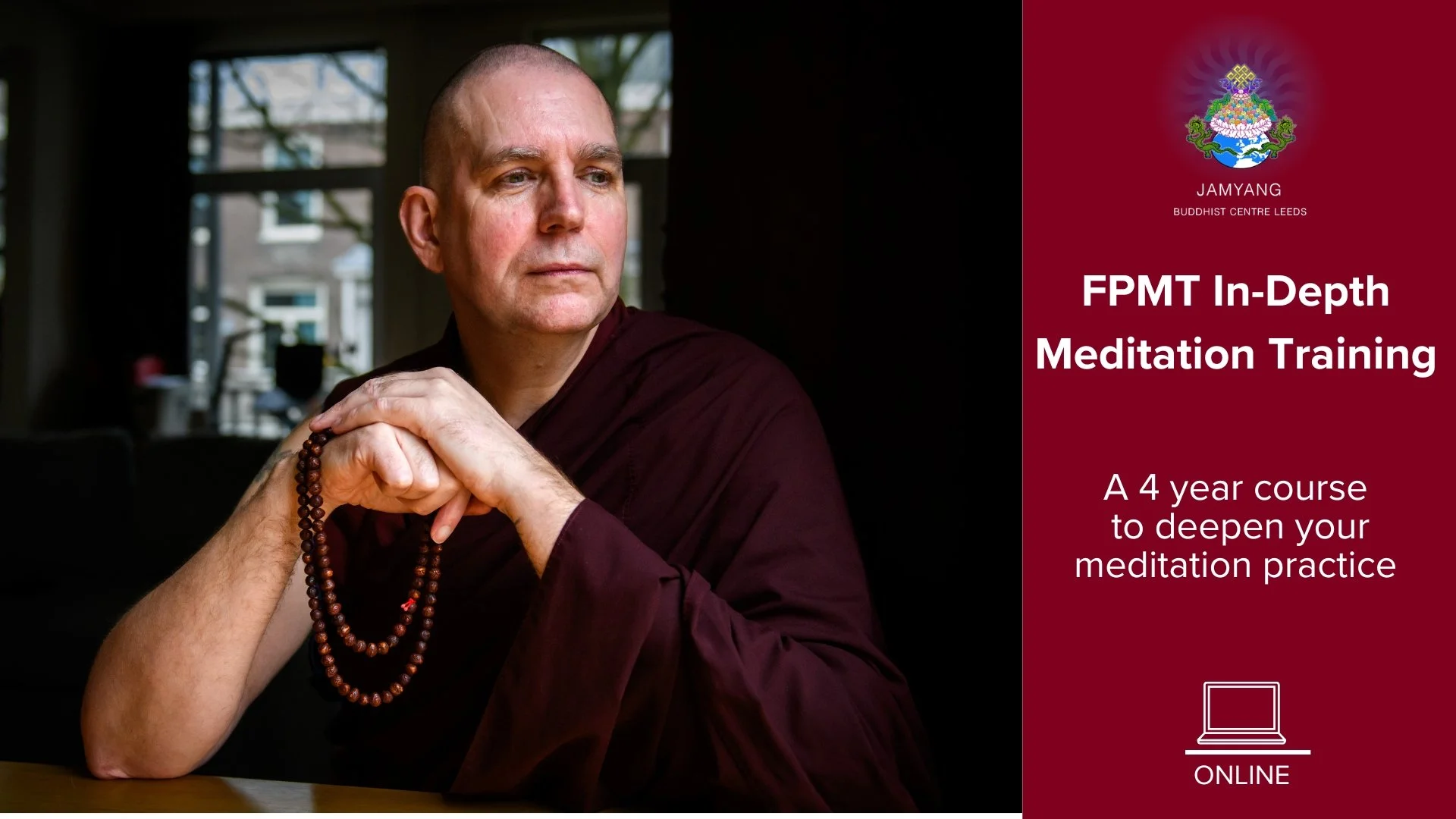
FPMT In-Depth Meditation Training
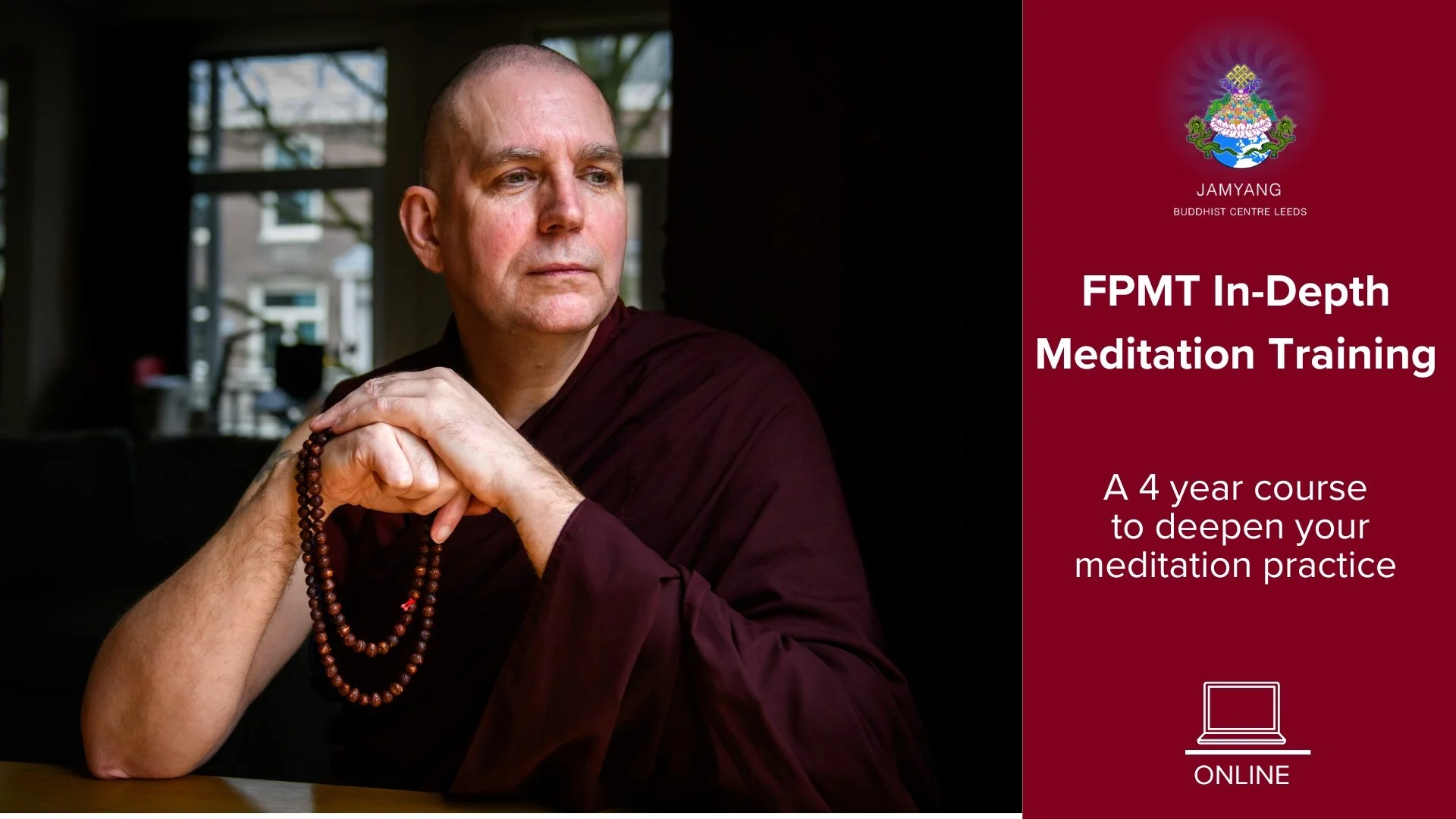
Overview of SESSION
DATE: 2026 / 2027: Year 4
Term 1: September 5th to November 28th 2026
If you are starting as a new student in year 4, don’t worry. You will get some preparatory advice on what previous recordings to have a listen to. Alternatively you may wish to join the new Ngondro Lamrim Meditation course for 2 years before starting In Depth Meditation Training. They are designed to be complementary.
TIME: Saturdays weekly 2:30pm – 5pm UK time
LOCATION: Zoom only
LEVEL: Buddhist Meditation – Intermediate to Advanced
IDMT Year Four, The Vajra Ground: Mahamudra and Kriya Tantra
In this culminating fourth year of our journey, our path turns inward to the mind itself—its empty, luminous nature—and outward to the transformative methods of tantra, where the naturally pure nature of our perception is recognized as the very ground of awakening.
As always, the year will start with generating the mind of awakening, using evocative instructions ranging from Langri Thangpa to Nāgārjuna and Lord Buddha in the famous Bodhisattvapiṭaka. This mind generation we'll cultivate through the four immeasurable thoughts and the support of calm abiding.
Illuminated by the life stories of the masters of the Gelug Mahāmudrā lineage and beyond, we'll explore its roots in the history of the early Indian Mahāsiddhas, such as Saraha and Tilopa, through the Kagyü master Gampopa's and Je Tsongkhapa's Mañjuśrī lineage up to Paṇchen Losang Chökyi Gyaltsen's Highway of the Conquerors and its perspective on this practice. In Sūtra Mahāmudrā we will practice resting attention in the empty nature of awareness, recognizing its clarity and openness as inseparable.
Kriyā Tantra offers a complementary method. Rather than suppress the ordinary, narrow self-narrative that we impose on ourselves and our world, it substitutes for it an extraordinary perspective of pure view. Occasionally, by way of introduction, we'll also taste practices from the higher tantras—glimpsing how afflictive emotions can be met as innate wisdom, and how the dissolution of the death process opens onto the innate mind of clear light. The structured practices of generation and recitation become a rehearsal for transformation, training perception to meet appearances as pure.
These methods rest on a relationship. We will therefore examine the practice of guru devotion candidly—both as the means by which the lineage's realization is transmitted and as a practice with real pitfalls, requiring discernment as much as trust. Through the Ganden Lha Gyāma, the Yoga of the inseparability of guru and Avalokiteśvara, and supporting sādhanas, devotion is approached not as deference but as the ethical road toward the state of Vajradhara: the full integration of wisdom and method.
This final year is an invitation to let realization ripen into a way of being. Grounded in bodhicitta and the four immeasurables, sustained by the preliminary practices, and held by the strength of community, we learn to meet the mind without grasping and to meet the world as pure appearance. Our aim is not to accumulate practices, but to bring the path to maturity—wisdom and compassion no longer cultivated separately, but lived as one.
This four-year online course provides students with long term, in-depth support in their meditative development.
The teacher and course developer is Venerable Losang Gendun. He has trained extensively in meditation in both Theravada and Mahayana Traditions
The In Depth Meditation Training course is also part of The Buddha Project led by Venerable Losang Gendun. You can find out more about Venerable Gendun, the course and who it is suitable for on our FPMT In-Depth Meditation Training webpage
If you have any questions you would like to ask before registering please email our In-Depth Meditation Coordinator Marie Odile on idmt@jamyangleeds.co.uk
The zoom link and all materials for the course are provided to registered students.
Donations:
Generosity is one of the cornerstones of the Buddhist path. With your donation we support The Buddha Project and we keep our centre going for the benefit of all sentient beings.
As the course is a collaboration with other FPMT centres it is not possible to offer this as part of our Jamyang Leeds membership programme.
The recommended donation per calendar month is £45.
If you are able to practice generosity and sponsor other students we recommend £58 per calendar month.
If you are on a reduced income it is £31 per calendar month.
There is also the option to donate annually.
If none of the above options are affordable please do still register, we never turn anyone away from the Dharma for financial reasons and we can agree a donation that is affordable for you right now. Please email Marie Odile our IDMT Coordinator idmt@jamyangleeds.co.uk if you would like to chat.
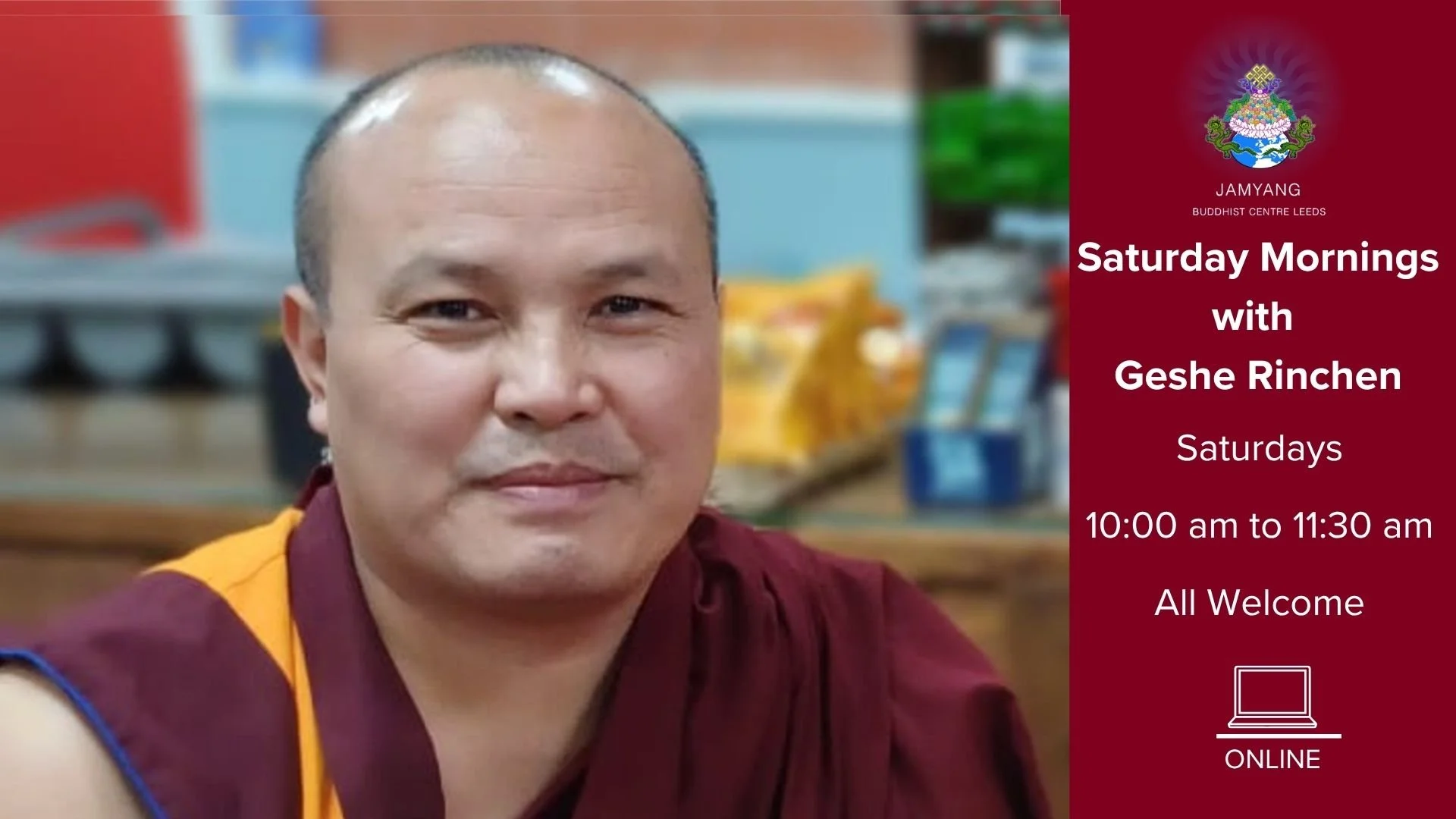
Saturday Mornings with Geshe Rinchen
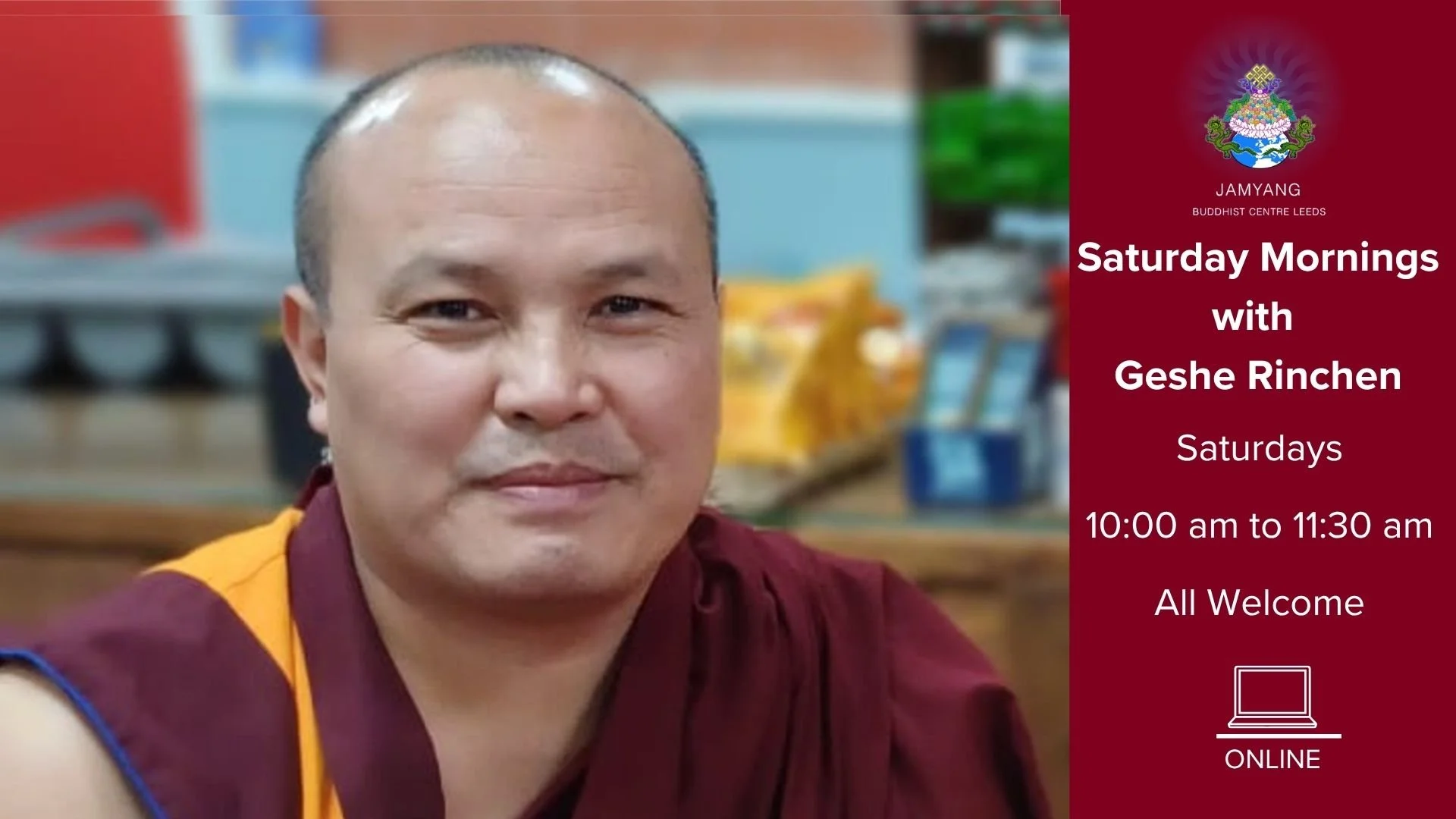
Overview of Programme
DATES: Saturdays weekly 4th July to 28th November
TIME: 10:00 am to 11:30 am
LOCATION: Online
LEVEL: Everyone interested in exploring Buddhism, from beginners to intermediate.
Saturday Mornings with Geshe Rinchen:
Are you curious about Buddhism and want to know more, or perhaps you already have some understanding but would like to expand on your knowledge. If so this Saturday morning class with Geshe Rinchen (Geshe La) is ideal for you. Designed as a drop in class with a different topic each week, covering key concepts in Buddhism and how they can make a real difference in our lives. Such as how we can deepen our connection with others, and how we can live our lives in the present moment. This is a great opportunity to spend time with Geshe La and ask questions.
Online drop in class – no need to register.
SUGGESTED DONATION FOR DROP IN CLASS:
Non-members – £12 per drop in class. This will contribute to the centre’s running costs and include a donation to the teacher.
Gift Aid: if you are a UK taxpayer we can claim back 25p for every £1 you donate. More information on Gift Aid can be found here.
Free to members of The Jamyang Buddhist Centre Leeds (your membership fees already contribute to our core costs in running the centre). You are invited to make a donation for the teacher, as is customary when receiving Buddhist teachings, in order to support their activity. For your reference we recommend a donation in the region of £4 per class. We will make the donation to the teacher on your behalf.
We never turn anyone away from the Dharma for financial reasons. If you cannot donate the suggested amount, please donate where possible within your means. It’s good to practice generosity where we can.
ABOUT YOUR Teacher: Geshe Rinchen Wangyal
Geshe Rinchen has dedicated his life to the study and practice of the Buddha’s teachings. He completed rigorous training in Buddhist philosophy, debate, and meditation, achieving the esteemed title of Geshe, the doctorate degree in the Tibetan Buddhist tradition.
His teachings are known for their clarity, warmth, and practical applicability, making profound topics accessible to students of all backgrounds.
Currently resident teacher at Jamyang Buddhist Centre Leeds, Geshe Rinchen combines his deep knowledge with genuine compassion, inspiring students to cultivate inner peace and wisdom in their own lives.
SESSION RESOURCES:
About this series:
July 2026
4 July – What did the Buddha Discover?
11 July – Buddha Nature – the Seed of Enlightenment
18 July – Understanding the Mind and Mental Factors
25 July – The Story of Milarepa: Transformation and Enlightenment
August 2026
1 August – The Four Noble Truths: An overview
8 August – Understanding Suffering
15 August – The Causes: Karma and Afflictive Emotions
22 August – The End of Suffering: What is Possible?
29 August – The Path: A Practical Way Forward
September 2026
5 September - Calm Abiding (Samatha)
12 September - Insightful Meditation (Vipassana)
19 September - the Mind of Awakening (Bodhicitta)
26 September – The Wisdom of Emptiness
October 2026
3 October – The Two Accumulations: Merit and Wisdom
10 October – Offering to the Three Jewels
17 October – Circumambulation Practice
24 October – Prostration Practice
31 October – Reciting Mantras and Their Benefits
November 2026
7 November – Introduction to Visualisation Practice
14 November – Medicine Buddha Practice
21 November – Tara Practice
28 November – Establishing Daily Practices
Who This Course Is For:
This is a wonderful opportunity to hear Geshe La teach each weekend online and to ask him questions.
These topics have been carefully selected for beginners,
They are also very suitable for all students of Buddhism to refresh and expand on their understanding.