

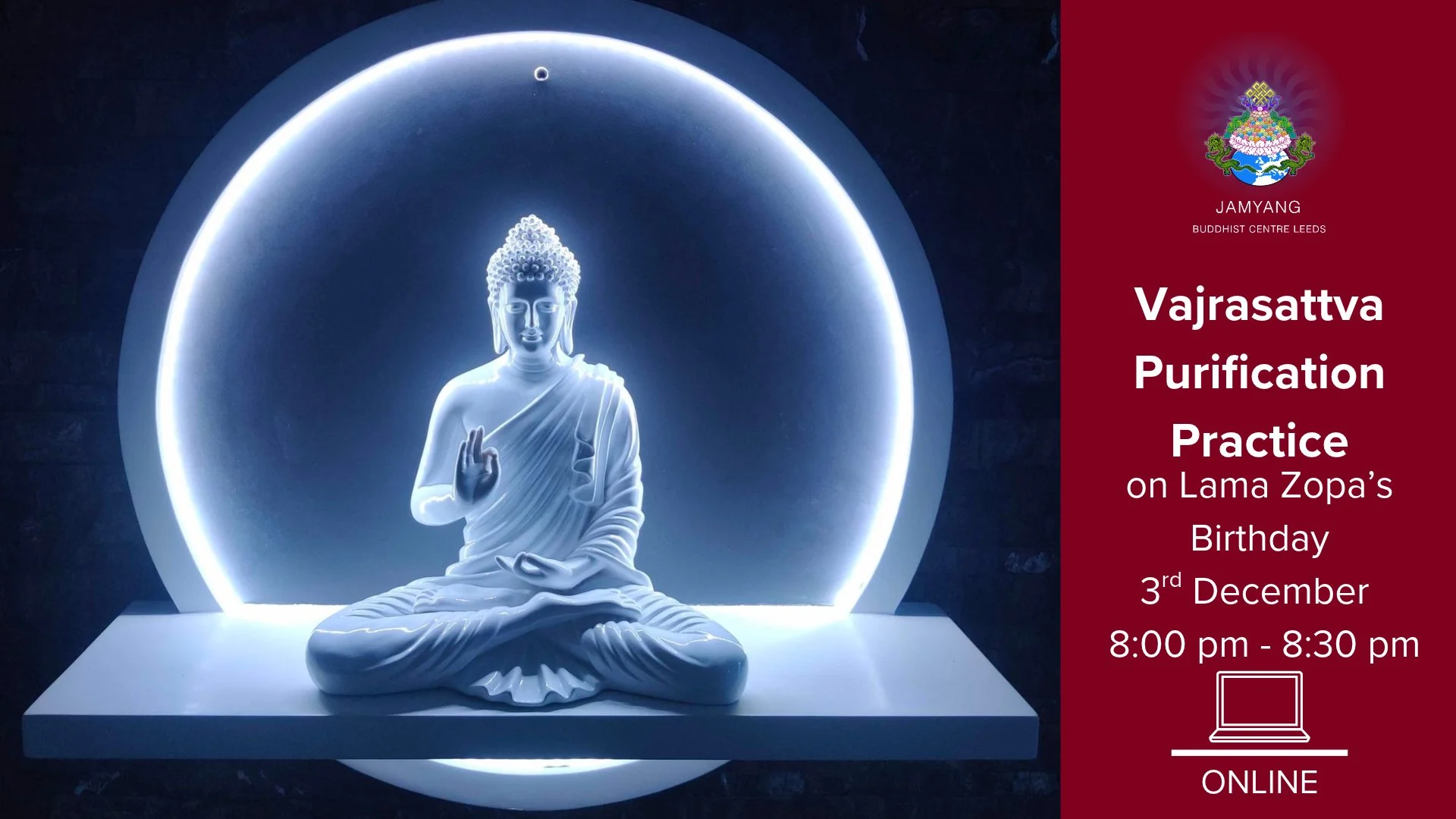
Overview of The Vajrasattva Practice
DATE: Thursday 3rd December
TIME: 8:00pm-8:30pm
LOCATION: Zoom
LEVEL: Buddhist Practices – All Welcome
SUGGESTED DONATION: £4
About Vajrasattva Purification Practice
Purification here means looking at our past unskillful actions which have created seeds of negative karma in our minds, and using visualisation and mantra recitation to remove those seeds in a healthy and productive way. Vajrasattva is the embodiment of all the Buddha’s cleaning and purifying energy. We all make mistakes, and how we deal with them is key to making spiritual progress. We’ll be using a short text composed by Lama Zopa Rinpoche
If you would like to join us for the first time please contact Chrissie on spc@jamyangleeds.co.uk ahead of time so that we can let our zoom hosts know to let you into the meeting
This is a very special day as it would have been Lama Zopa Rinpoche’s birthday and it is also Lama Tsongkhapa Day, which celebrates the parinirvana on Lama Tsongkhapa, the founder of the Gelug tradition of Tibetan Buddhism.
Please read below for more information about the celebrations and suggested practices:
Honoring Lama Zopa Rinpoche's Birthday
On December 3, we observe the birthday of Lama Zopa Rinpoche.
On this special day, a very large thangka of Padmasambhava (Guru Rinpoche) will be displayed at Khachoe Ghakyil Ling Nunnery (Kopan Nunnery). An auspicious 100,000 tsog offering (Guru Bumtsog) will also take place in honor of Lama Zopa Rinpoche’s birthday. The event commemorates Rinpoche’s life and honors his wishes.
The thangka measures 75 feet (23 meters) high and 87 feet (27 meters) wide. It is made of stitched appliqué and depicts the Padmasambhava merit field at its center. Lama Zopa Rinpoche personally designed and oversaw its creation. He also raised the funds for the project, thanks to the kindness of two generous donors. His Holiness the Dalai Lama blessed the thangka.
Displaying such a large thangka is a major undertaking. Its considerable weight and the skill required to raise it safely onto the scaffolding demand great care and effort. The puja also takes days of preparation and arrangement by the monks and nuns at Kopan. Preparing lunch for everyone attending is another significant part of the event.
This is also a particularly auspicious day to recite Chanting the Names of Noble Manjushri, as suggested by His Holiness the Dalai Lama, for the swift return of Lama Zopa Rinpoche. Students can also recite any of the Swift Return Prayers.
We warmly encourage FPMT centers, projects, and services, as well as all students of Lama Zopa Rinpoche, to rejoice in this auspicious occasion and take part in the prayers and dedications. May all of Rinpoche’s wishes be fulfilled without delay, and may the entire FPMT organization succeed in fulfilling his Vast Visions.
Ganden Ngamchoe, Lama Tsongkhapa Day
Ganden Ngamchoe, literally "Ganden Offering of the Twenty-Fifth Day," commemorates Lama Tsongkhapa's parinirvana. It is celebrated on the twenty-fifth day of the tenth month of the Tibetan calendar. This year, Lama Tsongkhapa Day falls on December 3, 2026.
Lama Tsongkhapa (1357–1417) was a Tibetan Buddhist master whose studies and meditations encompassed all the major schools. As Lama Yeshe said, "Lama Tsongkhapa is the perfect example of living according to the Dharma." For more, read The Mahasiddha Je Tsongkhapa.
Practices on Lama Tsongkhapa Day
Over the years, Lama Zopa Rinpoche has encouraged FPMT centers, projects, and services to engage in a variety of practices on this day to celebrate and create merit. Rinpoche's advice and suggestions can be found on the webpage Practices for Ganden Ngamchoe, Lama Tsongkhapa Day.
Students who are unable to attend an FPMT center are warmly encouraged to do these practices on their own, according to their time and ability. The essential practices are available here. More practice materials related to Lama Tsongkhapa, including practices in other languages, are available in the Foundation Store.
FPMT Education Services has also published a list compiled by Lama Zopa Rinpoche of prayers composed by Lama Tsongkhapa or in his honor. These can help students take part in this auspicious occasion through prayer and practice.
Offerings and Virtuous Activities
A traditional offering on Lama Tsongkhapa Day is offering lights. Lama Zopa Rinpoche says:
“Just as many people use lots of lights during Christmas and at marriages, we too should use lots of lights on Lama Tsongkhapa Day... By offering lights to Lama Tsongkhapa, merit fields, and so forth, we create the cause of enlightenment, of liberation from samsara, and of the happiness of future lives.”
Rinpoche's Extensive Offering Practice can also be used.
At Kopan Monastery, the Sangha marks the occasion each year with extensive light offerings, with hundreds of thousands of lights strung around the monastery and nunnery buildings and a special evening offering of candles. Lama Zopa Rinpoche started the tradition of offering lunch and dessert to all Sangha members in IMI communities on this special day.